
Who hasn’t been part of a team or company that promises you that the next product will change the world?
Who hasn’t been part of a team or company that promises you that the next product will change the world? Or being part of a project whose mission is to deliver brand new products every x time and behave as an innovation lab? These promises have long been the spirit of the technology business; we know that, but it still feels refreshing every time you jump into a new project or job.
Maybe this stake is more prominent in start-up environments, where new ideas surface every day and the opportunity for growth is potentially wider. Philosophies like “Build fast, fail fast” are at the core of an agile mindset, helping us determine whether an idea is viable in the early stages or whether a pivot is necessary to achieve the desired numbers and experience.
But what happens when an “innovation promised cycle” is built on unsteady ground? Maybe some of you think that’s the whole point of innovating (building under uncertainty), but for someone with many years in the industry, I don’t think that formula is always effective.
I know I’m maybe being very pessimistic, but, truth be told, behind some great product ideas is a lot of mess that eventually generates long-term stress (I’ll explain in a few paragraphs ahead).
When thinking about innovation, most product teams associate this term with ideas and justifications like: “We’re obsessed with users”, “this is what the market needs,” “we need to launch as fast as possible, and then we’ll figure out…”
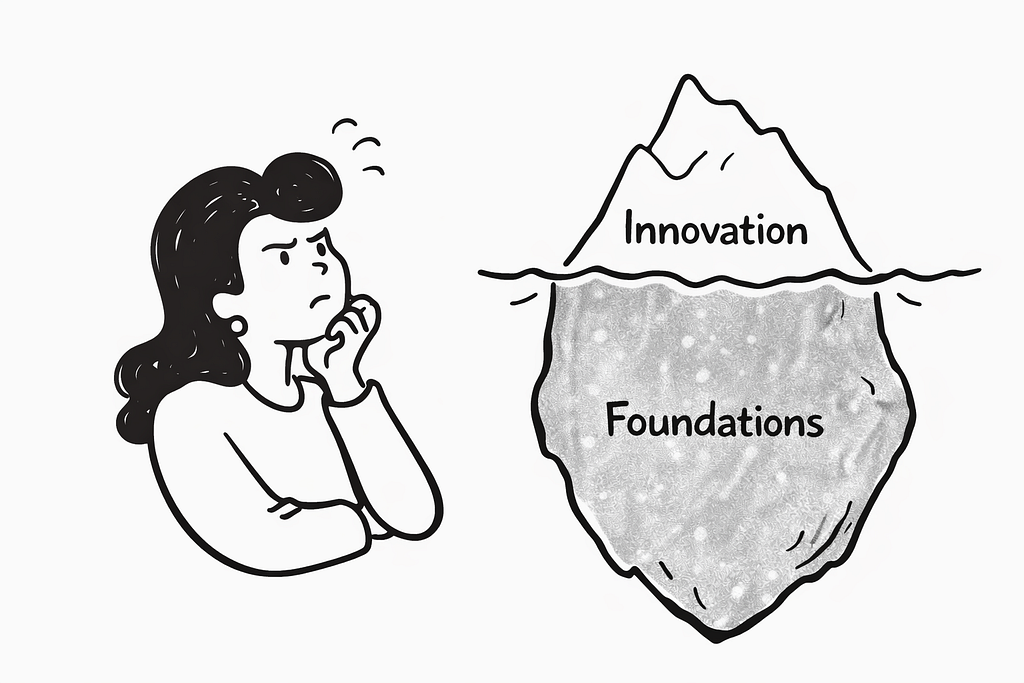
From my perspective, this approach is OK, but somehow incomplete because it neglects everything that might happen within the teams before putting something into the market, and failing to account for this variable will lead to future issues. To explain my point, let me use a graphic.
The innovation iceberg
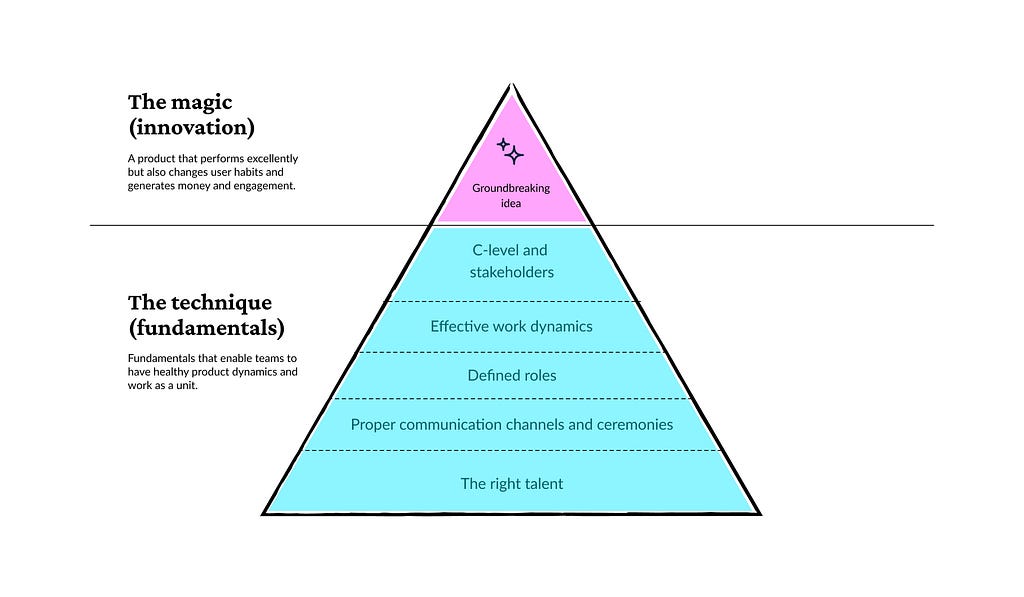
We are used to admiring, copying, and adopting ideas from other companies that have innovated the market. It is always a good idea to be inspired by others who have been on a journey like ours. But what we see is the tip of an iceberg, the final shape of something that has been built with some dynamic by some team; But what happens internally in the company is not always visible, and if so, it will be a positive innovation product case open to the public, no one is willing to say that after creating something new, now they have more problems to solve than before.
The way I see innovation is as the result of solid knowledge, experience, and good practices that allow me to spot opportunities or issues others haven’t seen, or to make moves others don’t expect. Take, for example, the greatest sports players in history; one of their characteristics is that they dominated the game they played and even changed it, but to do so, they always started with fundamental knowledge and abilities.
The technique (base of the iceberg)
Imagine all the greatest players and their glory without knowing how to throw a ball, or dribble, or jump, or make a stroke, hard to believe, right? Technique is what stimulates innovation once you have control of it. For example, in soccer, to perform a bicycle kick, you must first control your kick.
In companies, I refer to “the technique” as the fundamentals that enable teams to have healthy product dynamics and work as a unit; this is the hidden part of the iceberg, where several factors may influence innovative outcomes. From bottom to top, these are the most relevant:
- The right talent understands business, anticipates adversity, creates opportunities, and solves issues effectively.
- Proper communication channels and ceremonies with no room for misunderstanding or assumptions that affect the execution of ideas.
- Defined roles that leave no room for doubt regarding deliverable expectations and responsibilities.
- Effective work dynamics that ensure the synchronization of multiple roles towards an objective.
- C-level and stakeholders with a clear business vision that avoids confusion or ambiguous directions to the teams.
At the base of the iceberg, you are most likely to find a company’s most difficult challenges. The reasons are endless, but it is also a great opportunity to start looking at your company or team and solve foundational problems before thinking about how to change the world with an idea.
Without “the technique”, launching products might be a wild card with a high probability of being a flawed experience, hard to scale, and hard to manage in the future. Sorry to say this, but sometimes we fall in love with a superficial layer (the tip of the iceberg) rather than changing things from the foundations up.
The magic (the tip)
This part of the iceberg is the clutch play in game seven, where glory is the reward. In general, this is the action that makes history or changes the way we see or interact with things. In companies, this is the million-dollar idea: a product that not only performs excellently but also changes user habits and generates money and engagement.
We’ve all heard stories of people who, one day, spotted or stumbled upon an opportunity and turned it into a billion-dollar business out of nowhere. This part is the romantic side of success, but I’m sure that behind that story, there was a trained instinct or some business preparation that enabled this person to make business magic.
As the innovation iceberg shows us, a company’s approach to innovation spans multiple levels that directly affect a product. Products should also have a solid foundation that ensures proper management and scalability.
Layers of product innovation
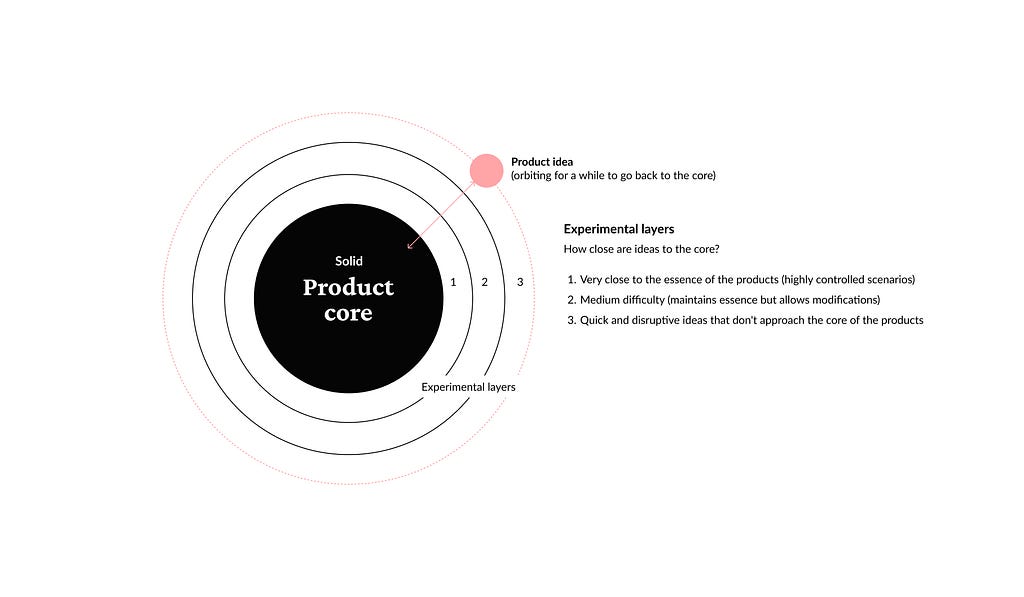
If your product development is stable, innovation can be a fun process. Think about having a solar system where the sun is the core that keeps everything working and in sync. The same effect can occur if you have a solid product core (technology, design systems, methodologies, frameworks, communication channels, etc.) that is perfectly orchestrated, so that if one disruptive idea succeeds, it will be easy to scale while maintaining high product standards.
Levels of experimentation
As in solar systems, elements farthest from the center are more susceptible to changes in their composition due to their distance. The same effect can occur when you have product ideas that are distant from the product’s core; they take an experimental nature. These quick ideas, like satellites, can have a short period of visibility and be fleeting (as in experimentation). When one of these ideas succeeds, making it back to the center to become part of “the system” is easier, and, for sure, it will adopt all your best product standards.
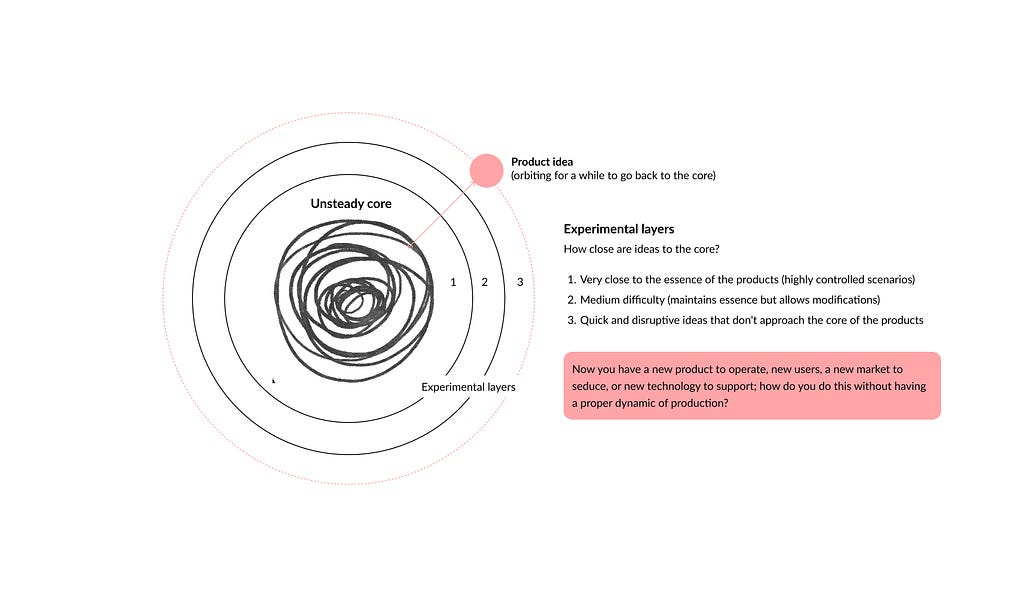
On the contrary, not having a solid product core and launching experimental ideas to test can be tricky for the company. Imagine you have a wonderful product idea that, in effect, might change the world. Once it shows high adoption and market demand, you need to scale up its structure from an experimental to an official product structure after the test period. Now you have a new product to operate, new users, a new market to seduce, or new technology to support; how do you do this without a proper production dynamic? Well, this is the everyday thing in some start-ups: on the inside, it’s just a mess, and we know messy environments lead to rushed delivery times, people burning out, massive resignations, a fragile culture, or, due to inefficient product growth, massive layoffs.
My reflection:
Innovation is not wrong; it is actually the heart of the industry, and we should keep trying harder. What I think is wrong is trying without first setting high product standards for the company or its teams. In this era of technology-expert proliferation, inspiring messages (the tip of the iceberg) may hide an uncomfortable truth that no one is willing to acknowledge. Maybe I’m being too dramatic about this, but I’ve witnessed this “innovation issue” several times, and its only contribution has been posting on LinkedIn to appear revolutionary.
To write this article, I want to credit all the fantastic information sources and other authors who have written about related topics, each from a different exciting perspective.
From Flexibility to Innovation: Why the Future of Work Puts People First
10 Tech innovation by 2030 that will change your life
Build Fast, Fail Faster: Embracing Agility and Imperfection
What Is Innovation in Technology? A Complete Guide to Digital Transformation

Innovation is not magic; it’s technique was originally published in UX Collective on Medium, where people are continuing the conversation by highlighting and responding to this story.
This post first appeared on Read More