
My favorite Frontend Masters Courses to learn JavaScript for Web Development in 2026

Hello guys, I wasted more than $400 and 120+ hours on mediocre JavaScript courses on Udemy and other online learning websites before I found Frontend Masters.
After testing 15+ JavaScript courses on the platform, I can tell you this with certainty: Frontend Masters teaches JavaScript differently than anyone else.
Not because they have flashier videos (they don’t). Not because courses are easier (they’re actually harder). But because the instructors are the people who literally wrote the books on JavaScript — and they teach you to think like they do.
Here’s what shocked me most: Most JavaScript courses teach you syntax. Frontend Masters teaches you systems thinking.
The difference? After typical courses, you can write JavaScript. After Frontend Masters, you can architect JavaScript applications, debug obscure issues, and explain complex concepts in technical interviews with confidence.
I’m a senior developer who’s been writing JavaScript professionally for 6 years. Even with that experience, these courses revealed gaps in my understanding I didn’t know existed. The “aha moments” were constant and sometimes humbling.
These 5 courses aren’t just the best JavaScript education on I Tried 15+ JavaScript Courses on Frontend Masters: Here are My Top 5 Recommendations for 2026
My favorite Frontend Masters Courses to learn JavaScript for Web Development in 2026
Hello guys, I wasted $400 and 120+ hours on mediocre JavaScript courses before I found Frontend Masters.
After testing 15+ JavaScript courses on the platform, I can tell you this with certainty: Frontend Masters teaches JavaScript differently than anyone else.
Not because they have flashier videos (they don’t). Not because courses are easier (they’re actually harder). But because the instructors are the people who literally wrote the books on JavaScript — and they teach you to think like they do.
Here’s what shocked me most: Most JavaScript courses teach you syntax. Frontend Masters teaches you systems thinking.
The difference? After typical courses, you can write JavaScript. After Frontend Masters, you can architect JavaScript applications, debug obscure issues, and explain complex concepts in technical interviews with confidence.
I’m a senior developer who’s been writing JavaScript professionally for 6 years. Even with that experience, these courses revealed gaps in my understanding I didn’t know existed. The “aha moments” were constant and sometimes humbling.
These 5 courses aren’t just the best JavaScript education on Frontend Masters — they’re the best JavaScript education I’ve found anywhere, period.
Let’s get into why.
The 5 Best JavaScript Courses on Frontend Masters (Ranked by Career Impact)
There are hundreds of JavaScript tutorials online, but most of them barely scratch the surface. If you want to truly understand concepts like closures, asynchronous execution, the event loop, prototypes, and performance optimization, you need deep, expert-led courses and these 5 are the ones which fits the bill.
1. JavaScript: The Hard Parts, v2 by Will Sentance
Perfect for: Developers ready to level up from intermediate to advanced
This is the course that changes careers.
Why it’s #1:
Will Sentance has a gift for making complex concepts click. This isn’t theory — it’s the JavaScript knowledge that separates senior developers from everyone else.
What you’ll master:
Closures (the concept that breaks most developers):
- How JavaScript “remembers” variables after functions return
- Why closures enable powerful patterns like module design
- Real-world use cases: data privacy, factory functions, memoization
- The mental models that make closures intuitive
Higher-Order Functions:
- Functional programming concepts that make code elegant and reusable
- Writing functions that take functions as arguments
- Map, filter, reduce — not just how, but why
- Creating custom higher-order functions for your own use cases
Asynchronous JavaScript:
- Understanding the event loop, call stack, and callback queue
- How JavaScript handles non-blocking operations
- The execution model that confuses most developers
Object-Oriented Programming:
- Prototypes and prototypal inheritance (how JavaScript really works)
- The this keyword — all four binding rules, clearly explained
- When to use prototypes vs. classes
- Object creation patterns used in production code
The teaching approach:
Will doesn’t lecture — he guides you through discovering concepts yourself. You’ll pause, think, predict, and then verify. This active learning cements understanding.
Real-world impact:
Students consistently report:
- Confidence in technical interviews (especially FAANG)
- Ability to debug complex JavaScript issues
- Understanding of library/framework internals
- “I finally get JavaScript” moments
My experience: This course answered questions I’d had for years but never fully understood. The closure section alone was worth the price.
Here is the link to join — JavaScript: The Hard Parts, v2 by Will Sentance
2. Deep JavaScript Foundations, v3 by Kyle Simpson
Perfect for: Developers who want to master JavaScript at a fundamental level
Kyle Simpson (author of You Don’t Know JS) teaches you JavaScript the way language designers think about it.
What makes this essential:
Type Coercion (JavaScript’s “weird” behavior explained):
- Why [] == ![] is true (and why it’s actually logical)
- Abstract equality vs. strict equality
- Type conversion rules that seem random but aren’t
- When coercion helps and when to avoid it
Scope & Closures:
- Lexical scope — how JavaScript resolves variables
- Block scope vs. function scope (and when each matters)
- Closure patterns used in real codebases
- The temporal dead zone (and why let behaves differently)
The this Keyword (demystified completely):
- Four binding rules that explain every this behavior
- Implicit vs. explicit binding
- Arrow functions and lexical this
- When to use .call(), .apply(), and .bind()
Prototypes (how JavaScript really works):
- The prototype chain explained visually
- Object linking vs. classical inheritance
- Why class is just syntactic sugar
- Delegation patterns for code reuse
ES6+ Features (with deep understanding):
- Why modern syntax exists (not just how to use it)
- Template literals, destructuring, rest/spread
- Iterators and generators
- Symbols, Maps, Sets, and when to use them
The teaching philosophy:
Kyle doesn’t teach shortcuts. He teaches you to think like the JavaScript engine, so you understand why code behaves the way it does.
Who benefits most:
Developers who want to be the “JavaScript expert” on their team. If people come to you with hard questions, this course gives you the depth to answer confidently.
My experience: I rewrote part of our codebase after understanding prototypes properly. The new version was 30% faster and infinitely more maintainable.
Pro tip: Take detailed notes. Kyle packs incredible density into every section.
Here is the link to join — Deep JavaScript Foundations, v3 by Kyle Simpson

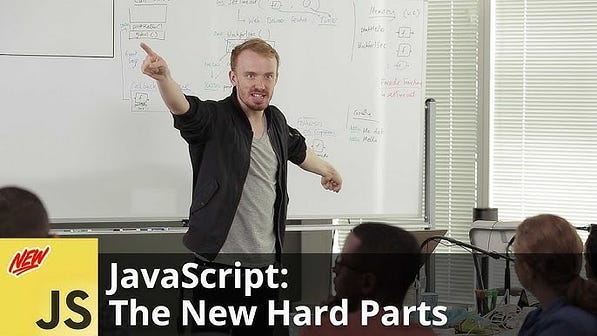
3. The Hard Parts of Asynchronous JavaScript by Will Sentance
Perfect for: Conquering async JavaScript once and for all
Async JavaScript is where many developers hit a wall. This course turns that wall into a door.
What you’ll conquer:
Event Loop Deep Dive:
- How JavaScript handles asynchronous operations
- The call stack, callback queue, and event loop visualized
- Microtasks vs. macrotasks (the execution order that trips up experienced developers)
- Why setTimeout(fn, 0) doesn’t execute immediately
Callback Patterns:
- Master callback functions without “callback hell”
- Error handling in callbacks
- Control flow with callbacks
- When callbacks are still the right choice
Promise Fundamentals:
- Understanding Promise states (pending, fulfilled, rejected)
- Promise chaining — the right way
- Error handling with .catch() and proper propagation
- Promise.all(), Promise.race(), Promise.allSettled()
Async/Await Mastery:
- Writing clean, readable asynchronous code
- Error handling with try/catch in async functions
- Parallel vs. sequential async operations
Let’s get into why.
The 5 Best JavaScript Courses on Frontend Masters (Ranked by Career Impact)
There are hundreds of JavaScript tutorials online, but most of them barely scratch the surface. If you want to truly understand concepts like closures, asynchronous execution, the event loop, prototypes, and performance optimization, you need deep, expert-led courses and these 5 are the ones which fits the bill.
1. JavaScript: The Hard Parts, v2 by Will Sentance
Perfect for: Developers ready to level up from intermediate to advanced
This is the course that changes careers.
Why it’s #1:
Will Sentance has a gift for making complex concepts click. This isn’t theory — it’s the JavaScript knowledge that separates senior developers from everyone else.
What you’ll master:
Closures (the concept that breaks most developers):
- How JavaScript “remembers” variables after functions return
- Why closures enable powerful patterns like module design
- Real-world use cases: data privacy, factory functions, memoization
- The mental models that make closures intuitive
Higher-Order Functions:
- Functional programming concepts that make code elegant and reusable
- Writing functions that take functions as arguments
- Map, filter, reduce — not just how, but why
- Creating custom higher-order functions for your own use cases
Asynchronous JavaScript:
- Understanding the event loop, call stack, and callback queue
- How JavaScript handles non-blocking operations
- The execution model that confuses most developers
Object-Oriented Programming:
- Prototypes and prototypal inheritance (how JavaScript really works)
- The this keyword — all four binding rules, clearly explained
- When to use prototypes vs. classes
- Object creation patterns used in production code
The teaching approach:
Will doesn’t lecture — he guides you through discovering concepts yourself. You’ll pause, think, predict, and then verify. This active learning cements understanding.
Real-world impact:
Students consistently report:
- Confidence in technical interviews (especially FAANG)
- Ability to debug complex JavaScript issues
- Understanding of library/framework internals
- “I finally get JavaScript” moments
My experience: This course answered questions I’d had for years but never fully understood. The closure section alone was worth the price.
Here is the link to join — JavaScript: The Hard Parts, v2 by Will Sentance
2. Deep JavaScript Foundations, v3 by Kyle Simpson
Perfect for: Developers who want to master JavaScript at a fundamental level
Kyle Simpson (author of You Don’t Know JS) teaches you JavaScript the way language designers think about it.
What makes this essential:
Type Coercion (JavaScript’s “weird” behavior explained):
- Why [] == ![] is true (and why it’s actually logical)
- Abstract equality vs. strict equality
- Type conversion rules that seem random but aren’t
- When coercion helps and when to avoid it
Scope & Closures:
- Lexical scope — how JavaScript resolves variables
- Block scope vs. function scope (and when each matters)
- Closure patterns used in real codebases
- The temporal dead zone (and why let behaves differently)
The this Keyword (demystified completely):
- Four binding rules that explain every this behavior
- Implicit vs. explicit binding
- Arrow functions and lexical this
- When to use .call(), .apply(), and .bind()
Prototypes (how JavaScript really works):
- The prototype chain explained visually
- Object linking vs. classical inheritance
- Why class is just syntactic sugar
- Delegation patterns for code reuse
ES6+ Features (with deep understanding):
- Why modern syntax exists (not just how to use it)
- Template literals, destructuring, rest/spread
- Iterators and generators
- Symbols, Maps, Sets, and when to use them
The teaching philosophy:
Kyle doesn’t teach shortcuts. He teaches you to think like the JavaScript engine, so you understand why code behaves the way it does.
Who benefits most:
Developers who want to be the “JavaScript expert” on their team. If people come to you with hard questions, this course gives you the depth to answer confidently.
My experience: I rewrote part of our codebase after understanding prototypes properly. The new version was 30% faster and infinitely more maintainable.
Pro tip: Take detailed notes. Kyle packs incredible density into every section.
Here is the link to join — Deep JavaScript Foundations, v3 by Kyle Simpson
3. The Hard Parts of Asynchronous JavaScript by Will Sentance
Perfect for: Conquering async JavaScript once and for all
Async JavaScript is where many developers hit a wall. This course turns that wall into a door.
What you’ll conquer:
Event Loop Deep Dive:
- How JavaScript handles asynchronous operations
- The call stack, callback queue, and event loop visualized
- Microtasks vs. macrotasks (the execution order that trips up experienced developers)
- Why setTimeout(fn, 0) doesn’t execute immediately
Callback Patterns:
- Master callback functions without “callback hell”
- Error handling in callbacks
- Control flow with callbacks
- When callbacks are still the right choice
Promise Fundamentals:
- Understanding Promise states (pending, fulfilled, rejected)
- Promise chaining — the right way
- Error handling with .catch() and proper propagation
- Promise.all(), Promise.race(), Promise.allSettled()
Async/Await Mastery:
- Writing clean, readable asynchronous code
- Error handling with try/catch in async functions
- Parallel vs. sequential async operations
- Common pitfalls and how to avoid them
Real-world scenarios covered:
- API calls and data fetching
- File operations and database interactions
- Event handling in complex applications
- Building async workflows
Why this matters in 2026:
Modern JavaScript is async JavaScript:
- React Server Components use async patterns
- Node.js APIs are fundamentally async
- Every API call, database query, and file operation
- Full-stack development requires async mastery
My experience: The microtasks vs. macrotasks section solved a production bug we’d struggled with for days. Understanding execution order is critical.
Career impact: Async knowledge is non-negotiable for full-stack roles. This course makes you comfortable with patterns used everywhere.
Here is the link to join — The Hard Parts of Asynchronous JavaScript by Will Sentance
4. Functional JavaScript First Steps by Anjana Vakil
Perfect for: Learning functional programming patterns that make code better
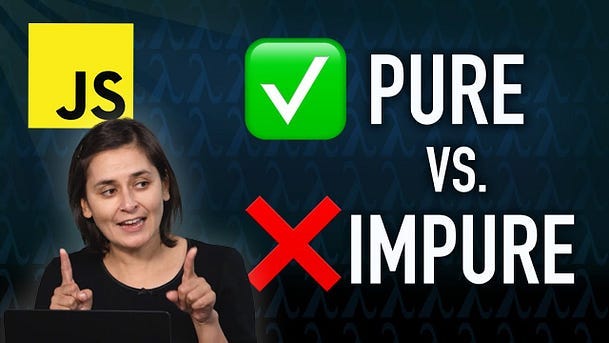
Functional programming isn’t academic theory — it’s a practical approach that makes JavaScript more predictable, testable, and maintainable.
Functional concepts you’ll master:
Pure Functions:
- Writing functions without side effects
- Why pure functions are easier to test and debug
- Identifying and eliminating side effects
- Building systems with pure functions
Higher-Order Functions:
- Map, filter, reduce — deeply understood
- Writing custom higher-order functions
- Function composition patterns
- Chaining operations elegantly
Immutability:
- Avoiding bugs by not mutating data
- Immutable data structures in JavaScript
- Spread operators and Object.assign() patterns
- When immutability helps and when it doesn’t
Function Composition:
- Building complex behavior from simple functions
- Pipe and compose patterns
- Point-free style (when appropriate)
- Reusable function building blocks
Currying & Partial Application:
- Creating specialized functions from general ones
- Practical use cases for currying
- When to curry and when not to
- Building function factories
Why functional programming matters in 2026:
The entire JavaScript ecosystem has moved functional:
- React hooks embrace functional patterns
- State management libraries (Redux, Zustand) use functional concepts
- Testing becomes easier with pure functions
- Code becomes more predictable and debuggable
Anjana’s teaching style:
Complex concepts feel approachable. She uses clear examples, visual explanations, and builds your intuition progressively.
Real-world impact:
After applying functional patterns:
- Our test coverage increased (pure functions are easy to test)
- Bugs decreased dramatically (immutability prevents entire bug classes)
- Code reviews became easier (functions do one thing clearly)
- Refactoring became safer (pure functions don’t have hidden dependencies)
Perfect pairing: Take this with “The Hard Parts” for a complete JavaScript education.
Here is the link to join — Functional JavaScript First Steps by Anjana Vakil
5. Getting Started with JavaScript, v3 by Kyle Simpson
Perfect for: Building rock-solid JavaScript fundamentals
Don’t let “getting started” fool you — this isn’t shallow. Kyle builds a foundation that prepares you for advanced concepts.
Why beginners love this course:
No Assumptions:
- Kyle explains everything from scratch
- No prior programming knowledge required
- Clear explanations without jargon
- Patient teaching that respects beginners
Practical Examples:
- Every concept demonstrated with runnable code
- Real-world scenarios from day one
- Progressive complexity that never feels overwhelming
- Exercises that reinforce learning
Progressive Learning:
- Each lesson builds naturally on previous ones
- Concepts connect into a coherent system
- No random topic jumps
- Logical skill progression
Industry Context:
- Learn not just what to do, but why
- Understand how experienced developers think
- Best practices from the beginning
- Career-oriented mindset
What you’ll learn:
JavaScript Fundamentals:
- Variables, types, and operators
- Functions and scope basics
- Arrays and objects
- Control flow and loops
Programming Principles:
- Writing readable code
- Debugging strategies
- Problem-solving approaches
- Code organization patterns
Learning Path:
This course perfectly sets you up for:
- “Deep JavaScript Foundations” (deep dive)
- “The Hard Parts” (advanced concepts)
Unique approach: Kyle teaches programming principles alongside JavaScript syntax, making you a better developer overall, not just someone who knows syntax.
Who should take it: Complete beginners or developers from other languages wanting solid JavaScript foundations.
Here is the link to join — Getting Started with JavaScript, v3 by Kyle Simpson

Why I like Frontend Masters Courses for Web Development?
After testing courses on Udemy, Educative, ZTM Academy, and Coursera, here’s what makes Frontend Masters different:
1. Instructor Quality
These aren’t professional course creators — they’re:
- Authors of definitive JavaScript books
- Conference speakers at JSConf, Node Summit
- Engineers at companies like Microsoft, Netflix, Stripe
- Open-source maintainers and language contributors
2. Technical Depth
Other platforms teach syntax. Frontend Masters teaches:
- Mental models used by expert developers
- Why JavaScript behaves the way it does
- How to think through complex problems
- Production patterns that actually scale
3. No Fluff
Every minute is packed with value:
- No 10-minute motivational speeches
- No padding with obvious content
- No teaching to the lowest common denominator
- Respect for your time and intelligence
4. Current & Maintained
Courses get updated regularly:
- Latest JavaScript features
- Modern best practices
- Current tooling and workflows
- Deprecated approaches removed
5. Community Trust
Over 500,000 developers have chosen Frontend Masters:
- Consistent quality across all courses
- High completion rates (people actually finish)
- Real career outcomes reported
- Industry recognition
The Investment That Changed My Career
Frontend Masters Annual Subscription: $390/year (currently 17% off)
They’re offering 17% discount on their annual plan — 200+ premium courses, guided learning paths, and mobile apps for learning on-the-go.

JavaScript in 2026: Why This Matters More Than Ever
JavaScript isn’t just surviving — it’s dominating:
Statistics that matter:
- Powers 98.8% of all websites
- Node.js drives most backend services
- React, Vue, Angular power modern frontends
- Used in AI applications, serverless computing, IoT
- Mobile apps via React Native, Capacitor
- Desktop apps via Electron
Emerging trends:
- WebAssembly integration (JavaScript + compiled languages)
- Edge computing with JavaScript
- Full-stack frameworks (Next.js, Remix, SvelteKit)
- TypeScript adoption (but JS knowledge remains critical)
- AI-assisted coding (understanding fundamentals matters more)
Career reality:
Demand for JavaScript developers continues growing. But the bar for “good JavaScript developer” is rising.
Companies want developers who:
- Understand async patterns deeply
- Can debug complex issues
- Write maintainable code
- Mentor junior developers
- Make architectural decisions
These 5 courses develop exactly those skills.
Final Thoughts
Here’s what 120+ hours of JavaScript courses taught me:
Most developers never learn JavaScript properly. They learn enough to be dangerous, then spend careers fighting the language instead of wielding it.
The difference between knowing JavaScript syntax and understanding JavaScript deeply is the difference between junior and senior developer salaries.
These 5 Frontend Masters courses are the fastest path from syntax to mastery I’ve found.
My honest recommendation:
Start with JavaScript: The Hard Parts, v2 this week. Even if you’re experienced, Will’s teaching will reveal gaps you didn’t know existed.
Then take Deep JavaScript Foundations, v3 to cement your understanding at a fundamental level.
Add the async course if you’re doing full-stack work. Add the functional course if you want cleaner code.
The investment:
- Money: $390/year for unlimited access
- Time: ~55 hours for these 5 courses
- Effort: Significant — these aren’t passive courses
The return:
- Career advancement
- Higher salary
- Better code
- Team leadership
- Interview confidence
- Lifelong JavaScript mastery
The developers who invest in deep JavaScript knowledge now will be the senior developers and tech leads in 2–3 years.
Don’t wait. Join Frontend Masters today and get 17% off.
Your future self will thank you.

I Tried 15+ JavaScript Courses on Frontend Masters: Here are My Top 5 Recommendations for 2026 was originally published in Javarevisited on Medium, where people are continuing the conversation by highlighting and responding to this story.
This post first appeared on Read More