

I Tried 40+ Software Design Courses: Here are My Top 6 Recommendations for 2026
Preparing for System Design Interview? These are the best resources you can use to crack FAANG level interviews.

The wake-up call: I failed my Google system design interview despite acing the coding rounds.
The interviewer asked me to design Instagram’s feed. I panicked. I knew data structures. I could solve LeetCode hards. But I had no idea how to design a system that serves 2 billion users.
That failure cost me a $400K+ job offer and taught me something critical: coding skills alone don’t get you senior engineer roles.
I spent the next 8 months testing 40+ system design courses across ByteByteGo, Educative, Udemy, DesignGurus, Exponent, Codemia, and Bugfree.ai. I invested $800+ and 200+ hours to find which resources actually teach you to design production systems.
The result:
- Passed interviews at Meta, Amazon, and Netflix
- Got promoted to Senior Engineer with $120K salary increase
- Now lead architecture decisions for systems serving 50M+ users
Here are the 6 courses and platforms that transformed me from “coder” to “systems architect.”
Why System Design Became Essential in 2026?
The shift that changed everything:
In 2026, AI can write most code. GitHub Copilot, Claude Code, and other AI tools handle implementation. What they can’t do is architectural thinking.
Companies no longer ask:
- Can you write a sorting algorithm?
- Can you implement a binary tree?
They ask:
- Can you design a system for 100M concurrent users?
- How would you architect real-time chat at WhatsApp scale?
- Design a recommendation engine for Netflix
Why this matters for your career:
Senior roles ($200K-$500K+) require architectural knowledge. You’re not hired to write code — you’re hired to design systems that others will code.
The gap: Most engineers can implement features. Few can design scalable architectures.
How I Evaluated 40+ Software Design Courses?
I tested every major platform:
- ByteByteGo, DesignGurus, Educative, Exponent
- Udemy courses from ex-FAANG engineers
- Codemia.io, Bugfree.ai for practice
- Read 5+ system design books
My evaluation criteria:
- Real-world examples — Not toy systems, actual architectures
- Visual learning — Diagrams that make complex systems clear
- Practice environment — Can you actually design systems?
- Interview focus — Prepares you for FAANG interviews
- Depth + breadth — Fundamentals + advanced concepts
- Current content — Updated for 2026 (serverless, AI, edge computing)
What I discovered: Most courses teach theory. Few teach you to think like an architect.
The 6 Best Software Design Resources for 2026
Here are the 6 tried and tested Software Design courses and platforms you can use to prepare for Software Design interviews in 2026.
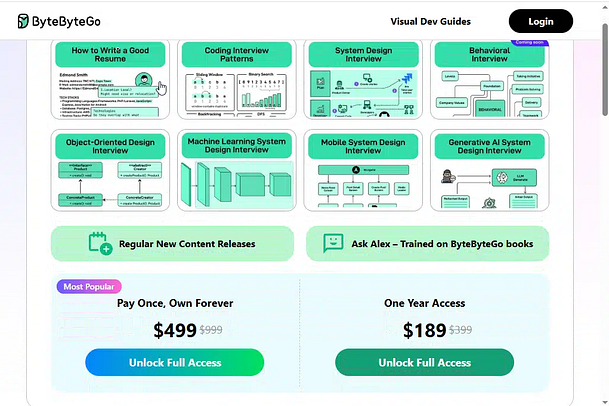
1. ByteByteGo — System Design Mastery
Perfect for: Visual learners who want comprehensive, production-level knowledge
Why it’s #1:
After testing 40+ courses, ByteByteGo is the only resource I consider complete. Created by Alex Xu (author of System Design Interview — An Insider’s Guide), it’s the gold standard.
What makes it exceptional:
Visual-First Learning:
- 1000+ beautifully crafted diagrams
- Animated explanations of complex systems
- Step-by-step architecture breakdowns
- Every concept visualized clearly
Comprehensive Coverage:
- 50+ real-world system architectures (Netflix, Uber, YouTube, ChatGPT)
- All content from 7 bestselling system design books
- ML System Design, Gen AI System Design
- Object-Oriented Design patterns
- ByteByteGo 101–101 coding patterns
Updated for 2026:
- Serverless architectures
- Edge computing patterns
- LLM integration strategies
- AI-powered system designs
- Weekly new content
Real architectures covered:
- Design Netflix’s video streaming
- Build Uber’s real-time matching
- Create WhatsApp’s message delivery
- Scale Instagram’s feed generation
- Design ChatGPT’s inference system
The breakthrough: ByteByteGo teaches you to think in systems, not just components.
Recent update (huge):
They’ve refreshed their entire platform and added:
- All 7 bestselling book contents
- ML and GenAI system design
- Behavioral interview guides
- Coding pattern exercises
Special offer: 50% OFF lifetime plan — This is what I bought and the investment paid for itself after one successful interview.
My recommendation: Start here. If you only get one resource, make it ByteByteGo.
2. Bugfree.ai — AI-Powered Interview Practice
Perfect for: Engineers who learn by doing and want AI feedback
Why it’s #2:
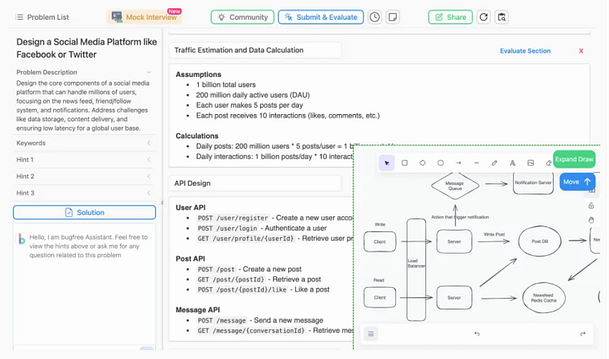
Theory without practice is useless. Bugfree.ai is the best platform for actually practicing system design with AI-powered feedback.
What makes it unique:
AI-Assisted Evaluation:
- Design a system (like Instagram feed)
- AI reviews your approach
- Identifies gaps in your design
- Suggests improvements
- Points out what you missed
It’s like having a mock interviewer 24/7.
Real interview-style questions:
- Design Twitter’s timeline
- Build YouTube’s recommendation system
- Create Uber’s surge pricing
- Scale WhatsApp’s message delivery
- Design Netflix’s CDN
Practice workflow:
- Get a system design question
- Design the architecture
- Submit your solution
- AI analyzes your design
- Receive detailed feedback
- Iterate and improve
Why this matters:
Reading about system design ≠ Designing systems yourself
My experience: Practicing 30+ designs with AI feedback improved my interview performance dramatically. I learned to:
- Structure answers clearly
- Cover all critical components
- Explain trade-offs confidently
- Think through edge cases
Behavioral interviews included:
Bugfree.ai also covers behavioral questions (150+ questions), making it a complete interview prep platform.
Pricing: Currently offering 25% OFF — Worth every penny for the feedback alone.
Best used with: ByteByteGo for learning + Bugfree.ai for practice = Complete preparation
3. Grokking the System Design Interview — DesignGurus.io
Perfect for: FAANG interview prep with structured framework
Why it’s essential:
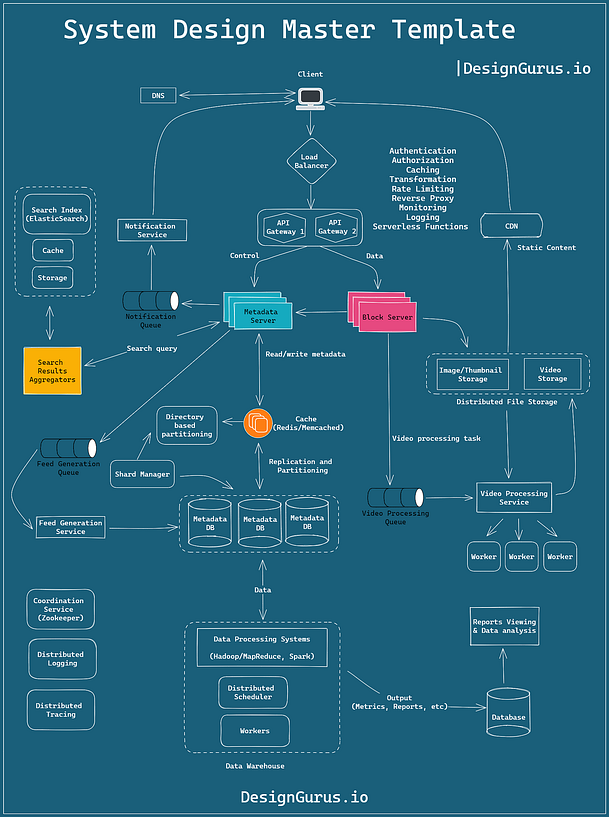
The original “Grokking” course is legendary in the interview prep community. It teaches a repeatable framework for tackling any system design question.
The framework:
Step 1: Requirements Clarification
- Functional requirements
- Non-functional requirements
- Scale estimates
- Constraints
Step 2: High-Level Design
- Core components
- Data flow
- API design
- Basic architecture
Step 3: Deep Dives
- Database schema
- Caching strategies
- Load balancing
- Scalability
Step 4: Trade-offs
- Consistency vs. Availability
- Latency vs. Throughput
- Cost vs. Performance
15+ Popular Interview Problems:
- Design Twitter
- Design YouTube
- Design Instagram
- Design Uber
- Design WhatsApp
- Design TinyURL
- Design Web Crawler
- Design Typeahead Suggestion
- Design API Rate Limiter
- Design Dropbox
- Design Notification System
- Design News Feed
- Design Chat System
- Design Search Autocomplete
- Design Distributed Message Queue
Each problem includes:
- Problem statement
- Requirements gathering
- Capacity estimation
- System interface definition
- Data model design
- High-level architecture
- Detailed component design
- Scalability considerations
Why this course works:
The framework gives you structure. You’re not scrambling during interviews — you follow proven steps.
My interview experience:
Used this framework in 8 system design interviews. It worked every time because:
- Demonstrates organized thinking
- Covers all critical aspects
- Shows architectural maturity
- Impressive to interviewers
Pro tip: Get the All Courses Bundle for 60% off — Includes coding patterns, OOP design, and more. Use code GURU for 55% discount.
4. System Design Interview Prep — Exponent
Perfect for: Mock interviews with real feedback
Why it’s valuable:
You can study for months, but nothing prepares you like simulating actual interviews.
What Exponent provides:
Mock Interview Platform:
- 5 free peer mock interviews (refreshed with good feedback)
- Practice with other engineers preparing for interviews
- Real-time whiteboarding
- Structured feedback
Expert Interviews:
- Interview with FAANG engineers (~$200)
- Get feedback from people who actually hire at Google, Meta, Amazon
- Identify weak areas before real interviews
- Learn what FAANG interviewers look for
Video Guides:
- Interview frameworks
- Common questions breakdown
- How to communicate designs
- Time management strategies
Why mock interviews matter:
Before mocks:
- Nervous, scattered thinking
- Poor time management
- Missed critical components
- Weak communication
After 5+ mocks:
- Confident, structured approach
- Effective time allocation
- Comprehensive coverage
- Clear communication
My recommendation:
Do at least 3–5 peer mocks for free before your real interview. If you have a FAANG interview lined up, the $200 expert mock is worth it to identify gaps.
Special pricing: Currently 70% OFF — Get Exponent subscription for just $12/month (normally $79/month).

5. Grokking Modern System Design — Educative.io
Perfect for: Interactive, hands-on learning for advanced concepts
Why Educative stands out:
Interactive learning — You don’t just read, you build systems in the browser.
What makes this course advanced:
Modern Architectures:
- Event-driven systems
- CQRS (Command Query Responsibility Segregation)
- Apache Kafka deep dive
- Microservices patterns
- Service mesh architectures
YouTube-Scale Systems:
- Designing for billions of users
- Multi-region deployments
- Global CDN strategies
- Data replication at scale
- Disaster recovery
AI Pipeline Design:
- ML model serving at scale
- Real-time inference systems
- Model versioning and deployment
- A/B testing infrastructure
- Feature stores
Cloud-Native Patterns:
- Containerization with Kubernetes
- Serverless architectures
- Auto-scaling strategies
- Cost optimization
- Multi-cloud designs
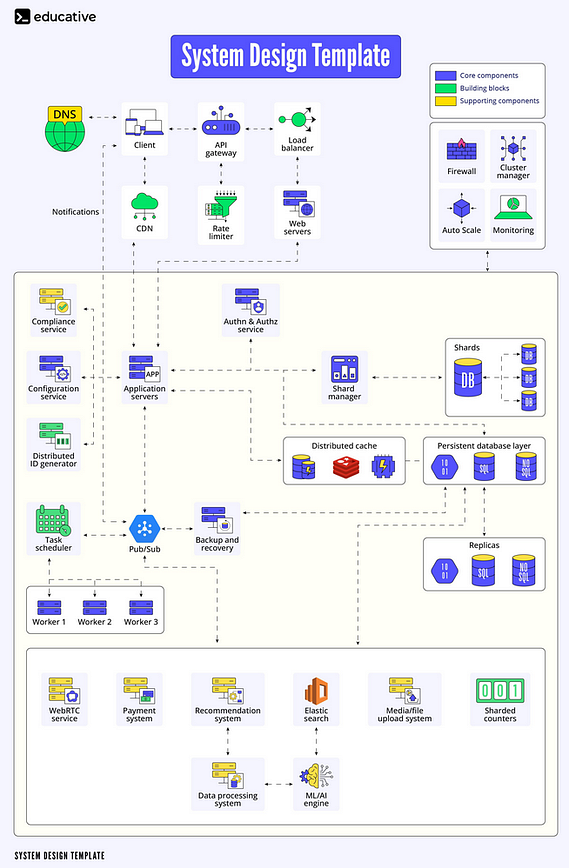
Clear Diagrams:
Every concept includes:
- Architecture diagrams
- Data flow visualizations
- Component breakdowns
- Trade-off analysis
Hands-On Practice:
Build systems directly in the browser:
- No installation needed
- Immediate feedback
- Step-by-step guidance
- Real code examples
Who should take this:
Mid-to-senior engineers ready to level up architectural thinking beyond basics.
My experience: After mastering fundamentals elsewhere, this course taught me modern, production-grade patterns.
Subscription value: You’ll need an Educative subscription ($14.99/month) which includes:
- 1200+ courses
- System Design, Coding, ML/AI
- Cloud platforms (AWS, Azure, GCP)
- Interview prep
- Currently 60% OFF
6. System Design Masterclass — Udemy
Perfect for: Budget-conscious learners wanting FAANG-quality content
Why Udemy works:
Taught by ex-FAANG engineers who’ve been on both sides of the interview table.
Comprehensive coverage:
20+ Case Studies:
- Design Netflix
- Design Uber
- Design WhatsApp
- Design Instagram
- Design Twitter
- Design YouTube
- Design TinyURL
- Design Parking Lot
- Design E-commerce Platform
- Design Stock Exchange
Core Topics:
- Scalability fundamentals
- API design patterns
- Database selection (SQL vs. NoSQL)
- Caching strategies
- Load balancing
- Distributed systems
- Microservices architecture
- Event-driven design
Practical walkthrough:
Each design includes:
- Requirements gathering
- Capacity estimation
- API design
- Database schema
- High-level architecture
- Detailed component design
- Scalability discussion
- Trade-off analysis
Lifetime access:
- Watch at your own pace
- Revisit before interviews
- Get all future updates
- Download for offline viewing
Affordable:
Often available for $15–20 during Udemy sales (regular price $100+)
Pro tip: Wait for Udemy sales (happen frequently) to get 80–90% OFF.
Other great Udemy options:
- Frank Kane’s course (ex-Amazon hiring manager)
- Sandeep’s System Design course
- Many excellent alternatives
Alternative: Get Udemy Personal Plan ($30/month) for access to 11,000+ courses if you want to take multiple courses.

Bonus: Essential System Design Books
Courses teach you. Books deepen understanding.
1. System Design Interview — An Insider’s Guide by Alex Xu
Why it’s essential:
The book that spawned ByteByteGo. Covers 15+ system design problems with:
- Beautiful diagrams
- Step-by-step solutions
- Real-world examples
- Interview-proven approaches
My experience: Read this 3 times. Referenced during interviews. Still consult it when designing production systems.
System Design Interview – An insider’s guide
2. Designing Data-Intensive Applications by Martin Kleppmann
Why it’s deep:
The definitive guide to distributed systems. Covers:
- Data models and query languages
- Replication and partitioning
- Consistency and consensus
- Batch and stream processing
Warning: Dense and technical. Not for beginners.
My take: Read this AFTER courses. It deepens understanding of concepts you’ve learned.
Combined approach: Courses for breadth, books for depth.
Why ByteByteGo + Bugfree.ai Is the Winning Combination
After testing everything, here’s my recommended stack:
ByteByteGo ($199 lifetime with 50% off):
- Learn comprehensive system design
- Visual explanations of real systems
- ML/GenAI system design
- Coding patterns included
- Practice 30+ system designs
- AI feedback on every design
- Interview-style questions
- Behavioral interview prep
Total investment: ~$350 for lifetime ByteByteGo + annual Bugfree.ai
ROI: One successful interview = $50K-$200K salary increase
My result: $120K salary increase after 3 months of focused study
The Bottom Line
System design is the #1 skill differentiating senior engineers from mid-level engineers.
Coding can be learned in months. System design takes longer because it requires:
- Understanding trade-offs at scale
- Knowing when to use which pattern
- Communicating architectural decisions
- Thinking in distributed systems
My honest recommendations:
If you can only choose ONE:
- Get ByteByteGo lifetime (50% OFF now)
If you want interview-ready:
- ByteByteGo + Bugfree.ai + Grokking
If you’re preparing for FAANG:
- All of the above + Exponent mocks
P. S. — If you want to do just one thing then join ByteByteGo and learn System Design Concepts and practice coding interviews you will thank me later. It’s one of the most comprehensive resource for not just coding interview but also for senior engineers to get better at their work.
System Design · Coding · Behavioral · Machine Learning Interviews

I Tried 40+ Software Design Courses: Here are My Top 6 Recommendations for 2026 was originally published in Javarevisited on Medium, where people are continuing the conversation by highlighting and responding to this story.
This post first appeared on Read More