
Manjaro has long been one of the more popular Arch-based Linux distributions, known for making Arch Linux more accessible to everyday users. But it has been losing ground for years, both in terms of user trust and active contributors, and the complaints about its direction have only gotten louder.
Now, things have hit a breaking point, with calls for a fork if the current leadership does not budge.
A Manjaro team member going by the handle “Aragorn” has published the “Manjaro 2.0 Manifesto” on the official Manjaro forum. The post lays out a detailed restructuring plan for the project that has been signed by 19 team members, including developers, community managers, moderators, and the company’s technical lead.
Is there any weight behind this?
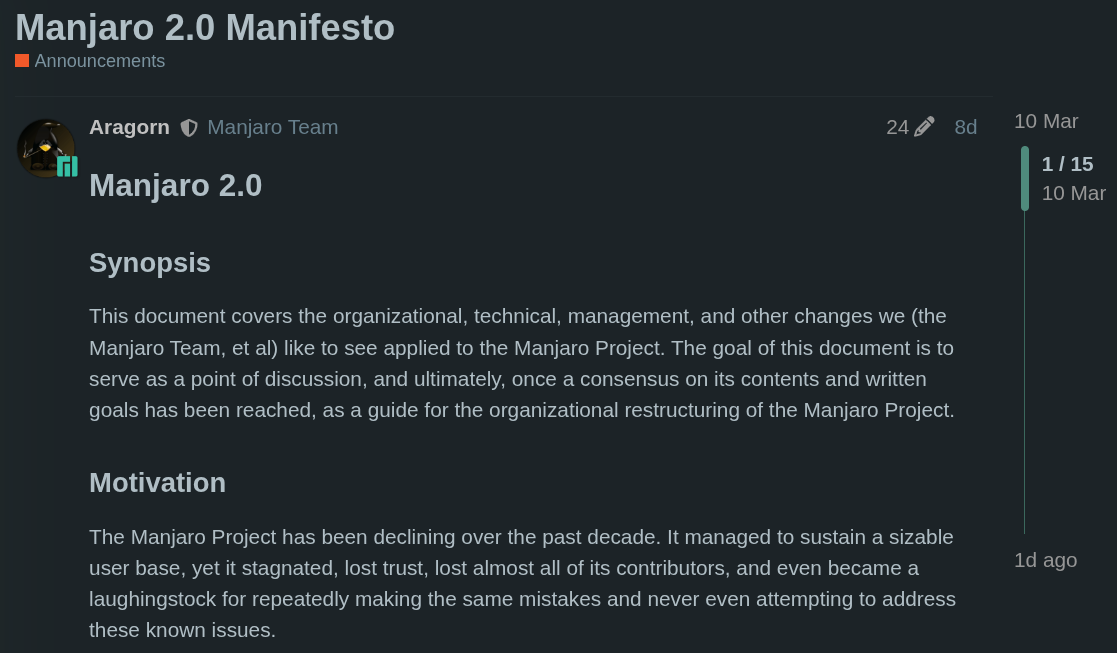
The manifesto opens by stating that the Manjaro Project has been declining over the past decade, losing trust and contributors while repeating the same mistakes without ever addressing them.
One example cited is the repeated failure to keep TLS certificates current, something volunteers had reportedly already built tooling to fix, only to be ignored.
From there, it goes after the core issue directly. Aragorn writes that Philip Müller (the project lead) has been running Manjaro as his own personal venture rather than a community effort, keeping a tight hold on access to both the codebase and the infrastructure.
Aragorn goes on to say that:
The priorities of the Project leadership do not align with those of the developers and community. The current leadership’s goal is to turn Manjaro into a successful business, and thus far, these attempts have mostly failed.
The money situation makes it worse. The manifesto says the company, Manjaro GmbH & Co KG, has not been funneling any of its funds back into the project and has not pursued outside funding either.
What the team wants is a clean separation, where the Manjaro Project is spun off from Manjaro GmbH & Co. KG and restructured as a registered nonprofit association under German law (e.V.).
The new structure would distribute ownership equally among members, use transparent voting for major decisions, and assign “arbiter” roles to experienced contributors for specific domains.
Under the proposal, the nonprofit would get full use of the Manjaro trademark through 2029. The company keeps the right to use it too, as long as the two don’t step on each other’s toes. After that initial period, the manifesto nudges the company to declare that it is willing to hand over full trademark ownership to the nonprofit for €1.
Key assets like the GitHub organizations, the self-hosted GitLab instance, forum, CDN, and the manjaro.org domain would all move over to the non-profit as well.
The team has also laid out what would happen if they were ignored. The “Our Resolve” section of the manifesto says that there are three stages (from 0-2): waiting for a reply, striking and going public, and finally forking or leaving. Within Stage 1, there are three phases that control how public the document gets.
They skipped Phase 2 and jumped straight to Phase 3 a few days ago, moving the manifesto to the public Announcements section of the forum and archiving the thread on archive.org. If things don’t improve, then a forum lockdown is on the table.
Don’t think that this is some kind of witch hunt. One of the Manjaro team members, Dennis ten Hoove, has clarified that the goal of this initiative is not to kick people off the project but to change the leadership and help foster Manjaro as a healthy community-driven project.
Expect a bumpy transition
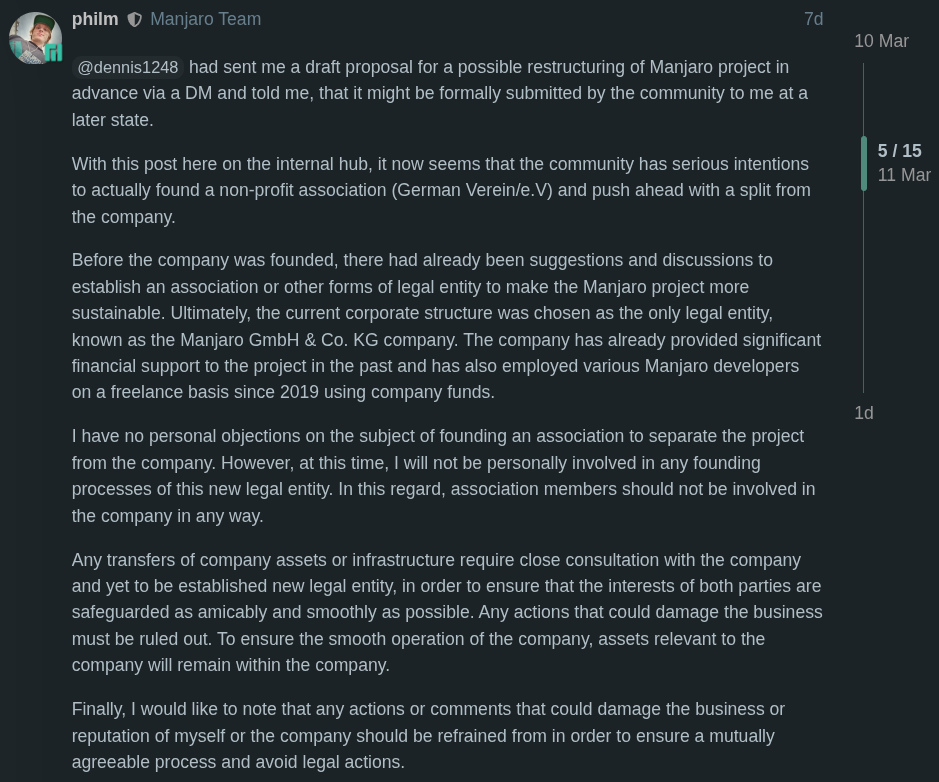
Philip did break his silence on the matter, saying that he is fine with an association being formed but wants no part in setting one up himself. He also made clear that handing over any assets would need to happen on the company’s terms and closed with a warning that public statements damaging to either himself or the business could have legal consequences.
The protesting team’s response was measured, where Aragorn pushed back, pointing out that the manifesto already lets the company continue using the infrastructure for as long as it needs to move its operations elsewhere.
Roman Gilg, who signed the manifesto despite being the company’s CTO, put a direct question to Philip, asking whether he had any specific objection to the list of assets outlined in the document. Philip went quiet again.
After days of silence on that question, Aragorn declared that Philip was stalling and announced the team was skipping Phase 2 and moving straight to Phase 3 (where things stand as of now).
What can you do?
There’s an active community discussion thread with over 200 replies, started specifically to accommodate talks surrounding the manifesto. If you have thoughts on what’s going wrong with the Manjaro project and what could be done better, you can head over and weigh in.
One of the Manjaro old timers, Stefano Capitani, has recently posted there, sharing his view of the situation:
I have to apologize to all of you. It seems I’ve missed some of the events here. I believe, without fear of contradiction, that I, along with @guinux , @oberon , and of course @philm, am one of the “old timers” still active, if not as much as before, but still active in Manjaro.
I have to be honest, I feel like I’m having flashbacks because we’ve already had these discussions or “storms” in the past. We’ve always come out stronger, and we’ll come out stronger this time too.
PS: You need to be logged in to the Manjaro forum to view user profiles.
Suggested Read 📖: Ageless Linux Emerges to Protest OS-Level Age Verification Laws

This article first appeared on Read More