
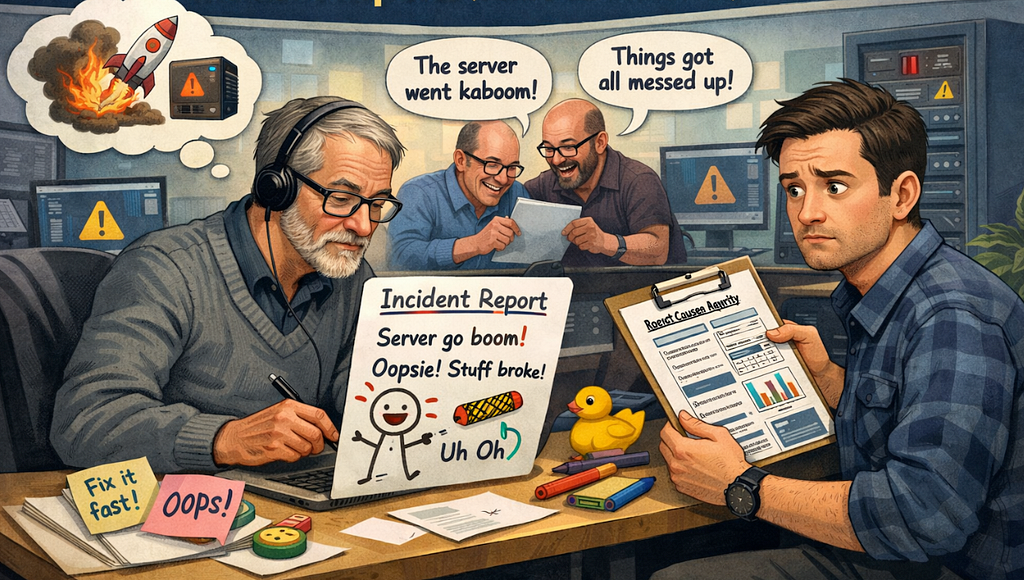
The $180K engineer who can architect a distributed system but can’t explain what broke to the VP of Engineering.
The Slack message came in at 11:43 PM on a Thursday.
“Can you walk me through yesterday’s outage? Board meeting tomorrow morning.”
I’d just spent six hours fixing a payment processing failure that cost us $67,000 in failed transactions. The incident was resolved. The postmortem was written. I was ready for bed.
I opened the document one of my senior engineers had written.
Incident Summary:
Database connection pool exhausted due to increased load.
Resolution: Restarted service, increased pool size.
Action: Monitor connection metrics.
Three sentences. For a $67K incident. Written by someone making $180K a year.
I stared at my screen. This read like something a bootcamp grad would write after their first production bug. Not a 10-year veteran who’d just debugged a catastrophic failure under pressure at 3 AM.
That’s when I realized: We’re promoting people based on technical skill, not communication skill. And it’s costing us credibility every single time something breaks.
The Gap Nobody Talks About
Here’s what happens in most engineering organizations:
You hire a junior developer. They learn to code. They get better at system design. They understand distributed systems, caching strategies, database optimization. Five years later, they’re senior. Maybe staff. Maybe principal.
At no point did anyone teach them how to write an incident report that doesn’t sound like a Git commit message.
I’ve reviewed over 200 incident reports from companies that raised Series A through Series C funding. I’ve seen reports from engineers at Google, Meta, Stripe, and a dozen well-funded startups.
The pattern is everywhere: The technical analysis is solid. The communication is terrible.
Senior engineers can tell you exactly which index was missing on the 47-million-row table. They can’t tell the CEO what it cost the company or why it won’t happen again without sounding defensive.
What a Junior-Level Report Looks Like
Let me show you a real example. Names changed, incident real:
**Incident Report - API Latency Spike**
Summary: API response times increased significantly on March 15th.
Root Cause: Redis cache was not working properly. Memory usage
was high. Cache misses caused database queries.
Resolution: Restarted Redis. Added memory monitoring. Optimized
some queries.
Prevention: Better monitoring. Code review for cache usage.
Status: Resolved.
This was written by a Senior Software Engineer. Six years of experience. Makes $165K. Can you spot the problems?
Problem 1: No impact. “Response times increased significantly” tells me nothing. Increased to what? How many users were affected? How much revenue did we lose while this was happening?
Problem 2: Vague root cause. “Redis was not working properly” is not a root cause. That’s a symptom. Why wasn’t it working? What specifically failed?
Problem 3: No evidence. Where’s the proof? Show me the logs. Show me the metrics. Show me the graph where everything went to hell.
Problem 4: Useless prevention plan. “Better monitoring” is what you write when you don’t actually know how to prevent this. What specific monitoring? Who’s implementing it? When?
Problem 5: No accountability. Who’s doing code review? Who’s adding the monitoring? When is it getting done?
This report tells me the engineer fixed the problem but learned nothing. And worse, it gives leadership zero confidence that this won’t happen again next week.
What a Senior-Level Report Actually Looks Like
Here’s the same incident, written properly:
**Executive Summary**
API latency spiked from 200ms to 8.4 seconds on March 15, 2026,
14:23-15:47 UTC (84 minutes). Impact: 12,847 failed requests,
estimated $23,400 revenue loss, 847 support tickets.
Root cause: Redis cluster ran out of memory due to unbounded cache
growth in the user-session store. When Redis hit max memory (16GB),
it stopped accepting writes. All cache misses fell through to PostgreSQL,
which saturated at 94% CPU under 47× normal query load.
**Timeline**
14:23 - First latency alert (P99 jumped to 2.1s) [Log ref: datadog-1]
14:31 - Redis memory at 98% (15.7GB/16GB) [Log ref: redis-metrics]
14:34 - Cache hit rate dropped to 12% (normal: 94%) [Dashboard ref]
14:47 - PostgreSQL CPU at 94%, connection pool exhausted [PG logs]
15:12 - Emergency Redis restart approved
15:19 - Redis back online, memory cleared
15:47 - Latency normalized (P99: 180ms)
**Root Cause Analysis**
User session data was cached with no TTL (time-to-live). Sessions
accumulated for 6 months without expiration. When we crossed 2.1M
active users, Redis memory hit the limit.
Contributing factors:
- No memory alerting on Redis (missed the 98% threshold)
- No TTL enforcement in session cache (unlimited growth)
- No cache eviction policy configured (should have been LRU)
**Evidence**
All claims above trace to logs:
- Latency spike: [Datadog dashboard - API metrics]
- Redis memory: [CloudWatch Redis/Memory timeline]
- DB saturation: [PostgreSQL slow query log, 14:47-15:19 UTC]
**Prevention (Implemented)**
1. Set 24-hour TTL on all session cache entries (Owner: Sarah Chen,
   Completed: March 16)
2. Configure Redis eviction policy: allkeys-lru (Owner: Mike Torres,
   Completed: March 16)
3. Add Redis memory alerts at 80% threshold (Owner: DevOps team,
   Completed: March 17)
4. Implement automated cache size audit (weekly) (Owner: Sarah Chen,
   Due: March 31)
**Business Impact**
- Direct revenue loss: $23,400 (failed checkout transactions)
- Support cost: 847 tickets × $12 avg handling = $10,164
- Customer experience: 12,847 users affected (2.3% churn risk)
Total estimated cost: $33,564
**Confidence: 95%**
Every claim in this report links to timestamped logs or metrics.
Manual verification recommended for revenue calculation (based on
average cart value $1.82).
Notice the difference?
Impact is quantified. Not “response times increased.” Exactly how much, for how long, affecting how many people, costing how much money.
Root cause is specific. Not “Redis wasn’t working.” Exactly what failed, why it failed, what the threshold was.
Evidence is linked. Every claim points to a log, a metric, a dashboard. You can verify everything.
Prevention is owned. Not “better monitoring.” Exactly what monitoring, who’s building it, when it’s done.
Accountability is clear. Names. Dates. Deliverables.
This is what a $180K engineer should produce. Not because they’re better at writing — because they understand that incident reports aren’t just technical documentation. They’re trust signals to leadership.
Why This Matters More Than You Think
I’ve watched three funding rounds slow down because incident reports made engineering leadership look incompetent.
Not because the incidents happened. Incidents happen everywhere. Because the reports made it look like the team didn’t know what they were doing.
One company lost a $2M Series A extension because their postmortem was eight pages of stack traces with no business impact calculation. The lead investor’s feedback: “I can’t tell if this team understands the severity of their own outages.”
Another company secured a $5M round two weeks after a major outage because their incident report was crisp, evidence-backed, and showed complete ownership. Same investor: “This is the kind of engineering maturity we want to fund.”
The technical skill to fix the bug is table stakes. The communication skill to explain what happened, why it mattered, and why it won’t happen again — that’s what separates senior engineers from senior engineers who get promoted.
The Harsh Reality
Most senior engineers can’t write a board-level incident report because they’ve never seen one.
They learned from other engineers who also couldn’t write them. They copied the format from their first job, where the bar was “just document what broke.” They never got feedback because engineering managers don’t know what good looks like either.
Here’s what I’ve learned after analyzing hundreds of these reports:
68% don’t include business impact. They describe the technical failure but never calculate what it cost.
54% have vague root causes. “Database was slow” or “cache wasn’t working” instead of specific, evidence-backed failures.
89% have no measurable prevention plan. Just platitudes: “improve monitoring,” “better testing,” “more code review.”
91% have no accountability. Prevention items with no owner, no deadline, no definition of done.
And here’s the kicker: The engineers who wrote these reports are excellent at their jobs. They’re great debuggers. They ship clean code. They mentor juniors. They just never learned that incident communication is part of the job.
What Actually Happened vs What You Write
Let me show you the translation problem.
What happened in your head: “The Redis cluster memory hit the max allocation threshold which triggered a state where new key writes were rejected, causing the cache layer to degrade into read-through mode where every miss resulted in a direct PostgreSQL query, and because we hadn’t provisioned for that query load the database connection pool saturated and queries started timing out which manifested as API latency spikes that exceeded our SLA.”
What you write in the report: “Redis ran out of memory. Database got slow. API latency increased.”
What leadership reads: “Something broke. They fixed it. They don’t really know why.”
The gap between those three things is where credibility dies.
The Framework I Wish Someone Had Shown Me
After reviewing 200+ reports and writing dozens myself, here’s the framework that actually works:
Part 1: Executive Summary (30 seconds to read)
Answer four questions:
- What broke? (one sentence, no jargon)
- What did it cost? (dollars + customers + time)
- Why did it break? (root cause, specific)
- How do we prevent it? (measurable actions, owned)
Part 2: Timeline (visual, not narrative)
Use a table. Every row is an event with:
- Timestamp
- What happened
- Evidence (link to log/metric)
No paragraphs. No storytelling. Just facts with proof.
Part 3: Root Cause (why, not how)
Don’t explain the technical mechanism. Explain the systemic failure.
Bad: “The connection pool size was set to 50 which was insufficient for the query load generated by cache misses.”
Good: “We had no capacity planning for cache-failure scenarios. When Redis failed, nothing prevented the database from being overwhelmed.”
See the difference? One is a config setting. The other is a missing practice.
Part 4: Prevention (owned, not hoped)
Every action item needs three things:
- Specific deliverable (not “improve X”)
- Owner (actual human name)
- Deadline (actual date)
Bad: “Improve Redis monitoring” Good: “Add memory alerts at 80% threshold (Mike, March 17)”
The Tools Don’t Fix This
I know what you’re thinking: “Can’t I just use a template?”
Templates help. But they don’t solve the core problem.
The core problem is that most engineers don’t know what executives actually want to read. They optimize for technical accuracy instead of decision-making clarity.
I built ProdRescue because I got tired of spending six hours reconstructing timelines from Slack chaos and Datadog logs. The AI reads your war-room thread, pulls the evidence, and generates the timeline and root cause automatically. It calculates revenue impact. It links every claim to actual log lines.
But here’s the thing: Even with automation, you still need to understand what a good report looks like. Because the AI can generate a timeline. It can’t tell you why the prevention plan matters or how to frame it for your board meeting.
What To Do If You’re That Senior Engineer
If you read this and thought “oh shit, that’s me” — you’re not alone. Most engineers are in the same boat.
Here’s how to fix it:
Step 1: Review your last three incident reports. Ask yourself: Could the CFO read this and understand what it cost? Could a board member read this and feel confident we learned something?
Step 2: Find someone who writes well. Not another engineer. Find someone in product or marketing who communicates with executives. Ask them to review your next report before you ship it.
Step 3: Steal shamelessly. Find companies that publish their incident reports publicly (Stripe, GitHub, Cloudflare). Study how they structure them. Copy the format.
Step 4: Practice calculating impact. Every incident has business impact. Start estimating:
- Failed transactions × average cart value = revenue loss
- Support tickets × handling cost = support impact
- Downtime × user count × churn risk = customer impact
Get comfortable with the business side of engineering. That’s what distinguishes senior engineers from principal engineers.
The Uncomfortable Truth
Your ability to architect a distributed system doesn’t matter if you can’t explain what broke when it fails.
Your skill at debugging race conditions doesn’t matter if your incident report makes leadership question your competence.
Your years of experience don’t matter if you write reports that look like they came from a junior engineer.
Technical skill gets you hired. Communication skill gets you promoted.
The engineers who figure this out become VPs. The ones who don’t stay senior forever and wonder why.
Resources That Actually Help
I’m not going to pretend I have all the answers. But here’s what’s helped me:
For manual reporting: I published a free Production Incident Prevention Kit with templates and checklists I actually use. It’s not perfect, but it’s better than starting from scratch.
For automated reporting: If you’re doing this weekly, ProdRescue reads your Slack war room and generates the timeline, root cause, and revenue impact in two minutes. First three reports are free, no credit card. I built it because I was tired of doing this by hand.
For more war stories: I write about real production failures every week on my newsletter. Subscribe if you want more stories about things breaking at 3 AM and what we learned.
The next time something breaks in production, before you write “database was slow” in your incident report, ask yourself:
Could I present this to the board? Would they fund us after reading it? Would they trust this team to prevent it from happening again?
If the answer is no, you’re writing a junior-level report. And you’re better than that.
What’s the worst incident report you’ve ever read? Reply with your horror stories. Misery loves company.

Your Senior Engineers Are Writing Junior-Level Incident Reports (And Don’t Know It) was originally published in Javarevisited on Medium, where people are continuing the conversation by highlighting and responding to this story.
This post first appeared on Read More