
My favorite online courses to learn AI Engineering and LLM Engineering in 2026
Hello friends, AI engineering has gone from a niche specialization to one of the most in-demand skills in the entire tech industry — and the pace of change shows no sign of slowing down.
Every week there’s a new course, a new bootcamp, a new specialization promising to turn you into an AI engineer in 30 days. Most of them don’t deliver.
I’ve spent the better part of the past year working through more than 40 AI engineering courses, programs, and specializations across every major learning platform like DataCamp, Udemy, Coursera, Towards AI Academy , Frontend Masters, Udacity, and ZTM Academy..
I’ve sat through the good, the bloated, and the genuinely excellent. I’ve finished courses that transformed how I build software, and I’ve abandoned courses two hours in because the content was already outdated before I started.
This article is the result of all that time invested. Here are the 5 AI engineering courses I’d actually recommend — each one selected for depth, practical value, and relevance to what the industry needs right now in 2026.
Whether you’re a developer wanting to build LLM-powered applications, a data scientist looking to make the leap into AI engineering, or someone who wants serious production-grade AI skills, there’s something on this list for you.
By the way, if you are in hurry and just need one course to start with then I highly recommend you to start with Associate AI Engineer for Developers track on Datacamp. This is one of the best structured course for beginners who wants to learn AI engineering.
What Makes a Great AI Engineering Course in 2026?
Before getting into the recommendations, here’s the criteria I used. A great AI engineering course in 2026 should:
- Teach you to build real things, not just explain concepts
- Cover the full stack — from prompting and model selection to deployment and production concerns
- Stay current with the tools and frameworks that practitioners are actually using
- Give you portfolio-ready projects, not just certificates
- Be taught by people who have built AI systems, not just studied them
With that in mind, here are the five courses that made the cut.
5 Best AI Engineering Courses You Can Join in 2026
Without any further ado, here are the great AI Engineering courses you can join online in 2026 to learn essential AI skills and become an AI Engineer.
1. Associate AI Engineer for Developers — DataCamp
Best for: Software developers wanting a structured, skills-based AI engineering track
DataCamp has built a well-deserved reputation for structured, skill-focused learning tracks, and their Associate AI Engineer for Developers program is one of the strongest offerings in their catalog.
Unlike a single course, this is a full career track — a curated sequence of courses, projects, and assessments designed to take you from developer to AI engineer in a systematic way.
What I appreciate about DataCamp’s approach here is the emphasis on assessment. You don’t just consume content; you demonstrate competency at each stage.
The platform’s interactive coding environment means you’re writing real code throughout, not just watching videos and hoping things stick.
By the end of the track, you’ll have earned a DataCamp certification that actually reflects tested skills rather than just course completion.
The curriculum is developer-first in the best sense — it assumes you can code, skips the programming basics, and gets straight to the AI engineering concepts that matter. That makes it significantly more efficient than courses designed for complete beginners.
What the track covers:
- Working with LLMs via APIs and open-source models
- Building and deploying AI-powered applications
- Prompt engineering and chain-of-thought techniques
- Vector databases and semantic search implementation
- AI agent design and tool integration
- Responsible AI practices and production considerations
For developers who want a structured path with clear milestones and a recognized certification at the end, this track is hard to beat.
Here is the link to join this course — Associate AI Engineer for Developers — DataCamp
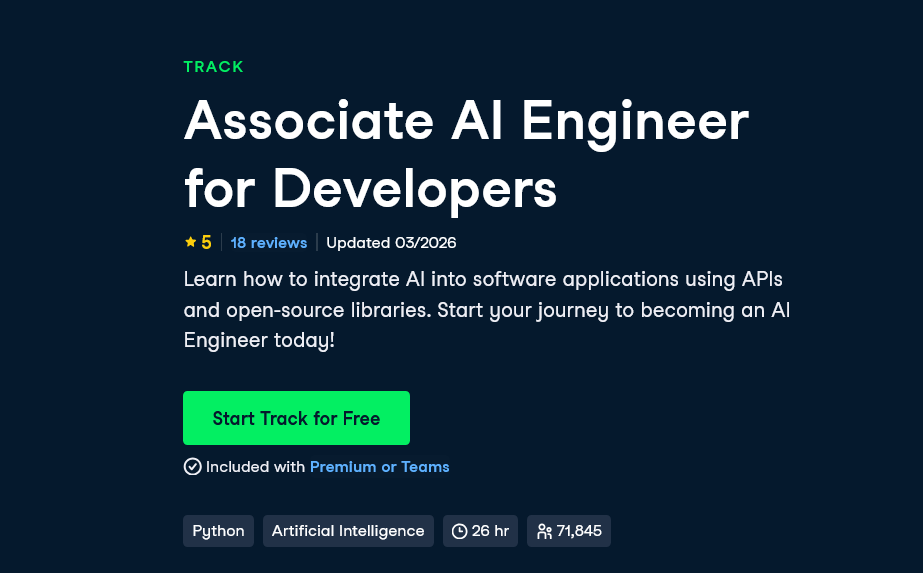
By the way, you need a Datacamp plan to access this course. They have different plans like standard, professionals, and premium which allows access to all projects. I recommend the standard plan because it is right-priced and you get access to all the essentials to grow your data skills.
The best thing is that you can now get it for 50% discount as Datacamp is running a sale now, click here to join for 50% OFF.
DataCamp Sale 2026 | DataCamp Promo & Discount
2. Full Stack AI Engineering — Towards AI Academy
Best for: Python developers who want to become serious AI engineers
If there’s one course on this list I’d push into the hands of every developer serious about AI engineering, it’s this one.
The Full Stack AI Engineering program from Towards AI Academy is the most comprehensive, technically rigorous AI engineering curriculum I’ve encountered anywhere — and that’s not an overstatement.
At around 80 hours of content, this isn’t a quick introduction. It’s a genuine deep dive built for Python developers who want to make the full transition into AI engineering.
The program takes you from the fundamentals of LLM development all the way through to advanced agent architectures, RAG pipelines, fine-tuning, and production deployment — covering the entire stack that a working AI engineer needs to understand.
What sets it apart from most courses is the combination of depth and practicality. You’re not watching someone explain what an embedding is in the abstract — you’re building systems that use embeddings to do useful things. Every concept is grounded in code that actually runs.
What you’ll learn:
- LLM fundamentals and how to work effectively with foundation models
- Retrieval-Augmented Generation (RAG) — design, implementation, and optimization
- AI agent architectures and multi-agent systems
- Fine-tuning and customizing models for specific use cases
- Vector databases, embeddings, and semantic search
- End-to-end deployment of AI-powered applications in production
This is the course that the serious tech community keeps recommending to each other, and after going through it myself, I understand why. If you’re a Python developer and AI engineering is your destination, this is your fastest legitimate path to getting there.
Here is the link to join this course — Full Stack AI Engineering — Towards AI Academy
And, if you also want to master Agentic AI, they also have a great course called Agentic AI Engineering which is created by none other than Paul Iustzin, author of popular LLM Engineering Handbook.
Production AI Agents Course: Learn Agentic Engineering
3. Master LLM Engineering & AI Agents: Build 14 Projects — Udemy
Best for: Developers who learn by building real projects
Theory is great. Fourteen projects is better. This Udemy course takes an aggressively project-driven approach to LLM engineering and AI agent development, and the result is one of the most portfolio-building programs available for aspiring AI engineers in 2026.
The course is structured around building — you work through 14 distinct projects that cover the full range of what modern AI engineering looks like in practice.
By the time you finish, you don’t just understand LLM engineering conceptually; you have a portfolio of working systems to show for it. That’s the difference between someone who has learned AI engineering and someone who can demonstrate it in a job interview or client meeting.
The content is also genuinely current. LLM tooling moves fast, and this course reflects what practitioners are actually using right now — including modern agent frameworks, tool-use patterns, and production deployment considerations that more dated courses completely miss.
What you’ll build and learn:
- End-to-end LLM applications with real-world use cases
- Agentic AI systems with tool use and multi-step reasoning
- RAG pipelines from scratch and with popular frameworks
- Fine-tuning workflows for domain-specific performance
- Production deployment patterns and cost management strategies
- 14 complete projects to fill out your AI engineering portfolio
If you learn best by doing and want concrete proof of your skills at the end of a course, this is the one to choose.
Here is the link to join this course — Master LLM Engineering & AI Agents: Build 14 Projects
4. Generative AI Engineering with LLMs Specialization — Coursera
Best for: Professionals who want an academically rigorous, industry-recognized credential
Not everyone needs a project portfolio as their primary output — some professionals need a credential that carries weight in corporate settings, or want the conceptual depth that comes from a more structured, university-style curriculum.
The Generative AI Engineering with LLMs Specialization on Coursera delivers exactly that.
This specialization goes deep on the engineering and architecture behind generative AI systems — not just how to use them, but why they work the way they do and how to make principled decisions when building with them.
If you’ve been curious about the technical foundations underneath the tools everyone is using, this program will satisfy that curiosity while also giving you practical skills.
Coursera’s format also makes this more accessible for professionals with demanding schedules — you work through the material at your own pace, and the certificate carries the kind of institutional recognition that resonates with employers who value structured credentials.
What the specialization covers:
- Architecture and mechanics of large language models
- Prompt engineering from basics to advanced techniques
- Fine-tuning, RLHF, and model customization workflows
- RAG system design and evaluation
- LLM application development and deployment
- Responsible AI, safety, and ethics in generative AI systems
For anyone who wants both the depth of understanding and the formal credential to back it up, this specialization is the right choice.
Here is the link to join this course — Generative AI Engineering with LLMs Specialization — Coursera
By the way, If you are planning to join multiple specializations, then consider taking a Coursera Plus subscription which provides you unlimited access to their most popular courses, specialization, professional certificate, and guided projects.
It costs around $59/ per month but is worth it because you get access to more than 10000+ courses and projects, and you can also get access to unlimited professional certificates like this one.
Coursera Plus | Unlimited Access to 10,000+ Online Courses
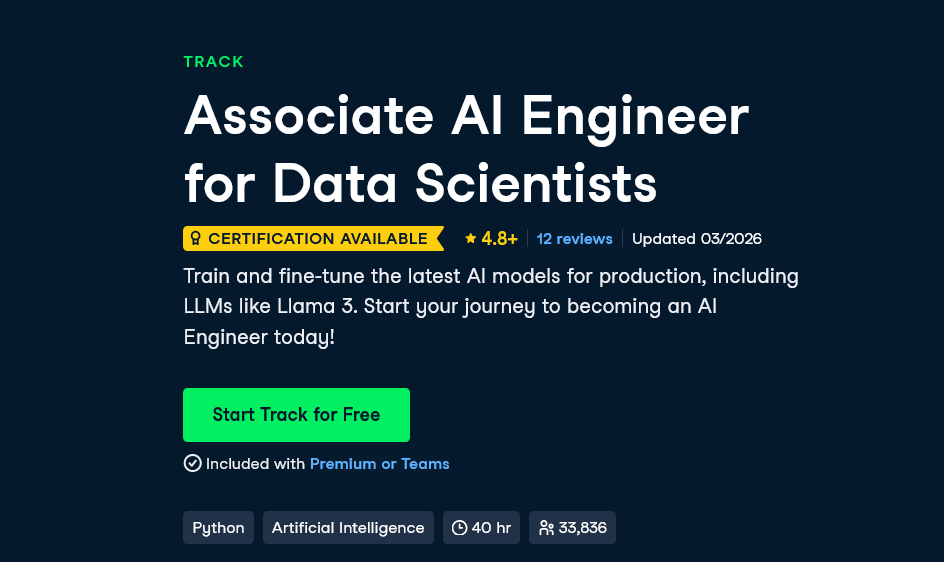
5. Associate AI Engineer for Data Scientists — DataCamp
Best for: Data scientists making the transition into AI engineering
Data scientists and AI engineers are neighbors in the technical landscape, but they’re not the same role — and making the transition requires building skills in areas that traditional data science training doesn’t cover.
This DataCamp track is built specifically for that transition, and it does it well.
The program assumes you already understand data, statistics, and the basics of machine learning. It doesn’t waste your time re-teaching things you know.
Instead, it focuses on the engineering skills that data scientists typically lack: building production systems, working with LLMs as infrastructure, designing scalable AI pipelines, and deploying models in ways that actually stay running reliably.
The result is a learning path that feels efficient rather than padded — you’re spending time on the delta between where you are and where you need to be, not retreading familiar ground.
What the track covers:
- Bridging the gap from ML models to production AI systems
- Working with LLMs and generative AI as engineering building blocks
- Building robust data pipelines for AI applications
- Integrating AI capabilities into scalable applications
- Vector search and retrieval systems for AI-powered products
- MLOps practices adapted for the LLM era
If you have a data science background and want to level up into AI engineering without starting from scratch, this track is designed for you.
Here is the link to join this track — Associate AI Engineer for Data Scientists — DataCamp
How to Choose the Right AI Engineering Course for You?
After going through 40+ programs, here’s the honest summary of who should take what:
- Python developer wanting full AI engineering mastery → Start with Full Stack AI Engineering on Towards AI. It’s the most comprehensive option and worth every hour.
- Developer who learns by building → The Udemy LLM Engineering course gives you 14 real projects to show for it.
- Software developer wanting structured certification → The DataCamp AI Engineer for Developers track is your best bet.
- Professional needing a formal, recognized credential → The Coursera LLM Specialization delivers depth and institutional recognition.
- Data scientist transitioning to AI engineering → Go straight to the DataCamp AI Engineer for Data Scientists track.
- Build Real Products with LLMs, Context Engineering, RAG.
- AI Engineer Course: Become an AI Engineer | DataCamp
Final Thoughts
The AI engineering field is moving faster than any other area of software development right now, which makes choosing the right learning resource more important — and harder — than ever.
Most courses are chasing trends without delivering real skills. The five programs above are the exceptions: each one will give you something concrete and lasting at the end.
Don’t wait for the perfect moment to start. The gap between developers who understand AI engineering and those who don’t is widening every month. The best time to close that gap is now.
Good luck — and feel free to drop a comment if you have questions about which course fits your situation.
P. S. — If you just want to do one thing, I suggest you to start with the Associate AI Engineer for Developers track on Datacamp. It’s one of the best structured program for developers to become AI Engineer in 2026, you will thank me later.
AI Engineer Course: Become an AI Engineer | DataCamp

I Tried 40+ AI Engineering Courses: Here Are the BEST 5 was originally published in Javarevisited on Medium, where people are continuing the conversation by highlighting and responding to this story.
This post first appeared on Read More