
The Collection interface in Java is implemented by several subinterfaces, each serving a different purpose. Understanding these interfaces is crucial for selecting the right data structure for your needs. Below is a breakdown of the key interfaces that extend Collection:
1. List<E>
- Order: Maintains insertion order.
- Duplicates: Allowed.
- Key Feature: Elements are indexed, supporting random access.
- Best Use Case: When ordered, indexed access is required.
🔹 Implementations:
✅ ArrayList (fast access, dynamic array)
✅ LinkedList (fast insertion/deletion)
✅ Vector (thread-safe, legacy)
✅ Stack (LIFO-based)
2. Set<E>
- Order: No duplicates allowed.
- Duplicates: Not allowed.
- Key Feature: Ensures uniqueness of elements.
- Best Use Case: When unique elements are required.
🔹 Implementations:
✅ HashSet (fast lookup, O(1), no order)
✅ LinkedHashSet (insertion order maintained)
✅ TreeSet (sorted order, O(log n) operations)
3. Queue<E>
- Order: FIFO (First In, First Out).
- Duplicates: Allowed.
- Key Feature: Retrieves elements in a queue-like manner.
- Best Use Case: When elements need to be processed sequentially.
🔹 Implementations:
✅ LinkedList (acts as a queue)
✅ PriorityQueue (orders elements based on priority)
✅ ArrayDeque (faster than LinkedList for queues)
4. Deque<E> (Double-Ended Queue)
- Order: Supports both FIFO and LIFO.
- Duplicates: Allowed.
- Key Feature: Can add/remove from both ends.
- Best Use Case: When you need flexibility in element removal (from head or tail).
🔹 Implementations:
✅ ArrayDeque (efficient for both stack and queue operations)
✅ LinkedList (doubly linked list-based)
5. SortedSet<E> (Extends Set)
- Order: Sorted in natural order (or custom Comparator).
- Duplicates: Not allowed.
- Key Feature: Elements are sorted.
- Best Use Case: When unique, sorted elements are required.
🔹 Implementation:
✅ TreeSet (Red-Black Tree-based, O(log n) operations)
6. NavigableSet<E> (Extends SortedSet)
- Order: Sorted order with navigation methods.
- Duplicates: Not allowed.
- Key Feature: Allows higher(), lower(), floor(), ceiling() navigation.
- Best Use Case: When sorted set navigation is required.
🔹 Implementation:
✅ TreeSet
When to Use Which?
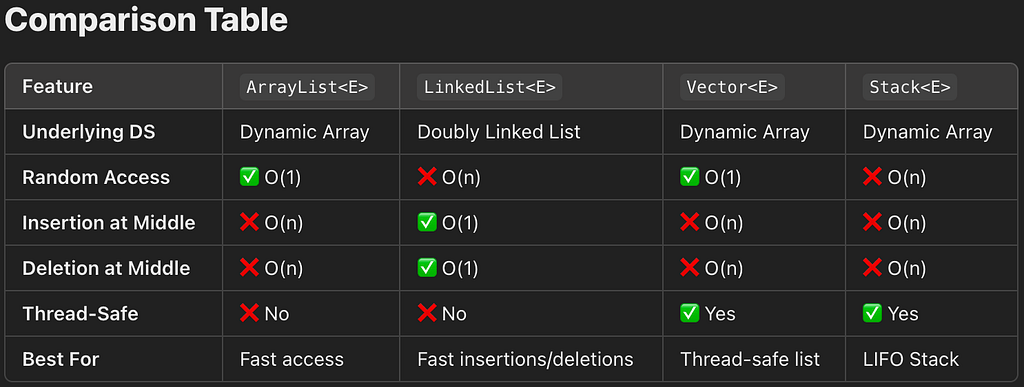
- Use List when order and index-based access are needed.
- Use Set when uniqueness is required.
- Use Queue for FIFO processing.
- Use Deque for both FIFO and LIFO scenarios.
- Use SortedSet when ordering matters.
- Use NavigableSet when you need additional navigation features.
By understanding these interfaces and their implementations, you can make an informed decision about the best data structure for your Java application.
📚 Want to go deeper?
Grab these resources: 🛒 Full Editions (use code FRIENDS20 for 20% off):
Grokking the Java Interview: link
Grokking the Spring Boot Interview: link
250+ Spring Professional Certification Practice Questions: link
🆓 Try before you buy — Free Sample Copies:
Grokking the Java Interview [Free Sample Copy]
Grokking the Spring Boot Interview [Free Sample Copy]
Spring Boot Certification Practice Questions [Free Sample Copy]

Java Collection Interfaces was originally published in Javarevisited on Medium, where people are continuing the conversation by highlighting and responding to this story.
This post first appeared on Read More