
Master agentic AI interviews with hands-on practice. Design autonomous agent systems, reason about tool use and safety, and build real-world AI agent architectures.
Hello friends, uf you’re a software engineer trying to get serious about agentic AI — whether for interviews, for your current job, or just to stay ahead — you’ve probably noticed the same problem I did.
There’s no shortage of AI content online. But most of it falls into one of two useless categories: surface-level explainer articles that stop at “here’s what an LLM is,” or framework tutorials that teach you LangChain syntax without ever explaining why the system is designed that way.
Neither makes you better at building or reasoning about agent systems.
Codemia takes a different approach entirely — and it’s the closest thing to a complete agentic AI learning path I’ve found.
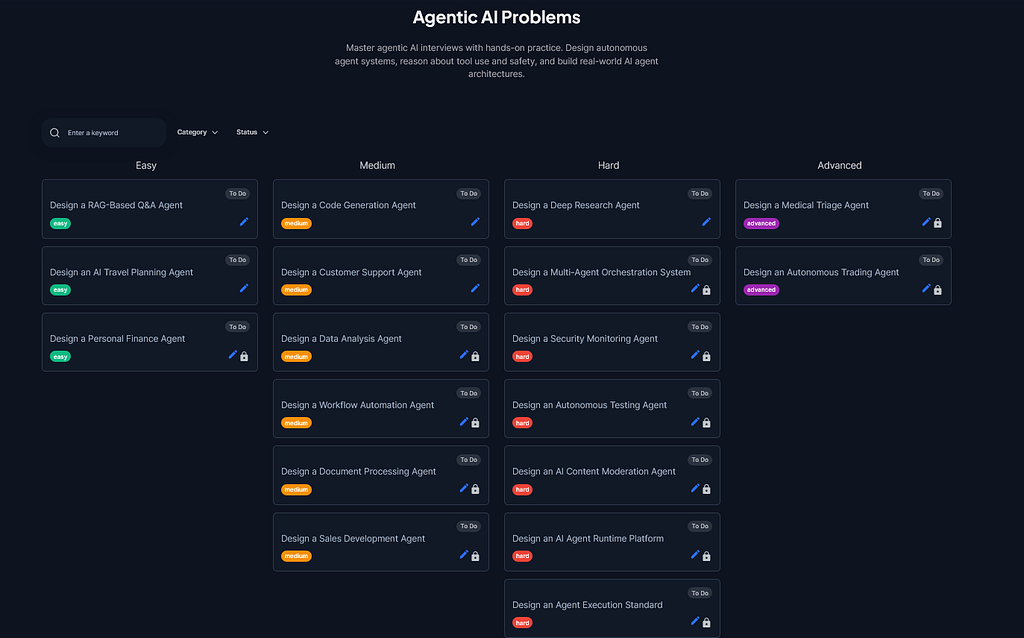
This platform not just provides you the course to learn all the Agentic AI fundamentals and architecture but also provides you real practice problems which you can practice online on their website to build non-trial useful AI agents like a a RAG-Based Q&A Agent, code generation agent, customer support agent, or a personal finance agent.
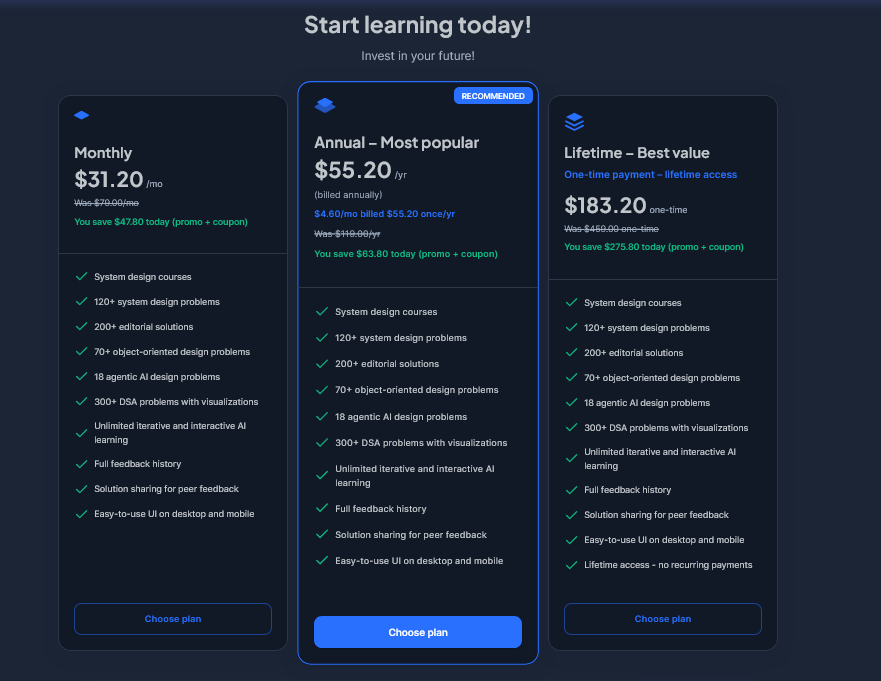
For just $183.20 one-time, you can invest in a resource that will support you every time you face a new Agentic AI challenge, whether it’s for a new job, a promotion, or a personal project.
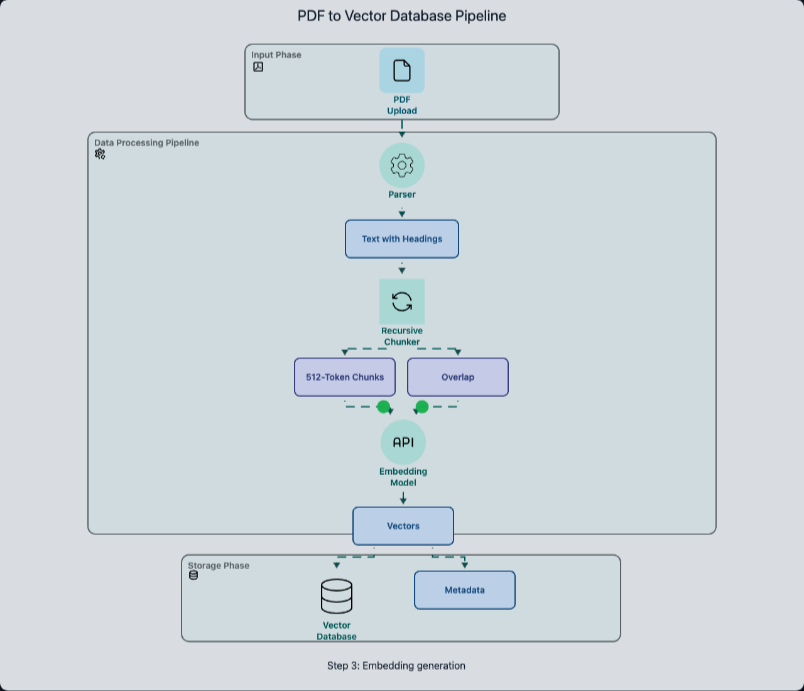
They also provide full editorial solution of many problems like this Design a RAG-Based Q&A Agent, which will teach you a lot of useful concepts related to building AI Agents, RAG pipeline and Agentic AI architecture. This solution is also free and you can see it here
Codemia | Master System Design Interviews Through Active Practice
So, far we have seen how Codemia can help you learn Agentic AI and now we will see why Codemia has the best Agentic AI resource on the Internet
The Problem With Most AI Learning Resources
Most platforms teach you what AI agents are. They show you a demo, walk you through a framework, maybe give you a quiz. You finish feeling like you learned something.
Then someone asks you to design an agent system from scratch — justify your memory architecture, explain how you’d handle tool failures, discuss the trade-offs between a single-agent and multi-agent approach — and you realize the gap between knowing about agents and actually being able to reason about them.
That gap exists because most resources skip the hard part: deliberate practice on real design problems.
Codemia closes that gap by providing both a course which teach you all the basics and a list of practice problems to really master what it take to design an Agentic AI architecture.
Start With the Course: Build the Mental Model First
Before you can practice well, you need a solid foundation. The Introduction to Agentic AI course is where that starts.
Course at a glance:
- Level: Beginner
- Study time: 12 hours
- Lessons: 27
- Quizzes: 414
- Chapters: 8
This course teaches developers the concepts, architectures, and trade-offs behind agentic AI systems.
You will learn how LLMs work under the hood (just enough to make good design decisions), how the agent loop turns a chatbot into an autonomous problem-solver, how memory and retrieval give agents persistent knowledge, and how to design agent systems that are safe, observable, and cost-effective in production.
By the end of this course, you will have the mental models to design, evaluate, and reason about agentic AI systems, whether you are building one, interviewing for a role that involves them, or making architectural decisions about when (and when not) to use agents.
Here is the link to join this course — Introduction to Agentic AI
Codemia | Master System Design Interviews Through Active Practice
What the Course Actually Covers ?
Now, let’s take a close look at what does the course actually covers?
The curriculum is structured as a genuine learning progression — each chapter builds on the last, so by the time you reach multi-agent systems, you have the vocabulary and mental models to understand them properly.
1.Foundation — How LLMs Actually Work ?
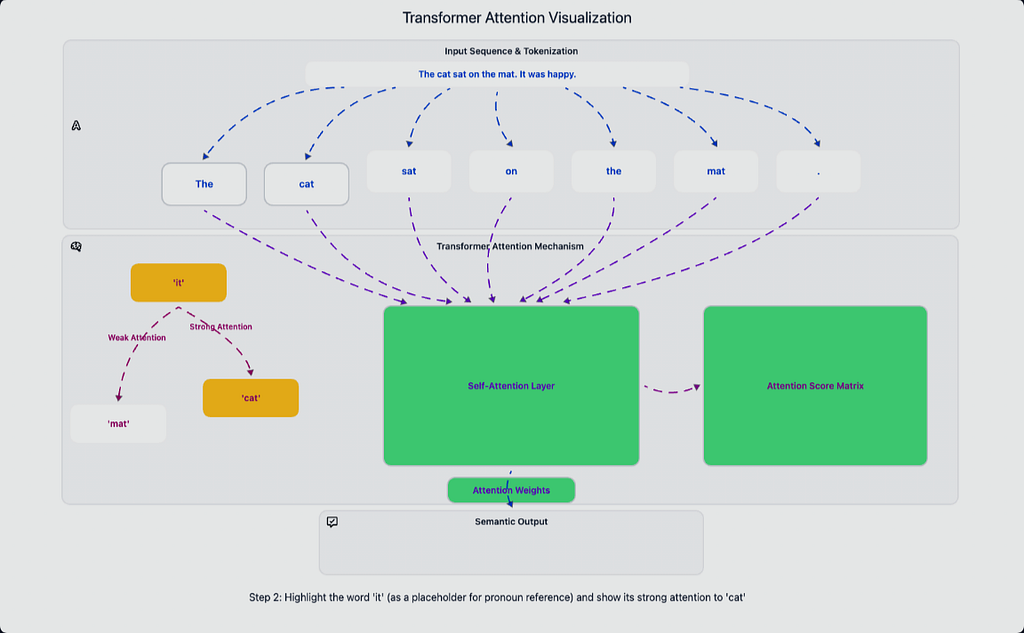
You start with just enough theory to make good design decisions: how transformers generate tokens, what “context window” really means operationally, how to think about model selection and API trade-offs. Not a PhD-level deep dive — a working engineer’s understanding.
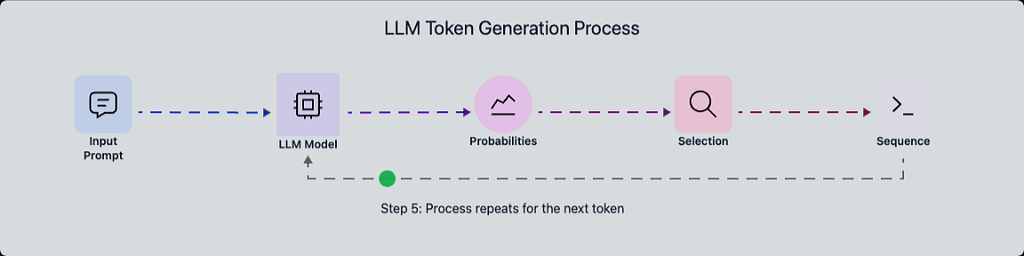
The course is also quite visual and you will find a lot of interesting animation and diagram to truly understand the concepts.
Here is one such example of LLM Token Generation Process:
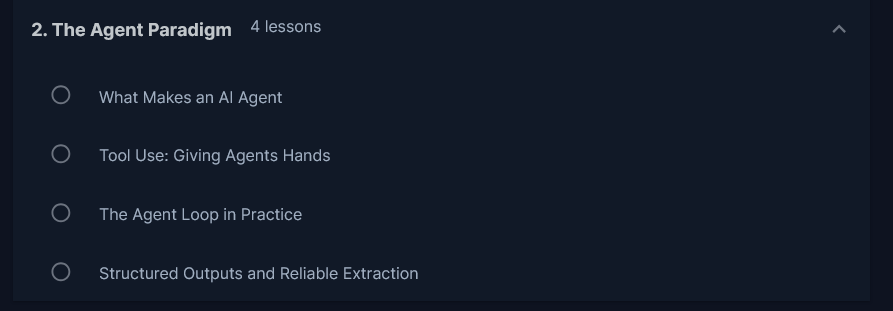
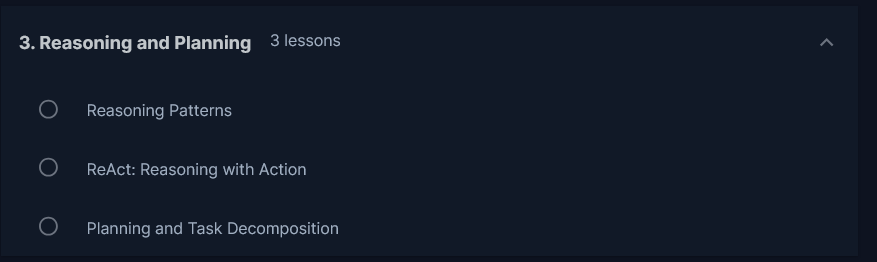
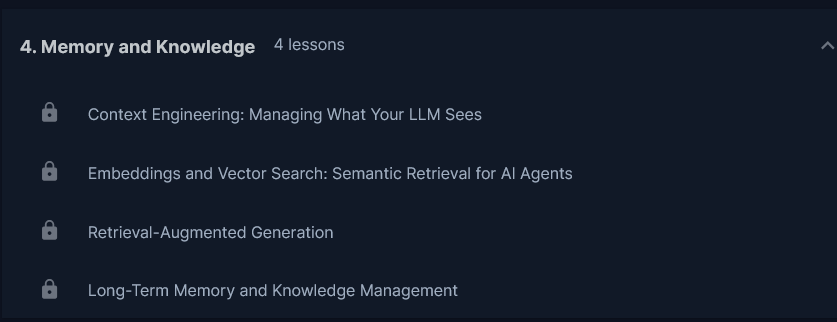
And here is full curriculum, most of these lessons are free, so you can try now here.

2. The Agent Loop — From Chatbot to Autonomous System
This is where the course earns its depth. You learn exactly what transforms a stateless language model into an agent: the loop of perception, reasoning, action, and observation.
You learn how tool use gives agents the ability to interact with the world, how structured outputs make agent behavior reliable, and how the ReAct pattern ties reasoning and action together.
3. Memory and Retrieval — Giving Agents Persistent Knowledge
One of the most misunderstood aspects of agent design. The course covers context engineering (deciding what your LLM actually sees), embeddings and vector search, retrieval-augmented generation, and long-term memory architecture. These aren’t just theoretical concepts — they’re the building blocks you’ll reach for in every serious agent design.
4. Multi-Agent Systems and Human-in-the-Loop Design
Single-agent patterns give way to orchestration: how agents delegate to sub-agents, how to design for human oversight without breaking autonomy, and the critical architectural distinction between agentic workflows and fully autonomous agents.
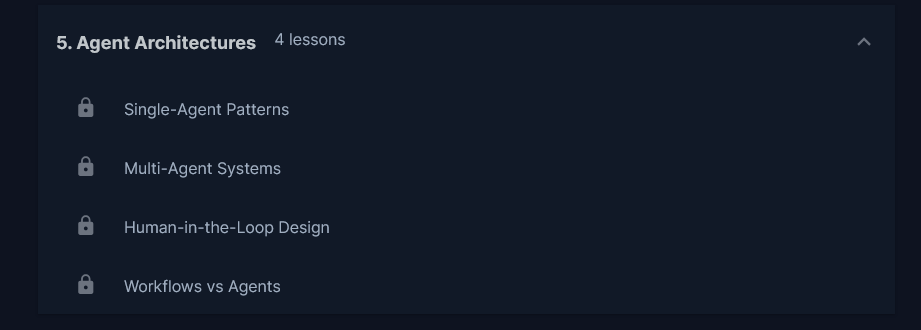
5. Safety, Observability, and Production Concerns
What separates a toy agent from a production system. Prompt injection attacks, sandboxing, output validation, guardrails, cost and latency optimization, error recovery — this is the chapter most courses skip entirely.
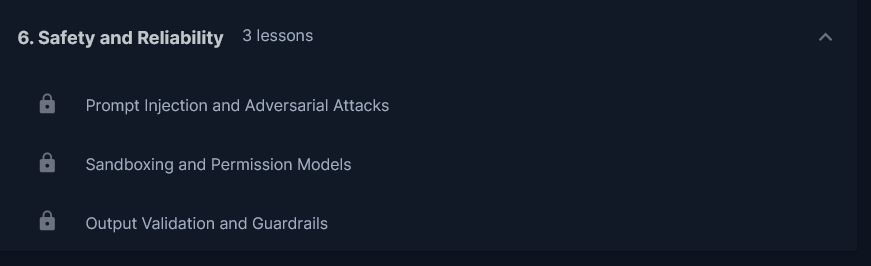
6. Real-World Agent Architectures
The course closes with concrete examples: coding agents and knowledge-work agents, showing how everything covered maps to systems you’d actually build or interview about.
Here is the link to join this course (its FREE) — Introduction to Agentic AI
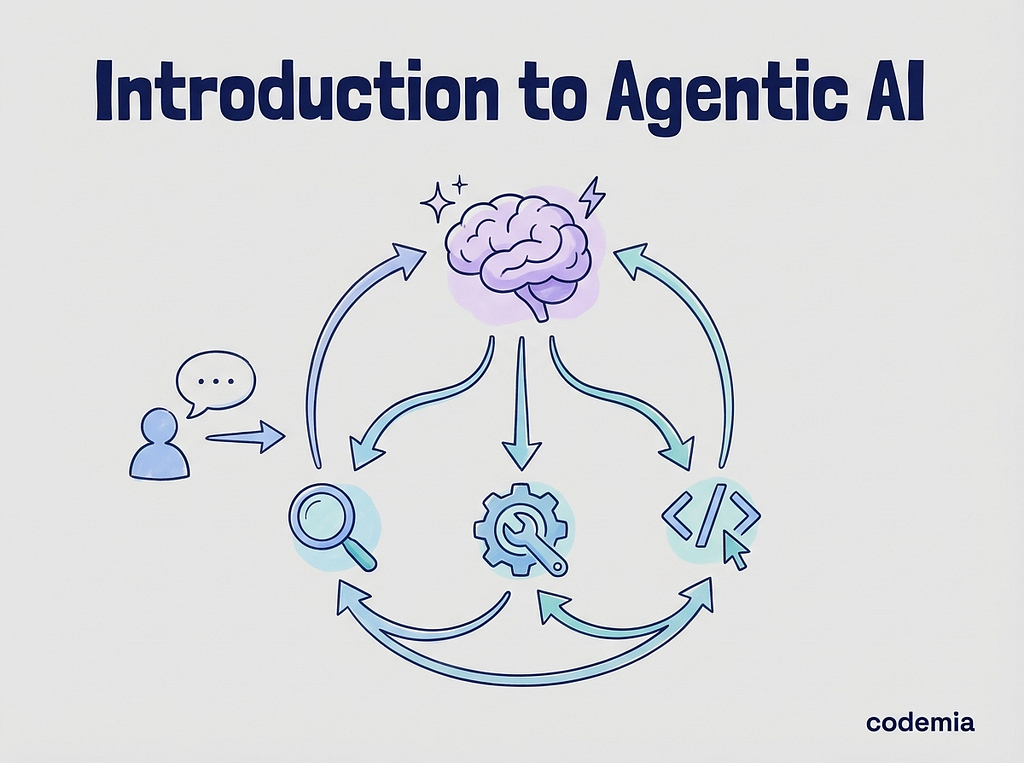
Why the No-Framework Approach Works?
The course deliberately teaches no specific framework — no LangChain, no AutoGen, no Crew. This is a feature, not a gap.
Production agent systems are almost always built with custom orchestration.
Frameworks change. The underlying patterns — the agent loop, memory hierarchies, tool selection strategies, safety layers — don’t.
Learning the principles means you can evaluate any framework clearly, adapt to any stack, and explain your decisions to any interviewer.
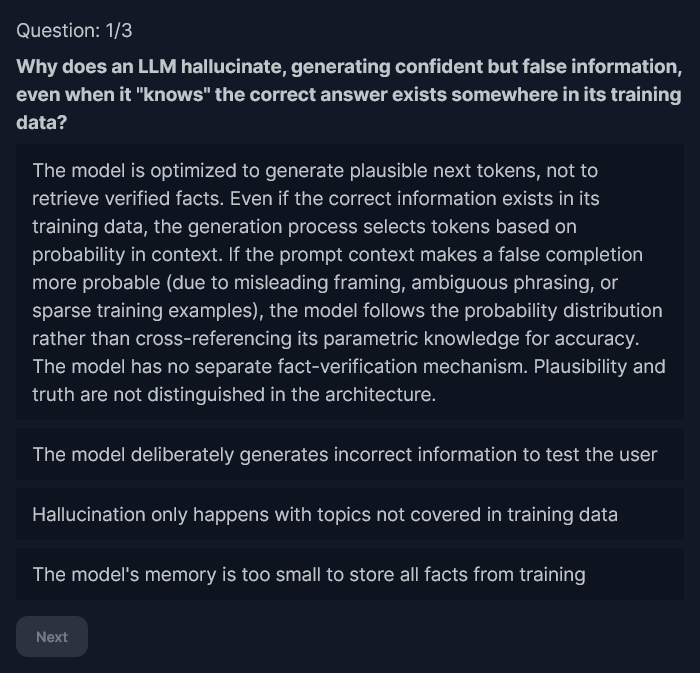
414 quizzes across 27 lessons means you’re not just reading passively. You’re constantly being asked to apply what you just learned — which is exactly how retention actually works.
Here is one such quiz question, see if you can answer it:
Then Practice: Where Real Learning Happens
The course builds your mental model. The Agentic AI practice problems are where that model gets tested, refined, and made durable.
This is the part most platforms skip. And it’s the part that matters most.
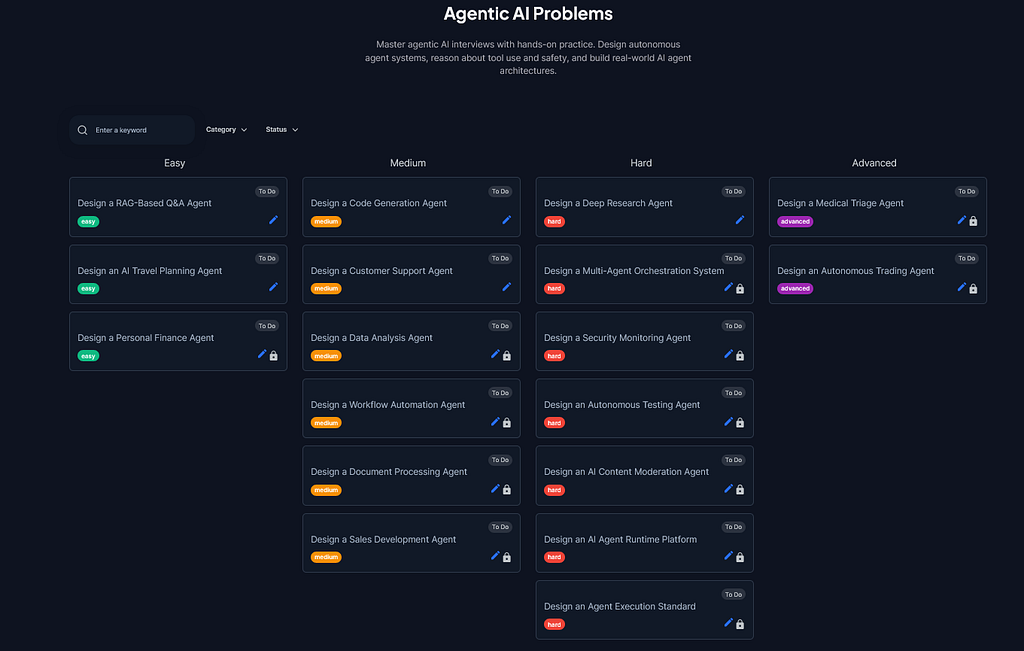
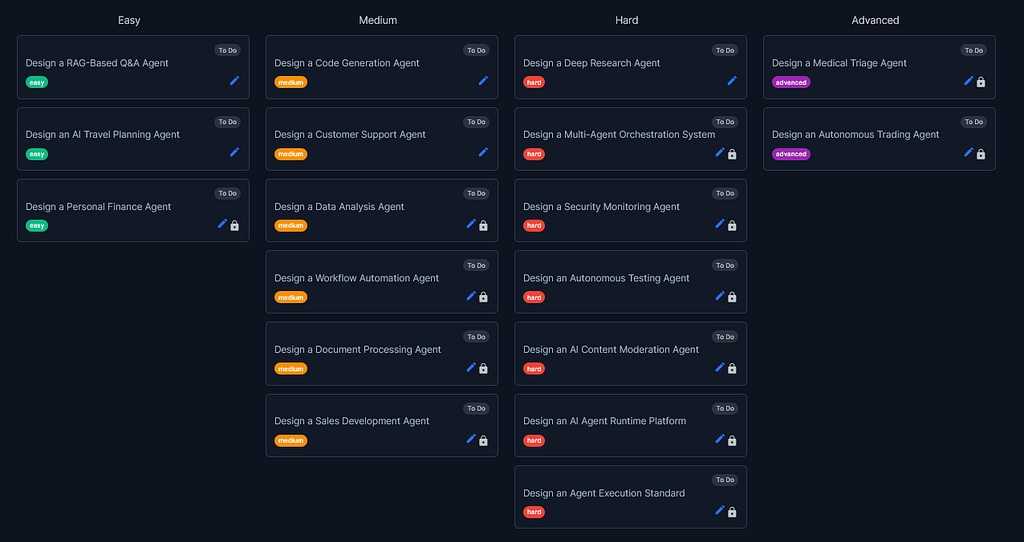
How the Problem Library Is Structured
Problems are organized by difficulty, letting you build genuine competence progressively rather than jumping straight to the hardest challenges before the fundamentals are solid.
Easy — Apply the Basics
Start here after finishing the first few course chapters. These problems force you to apply core concepts — RAG pipelines, tool use, basic agent loops — in concrete design scenarios:
- Design a RAG-Based Q&A Agent
- Design an AI Travel Planning Agent
- Design a Personal Finance Agent
You’ll realize quickly that “easy” doesn’t mean trivial. Designing a good RAG system requires real decisions: chunking strategy, embedding model selection, retrieval approach, hallucination mitigation. Working through these problems cements what the course taught you.
Medium — Handle Real Complexity
Once the foundations are solid, medium problems introduce the trade-offs that make agent design genuinely hard:
- Design a Code Generation Agent
- Design a Customer Support Agent
- Design a Data Analysis Agent
- Design a Workflow Automation Agent
- Design a Document Processing Agent
- Design a Sales Development Agent
Each of these requires you to reason about scope management, tool selection, failure handling, and the boundary between deterministic logic and LLM reasoning. You start developing instincts for when to trust the agent and when to constrain it.
Hard — Production-Grade Systems
Hard problems are where the course’s production-focused chapters pay off. These aren’t toy systems:
- Design a Deep Research Agent
- Design a Multi-Agent Orchestration System
- Design a Security Monitoring Agent
- Design an Autonomous Testing Agent
- Design an AI Content Moderation Agent
- Design an AI Agent Runtime Platform
- Design an Agent Execution Standard
A multi-agent orchestration system, for example, requires you to think through task decomposition, inter-agent communication, failure isolation, observability, and cost management simultaneously. You can’t hand-wave any of it.
Advanced — No Margin for Vagueness
Advanced problems demand the full picture — architecture, safety, ethics, regulation, and real-world constraints all at once:
- Design a Medical Triage Agent
- Design an Autonomous Trading Agent
These are the problems you work toward. If you can design a medical triage agent well — handling uncertainty, maintaining human oversight, reasoning about failure modes in a high-stakes domain — you can handle any agentic AI question a real interview or real project throws at you.
Here is the link to explore all Agentic AI Practice Problems:
Why Course + Practice Together Makes the Difference?
Here’s the thing about agentic AI knowledge: it has a short half-life if you only read about it.
The course gives you the vocabulary and the mental models. But until you try to apply them — until you sit down and actually work through “design a multi-agent orchestration system” — you don’t really know what you know.
The learning loop looks like this:
- Course chapter — learn the concept (e.g., multi-agent systems and task decomposition)
- Easy problem — apply it in a constrained scenario
- Medium problem — apply it with real trade-offs and constraints
- Hard/Advanced problem — defend every decision under pressure
Each pass through a problem reveals gaps the course reading didn’t surface. You go back, re-read a section, and suddenly it clicks differently because now you have a concrete problem it needs to solve.
That back-and-forth between structured learning and hands-on practice is how you move from “I understand this concept” to “I can reason about this clearly under pressure.”
The Broader Platform
Agentic AI doesn’t exist in isolation. Codemia’s full platform covers the adjacent skills that round out a complete interview prep picture:
- System Design — 120+ problems covering distributed systems, storage, messaging, and more
- Object-Oriented Design — class diagrams, design patterns, API design
- DSA — data structures and algorithms for coding rounds
- Mock Interviews — practice with real engineers, not simulated scenarios
Two free courses are worth bookmarking regardless of where you are in your prep: System Design Fundamentals and Tackling System Design Interview Problems. The latter is especially good for building a repeatable approach to any design problem.
See full pricing here — a significant portion of the content is free to start.
The good thing is that they are also offering big discount now.
For just $183.20 one-time, you can invest in a resource that will support you every time you face a new Agentic AI challenge, whether it’s for a new job, a promotion, or a personal project.
👉 Grab Codemia Lifetime Plan — Save $299.80 Today
This is one of those rare investments that pays off every time you interview — and every time you build systems in the real world.
The Bottom Line
That’s all about why Codemia has the best Agentic AI resource on the Internet at the moment. Agentic AI system design is quickly becoming a standard interview topic at companies building AI products — which is most of them.
The engineers who understand it deeply, who can reason about memory architectures and tool selection and safety constraints and multi-agent coordination without reaching for a framework tutorial, will have a real edge.
Codemia’s combination of a rigorous, framework-free course and a structured library of progressively harder practice problems is the fastest path to that kind of understanding I’ve seen.
Start with the free course. Work through the practice problems. Do it in order.
The depth compounds quickly.
All the best with your Agentic AI learning journey !!

Why Codemia Has the Best Agentic AI Resource on the Internet? was originally published in Javarevisited on Medium, where people are continuing the conversation by highlighting and responding to this story.
This post first appeared on Read More