
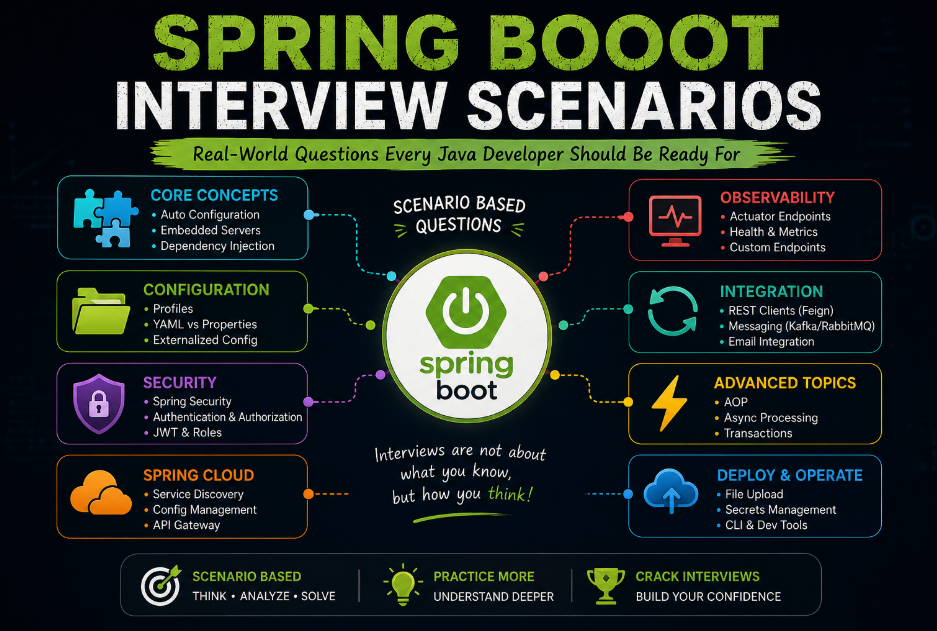
Spring Boot Interview Questions: Real-World Scenarios Every Java Developer Should Be Ready For (Part 2)
In this part, we cover: Spring Cloud, AOP, Dependency Injection, Embedded Servers, Async Processing, Security & JWT Concepts, File Upload APIs, Email Integration, Secrets Management, Spring Boot CLI, and other commonly asked Spring Boot interview topics.
18. What is Aspect-Oriented Programming (AOP) in Spring Framework?
Answer
AOP helps separate cross-cutting concerns from business logic.
Instead of writing logging, security, or transaction code inside every method, we define them once in an Aspect and apply them wherever needed.
This keeps the main business logic clean and maintainable.
Key Takeaway
AOP = Logging + Security + Transactions without polluting business code.
19. What is Spring Cloud and how is it useful for building microservices?
Answer
Spring Cloud provides tools for building and managing microservices.
It helps with:
- Service Discovery
- Configuration Management
- Load Balancing
- API Gateway
- Distributed Tracing
It simplifies communication and management of distributed systems.
Key Takeaway
Spring Cloud is the ecosystem that makes microservices easier to build and operate.
20. How do you get the list of all beans in a Spring Boot application?
Answer
Spring stores all managed beans inside the ApplicationContext.
Using ApplicationContext, we can retrieve all bean names and inspect the Spring container.
Key Takeaway
ApplicationContext acts as the central bean registry.
21. How does Spring Boot decide which server to use?
Answer
Spring Boot checks the dependencies available on the classpath.
If Tomcat is present, it configures Tomcat.
If Jetty or Undertow is present instead, it configures those servers automatically.
Key Takeaway
Classpath dependencies determine the embedded server.
22. How would you practically retrieve all bean definitions from ApplicationContext?
Answer
Inject ApplicationContext and call:
getBeanDefinitionNames()
This returns all bean names registered in the Spring container.
Key Takeaway
ApplicationContext + getBeanDefinitionNames() = Complete bean list.
23. Describe a Spring Boot project where you significantly improved performance.
Answer
Performance improvements can include:
- Connection Pooling
- EhCache
- HTTP Compression
- Stateless Sessions
- Asynchronous Processing
- Monitoring through Actuator
These optimizations reduce response time and improve concurrency.
Key Takeaway
Performance tuning involves improvements at database, application, and network layers.
24. Explain the concept of Spring Boot Embedded Servlet Containers.
Answer
Spring Boot packages web servers such as:
- Tomcat
- Jetty
- Undertow
directly inside the application.
This allows applications to run without installing an external server.
Key Takeaway
Spring Boot applications are self-contained and easy to deploy.
25. How does Spring Boot make Dependency Injection easier compared to traditional Spring?
Answer
Traditional Spring required extensive XML or manual bean configuration.
Spring Boot uses:
- Auto Configuration
- Component Scanning
- Dependency Injection
to automatically discover and wire beans.
Key Takeaway
Less configuration, more focus on business logic.
26. How does Spring Boot simplify management of secrets and sensitive configurations?
Answer
Spring Boot externalizes configuration through:
- Properties Files
- YAML Files
- Environment Variables
- Command Line Arguments
For secure secret management it can integrate with:
- Spring Cloud Config
- HashiCorp Vault
Key Takeaway
Never hardcode secrets inside application code.
27. Explain Spring Boot’s approach to handling asynchronous operations.
Answer
Spring Boot uses @Async to execute tasks in separate threads.
This allows long-running operations like:
- Email Sending
- File Processing
- Report Generation
without blocking the main request thread.
Key Takeaway
@Async improves responsiveness and throughput.
28. How can you enable and use asynchronous methods?
Answer
Steps:
- Add @EnableAsync
- Annotate methods with @Async
- Call methods from another Spring bean
Spring executes the method in a separate thread.
Key Takeaway
@EnableAsync activates asynchronous execution.
29. How would you secure sensitive data accessed by multiple users with different roles?
Answer
I would:
- Implement Authentication
- Implement Authorization
- Encrypt sensitive data
- Store secrets securely
- Maintain audit logs
Each user would have access based on assigned roles and permissions.
Key Takeaway
Authentication verifies identity, authorization controls access.
30. How would you handle file uploads in Spring Boot?
Answer
Create a POST endpoint and accept files using MultipartFile.
The uploaded file can then be stored:
- Locally
- Database
- AWS S3
- Azure Blob Storage
- Google Cloud Storage
depending on requirements.
Key Takeaway
MultipartFile is the standard file upload mechanism.
31. What is the difference between Authentication and Authorization?
Answer
Authentication answers:
Who are you?
Authorization answers:
What are you allowed to do?
Authentication occurs first, followed by authorization.
Key Takeaway
Authentication = Identity
Authorization = Permissions
32. After successful registration, how would you send a welcome email?
Answer
Steps:
- Add Spring Boot Starter Mail
- Configure SMTP details
- Create a Mail Service using JavaMailSender
- Trigger email after successful registration
Key Takeaway
JavaMailSender is commonly used for email integration.
33. What is Spring Boot CLI and how do you execute applications using it?
Answer
Spring Boot CLI allows quick execution of Spring Boot applications using Groovy scripts.
Steps:
- Install CLI
- Create Groovy script
- Execute:
spring run myApp.groovy
Key Takeaway
Spring Boot CLI reduces boilerplate and speeds up prototyping.
34. How is Spring Security implemented in Spring Boot?
Answer
Implementation typically includes:
- Add Spring Security dependency
- Configure security rules
- Implement UserDetailsService
- Use BCryptPasswordEncoder
- Secure endpoints using role-based access
Key Takeaway
Spring Security handles both Authentication and Authorization.
Final Note
These are Questions 18–34 from my collection of 49 Spring Boot interview questions.
Spring Boot is a vast topic and many of these concepts can be explored much deeper. The purpose of these notes is to build interview confidence and provide a quick revision guide for commonly asked interview topics.
Part 3 will cover the remaining Spring Boot interview questions.
Happy Learning!!
Medium: @deepgupt963
LinkedIn: linkedin.com/in/deepakumar0111

Spring Boot Interview Questions: Real-World Scenarios Every Java Developer Should Be Ready For… was originally published in Javarevisited on Medium, where people are continuing the conversation by highlighting and responding to this story.
This post first appeared on Read More