
For years, I believed the path to FAANG interviews was simple: grind LeetCode.
Solve 100 problems. Then 200. Then 300. Eventually, the patterns would click, muscle memory would develop, and I’d be interview-ready.
That’s what everyone said.
But after six months of grinding LeetCode — solving over 300 problems, hitting walls repeatedly, and still struggling with novel problem variations — I realized something:
Volume without structure doesn’t create mastery. It creates burnout.
I wasn’t learning patterns. I was learning to copy-paste solutions and possibly trying to memorize them.
When an interviewer asked a variation I hadn’t seen, I’d panic. I could recognize “this is a graph problem,” but couldn’t think through the approach systematically.
That’s when I discovered AlgoMonster.
AlgoMonster: The Most Structured Way to Prepare for Coding Interviews
The difference was night and day.
Instead of solving 300+ random problems, I learned 20 core patterns deeply. Instead of memorizing solutions, I understood why each approach worked. Instead of grinding endlessly, I solved strategic problems that reinforced core concepts.
Within 8 weeks, my interview performance improved more than the previous six months combined.
Here’s what I learned and why AlgoMonster’s approach fundamentally changed my preparation.
The LeetCode Problem (And It’s Not What You Think)
Let me be clear: LeetCode isn’t bad. It’s a phenomenal resource. Over 3,000 problems. Companies explicitly mention problems appear in interviews. The platform is comprehensive.
But it has a critical flaw for interview preparation: It optimizes for volume, not mastery.
LeetCode says: “Solve more problems, get faster, improve.”
That works if you already understand patterns. But for most people learning, it’s like giving someone a library and saying “read everything.”
The Hidden Cost of LeetCode’s Approach:
- No structure: Problems are tagged by difficulty and company, but not by underlying pattern or learning progression
- Pattern blindness: You can solve 300 problems without understanding the 20 patterns they all use
- False progress: Solving problems fast ≠ understanding deeply
- Time waste: If you’re learning patterns, you don’t need 300+ problems. You need 50 problems that teach 20 patterns
- Interview mismatch: Interviews aren’t about solving many problems. They’re about thinking systematically through novel problems
I was solving problems efficiently but learning inefficiently.
The Paradigm Shift: Pattern-Based Learning
This is where AlgoMonster operates differently.
Instead of asking “Can you solve 300 LeetCode problems?”, it asks: “Do you understand the 20 patterns underlying 90% of interview problems?”
That’s a completely different preparation philosophy.
AlgoMonster’s Core Premise:
Most coding interview questions aren’t unique. They’re variations of a few core patterns:
- Two pointers
- Sliding window
- Fast/slow pointers
- BFS/DFS
- Binary search
- Dynamic programming
- Backtracking
- Prefix sums
- And ~12 others
Once you truly understand these patterns — not just recognize them, but think through them systematically — you can solve novel problems you’ve never seen.
The Math:
- LeetCode: Solve 300+ problems to cover pattern variations (high volume, lower retention)
- AlgoMonster: Master 20 patterns across 150–200 problems (focused learning, high retention)
Same coverage. Dramatically less time. Much better understanding.
If this make sense and you want to join Algomonster , now is the perfect time because they are offering 50% discount on their annual plan, I have the same and it provide best value.
Here is the link to learn more — 50% discount on Algomonster
What Makes AlgoMonster Different?
Here are few things I really love about AlgoMonster:
1. Pattern-First Organization
AlgoMonster organizes by pattern, not by difficulty or company.
You learn:
- Two pointers pattern (understanding, not memorization)
- 10 problem variations of two pointers (reinforcement)
- When to apply two pointers vs. other patterns (strategic thinking)
Then you move to the next pattern.
By the time you finish, you don’t just know patterns. You’ve internalized them. You see a problem and immediately recognize “this is a sliding window problem” before looking at any code.
2. Interactive Explanations
Reading explanations is passive. AlgoMonster uses interactive visualizations.
You can:
- Step through algorithm execution
- See data structures changing in real-time
- Understand why each step matters
- Visualize complex concepts (tree traversal, dynamic programming tables, etc.)
This makes complex patterns visceral instead of abstract.
3. Progress Tracking by Pattern Mastery
LeetCode shows: “You solved 37% of problems.”
AlgoMonster shows: “You’ve mastered two pointers pattern. You’re 60% through sliding window. You haven’t started binary search.”
Massive difference. You know exactly where to focus.
4. Company-Specific Problem Lists
AlgoMonster includes problems explicitly asked by Google, Amazon, Meta, Microsoft.
You can say: “I’m interviewing at Google next month” and get a focused list of Google’s actual interview questions, organized by pattern.
5. Time Efficiency
Here’s the ROI calculation:
- LeetCode: 300–500 problems × 30 minutes average = 150–250 hours
- AlgoMonster: 150–200 problems × 20 minutes average = 50–70 hours
Same pattern coverage. 2–4x faster.
The Strategic Problem Lists (Don’t Skip This)
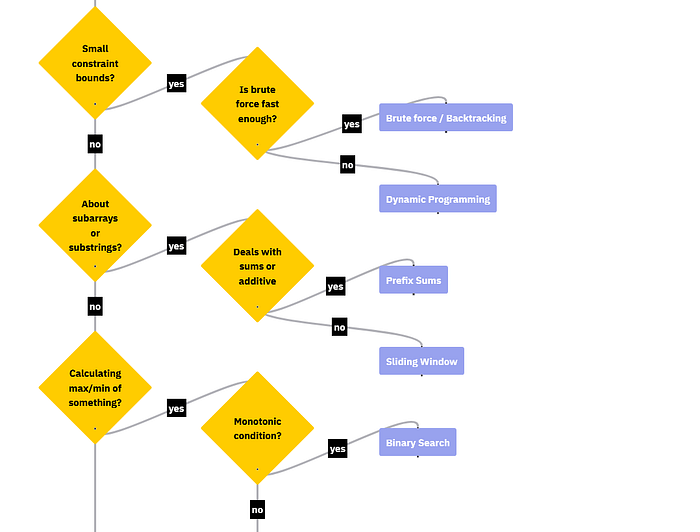
Here’s the key insight: You don’t need to solve all 3,000+ LeetCode problems.
You need to solve the right problems.
Several curated lists exist. These are gold:
Monster 50 by AlgoMonster
If you have limited time: Start here.
50 essential problems covering all major patterns. Designed by Google engineers. Optimized for maximum pattern exposure in minimum time.
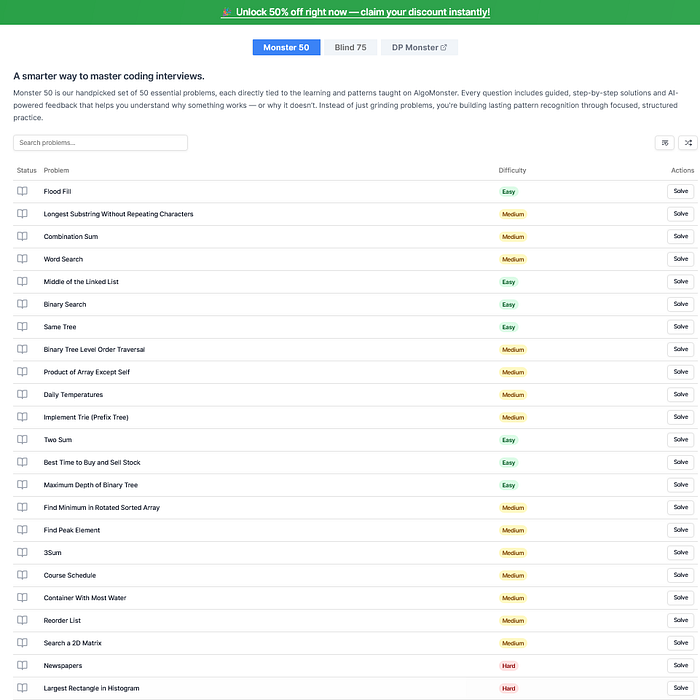
Perfect for: People with 3–6 weeks to prepare
What it covers: All core patterns, company-specific problems, interview-ready problems
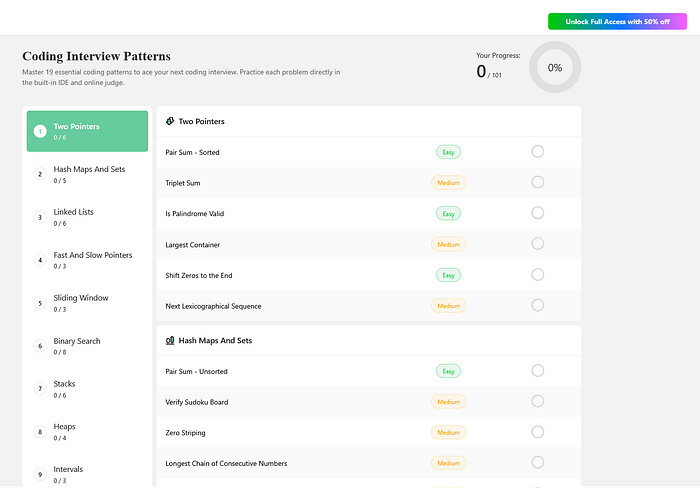
ByteByteGo 101 Coding Patterns
101 curated problems teaching 19 coding patterns systematically.
Perfect for: People wanting comprehensive pattern coverage with system design included
What it covers: Coding patterns + system design patterns in one place
Bonus: ByteByteGo is currently offering 50% discount on lifetime plan — the most complete interview prep platform available.
Blind 75 by NeetCode
The community gold standard. 75 problems covering essential patterns.
Perfect for: Solid preparation, community-vetted problems
What it covers: Core patterns, well-explained solutions, community support
Educative-99
99 guided problems with deep explanations.
Perfect for: Learning-focused, text-heavy explanations preferred
What it covers: Comprehensive pattern coverage, detailed walkthroughs
Educative-99 in Java: Accelerate Your Coding Interview Prep – AI-Powered Learning for Developers
My Honest Comparison: When to Use What
Use LeetCode if:
- You already understand coding patterns
- You want unlimited volume for competitive practice
- You have 3+ months to prepare (grinding can work with time)
- You want a specific company’s problem list
- You prefer solving problems without guidance
Use AlgoMonster if:
- You’re learning patterns for the first time
- You have limited time (weeks, not months)
- You want structured, systematic learning
- You want to understand why solutions work
- You want to maximize learning per hour invested
Use ByteByteGo if:
- You need both coding AND system design prep
- You want pattern-based learning for both
- You want the most comprehensive interview resource
- Current 50% discount makes it unbeatable value
My Recommendation by Timeline:
1–2 weeks: Monster 50 + AlgoMonster
3–4 weeks: Monster 50 + ByteByteGo 101
2+ months: ByteByteGo 101 + LeetCode (company-specific problems)
The Reality Check: What I Actually Experienced
Let me be specific about my improvement:
Before AlgoMonster (6 months of LeetCode):
- Mock interview success rate: ~40%
- Time to approach a new problem: 5–10 minutes (lots of false starts)
- Pattern recognition: Weak (I’d recognize “binary search” but not apply it)
- Confidence in interviews: Low (felt I’d memorized rather than understood)
After AlgoMonster (8 weeks of focused learning):
- Mock interview success rate: ~85%
- Time to approach a new problem: 1–2 minutes (immediate pattern recognition)
- Pattern recognition: Strong (I see problem → immediately identify approach)
- Confidence in interviews: High (I understand the reasoning, not just the code)
The difference wasn’t just numbers. It was thinking clarity.
When interviewers asked follow-up questions like “Can you optimize this further?” or “What if we add this constraint?”, I could reason through it systematically instead of panicking.
That’s the real payoff of pattern-based learning.
The Math on Investment
AlgoMonster is currently offering 50% discount.
Compare the options:
Option Cost Time Pattern Coverage Interview Readiness
LeetCode (grinding) ~$100/year 200–300 hrs Scattered Moderate AlgoMonster (focused) ~$70 (50% off) 50–70 hrs Systematic High ByteByteGo (comprehensive) ~$60 (50% off) 80–100 hrs Systematic + System Design Very High
Both (optimal) ~$130 (50% off each) 100–140 hrs Complete coverage Very High
If a FAANG job pays $200K+, a few hundred dollars on prep is rounding error.
The real comparison is hours saved.
Saving 100+ hours of preparation while improving outcomes? That’s a no-brainer.
Join AlgoMonster with 50% discount
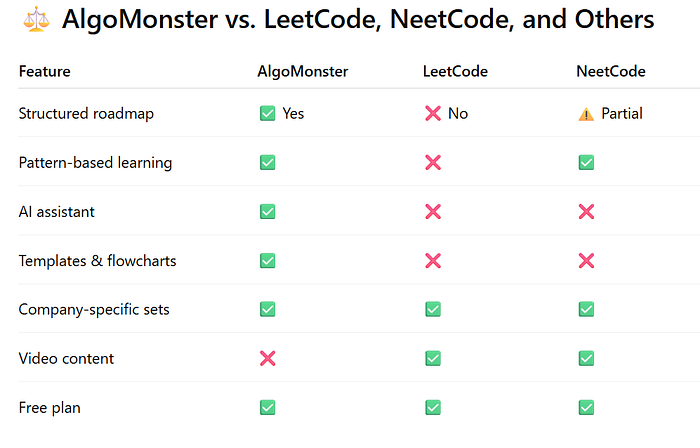
Comparison Chart
Here’s how the major platforms stack up:
Final Thoughts
In 2026, coding interviews reward systematic thinking, not volume grinding.
AlgoMonster optimizes for systematic thinking. LeetCode optimizes for volume. Both have their place, but for most interview preparation, AlgoMonster is the smarter choice.
If you’re serious about FAANG interviews:
- Start with AlgoMonster or ByteByteGo (pattern foundation)
- Use Monster 50 or Blind 75 (focused practice)
- Supplement with company-specific problems (final polish)
- Do mock interviews (communication and thinking clarity)
This strategy gets you interview-ready in 8–12 weeks instead of 6+ months.
Join AlgoMonster (50% OFF) — The most efficient path to coding interview mastery.
Join ByteByteGo (50% OFF) — If you also need system design preparation (and who doesn’t?).
The time to prepare is now. The compound interest on interview readiness is enormous.
P.S. — If you’re serious about cracking FAANG interviews, here’s my complete recipe:
- For Coding Interviews: AlgoMonster (50% OFF) + Monster 50 curated list
- For System Design: ByteByteGo (50% OFF) + their 101 coding patterns
- For Practice: Exponent for mock interviews
This combination covers everything. Give yourself 8–12 weeks, stay consistent, and you’ll be ready.
Good luck with your interviews! 🚀

I Switched From LeetCode to AlgoMonster and Here’s What Happened was originally published in Javarevisited on Medium, where people are continuing the conversation by highlighting and responding to this story.
This post first appeared on Read More