
Java Interview Preparation | System Design | Software Testing
Modern SDET interviews test far more than Java syntax. Learn how to think about scalability, distributed systems, observability, and architectural trade-offs like a senior engineer.

Five years ago, senior SDET interviews were largely about frameworks, Java syntax, and Selenium.
Today, interviewers are just as likely to ask you to design a distributed execution platform, explain how you’d observe failures in a microservice architecture, or reduce a four-hour regression suite to thirty minutes.
That’s a fundamentally different interview.
Senior SDET interviews increasingly focus on system design. Interviewers want to know how you would execute 10,000 tests a day, generate reliable test data across hundreds of parallel workers, observe failures in distributed systems, and build automation that scales with modern cloud-native applications.
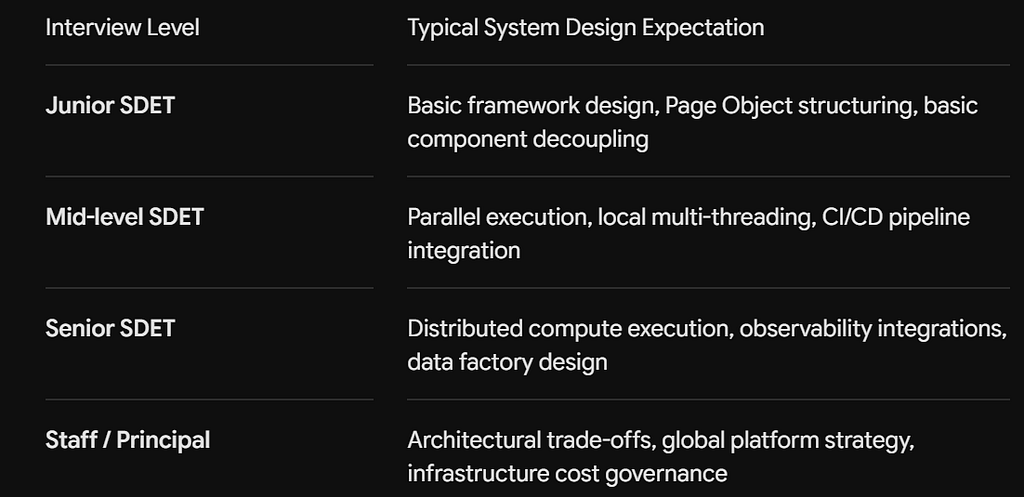
This article covers fifteen system design questions that experienced Java SDETs should be prepared to discuss, along with the architectural thinking, real-world constraints, and structural trade-offs behind strong answers.
How to use this guide
Don’t try to memorise these answers. In an interview, the goal isn’t to reproduce a perfect architecture from memory. It’s to demonstrate how you reason about trade-offs, scalability, reliability, and operational constraints. Use these questions as practice scenarios, not scripts
Part 1: Designing for Scale
1. How would you design an automation framework that executes 10,000 tests every day?
The Core Problem: Running 10,000 end-to-end tests sequentially is operationally impractical. If a test suite takes an average of 30 seconds per test, running them back-to-back requires over 83 hours of continuous execution time.
Questions I’d Ask the Interviewer First: * What types of tests make up these 10,000 executions (e.g., UI, API, or visual integration)?
- What is the target release cadence — continuous deployment per commit or nightly regressions?
How to Structure Your Answer
In an interview, I wouldn’t jump straight into drawing infrastructure boxes. I’d first explain that a scalable system requires building an elastic orchestration pipeline divided into four clear areas:
- Test distribution: Moving away from localized machine resources and introducing a persistent task queue.
- Environment isolation: Preventing parallel task workers from corrupting shared data states.
- Failure recovery: Ensuring network blips or unhandled worker crashes do not invalidate a multi-hour suite pass.
- Asynchronous reporting: Moving execution logs outside the main test execution thread pool.
[ GitHub Actions Pipeline ]
               │
               ▼
       [ Test Scheduler ]
               │
               ▼
   [ RabbitMQ / Kafka Queue ]
         │     │     │
   ┌─────┴─────┼─────┴─────┐
   ▼           ▼           ▼
[Worker 1]  [Worker 2]  [Worker 3] (Ephemeral Pods)
   │           │           │
   └───────────┼───────────┘
               ▼
       [ Kafka Event Topic ]
               │
               ▼
     [ Reporting Dashboard ]
Detailed Architecture
In an interview, I’d explain that I wouldn’t run this via localized JVM multi-threading on a single massive machine. Instead, I would design a decoupled, queue-driven worker architecture. The CI system triggers an internal scheduling service that parses the target test metadata and publishes individual test tasks as independent messages to a durable queue like RabbitMQ or Kafka.
A dynamic cluster of ephemeral, auto-scaling worker nodes (managed as Kubernetes pods) consumes these tasks concurrently. Each worker node runs an isolated instance of a custom Java test runner that processes one task at a time, pointing to separate, isolated environments. Workers emit lifecycle execution events to a backend message stream, allowing a downstream consumer service to update an executive dashboard asynchronously.
Trade-offs:
- Pros: Reliable horizontal isolation; predictable auto-scaling; structural resilience if single containers crash.
- Cons: Higher cloud infrastructure bill; container cold-start overhead; message broker synchronization complexity.
💡 Common Mistake: “I would just configure a TestNG XML suite with thread-count=”200″ and run it on a high-spec Jenkins agent machine.” (This causes massive thread contention and out-of-memory errors on the host.)
What Interviewers Are Looking For: They want to see that you treat a test runner as a distributed worker system rather than an isolated code script.
2. How would you design a scalable Selenium or Playwright Grid?
The Core Problem: Static, always-on browser grids experience performance degradation due to browser memory leaks, hanging driver processes, and unfair CPU thread allocation across sibling test runs.
Questions I’d Ask the Interviewer First:
- Are we testing predominantly against Chrome, or do we require comprehensive cross-browser coverage?
- Do we need video recordings saved for every execution, or just on failures?
How to Structure Your Answer
- Dynamic node provisioning: Generating clean browser execution contexts on demand.
- Lifecycle container sanitization: Forcing node destruction immediately post-test.
- Resource boundaries: Setting explicit hardware requests to avoid host starvation.
Detailed Architecture
I’ve learned the hard way that persistent browser containers eventually stall. I once saw a full suite freeze mid-run because dozens of orphan driver processes accumulated on a static host, exhausting the shared memory space (/dev/shm).
To pitch this in an interview, propose an elastic, containerized browser cluster inside Kubernetes using an autoscaler like KEDA. When a Java test client initializes a remote driver session, a proxy router intercepts the network request. The autoscale controller monitors the queue depth and provisions an ephemeral browser container on demand. The test runs inside its own sandbox. When the test calls driver.quit(), the browser container is terminated, wiping out all memory allocations and residual states before the next test can execute.
Trade-offs:
- Pros: No cross-test state leakage; predictable browser baseline performance.
- Cons: Slight session startup delay; image registry maintenance overhead for browser version matrices.
💡 Common Mistake: “I would provision five large cloud instances and keep 50 persistent browser containers active on each.”
What Interviewers Are Looking For: They are verifying if you treat browsers as volatile, volatile resources that must be isolated and recycled aggressively.
3. Your CI pipeline must finish within 30 minutes. What would you redesign?
The Core Problem: As platforms expand, test suites grow, turning a vital validation safety net into an expensive delivery bottleneck.
Questions I’d Ask the Interviewer First:
- How many developer commits enter the branch per day?
- What percentage of our current execution runtime is spent on UI tests versus lightweight API checks?
How to Structure Your Answer
- Intelligent sharding: Partitioning files based on historical execution timing data.
- Impact analysis models: Isolating and executing only tests linked to the modified packages.
- Pipeline phase splitting: Shifting non-critical, slow verification blocks to async post-merge runs.
[ Developer Pull Request ]
                   │
                   ▼
       [ Change Impact Engine ] (Custom AST / Git Diff tool)
                   │
        ┌──────────┴──────────┐
        ▼                     ▼
[ Affected Impact Suite ]   [ Skipped Test Suites ]
        │
   ┌────┴──────────────────────────┐
   ▼                               ▼
[ Shard A: Run Time 12m ]   [ Shard B: Run Time 11m ]
Detailed Architecture
The solution isn’t just to throw money at compute power. I’ve seen teams double their CI infrastructure spend only to discover that shared test data conflicts, not compute power, was the real bottleneck slowing down parallel executions.
In an interview, I’d explain how to implement a pre-execution change impact analysis step using Git diff or Abstract Syntax Tree (AST) parsing tools. If a pull request only alters an internal invoicing package, the system programmatically skips unrelated UI flows and targets only invoice and core contract paths. For the tests that must run, the pipeline queries a historical runtime database, balancing tests across parallel shards so that each node takes approximately the same amount of time to finish.
Trade-offs:
- Pros: Short developer wait times; optimized cloud compute utilization.
- Cons: Complex dependency map code management; risk of missing edge-case bugs if the change-impact graph drifts out of sync.
- What Interviewers Are Looking For: They want to see that you don’t treat all tests equally, using risk-based prioritization and optimization instead of brute-force parallelization.
4. How would you test resilience when services fail unexpectedly?
The Core Problem: Classic automated tests validate stable, happy-path scenarios, failing to confirm how an architecture handles network drops, slow databases, or sudden container crashes.
Detailed Architecture
I wouldn’t draw every architecture component here unless asked. Instead, focus on demonstrating how you integrate automated chaos injection into your test execution workflows.
Your automation framework can connect natively with open-source chaos engines like Chaos Mesh or LitmusChaos through programmatic REST clients. For example, your test script initiates a standard checkout action. While the request is active, the test runner fires a concurrent background API call to the chaos engine to inject 5000ms of latency into the payment microservice, or abruptly terminate the active replica database pod. The test then asserts that the application’s circuit breaker patterns (like Resilience4j definitions) trip instantly, connection pools drop back safely, and a user-friendly fallback state handles the request cleanly without dropping transactions.
Trade-offs:
- Pros: Exposes catastrophic distributed failure modes early in a safe sandbox.
- Cons: Running chaos mutations in shared integration spaces can create false-positive breakages for sibling engineering teams.
5. How do you prevent third-party API rate limits from breaking your test suite?
The Core Problem: Running large-scale automation against live external sandboxes (like Stripe or Twilio) triggers HTTP 429 rate-limiting blocks, drives up vendor bills, and introduces brittle network dependencies.
Detailed Architecture
In an interview, I’d explain how to use service virtualization to isolate the microservices under test from the outside world. Route all outbound application traffic during testing through localized sidecar mock containers like WireMock or Hoverfly.
Configure your Java microservices’ environment profiles to direct external traffic away from real sandboxes. By matching production latency profiles inside the mock headers, your local proxy handles outbound traffic seamlessly. This approach also allows you to test hard-to-reproduce errors — like a network timeout mid-handshake — which real public staging sandboxes often block you from simulating.
Trade-offs:
- Pros: Fast execution loops; zero sandbox transaction fees; highly deterministic responses for tricky edge cases.
- Cons: Mock drift occurs if the third-party changes their payload schemas without notifying your platform team.
💡 Common Mistake: “We can just add a global retry mechanism or back-off logic whenever we hit a 429 error.” (This chokes pipelines and makes execution times unpredictable).
Part 2: Managing Data and State
6. How do you test asynchronous Kafka workflows without using Thread.sleep()?
The Core Problem: Event-driven microservices do not return immediate HTTP responses. Relying on hardcoded wait statements makes tests brittle and inflates pipeline run times.
Detailed Architecture
I remember inheriting a suite where over 20% of execution time was spent on static Thread.sleep() buffers. We saved hours of pipeline latency simply by switching to an asynchronous polling mechanism.
In a system design interview, explain how you would introduce a library like Awaitility or design a custom polling loop that evaluates a given condition at explicit intervals (e.g., poll every 200ms with a max timeout of 5 seconds). The test thread immediately unblocks the moment the state becomes valid.
// Production-grade async assertion instead of structural sleep blocks
Awaitility.await()
    .atMost(5, TimeUnit.SECONDS)
    .pollInterval(200, TimeUnit.MILLISECONDS)
    .until(() -> database.getOrderStatus(orderId) == Status.PROCESSED);
Trade-offs:
- Pros: Optimizes test performance by matching the true physical latency of the microservice; eliminates flake caused by environment slowdowns.
- Cons: Requires a deep understanding of downstream state mutation boundaries.
7. How would you generate reliable test data for hundreds of parallel executions?
The Core Problem: Parallel workers modifying the same global pool of static entities (like a shared test_user account) will collide, leading to optimistic locking exceptions and false test failures.
[ Worker Thread 1 ] ──► Updates Account balance  ┐
                                                        ├─► [ Collide / Lock Error ]
       [ Worker Thread 2 ] ──► Deletes Account profile  ┘
Detailed Architecture
Design an insulated Multi-Tenant State Factory pattern. Instead of using static data sheets, the automation framework targets a dedicated state creation endpoint before every execution cycle. The factory generates unique runtime records containing random alphanumeric strings or unique UUID identifiers.
If your application interacts with a single relational database cluster, use programmatic transaction controls. Have your test fixtures launch execution paths inside distinct database savepoints, issuing a clean rollback command during the teardown block to ensure zero persistent data pollution.
Trade-offs:
- Pros: Complete parallel safety; no test-to-test data leakage.
- Cons: Increased data insertion overhead can slow down individual test setups.
💡 Common Mistake: “I would just reset the database using a script before every test suite pass.” (This completely kills your ability to run parallel test suites across multiple CI pipeline workers).
8. How would you validate a distributed payment workflow?
The Core Problem: Distributed financial transactions rely on asynchronous saga orchestration. If a step fails halfway through, the system must reverse previous operations to prevent data corruption.
Detailed Architecture
Explain that you would look for edge cases across system boundaries rather than validating simple happy-path UI pages. Design your automation framework to submit duplicate payment payloads with identical transaction tokens inside a tight, sub-millisecond window. This validates that the system’s idempotency filtering layer correctly flags and drops duplicate requests safely.
To test saga reconciliation, configure your test harness to instruct a virtualized downstream mock (like the inventory service) to return a sudden failure payload after the billing service has already successfully authorized a charge. The automation framework then asserts that a compensation workflow fires, reversing the initial billing authorization to maintain ledger consistency across services.
9. How would you detect resource leaks caused by automated tests?
The Core Problem: Running thousands of automated steps can mask lingering background leakages, such as orphaned webdrivers, open database connections, or unclosed file streams.
Detailed Architecture
In an interview, focus on tracking test lifecycle boundaries. Explain how you would write a custom JUnit 5 extension or global listener that executes after every class run.
This extension interfaces directly with internal component telemetry metrics — such as checking the active pool count of your HikariDataSource. If the count fails to return to baseline when a test finishes, the framework automatically logs a leak signature. Additionally, instrument your runner containers with JVM metrics tracking tools (like Micrometer) to feed memory allocation charts into an executive dashboard, making it obvious if your memory footprint climbs continuously run-over-run.
10. How would you test cache consistency across multiple regions?
The Core Problem: Globally distributed environments duplicate database caches (like regional Redis clusters) to cut down latency. Slow replication intervals can cause split-brain states where users read outdated data.
Detailed Architecture
Propose a multi-threaded validation loop within your Java framework. The runner initiates a direct write configuration change through an API endpoint explicitly routed to the primary region’s server cluster.
Instantly, the framework fires multiple parallel thread calls targeted directly at secondary regional cache read endpoints. Your test asserts that either the regional cache boundaries successfully drop their stale states inside a strict SLA window, or the application code correctly routes traffic around the replication delay to fetch clean data from the master node.
Part 3: Observability and Reliability
11. How would you identify genuinely flaky tests?
The Core Problem: Relying on standard framework retries hides legitimate code regressions, inflates resource run costs, and ruins engineer trust in CI pipeline stability indicators.
[ Test Failure Event ] ──► [ Extract Stack Trace + Logs ]
                                  │
                                  ▼
                    [ Failure Clustering Service ]
                                  │
         ┌────────────────────────┴────────────────────────┐
         ▼                                                 ▼
(Signature matches previous logs)               (New unique error log pattern)
         │                                                 │
         ▼                                                 ▼
[ Cluster A: Shared DB Conflict ]               [ Flag Unique Code Regression ]
         │                                                 │
         ▼                                                 ▼
   (Auto-Quarantine Test)                       (Block Pipeline Branch)
Detailed Architecture
Reject basic retry loops completely in your answer. Instead, describe a data-driven approach: build a central telemetry service that captures the exact footprint of every test failure — including stack trace logs, container specs, active sibling execution threads, and server-side CPU utilization profiles.
Run an internal clustering service that groups failure logs by matching trace footprints. If a test case breaks occasionally with an unhandled exception, and the tracking service notices it only happens when a resource-heavy job runs on the same database node, you can flag it as an infrastructure data-contention problem rather than an application bug. If a test’s individual health baseline drops below a certain SLA (e.g., failing 5% of runs over a week with no code changes), an automated script tags it with a @Quarantine annotation, separating it from blocking delivery runs until fixed.
Trade-offs:
- Pros: Clear, actionable data on pipeline instability; protects the integrity of your merge gates.
- Cons: Requires dedicated development time to build and scale a central log-tracking data store.
12. How would your automation use distributed tracing?
The Core Problem: In microservice systems, a single end-to-end user transaction can touch dozens of independent service boundaries. A generic HTTP 500 error returned to a test runner contains no actionable context for debugging.
Detailed Architecture
Explain how you would hook your Java HTTP client engines (such as RestAssured or WebClient configurations) directly into your platform’s OpenTelemetry context propagation fields.
The automation framework should programmatically generate and append unique tracing metadata headers (traceparent or X-B3-TraceId) to every outbound call. When an assertion fails, the framework extracts that active trace ID inside the teardown block and uses a REST client to query the tracing backend (like Jaeger or Zipkin). It then injects the downstream waterfall span logs directly into your test’s failure output, providing developers with a straight line to the exact service and line of code that triggered the error.
13. How would you build useful failure reports?
The Core Problem: Traditional text logs or standalone browser screenshots fail to capture the holistic state of a distributed system at the exact millisecond a validation step fails.
┌─────── Failed Test Artifacts ────────┐
                    │                                      │
[ Timeline Sync ] ──┼──► [ UI Screencast / Screenshot ]    │
                    ├──► [ Local Browser HAR Network Logs ]│
                    └──► [ Core Server Side Micro-Logs ]   │
                                                           │
                                                           ▼
                                            [ Consolidated Report Dashboard ]
Detailed Architecture
In an interview, outline a time-synchronized aggregation model. Explain that your framework shouldn’t just record stack traces. Instead, it should aggregate and stitch client-side browser console warnings, network HAR logs, and server-side container log streams together into a single, unified view.
Instead of outputting isolated, individual HTML sheets on a build agent, publish these artifacts to a central reporting dashboard. This gives engineers an interactive, step-by-step timeline of the execution pass, showing exactly what was happening across the frontend network layer alongside corresponding backend server errors at the precise moment a validation failed.
14. How would you design contract testing between microservices?
The Core Problem: Spinning up full, live end-to-end multi-service environments just to check basic API payload changes is slow, expensive, and catches schema updates way too late in the development lifecycle.
[ Consumer Service Pipeline ] ──► Generates Contract File (JSON) ──► [ Pact Broker ]
                                                                           │
                                                                           ▼
[ Provider Service Pipeline ] ◄── Validates Code Against Contract ◄────────┘
Detailed Architecture
Propose a consumer-driven contract testing model using a tool like Pact. The team managing the client microservice maps out their explicit request payload and schema response expectations inside localized Java test fixtures. Running these generates a contract configuration JSON file that is automatically uploaded to a central Pact Broker.
When the downstream producer service triggers its own independent build, a custom step pulls down these saved contracts. The contract runner fires those explicit request specifications directly against the provider’s local code instance and asserts that the actual output strictly satisfies the consumer’s expectations. This allows you to guarantee backward compatibility and catch breaking API schema changes locally, without ever deploying a single live downstream dependency.
15. How would you modernize a legacy automation framework?
The Core Problem: Attempting to pull off a “big-bang” rewrite of a massive legacy testing repository slows down feature development, creates messy merge branches, and rarely delivers sustainable value.
Detailed Architecture
Explain that you would deploy a modernization process based on the Strangler Fig pattern. Instead of changing all files at once, write a clean abstract driver wrapper interface directly between your high-level test scripts and your underlying execution libraries:
Java
public interface BrowserDriver {
    void navigateTo(String url);
    void clickElement(String locator);
}
Implement your updated execution drivers (like modern, asynchronous Playwright configurations) underneath this stable interface line. Use an environment runtime toggle to selectively branch execution. You can migrate your high-value smoke suites first, letting the old framework paths continue to handle legacy flows until they are naturally deprecated. This isolates migration risks and keeps your automation suites running smoothly without disrupting active product releases.
Common Mistakes Candidates Make in System Design Interviews
- Jumping Straight into Code Instead of Architecture: Writing low-level Java code snippets or detailing page elements when asked about massive system scale signals a lack of systemic, architectural perspective.
- Assuming Unlimited Infrastructure: Designing grids and pipelines that assume unlimited cloud compute budgets without factoring in resource constraints, network bounds, and cloud billing ceilings.
- Forgetting System Observability: Failing to incorporate trace propagation, distributed log harvesting, and systemic metrics tracking directly into the core design of your test frameworks.
- Treating Flakiness as a Fact of Life: Masking environment hiccups or timing errors behind endless automatic retry layers instead of using data telemetry to identify and isolate the root cause.
- Over-Engineering Abstractions Early: Introducing complex distributed systems and microservice layers for a small startup architecture where a clean, single-node parallelized framework is the practical choice.
Final Thoughts
Every system design interview is different. One interviewer might ask you to redesign a Selenium Grid, another might ask how you’d handle flaky tests or asynchronous messaging. The technologies change, but the underlying skill doesn’t.
Strong SDETs think beyond tools. They think about isolation, scalability, observability, failure recovery, and trade-offs. If you can explain those clearly, you’ll usually have a much stronger interview than someone who simply remembers more APIs.
The strongest senior SDETs don’t think in terms of Selenium commands or Java syntax. They think in terms of systems.
They ask where bottlenecks will appear, how failures will be observed, how test data will be isolated, and what happens when the happy path disappears. That’s ultimately what system design interviews are measuring. They’re not testing whether you can draw neat boxes on a whiteboard. They’re testing whether you’ve spent enough time building automation at scale to understand why those boxes exist in the first place.

Top 15 Java System Design Questions Asked in Senior SDET Interviews was originally published in Javarevisited on Medium, where people are continuing the conversation by highlighting and responding to this story.
This post first appeared on Read More