
Canonical is now a Gold Sponsor of the Trifecta Tech Foundation, a non-profit focused on keeping critical infrastructure software memory-safe. The new backing comes with a yearly €40,000 contribution, meant to fund continued work on memory-safe system utilities written in Rust.
Trifecta Tech Foundation operates projects across three areas: data compression, time synchronization, and privilege boundaries. sudo-rs is its best-known output so far, but the foundation also works on zlib-rs and several other Rust rewrites most Linux users never think about.
Don’t think that Canonical just started contributing to the foundation; it has been a backer since 2025, co-sponsoring the development of sudo-rs, and as you already know, that collaboration paid off.
It became Ubuntu’s default privilege escalation tool in 25.10 and carried over into 26.04 LTS a few months later.
The sponsorship is a bigger step in the same direction, part of what Canonical once called an effort to go “carefully but purposefully oxidising Ubuntu.” Coreutils, findutils, diffutils, and sudo have already been swapped for Rust alternatives. That leaves time synchronization as the next frontier.
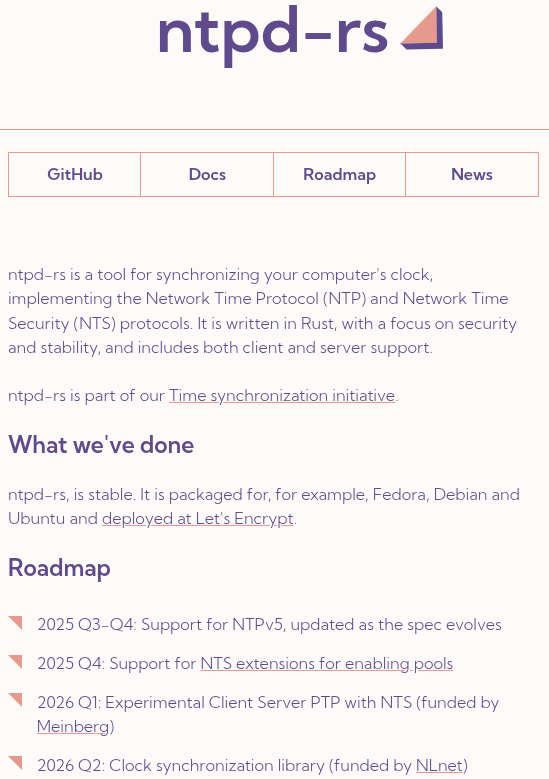
The current phase of their partnership is moving to ntpd-rs, the Rust rewrite that Canonical wants to make Ubuntu’s default time synchronization client and server.
What do Ubuntu users get out of this?
Fewer memory-safety bugs in a piece of software every Ubuntu install relies on to keep its clock, and by extension its TLS certificates, in sync with the rest of the internet.
ntpd-rs isn’t an untested experiment either. Jon Seager, the VP of Engineering at Canonical, points out that it has already been running in production at Let’s Encrypt since June 2024, following a staging rollout that started two months earlier.
Trifecta is also developing Statime, a memory-safe implementation of the Precision Time Protocol (PTP), with a plan to build its capabilities directly into ntpd-rs.
Canonical’s funding also covers feature-parity work. That includes GPSd IP socket support, multi-threading for NTP servers, and support for multi-homed server setups, closing gaps that currently exist between ntpd-rs and chrony.
For more specialized deployments, the funding also covers gPTP support, useful for automotive and connected vehicle use cases, along with experimental support for the proposed Client-Server PTP protocol.
Security is an area of focus too, with work being done to build AppArmor and seccomp profiles for ntpd-rs, matching the isolation chrony already gets. Along with support for rustls to fall back on OpenSSL as a crypto provider for organizations with strict compliance policies.
When to expect?
Canonical is targeting Ubuntu 26.10 as the first real milestone, including ntpd-rs in the archive so people can start testing it.
Followed by the bigger goal of introducing ntpd-rs as the default time synchronization tool for Ubuntu in the 27.04 release next year. For you as a regular desktop user, not much will change; this looks to be focused more on sysadmins than anyone else.
Suggested Read 📖: sudo vs. sudo-rs, Which One is For You?

This article first appeared on Read More