

Why Even Senior Engineers Struggle to Pass the System Design Interview?
The Real Reason Most Engineers Fail System Design Interviews (Even Experienced Ones)

Hello Guys, If you’ve ever prepared for a System Design Interview, you know the feeling — you’ve built large systems, written production code, maybe even led architecture discussions at work.
Yet, when you sit down for the interview, everything suddenly feels different. The interviewer throws a vague prompt like “Design Rate Limiter”, “Design LRU Cache”, “Design Twitter” or “Design Uber,” and your mind goes blank.
You’re not alone. Even senior engineers with years of experience often struggle to perform well in system design interviews.
The truth is, success in these interviews has less to do with experience and more to do with structured thinking, communication, and understanding trade-offs at scale.
After years of studying and helping others prepare for these interviews, I’ve realized most engineers fail for predictable reasons — and the good news is, they’re all fixable.
1. Real-World Experience ≠ Interview Readiness
Many experienced engineers assume their day-to-day experience designing systems at work will automatically translate into interview success. Unfortunately, that’s rarely the case.
In your job, you work within an existing system with well-defined constraints, known tech stacks, and team context.
In an interview, you’re expected to design a system from scratch while thinking aloud, justifying trade-offs, and explaining design decisions clearly — all in under 45 minutes.
That’s a completely different skill set, and one that needs deliberate practice.
This is where structured resources like ByteByteGo come in. Founded by Alex Xu, author of the popular System Design Interview book series, ByteByteGo breaks down complex design topics into intuitive visuals, real-world examples, and step-by-step design frameworks.
Their System Design Fundamentals and Case Study courses are designed to build that interview-ready mindset — and right now, they’re offering a 50% discount on their lifetime plan, which gives you access to all courses, diagrams, and system design updates forever.
It’s easily the best long-term investment for serious interview prep and I highly recommend it to both senior and junior engineers who wants to grow and their career and aim for FAANG or Investment banking jobs as AVP or VP.
Here is the link to get the discount — 50% discount on their lifetime plan

2. Lack of a Structured Framework
Most engineers jump straight into designing the architecture without first clarifying the problem or constraints. This leads to messy answers and incomplete designs.
Interviewers expect a structured approach — defining scope, identifying bottlenecks, estimating scale, and gradually evolving the system. Without a framework, even good ideas come across as chaotic.
This is why I recommend resources like DesignGurus.io and Exponent for structured learning.
- DesignGurus.io’s Grokking System Design course is one of the most popular system design resources on the internet. It teaches reusable design patterns and covers 20+ real-world systems like YouTube, Instagram, and WhatsApp.
Grokking the System Design Interview | Video Course by Design Gurus
- Exponent focuses on mock interviews and interactive learning, making it perfect for practicing your articulation and communication during interviews.
Interview prep for product, engineering, data science, and more – Exponent
Combine those with ByteByteGo’s visual explanations, and you’ll have a complete system design preparation toolkit.
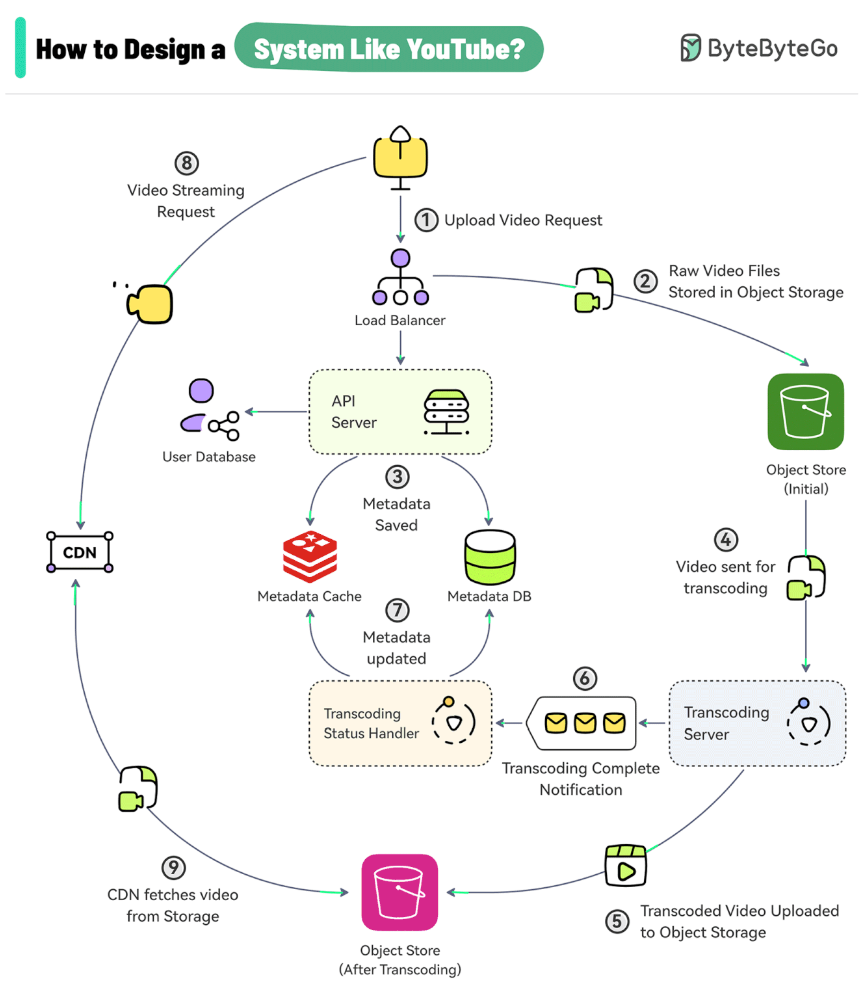
Here is an example of visual guide from ByteByteGo for designing a System like YouTube
3. Not Practicing End-to-End Design
Reading books or watching videos is helpful, but practice is where the real learning happens. You need to simulate actual interviews — think aloud, make trade-offs, and explain why you choose one approach over another.
Platforms like Codemia.io and System Design School do a fantastic job at providing realistic, scenario-based challenges.
Here are few System Design question you can practice on Codemia.io for free, this will give you good idea of what it takes to solve such problems on real interview and whether you are ready or not
- Codemia | Master System Design Interviews Through Active Practice
- Master System Design Interviews Through Active Practice
Codemia also offers guided practice problems and architecture case studies tailored for modern interviews, while System Design School helps you practice live and get expert feedback.
Learn System Design and Ace Your System Design Interview | Learn from Ex-FAANG Engineers
4. Ignoring the Fundamentals
Before diving into distributed systems and load balancers, you need to have a solid grasp of computer science fundamentals — caching, databases, consistency models, and concurrency.
If these concepts aren’t clear, you’ll struggle to reason about system trade-offs. This is where Educative.io and AlgoMonster shine:
- Educative’s Grokking the Modern System Design Interview and System Design Deep Dive: Real-World Distributed Systems courses are perfect for building core knowledge interactively.
- Grokking System Design Interview: Patterns & Mock Interviews
- System Design Deep Dive: Real-World Distributed Systems – AI-Powered Course
AlgoMonster complements it by reinforcing your data structure and algorithmic thinking — essential when your design involves trade-offs between speed and space.
5. Overlooking Code Quality and Real-World Scenarios
System design isn’t just about diagrams — it’s about writing robust, maintainable, and efficient systems. Many candidates overlook this aspect entirely.
That’s where BugFree.ai can be a game-changer. It acts as your AI-powered code reviewer, catching bugs, bad patterns, and design flaws before they become interview embarrassments.
Practicing with BugFree.ai improves not just your code but also your ability to reason about design trade-offs — a skill interviewers love to see.
Here are popular classical system design questions you can practice on Bugfree.ai:
- Design a URL Shortening Service like Bitly – System Design Interview Question
- Design Parking Lot System – Object-Oriented Design Interview Question
What Senior Engineers Can Do to Finally Crack the System Design Interview?
If you’re a senior engineer, chances are you already understand distributed systems, APIs, and scaling — but the real challenge lies in communicating and structuring that knowledge under pressure.
System Design Interviews are less about raw technical depth and more about demonstrating clear thinking, trade-off reasoning, and end-to-end system architecture design.
Here’s what you can do to bridge that gap and ace your next interview:
1. Master the Framework, Not Just the Concepts
Most engineers jump straight into designing databases or APIs without following a structured approach.
Use proven frameworks such as ByteByteGo’s System Design Framework, which teaches you how to break problems into components like requirements, APIs, data modeling, storage, scalability, reliability, and trade-offs.
Frameworks help you stay calm and methodical — which is exactly what interviewers look for.
👉 Check out ByteByteGo’s System Design Course (50% OFF Lifetime Plan)
System Design · Coding · Behavioral · Machine Learning Interviews
2. Practice with Real Interview Scenarios
Theory isn’t enough. You need exposure to actual interview-style problems like designing YouTube, WhatsApp, or Uber — under real time constraints.
Platforms like DesignGurus.io and Codemia.io simulate real interview challenges, helping you refine your thinking and identify weak spots early.
👉 Join DesignGurus.io for real-world system design practice
👉 Join Codemia.io for structured interview prep and feedback
Master System Design Interviews Through Active Practice
3. Learn by Watching Experts Design
Seeing how top engineers approach problems can accelerate your learning curve.
Exponent provides mock interviews and detailed walkthroughs of FAANG-style system design problems, helping you understand how experts think out loud, manage ambiguity, and communicate trade-offs effectively.
👉 Explore Exponent’s mock system design interviews
Interview prep for product, engineering, data science, and more – Exponent
4. Build and Analyze Real Systems
You’ll learn much faster by building actual systems — whether it’s a small-scale distributed cache or an event-driven notification service.
Educative.io’s Grokking the System Design Interview and BugFree.ai both offer hands-on challenges where you can apply theory to real-world scenarios.
👉 Learn System Design interactively on Educative.io
👉 Use BugFree.ai for AI-assisted interview prep
5. Don’t Just Memorize — Internalize Trade-offs
Senior engineers are expected to reason through design choices — not just recall patterns. Learn to explain why you chose Kafka over RabbitMQ, when to use SQL vs NoSQL, or how caching strategies affect consistency. Understanding trade-offs is what separates a mid-level engineer from a staff-level one.
6. Combine Practice + Feedback + Frameworks
If you combine ByteByteGo’s structured explanations, DesignGurus.io’s hands-on problems, Exponent’s mock interviews, and Codemia.io’s guided approach — you’ll have the most complete toolkit to succeed. Add consistent weekly practice, and you’ll notice a huge improvement in confidence and clarity.
Why ByteByteGo Is Still the Best Resource in 2025
There are dozens of great platforms for system design prep today, but ByteByteGo remains the gold standard — and for good reason.
Here’s why it stands out:
- Visual learning — Every concept is illustrated with diagrams that make even complex systems easy to understand.
- Real-world case studies — From Netflix to Dropbox, you’ll see how top-tier companies actually design their systems.
- Lifetime access — A one-time payment gives you lifetime access to all current and future content.
- 50% discount offer — Their lifetime plan is currently half off, making it an unbeatable value for the depth and quality of material you get.
If you’re serious about cracking system design interviews — or even improving as an engineer — ByteByteGo should be your first stop.
👉 Grab ByteByteGo’s Lifetime Plan at 50% OFF and start learning System Design the visual way — faster, deeper, and smarter.
Final Thoughts
System Design Interviews are hard, but not impossible. Most people fail because they rely on experience alone or jump in without structure. The right mindset, framework, and resources can make all the difference.
Here’s a quick roadmap to prepare effectively:
- Start with Educative or DesignGurus to learn the basics.
- Move to ByteByteGo for visual explanations and deep dives.
- Practice mock interviews on Exponent or Codemia.io.
- Use BugFree.ai for code review and architectural validation.
- Finally, review case studies from System Design School to refine your storytelling and clarity.
Passing the system design interview isn’t about luck or memorizing patterns — it’s about building intuition. Once you master that, even the toughest design questions start to feel natural.
Other Programming and Interview Articles you may like
- ByteByteGo vs LeetCode? which one is better for tech interview?
- How Algomonster helped me to master DSA for interviews?
- Exponent 70% OFF — Is It Worth It for FAANG Interview Prep?
- LeetCode vs. AlgoMonster? Which One Should You Use for Coding Interviews?
- ByteByteGo Lifetime Plan Review: Is It the Best Investment for Developers in 2025?
- 25 Software Design Interview Questions for Programmers
- ByteByteGo vs NeetCode vs Educative? which one is better?
- Codemia.io Annual vs. Lifetime Plan?
- Is ByteByteGo a good place for Coding interviews?
- 3 Free Books and Courses for System Design Interviews
- Is System Design Interview RoadMap by DesignGuru worth it?
- Why System Design Is the Hardest Part of FAANG Interviews?
- How to Prepare for Coding Interviews?
- AlgoMonster vs Exponent vs DesignGurus?
- Codemia.io 65% OFF Lifetime Plan — Is It Worth It for FAANG Interview?
- Is DesignGuru’s System Design Course worth it
- Algomonster Review 2025 — Is it worth it?
- Is Exponent’s System Design Course worth it?
- LeetCode vs AlgoMonster? Which is better for Coding Interview?
- 10 Best Places to Learn System Design in 2025
- My Favorite Software Design Courses for 2025
- ByteByteGo 50% OFF? Should you Join?
- 10 Reasons to Learn System Design in 2025
Thanks for reading this article so far. If you like this article then please share them with your friends and colleagues. If you have any questions or feedback, then please drop a note.
P. S. — If you just want to do one thing at this moment, go join ByteByteGo and start learning System Design and Coding Interview concepts, you will thank me later. The FAANG dream job you always wanted is not far anymore.
System Design · Coding · Behavioral · Machine Learning Interviews

Why Even Senior Engineers Struggle to Pass the System Design Interview? was originally published in Javarevisited on Medium, where people are continuing the conversation by highlighting and responding to this story.
This post first appeared on Read More