

The 2026 AI Engineer RoadMap
Becoming an AI Engineer: A Realistic Roadmap for Beginners (2026 Guide)
Hello guys, every since ChatGPT was launched on late 2023, the world has been changing really fast. It all started with using AI for things like how to sort an ArrayList but now we have AI model which can code much better than many senior engineers.
Coding, one skill which differentiated an average developer from a good one is not remain a differentiator anymore.
Due to these changes, every software engineer is nervous and want to get into AI Engineering. If you are also one who wants to learn AI Engineering or want to become an AI engineer then you have come to the right place.
While you can find a lot of information and resources on becoming an AI engineer online, for example, every week, a new video claims you can become an AI Engineer in 3 months.
Let’s be honest — that’s not how this works.
AI engineering is one of the most exciting careers in tech today, but it’s also a multi-year craft that combines software engineering, machine learning, and real-world system design.
The good news? You don’t need to master everything on day one to start building useful AI applications.
This guide breaks down a realistic roadmap — what to learn, when to learn it, and how to grow from beginner to professional AI engineer.
First, What Does an AI Engineer Actually Do?
AI Engineers are application builders, not primarily model researchers.
Instead of training models from scratch, AI engineers:
- Build apps on top of pre-trained foundation models (GPT, Claude, Llama, etc.)
- Use prompt engineering, RAG, and fine-tuning
- Focus on deployment, scalability, evaluation, and optimization
- Handle security, data pipelines, and user feedback loops
In short:
AI engineering is software engineering + AI integration
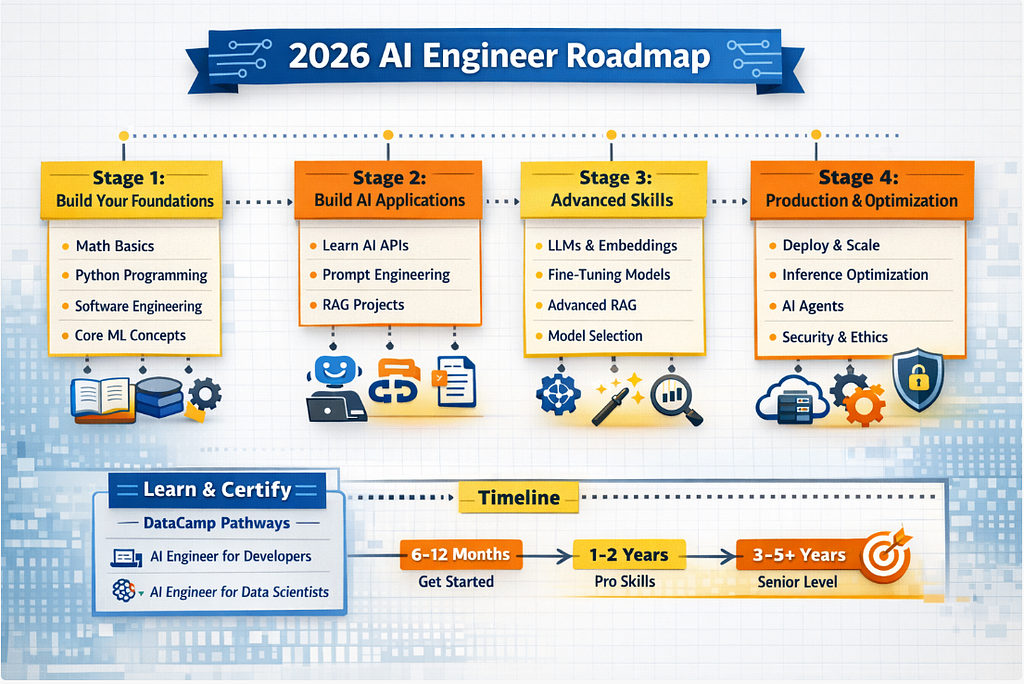
The 2026 AI Engineering RoadMap
Here is the roadmap you can follow in 2026 to become an AI Engineer. If you are looking for shortcuts then this roadmap is not for you.
I am sorry but you cannot become an AI Engineer in 3 months or even 6 months.
You need to put time and effort to gain all the skills required to get a job as an AI Engineer in today’s market.
Stage 1 — Build Your Foundations
Before touching LLMs, you need core skills, this is where most people struggle as they are not fancy. They are neither easy and require determination and hard work.
Here are the core skills you should revise/learn/master to become an AI Engineer in 2026
1.1 Math (Conceptual Level)
You don’t need a PhD, but you should understand:
- Probability
- Statistics
- Basic linear algebra (vectors, matrices)
In particular Matrix multiplication which is the basis of how these large language model and generative AI work.
1.2. Python Programming
AI engineering runs on Python. You should be comfortable writing clean, production-style code.
1.3 Software Engineering Basics
If you are a junior engineer who directly wants to get into AI engineering, then you should learn software engineering basics first like:
- Git & version control
- APIs
- Command line
- How services communicate
1.4 Core ML Concepts
This is the most important part for anyone who want to become an AI Engineer. Even if you don’t train models, you must understand:
- Supervised vs. unsupervised learning
- Overfitting vs. underfitting
- Evaluation metrics
In short, AI engineering sits on top of software engineering, not instead of it.
Stage 2 — Start Using AI in Real Applications
Now the fun begins.
1. Learn AI APIs
Use services like OpenAI or other LLM APIs to build features without worrying about model training.
2. Master Prompt Engineering
Well-designed prompts = dramatically better results. This becomes a daily skill.
3. Build RAG Applications
Retrieval-Augmented Generation (RAG) connects LLMs to your own data using:
- Embeddings
- Vector databases
This is what makes AI apps actually useful.
4. Build Simple Projects
I am big fan of project based learning as that’s where true learning happens. You should start with small and fun projects like:
- Chatbots
- Content generators
- Document Q&A tools
- Simple automation apps
In short, Projects > theory at this stage and you must build as many as short, medium or large project as you can.
Too much reading and you will forget everything, too little reading and you will always look back, so just create a right balance between reading and actually building stuff.
Stage 3 — Go Beyond the Basics
Once you’ve built multiple projects, you’ll naturally want deeper understanding.
3.1 Understand How LLMs Work
- Transformer architecture
- Attention mechanisms
- Embeddings
You don’t need to be a researcher, but you should know what’s happening under the hood. For this thing I recommend reading books like The LLM Engineer’s handbook, it covers all these concepts in depth.
3.2 Advanced RAG Systems
If you truly want to excel as an AI Engineer not just want those certification and knowledge then you should move beyond simple setups instead you should:
- Better chunking strategies
- Smarter retrieval methods
- Embedding optimization
These things will help you grow faster, much faster if you are the right place and right time as more and more companies are building their AI strategies to make full use of all the data they have collected over the years.
3.3. Fine-Tuning & Model Selection
This is another thing which can help you to really showcase your AI skills and put you into category of senior AI engineer which are in huge demand right now.
You should at least try to learn:
- When to fine-tune vs. prompt engineer
- Cost vs. performance tradeoffs
- Model licensing considerations
While fine-tuning and model selection is not an easy task, most of the companies are looking for engineers who can not just create AI models but make them work with their data in the most optimal way.
Stage 4 — Think Like a Production AI Engineer
This is where you level up from “builder” to “professional.” You have heard about end-to-end, this is what it means. You are not just familiar with software but also hardware and infra which powers it.
Once you have gone through previous stages and build enough skill and confidence to call yourself AI engineer, these are things I want you to focus on
4. 1. Deployment & Infrastructure
- Docker
- Cloud platforms (AWS, GCP, Azure)
- Monitoring & logging
4.2. Evaluation Systems
You must measure:
- Hallucinations
- Bias
- Response quality
AI engineering is not just “it works on my laptop.” or “works on my mobile” but it must work for everyone.
4.3. Inference Optimization
This is another advanced topic which AI Engineer should learn. Inference optimization is about making models cheaper and faster using:
- Quantization
- Distillation
- Efficient serving architectures
4.4 AI Agents
Now, the hottest thing of 2026, the AI agents. You should try to build systems that:
- Use tools
- Maintain context
- Break down complex tasks
4.5 Security, Privacy & Ethics
While whatever we learn so far its important but you cannot use it on production if you don’t know how to handle security and privacy.
You should at least learn to defend against:
- Prompt injection
- Data leakage
- Misuse of AI systems
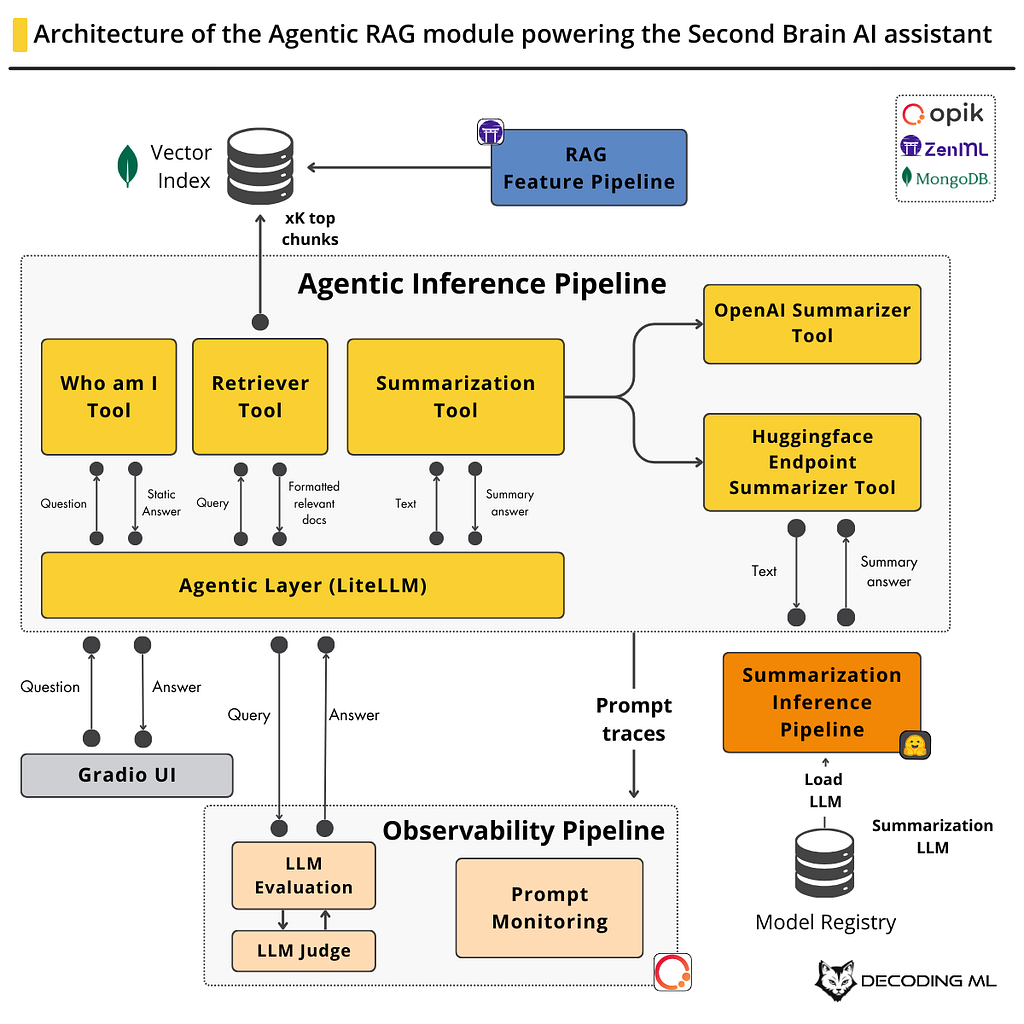
Here is a sample architecture you can try to build using Agents, RAG and LLMOps:

How to Learn These AI Skills?
Now, the big question is how will you learn these essential AI skills?
Well, I like to choose training which not just cover theory but also full of quizzes, exercises and projects, and If you want a guided path instead of random tutorials, structured tracks can help a lot.
While there are many places you can go for structured learning, I often choose Datacamp because of their byte sized lesson and effective curriculam.
For developers, Datacamp’s AI Engineer learning track covers APIs, LLM apps, LangChain, and vector databases. It also prepares you for the professional certification like AI Engineer for Developers Associate Certification
On the other hand, If you come from a data science or ML background, then you can explore Associate AI Engineer for Data Scientists track on Datacamp as it focuses more on working with foundation models and MLOps.
These paths are great because they combine theory + hands-on AI application building, which is exactly what this role requires.
The Realistic Timeline (No Hype)
Here’s what the journey typically looks like:
- Foundations + first apps — ~6 months (part-time)
- Advanced conceps — 6–12 more months
- Professional-level skills — 1–2 years
- Senior AI engineer — 3–5 additional years
So yes — this is a 3–6 year journey if you start from scratch.
But here’s the key:
- You can start building and even working with AI much earlier
- You don’t need to “know everything” before you start
Another great thing is that if you are already a softwar eengineer then you already know many stuff including fundamentals and traditional software engineering topics and skills.
Final Thoughts
That’s all about this 2026 AI Engineer Roadmap. AI engineering isn’t a 90-day sprint. It’s a long-term, high-reward career path that blends coding, systems thinking, and applied AI.
If you:
- Focus on real projects
- Learn tools step by step
- Use structured learning when needed
- Stay consistent
You’ll be far ahead of people chasing shortcuts.
The future doesn’t belong to people who talk about AI. It belongs to those who build with it.
All the best with your AI Engineering journey !!

The 2026 AI Engineer RoadMap was originally published in Javarevisited on Medium, where people are continuing the conversation by highlighting and responding to this story.
This post first appeared on Read More