

Practice notes on including citizens in the design process
Field notes on trust, participatory scaffolding, and shared agency.
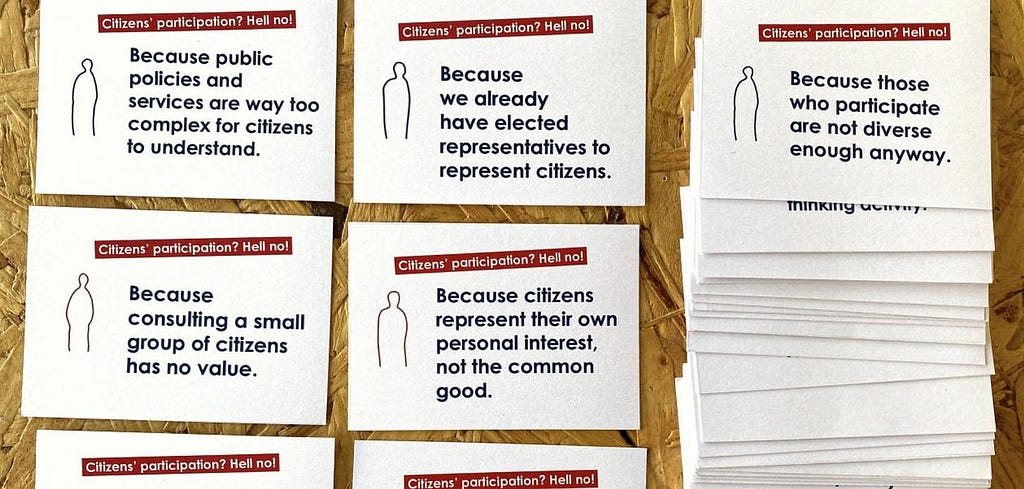
Involving citizens in public design is much more than running an “open” process. It is about redistributing agency — enabling people to shape decisions, define problems, and participate in making change happen. It is as much about co-authoring a story of change as it is about delivering outcomes.
Over the past eight years, I’ve been fortunate to work with a broad range of people — from children on dialysis wards or someone’s friend’s uncle in Germany looking to rent power tools to everyday citizens wanting to inquire about their tax bill, and the people I work with. Across all of these experiences, I’ve come to trust something quite simple. That work gets better when people (or citizens) are involved in defining needs, shaping response,s and proposing designs — not just talking about change, but helping to make it happen, together.
Given that I’m currently working with a brilliant teaching team on the MPA in Innovation, Public Policy and Public Value at UCL’s Institute for Innovation and Public Purpose — with Rowan Conway, Gabriella Gomez-Mont, Agostina Argiro Fuertes, Cecilia Santucho and Nickolas Laport Aldunate — supporting students to start tuning into how we better engage, enable and empower citizens through participatory scaffolding, it felt timely to pause and reflect on what it really means to include citizens in the design process.
Drawn from fieldwork, facilitation, practice, research, and a somewhat substantial volume of reading across public innovation and social infrastructure in recent years, here are some notes from the field that I’ve been marinating on.
1. Spend more time outside than in the office.
Being and doing things together on site is where trust and respect are built across differences. Thinking doesn’t happen in spreadsheets alone; it happens in kitchens, on pavements, in school corridors, in workshops and vans. We can’t expect colleagues — or citizens — to always come to us, or to log into a Team’s call, when they are balancing lives of their own.
Instead, jump in a tradesman’s van for a ride-along, chat to your taxi driver, go on a dog walk, have spontaneous conversations where people naturally gather: the barber shop, the football pitch, the school gate. These are all so much more than romantic gestures, they are cultural and essential ethnography into how people actually live their lives.
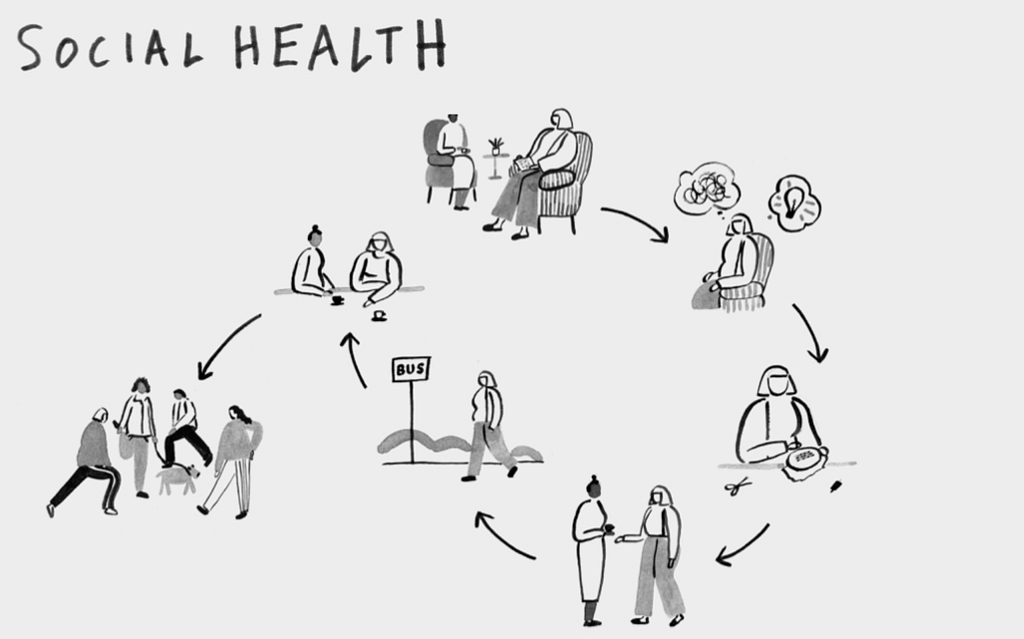
This echoes much of Hilary Cottam’s work on relational welfare — the idea that change does not emerge from service transactions but from relationships built in the everyday spaces of life. In Revolution 5.0 A Social Manifesto (which inspired this post) Hilary argues that our public systems are over-optimised for institutional efficiency and under-designed for human connection. Spending time outside the office is not a gimmick; it is a much-needed human correction.
A varied working process also opens more ways of contributing. Different spaces unlock different competencies. Some people speak best in formal rooms; others in motion, or over tea. Inclusion is not only about who is invited, but about the environments we design for participation. Basically, complex systems can’t be redesigned in conference rooms.
2. Hold back and wait.
Spend time. Percolate. Let plans evolve and be open to change. So much pressure comes from what we assume are procedural rules of the system — deadlines, reporting cycles, funding windows. But what happens when we loosen our grip? What could happen if communities genuinely shaped the direction, rather than reacting to pre-set options?
This isn’t easy. It often means moving at the “pace of trust” — and trust, that pesky, vague word, takes years to build and only moments to lose. It really means that this work cannot be rushed to meet artificial six-month timelines or funding deadlines. This theme has surfaced repeatedly in my conversations with practitioners and articulated much more fluently than I could dream of, particularly those working in place-based change like John Hitchin or Jo Blundell, who have that special skill at crystallising thoughts. The Place & Evidence substack is a shining example of this.
In many of my own experiences, breakthroughs came only after long stretches of what looked, from the outside, like slow work: listening, showing up, returning again and again. Staying in the deep end long enough for patterns and signals to manifest. People (and by people I mean anyone from the policy teams I work with to the students I support) often ask, “How much research do we need?” But that’s a category error. You don’t know until you start learning — and learning takes time.
In complex systems, premature solutions often risk strengthening the status quo because they fail to shift underlying conditions. In this context, holding back does not mean being passive. It means resisting premature convergence of ideas. It means allowing relationships to form before solutions harden. It means accepting that the “messy middle” is not a phase to rush through, but that relationships are the core of transformation. Our role as practitioners is to continually pry open the space between problems and solutions, creating room for deeper exploration before closure.
3. Lead with deep generosity and an abundance mindset.
Reject the conventional economic logic of the “bare minimum” and instead bring intentional generosity and care into every interaction — throughout life and your work.
This can mean many things and, in public systems, it’s not easy. Generosity can feel naïve. We are trained to optimise, to reduce, to streamline. Time is scarce. Budgets are tight. Engagement becomes extractive almost by default: What do we need from people? How quickly can we get it? How cheaply can we deliver it?
Leading with deep generosity flips that frame.
It can mean taking the time to listen deeply to citizens to understand what they value and what makes a place work, rather than leading with data-heavy, deficit-focused profiles. It can mean hosting rather than merely facilitating — setting the boundaries of a space physically, socially and conceptually. Considering how much natural light is in the room. Whether the snacks are nourishing. Whether the space smells right. Whether the premise of gathering feels intentional and human. Even ensuring the font sizes in your document are consistent — because coherence communicates care.
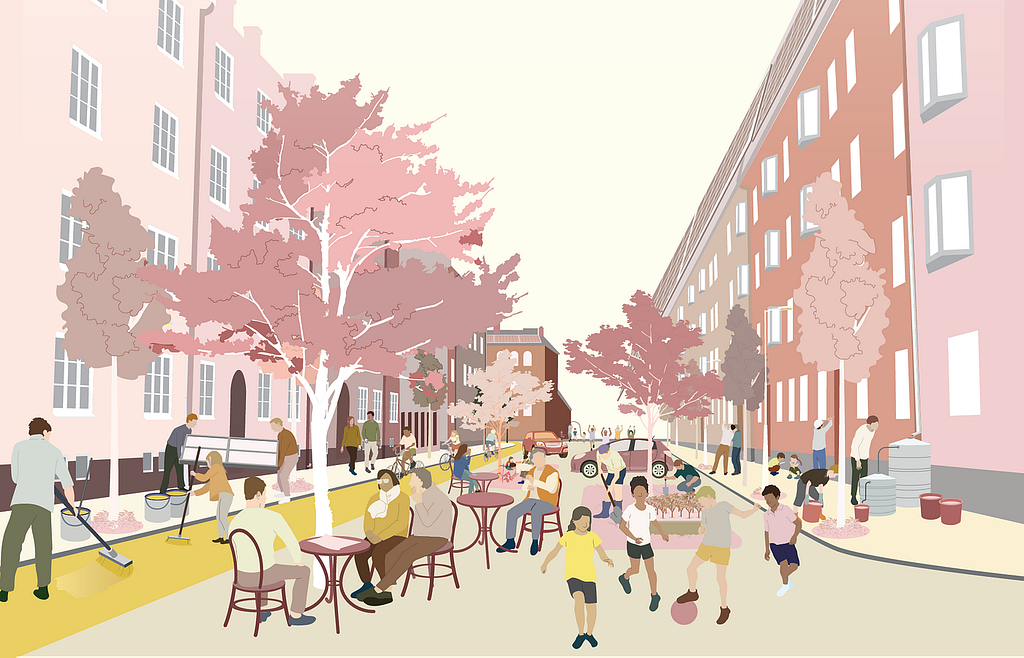
I think that Dark Matter Labs is fantastic at illustrating this principle by arguing that transformation requires shifting underlying logics — not just introducing new tools (See: Dm Threads). In this framing, generosity is not softness; it is a structural move. It changes incentives. It signals safety. It invites reciprocity rather than compliance. And when people feel respected and safe, experimentation becomes possible. Risk becomes shared rather than imposed. Generosity creates the conditions for long-term relationships (in perpetuity) rather than one-off transactions. It moves us from episodic engagement to ongoing stewardship.
Fundamentally, working from abundance recognises the immense skills, networks and energy already present in communities or teams, rather than viewing them through a lens of scarcity, conflict or decline. In complex work, what you choose to amplify matters. An abundance mindset amplifies capability — and capability compounds over time.
4. Provide the “milk carton,” not the “flavour.”
We have the amazing Lauren Dark to thank for this framing. As practitioners, our role is to provide the “scaffolding” and guardrails for participation (the “milk carton”) — such as safeguarding, policies, and frameworks — while allowing the local community to provide their specific identities, responses and lived experiences (the “flavour”).
This means designing participatory scaffolding around psychological safety and sensory comfort. As with my note on leading with deep generosity, the physical environment is a super easy way to think about shaping how people participate. A bland community hall with poor coffee can put people on edge. Designing lounge-room-like environments — creating front rooms rather than back offices — is part of this shift. Physical space communicates whether power is shared or retained. The container should feel safe enough for people to experiment, disagree and create.
But the “milk carton” is not only physical. It extends to the social and governance scaffolding we build around engagement. Frameworks such as Free, Prior and Informed Consent (FPIC) ensure that decisions are made freely, in advance and with full information — acting as safeguards for self-determination and sustainable development. This is not bureaucratic box-ticking; it is participatory infrastructure. Practitioners such as Julian Thompson (through Rooted) are doing super important work in this space, grounding engagement in Design Justice principles. Their work reminds us that inclusion is not neutral. It requires increasing our own capacity to build empathy, recognise positionality and actively avoid harm.
My own mental model is to remember to avoid the trap of being the “hero” designer and being eternally optimistic about solving everything and helping everyone; instead, we should be striving to act as a translator or craftsperson who helps amplify the brilliant things the community is already doing.
5. Building “breadcrumbs” for policy change
Relational work is powerful — but fragile. Without translation, it evaporates at the policy interface. To ensure local insights aren’t lost, codify community conversations into thematic “breadcrumbs” that future policy decisions can remain accountable to. Make things tangible.
Dan Hill (in his book: Dark Matter and Trojan Horses) refers to these, from a strategic design perspective, as “MacGuffins” — artefacts or interventions that carry narrative weight and create movement within complex systems. Extended through ideas like Trojan Horses, they become strategic devices: visible, workable objects or experiments that bridge the gap between radical local practice and the institutional mindsets of national policymakers. They make change experiential rather than rhetorical — ensuring that inclusive growth is rooted in lived, everyday experience rather than abstract ambition.
In practice, this means getting your hands dirty. Improvising. Being creative. Perhaps it’s my background in industrial design, but I believe in working through prototypes and experiments that allow participation to become a collective act of change. It means using probes, pilots and live tests to understand how ideas behave in real space — not just on paper. When something is built, placed, trialled or enacted physically, it shifts the narrative. It becomes evidence that listening has occurred in a way people can experience.

There is something powerful about interventions you can see, touch and use. Think about Santander Cycles — or “Boris Bikes.” Whatever your view on their politics (of both the service and the bureaucrat), they were tangible. Rows of red bicycles appearing across London were visible proof that a conversation about congestion, health and mobility had translated into action. You didn’t need to read a strategy document or look through a spreadsheet to understand that something had changed. The city felt different.
A shared reference point was created — something that allowed disagreement to be productive rather than abstract. Something for communities to respond to, debate, adapt and reinterpret — not just hypotheticals, but lived experience.
Without these breadcrumbs, participation risks becoming episodic — a series of conversations that dissolve once the workshop ends. With them, it becomes cumulative. It becomes part of how a place understands itself, and how institutions learn to act differently over time.
To close…
None of these thoughts is particularly new. Most of it is slow. All of it is relational. Fundamentally, this note is acting as a reminder. Including citizens in design is not a technique to master, but a way of working to practise — one that redistributes agency not just in theory, but in the everyday spaces where change actually happens.
This post is part of CIVICWORKS; a publication on (re)thinking civic bureaucracy, institutional reform, dynamic capabilities, policymaking and technology.

Practice notes on including citizens in the design process was originally published in UX Collective on Medium, where people are continuing the conversation by highlighting and responding to this story.
This post first appeared on Read More