

The 2026 Python Developer RoadMap
Your complete, step-by-step guide to become a Python developer in 2026 with right resources.

Hello guys, there is no doubt that Python is the most in-demand programming language in the world right now. It powers everything from web applications and automation scripts to machine learning models and AI systems.
Companies are hiring Python developers at every level and the salaries reflect it.
But here’s the problem: most people trying to learn Python in 2026 are doing it wrong.
They watch tutorial after tutorial, read blog post after blog post, and after months of “learning” they still can’t build anything real or pass a technical interview.
This roadmap fixes that.
What follows is a proven, step-by-step blueprint to go from zero Python experience to job-ready developer — with the exact skills, tools, niches, and resources you need at every stage.
The four-stage framework:
- Master the core skills
- Get efficient with essential tools
- Specialize in a high-demand niche
- Land your first Python job
Let’s break down exactly how to execute each stage.
The #1 Mistake Python Learners Make
Before diving into the roadmap, let’s address the mistake that kills most Python learning journeys before they get anywhere.
Passive learning.
Watching tutorials, reading books, following along with other people’s code. Studies show this approach only helps you retain about 20% of what you consume. You feel productive. You’re not building skills.
When you actually write code, build projects, experiment, and make mistakes — retention jumps to 75–90%.
That’s the difference between someone who “learned Python” for six months and can’t build anything, and someone who’s job-ready in three months.
The solution is interactive, project-based learning from day one.
That’s why I recommend DataCamp as the learning platform for this roadmap. Their platform is built specifically around writing real Python code in your browser, getting instant feedback, and working on projects that cement your skills — not just watching someone else code.
Two tracks in particular map perfectly to this roadmap:
- Python Programming Fundamentals — covers everything in Stage 1: variables, data types, functions, and hands-on code from day one
- Associate Python Developer — covers Stage 1 advanced topics: OOP, debugging, and real-world projects that build a job-ready portfolio
Keep both of these bookmarked. We’ll reference them throughout the roadmap.
The 2026 Python Developer RoadMap
Here is your complete guide to become a Python developer in 2026. It’s divided into 4 stages, starting from mastering the core Python skills, learning essential tools, specializing in a high-demand niche like web development, AI, or Machine Learning, and finally getting a job.
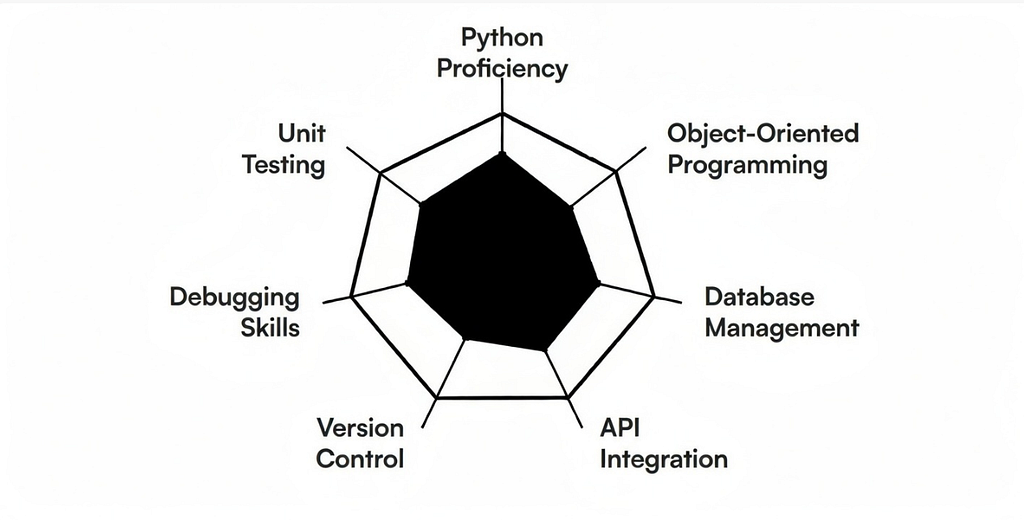
Stage 1: Master the Core Python Skills
Nothing else matters until you have solid fundamentals. This stage builds the foundation everything else rests on.
1.1 Core Syntax (~2 Weeks)
What to learn:
- Variables and data types
- Loops and conditionals
- Data structures: lists, dictionaries, and sets
- Functions and basic scripting
How to learn it: Don’t just read about these concepts — write code that uses them immediately. Build small scripts that automate real tasks: rename a batch of files, do simple calculations, manipulate basic data.
The Python Programming Fundamentals track on DataCamp covers all of this interactively — you’re writing real Python in your browser from the first lesson, not copying code from a screen.
Goal: After two weeks you should be comfortable writing Python scripts without looking up basic syntax.
1.2 Object-Oriented Programming
What to learn:
- Classes and objects
- Inheritance and encapsulation
- How to design systems using OOP principles
Why it matters: Python is an object-oriented language at its core. To write professional Python code — not just scripts — you need to understand OOP deeply. Every serious Python codebase uses classes. Every Python job interview tests OOP understanding.
How to practice: Build projects that require you to design classes and relationships:
- A bank account management system
- A text-based adventure game
- A simple inventory management tool
Anything that forces you to think in objects, not just functions, is valuable practice.
The Associate Python Developer track dives deep into OOP with real-world projects — exactly the kind of hands-on practice that builds genuine understanding.
1.3 Async and Concurrency
What to learn:
- How async operations work using the asyncio library
- Basic multithreading
- The Global Interpreter Lock (GIL) and what it means for your Python version
Why it matters: Most real applications do multiple things at once — handle requests, query databases, call external APIs. Understanding async and concurrency is what separates developers who can build production systems from those who can only build toys.
How to practice:
- Build a basic web scraper that fetches multiple pages concurrently
- Build a simple chat application to test concurrency in action
Don’t skip this step. It seems advanced but the concepts become natural quickly with hands-on practice.
1.4 Advanced Python Features
What to learn:
- Decorators
- Generators
- Context managers
- List/dict comprehensions
Why it matters: These features are what professional Python code actually looks like. If you can’t read and write decorators and generators, you’ll struggle to contribute to any serious Python codebase.
Goal: After this stage you should be writing Python that looks professional — not just correct, but efficient and idiomatic.
1.5 Modules, Packages, and the Standard Library
What to learn:
- How to organize code into reusable modules and packages
- How to structure Python projects properly
- Key built-in modules: os, json, datetime
- Essential third-party modules: requests
Why it matters: Real projects aren’t single files. Understanding project structure and the module system is essential for contributing to existing codebases and building maintainable projects of your own.
Resource: The Associate Python Developer track covers project structure and real-world Python development patterns that most courses skip entirely.
Stage 2: Get Efficient With Essential Developer Tools
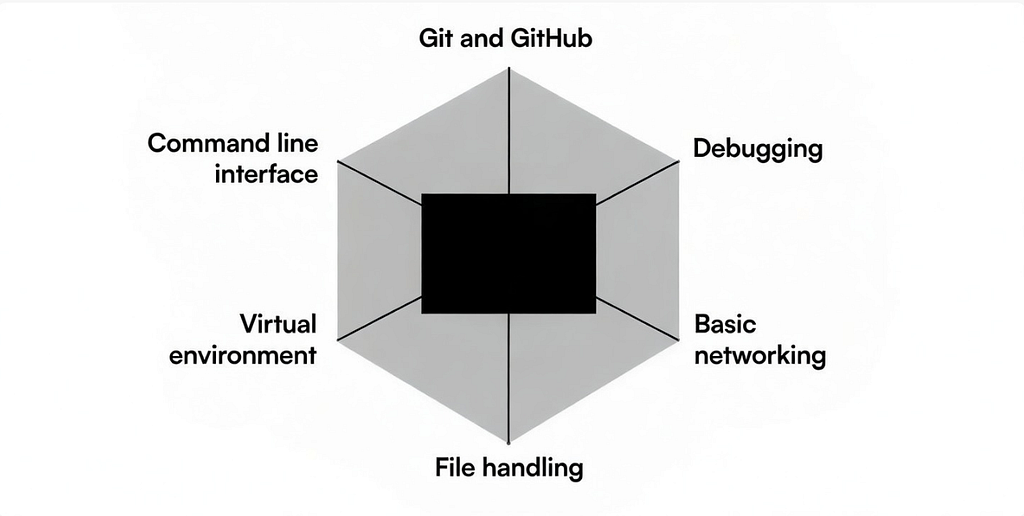
Learning Python syntax is step one. Becoming an effective developer means mastering the tools professionals use every single day. These are non-negotiable.
2.1 Git and GitHub
What to master:
- Core Git commands: commit, branch, merge, rebase, revert
- Creating and managing GitHub repositories
- Collaborating on shared codebases with other developers
Why it matters: Every professional development environment uses Git. If you can’t use version control confidently, you can’t work on a team. There are no exceptions.
How to practice: Create a GitHub account today. Put every project you build on GitHub. Make commits daily. Contribute to an open-source project when you’re ready.
2.2 Command Line Interface (CLI)
What to master:
- Core commands: cd, ls, mkdir, cp, mv, grep
- Navigating the file system without a GUI
- Running Python scripts from the terminal
Why it matters: Python development relies heavily on the command line. Scripts run from terminals. Servers have no graphical interface. Deployment happens via CLI. Being uncomfortable in the terminal slows down everything.
2.3 Basic Networking
What to understand:
- HTTP protocols and how the web works
- REST APIs — what they are and how to consume them
- Handling requests and parsing responses with Python’s requests library
Why it matters: Almost every Python application — web apps, data pipelines, automation scripts, AI systems — communicates over a network. Understanding how HTTP and REST work is foundational knowledge for any Python niche.
2.4 Virtual Environments
What to master:
- venv for standard virtual environments
- uv for modern, fast dependency management
- Anaconda for data science environments
Why it matters: Every professional Python project uses virtual environments to isolate dependencies. Working without them causes dependency conflicts that are painful to debug. This is just standard professional practice — learn it early, use it always.
2.5 Debugging and Testing
What to learn:
- Python’s built-in debugger (pdb)
- Writing unit tests with pytest
- How to think about test coverage
- How to read error messages and tracebacks effectively
Why it matters: You will write bugs. Every developer does. The difference between a junior developer and a productive professional is how quickly they find and fix them. Testing skills also signal professional maturity to employers — it’s a differentiator in job applications.
Stage 3: Specialize in a High-Demand Niche
Here’s where most Python roadmaps fail you — they treat Python as a single career path. It isn’t.
Python is used across wildly different domains. To land a job and be genuinely valuable from day one, you need to pick one niche and go deep. Employers hire specialists, not generalists who “know Python.”
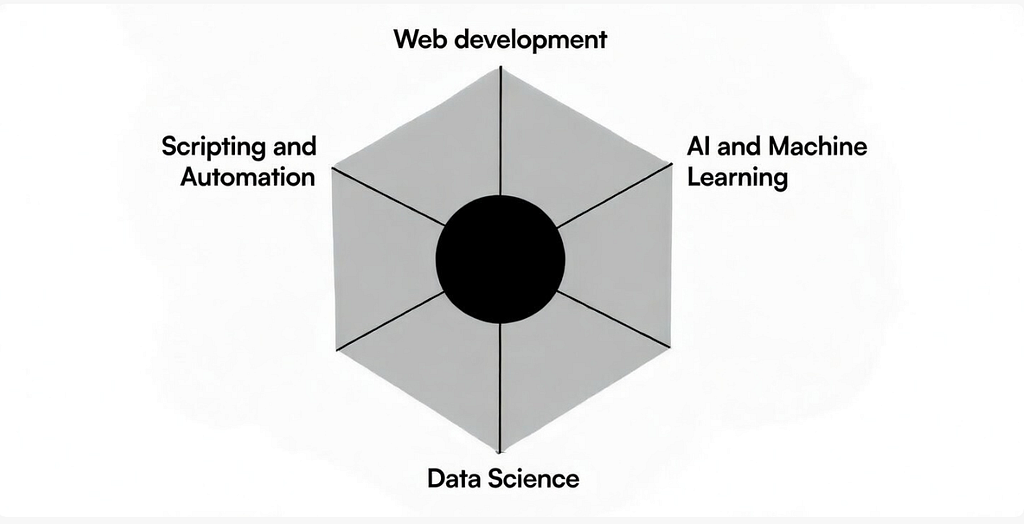
Here are the four highest-demand Python niches in 2026:
Niche 1: Web Development
What to learn:
- Django — full-featured web framework for complex applications
- Flask — lightweight framework for APIs and microservices
- FastAPI — modern, fast framework for building APIs (growing rapidly)
What you’ll build:
- E-commerce backends
- REST APIs for mobile and web applications
- Blog and content management systems
- Internal business tools
Why it’s a strong choice: Web development has the highest volume of Python job openings. If you want the most options and the fastest path to a first job, web development is it.
Salary range: $75k-$130k for mid-level Python web developers
Niche 2: AI and Machine Learning
What to learn:
- TensorFlow and PyTorch for deep learning
- scikit-learn for traditional machine learning
- NumPy and pandas for data manipulation
- Core ML algorithms: regression, classification, neural networks
- Advanced topics: CNNs, computer vision, LLMs
What you’ll build:
- Predictive models
- Image classification systems
- Natural language processing applications
- AI-powered features for existing products
Why it’s a strong choice: AI and ML roles are the highest-paying Python jobs in 2026. Demand is growing faster than the talent supply. If you’re willing to invest in the mathematics (probability, statistics, linear algebra) alongside the coding, the payoff is significant.
Salary range: $110k-$200k+ for ML engineers
Niche 3: Data Science
What to learn:
- pandas and NumPy for data manipulation
- matplotlib and seaborn for visualization
- Statistical analysis: probability, hypothesis testing
- Data cleaning, exploration, and storytelling
What you’ll build:
- Data analysis pipelines
- Business intelligence dashboards
- Automated reporting systems
- Statistical models for business decision-making
Why it’s a strong choice: Data science roles exist in virtually every industry — finance, healthcare, retail, tech. The breadth of opportunity is unmatched, and the skills transfer across domains easily.
Salary range: $85k-$150k for data scientists
Niche 4: Scripting and DevOps
What to learn:
- Docker and Kubernetes for containerization
- CI/CD pipelines (GitHub Actions, Jenkins)
- Cloud platforms: AWS, Azure, or Google Cloud
- Infrastructure as Code with Python scripting
What you’ll build:
- Deployment automation scripts
- Infrastructure provisioning tools
- Monitoring and alerting systems
- Cloud resource management scripts
Why it’s a strong choice: Python is the default scripting language for DevOps and cloud automation. As companies move to cloud-native infrastructure, Python DevOps skills are increasingly essential — and often overlooked by developers who focus only on application code.
Salary range: $95k-$160k for Python DevOps engineers
Which Niche Should You Choose?
Ask yourself three questions:
- What problems do I find interesting? (Web apps, data analysis, building AI, automating systems)
- What’s the job market like in my target location? (Check LinkedIn Jobs for local demand)
- What’s my mathematics comfort level? (AI/ML requires more math than web dev or DevOps)
Pick one. Go deep. Don’t try to learn all four simultaneously — you’ll be mediocre at everything and exceptional at nothing.
Stage 4: Land Your First Python Job
You have the skills. Now you need to get hired. This is where most developers drop the ball — not because the steps are unknown, but because they don’t follow through consistently.
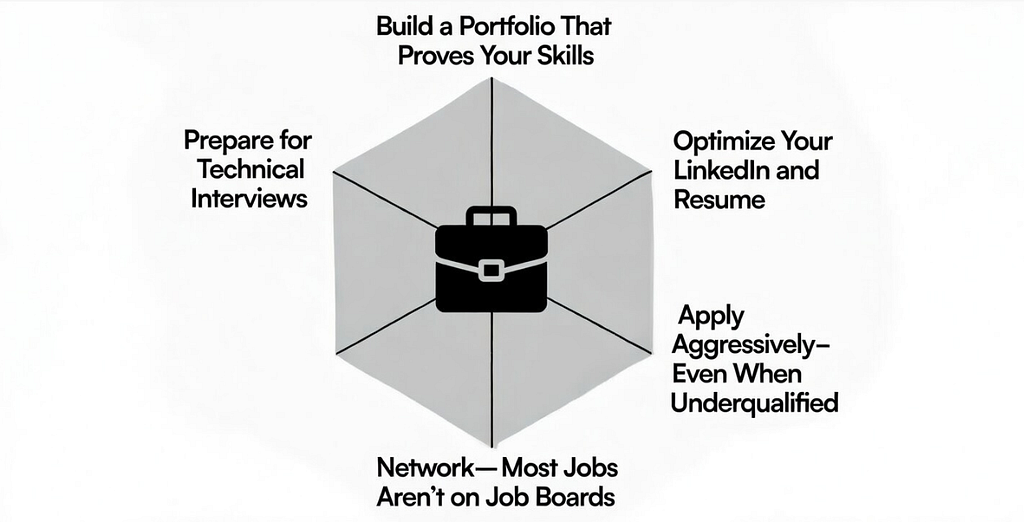
4.1 Build a Portfolio That Proves Your Skills
No experience? Build 3–5 projects that demonstrate real ability in your chosen niche:
- Web dev: A deployed REST API or full-stack application (hosted on Railway or Heroku)
- AI/ML: A trained model with documented performance metrics (hosted on Hugging Face or GitHub)
- Data science: A data analysis report with visualizations (published on Kaggle or GitHub)
- DevOps: Infrastructure automation scripts with documentation
The key word is deployed. Code sitting on your local machine proves nothing. Code running on the internet — or documented on GitHub with clear READMEs — proves you can ship.
4.2 Optimize Your LinkedIn and Resume
Stop being a “Python developer.” Start being a “Python Backend Engineer with Django and FastAPI experience” or a “Machine Learning Engineer specializing in NLP.”
Your LinkedIn profile should:
- State your specific Python niche in the headline
- List concrete projects with links
- Show specific technologies, not just “Python”
- Have a summary that explains the value you bring
Your resume should:
- Lead with skills and projects, not education (unless it’s relevant)
- Quantify results where possible (“Built API handling 10k daily requests”)
- Match keywords in job descriptions (ATS systems filter resumes)
4.3 Apply Aggressively — Even When Underqualified
This is the step most developers skip. They wait until they feel “ready.” They never feel ready.
Job descriptions are wishlists, not strict requirements. If you meet 60–70% of the requirements and genuinely have the core skills, apply. The worst outcome is no response — which is the same outcome as not applying.
Apply to:
- Entry-level and junior Python positions
- Internships (even if you’re not a student)
- Contract and freelance projects to build experience
- Startups (lower competition, more willingness to hire junior developers)
Set a target: 10 applications per week, minimum.
4.4 Network — Most Jobs Aren’t on Job Boards
Studies consistently show that 70–80% of jobs are filled through networking before they’re ever publicly posted. Networking isn’t optional if you want to land a job quickly.
How to network effectively:
- Connect with Python developers on LinkedIn and engage with their content
- Attend local tech meetups and Python user groups
- Contribute to open-source Python projects
- Post about what you’re building on LinkedIn and Twitter/X
- Join Python communities on Discord and Reddit
One warm introduction is worth 50 cold applications. Invest in relationships.
4.5 Prepare for Technical Interviews
Python technical interviews typically include:
- Coding challenges — Practice on LeetCode and HackerRank (focus on easy and medium problems)
- Python-specific questions — OOP, decorators, generators, memory management
- System design — Basic architecture questions for senior roles
- Niche-specific questions — Django internals, ML algorithms, data structures
The most important preparation is simply being good at writing Python code. All the LeetCode practice in the world won’t save you if you can’t write clean, working Python under pressure.
The Associate Python Developer track on DataCamp builds exactly the kind of practical coding fluency that technical interviews test — through real projects and hands-on exercises, not theory.
The Bottom Line
Becoming a Python developer in 2026 is absolutely achievable — but only if you approach it the right way.
The developers who fail spend months passively consuming tutorials and wondering why they can’t build anything. The developers who succeed write real code from day one, build projects that prove their skills, specialize in a marketable niche, and pursue jobs aggressively.
The four steps, one more time:
- Master core skills — syntax, OOP, async, advanced Python, modules
- Use essential tools — Git, CLI, networking, virtual environments, testing
- Specialize in a niche — web dev, AI/ML, data science, or DevOps
- Land the job — portfolio, LinkedIn, applications, networking, interviews
This isn’t easy. But it’s straightforward — and thousands of developers have followed exactly this path to land Python jobs.
Start with the Python Programming Fundamentals track today. Write real code. Build real things. The job follows the skills.
P.S. — The biggest thing separating developers who land jobs from those who don’t isn’t talent or even knowledge. It’s consistency. Show up every day, write code every day, and trust the process. The Associate Python Developer track gives you the structured path — you just have to follow it.

The 2026 Python Developer RoadMap was originally published in Javarevisited on Medium, where people are continuing the conversation by highlighting and responding to this story.
This post first appeared on Read More