

Tips for Improving Code Quality in Java Software Development
It’s been quite a while since I have been working in the tech industry, and even after all these years, somehow the space doesn’t fail to amaze me at all. My work experience mainly included writing and reviewing code and working in sync with different teams. So I can simply vouch for the fact that the significance of writing clean code shouldn’t be ignored at any rate.
Do you wish to master the art of writing high-quality code, especially in your upcoming Java software development project? It’s the right space to begin with, here you will find certain crucial tips, accompanied by personal guidance which can definitely give you an upper hand in terms of writing better, cleaner and truly efficient code.
It doesn’t matter whether you have begun your journey as a software developer or you are someone who has experience of a year or two; I am sure you must be acquainted with the concept of inheriting a code base. Well, the concept is all about familiarising oneself with the code, and not just how it is built, how it functions, what kind of programming languages, libraries, and frameworks are used.
One of the most annoying scenarios that you might face as a developer is navigating through unfamiliar code or code that you had written a while ago. Whatever the requirement is, whether it is to fix bugs or enhance functionality, improve performance, unveiling the state of code can be pretty daunting and troublesome.
This is why it is always advisable to write clean code; at least it can save you from countless hours and frustrations, and even from getting embarrassed in front of your colleagues. Now anybody can write Java code, it’s no biggie! What matters the most is that it has to be insanely clean, readable and highly maintainable and trust me, this is a whole lot of challenge.
There are times when the codebase might feel bloated, confusing, and even hard to test. This means you need to refactor right then and there. Well, a quick tip, when you happen to write clean code using the right techniques, it becomes faster, cleaner and much easier to work with.
Why do you need to write clean code in Java?
You see what really happens when you don’t opt for the right technique to enhance code quality. Usually, there are a few circumstances, such as bloated methods, using random magic numbers, and of course, duplication, which result in the Java code being difficult to read, test and debug. On the contrary, refactoring or implementing ways to improve code quality can assist the team members to work in sync in a speedy manner, and that too with fewer errors.
First and foremost, let us understand what the term clean code means. Well, cleaner code might mean different things for every programmer. Clean code is said to be the code that can be easily read and comprehended. Moreover, the code needs to be well-organised and must be created using best practices of the Java programming language. Moreover, clean code is free of errors as well as bugs.
However, with the rise in tech advancements, it is pretty easy to create a convoluted codebase and that too free of bugs and errors. Unfortunately, we humans aren’t that one-dimensional creatures. We need to put ample of time and effort into understanding the logic behind the code which has already been written.
Not to mention, getting a grip on or understanding the codebase, is one of the common yet crucial task for a developer. Which is why it is often believed that the profession of software development is more in regards to reading instead of developing, because 80% of the time spent is all about reviewing and trying to understand what code has been written. Unfortunately, this is not an easy 9to5 job.
And the worst part of all, the minimal team turnover, there is no way developers, irrespective of their experience, can be familiar with every part of the codebase.
How to write clean code in Java?
Writing clean code is more like a mandatory thing to do, all your efforts will go in vain. The first and foremost aspect is to have a good knowledge of the Java language and its syntax. Now here I am, not asking anyone to wait for gaining ten years of experience to write clean code. It is possible right here, right now! Here are a few common yet crucial principles to keep in mind and apply to practice.
- Simplicity — Make sure you strive harder to make the code as simple as possible. Any kind of issues or unnecessary complexity found can lead to things getting out of control and being prone to errors.
- Maintenance — Whatever the code is written needs to be easy for other developers to work on, as well as be maintained well. Basically, the entire app shouldn’t break down even if you manage to change a few components here and there.
- Testability — Unit tests are one of the most crucial aspects, especially when you need to come up with clean Java code. In fact, testing rigorously is a sure-shot way to achieve fruitful outcomes.
Tips and Techniques to enhance overall code quality
Ways to improve code quality can range from conducting simple cleanups to making bigger design changes; however, the below-mentioned tips and techniques must be taken into account by combining Java practices.
1. Understand the Problem First
Yes, one of the most common mistakes made by programmers all across the globe is that they simply dive in instead of getting to know the problem first. Yes, how can you find the solution before even knowing the problem or comprehending it? For example, you need to find the maximum number in an array. So what happens when you try to understand the problem first?
java
int[] numbers = {1, 3, 5, 7, 9};
int max = Arrays.stream(numbers).max().getAsInt();
System. out.println(“Max number is: “ + max);
2. Use a Standard Project Structure
Project structure is something that successfully outlines how to arrange different components in your project, for example, Java source files, test files, documentation files, build files, and configuration files. Having a clear and concise project structure in mind makes it extremely easy to understand, navigate and even modify a project codebase. And when you have a poor project structure, there is a high probability for confusion, especially if you are working with projects featuring many files. However, this doesn’t mean Java compels developers to create specific project structures, but it does focus on making the right choices, especially in terms of tools such as Maven.
src
├── main
│ ├── Java Application/Library sources
│ ├── resources Application/Library resources
│ ├── filters Resource filter files
│ └── webapp Web application sources
└── test
├── Java Test sources
├── resources Test resources
└── filters Test resource filter files
3. Break Down Large Methods into Smaller Ones
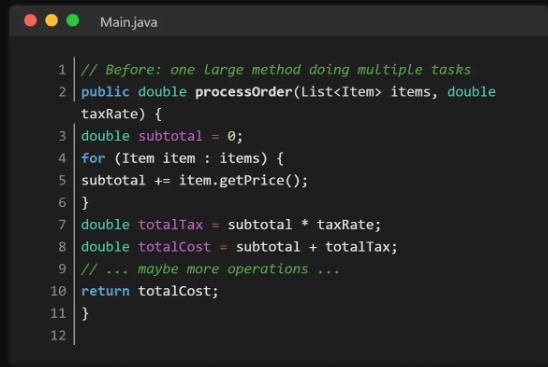
There are times when you conduct a Java development project, you might end up incorporating methods that are too long or a space where programmers must be involved, especially when handling multiple tasks; you can think of breaking it into smaller chunks, wondering how? Try using an Extract Method technique. You see, managing long methods can be pretty difficult, especially regarding reading, understanding and maintaining. So all you can think of is split them into smaller chunks and then see the magic. Here, you won’t just find well-focused methods, but even manage to make the code cleaner and easier to reuse whenever needed. Just make sure whatever method you tend to choose, it must take care of a single, well-defined task.
Let us try an example here. Here is a method that processes an order by calculating a subtotal, applying tax, and then computing the final total.
So, how to improve the current situation? You can try this method instead:
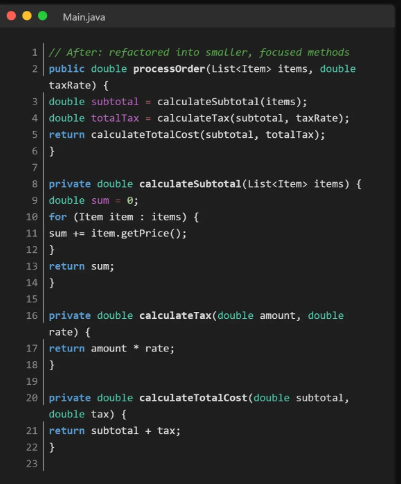
Doesn’t it look like a simple instruction list where you need to calculate the subtotal, then calculate tax and return the total? In case a bug shows up, you already know the path to rectify the situation, and it is possible to reuse parts like calculateSubtotal in different areas.
4. Planning the Code
The next interesting technique to pick is planning the code. Yes, no matter how lame and obvious a step may seem, many of you might think, but believe me, programmers often end up skipping the step and end up facing unwanted headaches and bottlenecks in the future. Let’s say we are creating a class to represent a “person”, so what we need to do is simply plan the attributes and methods the following class needs to have:
java
class Person {
String name;
int age;
Person(String name, int age) {
this.name = name;
this.age = age;
}
void sayHello() {
System.out.println(“Hello, my name is “ + name);
}
}
5. Have you Come Across the Java Naming Convention?
Java naming conventions are a set of rules that dictate how Java developers must name identifiers. The Java Specification Document defines different naming rules for variables, packages, classes, and methods. So what these naming conventions do is they enable developers to keep things in order, especially when writing code. You see, good naming enhances code readability, consistency, and maintainability.
Some of the Java naming conventions include:
- Class and interface names should have the first letter capitalised and should be nouns.
- Method name should consist of verbs.
- Variable names must be crisp and concise.
- Package names must be written in lowercase.
- Constant names should only carry capitalisation.
package com.example.project;
public class Person {
private String firstName;
private String lastName;
public Person(String firstName, String lastName) {
this.firstName = firstName;
this.lastName = lastName;
}
public String getFullName() {
return firstName + “ “ + lastName;
}
public static final int MAX_AGE = 100;
public boolean hasValidName() {
return firstName != null && lastName != null;
}
}
6. Readability over Reusability
Another amazing tip and trick to enhance code quality in Java is reusability. Being one of the most advocated concepts within the software development phase, it does lessen unwanted development time and allows programmers to take it easy, especially regarding maintenance, especially when developers have a better understanding of reusable components.
Reusability as a concept sounds pretty great, and of course, offers a wide range of benefits, but at the same time, it comes with a wide range of pitfalls as well, and these challenges become pretty intense if you end up working on an unfamiliar codebase. Which is why it is said that code reusability is a must-consider factor, especially if you are working on large applications, since this aspect can certainly lessen usability and maintainability, irrespective of the fact that proper design isn’t in place.
Not to mention Poor code readability makes debugging difficult, and trust me when I say this, you have to put in a lot of effort not just to develop but even to maintain the codebase. It might seem a bit normal, but this can be challenging, especially when trying to onboard new developers into your project. Therefore, it is rightly said that you don’t have to prioritise reusability over readability.
7. Use Meaningful Comments and Documentation
The next amazing way to enhance code quality is to use meaningful comments and documentation. Yes, documentation is extremely important when you are conducting a development project. You see, software development is not a one-time single process; it is an ongoing venture. So if the developer has documented it correctly, no matter whether the same developers want to refer to the code or another programmer needs to, they simply needs to go through the documentation.
So overall, it is very important to have proper use of comments and documentation. Of course, the code needs to be highly readable and self-explanatory, and for that, you do need to avoid complicated logic as well. So to ease the job, you can make use of different strategic comments within the code. You get to explain the logic behind certain parts of the code, especially the ones that aren’t straightforward.
When working on any kind of Java development project, programmers can leverage mainly two types of comments: documentation comments, which are target codebase users and implementation comments, which are meant for developers who are seriously working on the codebase.
/**
* This class represents a RESTful controller for managing user resources.
* It provides endpoints for creating, retrieving, updating, and deleting users.
*/
@RestController
@RequestMapping(“/api/users”)
public class UserController {
/**
* Retrieves a user by ID.
*
* @param id The ID of the user to retrieve.
* @return The user with the specified ID.
*/
@GetMapping(“/{id}”)
public ResponseEntity<User> getUserById(@PathVariable(“id”) Long id) {
// Implementation omitted for brevity
}
/**
* Creates a new user.
*
* @param user The user object to create.
* @return The created user.
*/
@PostMapping
public ResponseEntity<User> createUser(@RequestBody User user) {
// Implementation goes here
}
//Rest of the code
Another example of a good comment,
“`java
// This is a bad comment
int x = 5; // Assigns 5 to x
// This is a good comment
int x = 5; // Start at 5 because the first five values have been processed already
“`
- Avoid Duplicate Code
There are times when you end up repeating the same code in multiple places, and this is not just wrong; it can be one of the worst nightmares for a developer. Let’s say if a bug appears in one section, the chances are pretty high of a similar kind or even different kind of bug appearing in other places as well. Not to mention, fixing all of them takes ample of time and effort. So this is the reason why experienced developers tend to opt for the DRY (Don’t Repeat Yourself) principle. By doing so, they can seamlessly eliminate duplicate code, and this is possible by simplifying and streamlining the code.
Let us take an example for better understanding, imagine there are two classes where each feature methods to display details, and where exactly the difference lies? It is in the label they use. So, as a solution, you can use a common interface or a helper method. So all you need to do is maintain the logic in a single place, and this is the sure-shot way to maintain the logic in a single place, ensuring all the future updates more simple and less prone to errors.
Time to eliminate tedious debugging here. All you will be able to do is write clean and highly impactful code.
- Use of Unnecessary Log Statements and Incorrect Log Levels
Another very significant way to improve code quality in Java is logging. Yes, and to achieve more fruitful results, it is extremely important for any application to be able to be implemented in the most efficient manner by doing so, one can successfully avoid performance hits, especially due to incorrect logging and log levels. It is extremely important to avoid logging big objects into code and also, another important aspect is that logging must be limited to specific parameters which are required to monitor; it doesn’t mean you need to monitor the whole object. Also make sure the logging level is kept to higher levels, such as DEBUG, ERROR, and not INFO.
Logger.debug(“User info : “ + user.toString());
Logger.info(“Method called for setting user data:” + user.getData());
This method is not correct, instead try using this one:
Logger.debug(“User info : “ + user.getName() + “ : login ID : “ + user.getLoginId());
Logger.info(“Method called for setting user data”);
- Do not forget to take breaks
Yes, coding can be pretty exhausting, daunting and above all, it is extremely time-consuming. So what one requires is regular breaks, which can not only assist in enhancing productivity levels but also prevent burnout.
On and all, writing better code is a continuous journey, no two ways about it. I am pretty sure the above-mentioned tips can be quite helpful. So wish you all the very best in writing cleaner, more efficient, and maintainable code. Also, keep this in mind: it is not about achieving perfection but ensuring constant improvement.
Conclusion
Enhancing overall code quality or writing clean code means writing clear, concise, straight, easy to read, test code. However, even the bad code can function, but in case if the code isn’t clean and concise, it can definitely doom every aspect associated. Over all these years, it has been stated that countless hours and significant resources have been lost due to poorly written code, and since this has been happening doesn’t mean it has to keep on happening that way. Lastly, here I would like to mention a few benefits of writing clean code:
- Great maintenance
- Easy and quick debugging
- High scalability
- Robust solutions
- Quick collaboration
- Accurate documentation
- Great efficiency
- High readability
So that’s all for now! Conducting a Java development project is not easy, especially in the current cut-throat competitive times. I hope you did find the following post worth taking into account, and in case you have any kind of further doubts or queries, feel free to mention them in the comment section below. Good luck with your upcoming development ventures.

Tips for Improving Code Quality in Java Software Development was originally published in Javarevisited on Medium, where people are continuing the conversation by highlighting and responding to this story.
This post first appeared on Read More