

I Found LeetCode for Software Design and It’s Awesome
Why Bugfree.ai is the best place for practicing System Design questions for interviews
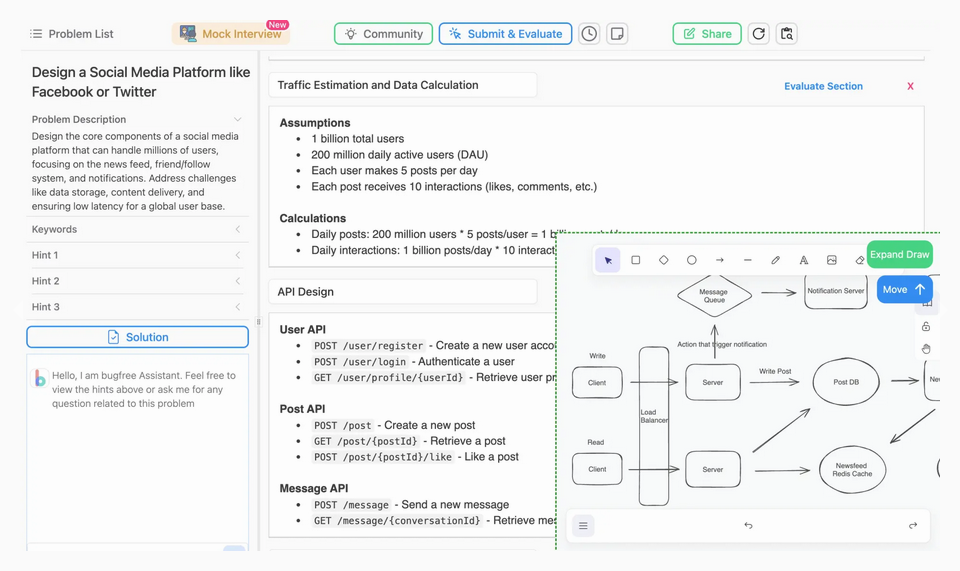
If you’re preparing for FAANG interviews, you already know that Data Structures & Algorithms (DSA) and System Design are the two critical areas where you’ll be tested rigorously.
While LeetCode has become the standard platform for DSA practice, system design preparation has always been fragmented — scattered across expensive courses, text-heavy articles, and YouTube videos with no hands-on practice.
That changed when I discovered BugFree.ai.
Master System Design & Behavioral Interviews Like Leetcode
After using it to prepare for my recent FAANG interviews, I can confidently say: BugFree.ai is the LeetCode for System Design — and it’s exactly what the interview prep landscape has been missing.
If you’ve struggled with structuring system design answers, getting real feedback, or knowing whether your approach matches industry standards, BugFree.ai solves all of these problems.
Why System Design Needs a Platform Like LeetCode or BugFree.ai?
Most system design resources today fall into one of these categories:
1. Long, Text-Heavy Courses
- Passive learning with no hands-on practice
- You read about designs but never actually create them
- No way to validate your understanding
2. Expensive Mock Interview Platforms
- $200–500 per session
- Limited feedback
- Not scalable for comprehensive preparation
3. YouTube Videos and Blog Posts
- Fragmented information
- No structured progression
- No evaluation of your solutions
The fundamental problem: Reading about system design isn’t enough. You need to actively design solutions and get expert feedback on your approach.
This is where BugFree.ai changes the game completely.
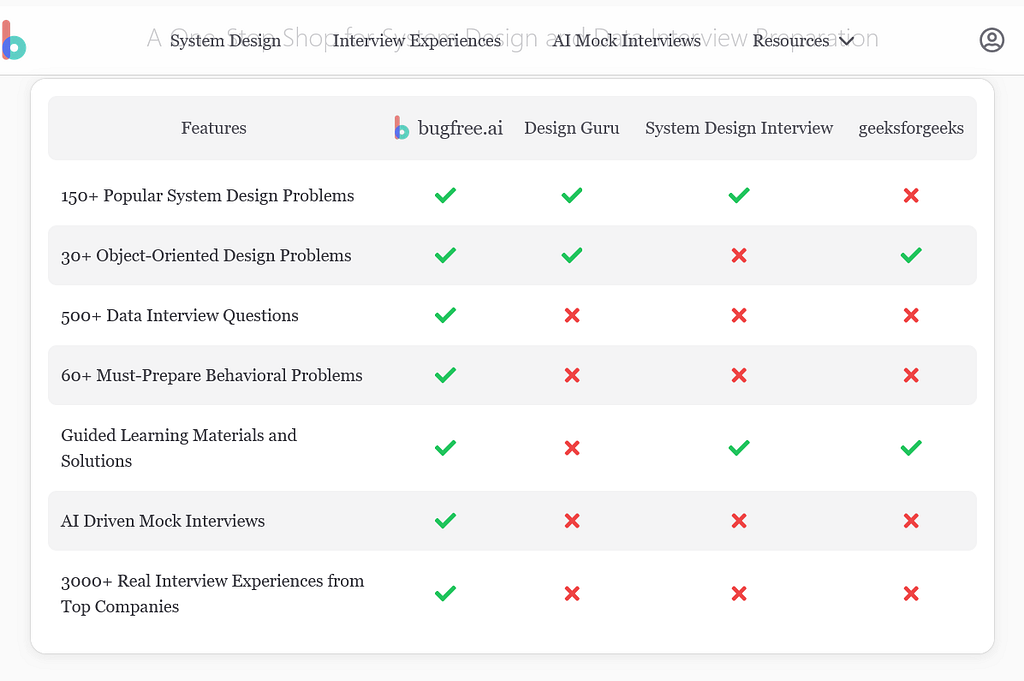
What Makes BugFree.ai Special?
Instead of passive learning, BugFree.ai provides an interactive, hands-on, and AI-powered approach to mastering system design. Here’s what sets it apart:
1. Real-World System Design Problems with Interactive Practice
BugFree.ai offers a comprehensive collection of system design problems structured exactly like LeetCode presents DSA problems — but for architecture and design.
Example: Design URL Shortener
You work through:
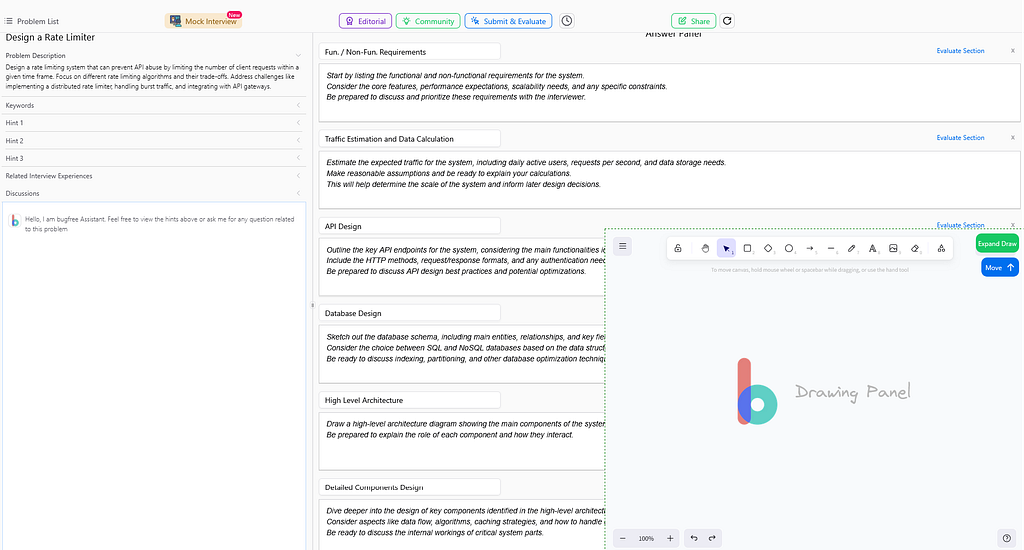
- Functional and Non-Functional Requirements
- Capacity Estimation and Constraints
- API Design and Data Models
- High-Level Architecture
- Deep Dives into Critical Components
- Scalability and Trade-offs
The difference: You don’t just read about URL shorteners — you actually design one step-by-step, with guidance and validation at each stage.
Built-in Drawing Tools:
Just like in real interviews, you get access to an interactive whiteboard where you can sketch architectures, draw component diagrams, and visualize data flows
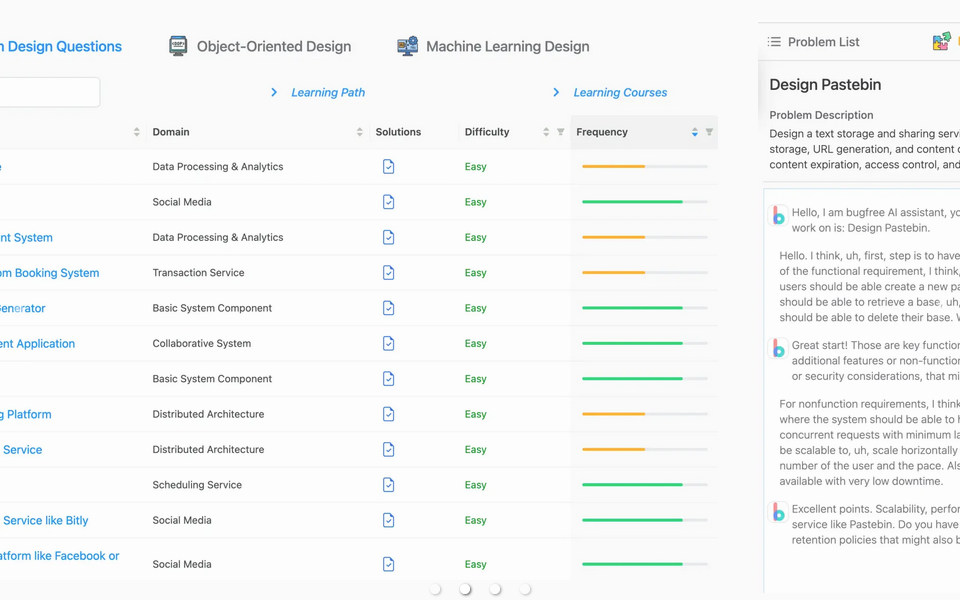
Here are some of the popular System Design questions you can solve on Bugfree.ai for practice:
2. Difficulty-Based Categorization (Just Like LeetCode)
BugFree.ai categorizes problems by difficulty level, making it easy to progress systematically:
Easy — Foundational concepts:
- Load Balancing
- Caching Strategies
- Message Queues
- Basic API Design
Medium — Real-world scenarios:
- Rate Limiting Systems
- Search Autocomplete
- Real-Time Chat Applications
- Notification Systems
Hard — Complex distributed systems:
- Design YouTube/Netflix
- Distributed Databases
- Cloud Storage Systems
- Microservices Architecture
- Design Web Crawler
Each problem includes company tags showing which FAANG and top tech companies ask them, so you can focus your preparation strategically.
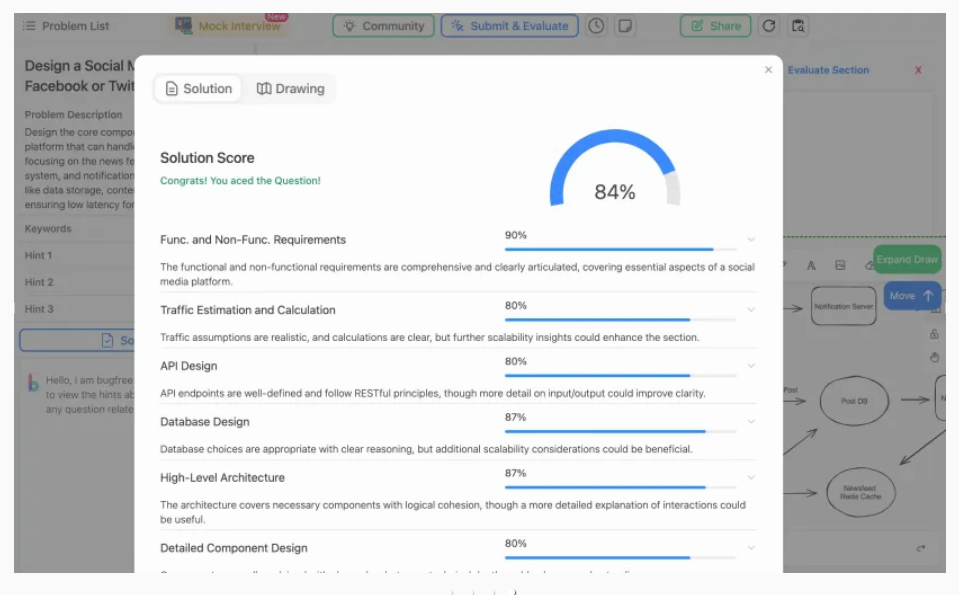
3. AI-Powered Coaching and Feedback
This is where BugFree.ai truly shines — AI-assisted learning that feels like having an expert mentor available 24/7.
How it works:
- Smart Hints: Stuck on a problem? The AI provides hints without giving away the answer.
- Design Evaluation: Submit your design and get automated feedback on scalability, reliability, and best practices.
- Industry Standards: Your solution is evaluated against real-world architectural patterns.
- Interactive Q&A: Ask questions about your design decisions and get immediate clarification
This bridges the gap between self-study and expensive coaching — you get expert-level feedback at a fraction of the cost.
4. AI-Powered Mock Interviews
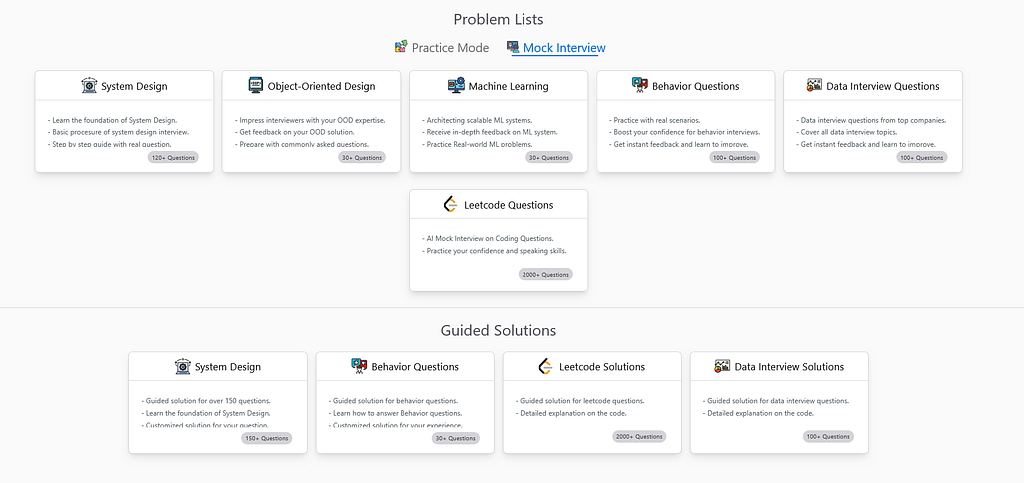
Here’s the feature that sets BugFree.ai apart from every other platform: AI-driven mock interviews.
The Problem with Traditional Mock Interviews:
- Expensive ($200–500 per session)
- Limited availability
- Inconsistent interviewer quality
- Can’t practice as much as you want
BugFree.ai’s Solution:
Unlimited mock interviews powered by AI that simulate real FAANG interview conditions:
- Realistic Interview Experience: Timed sessions with ambiguous requirements (just like real interviews).
- Follow-up Questions: AI interviewer asks probing questions about your design decisions.
- Performance Evaluation: Detailed feedback on communication, technical depth, and trade-off analysis.
- Unlimited Practice: Take as many mock interviews as you need to build confidence
Example: Web Crawler System Design Mock Interview
The AI interviewer guides you through designing a web crawler, asks follow-ups about politeness policies, distributed crawling, and URL deduplication — exactly like a real interview.
My experience: After 10+ mock interviews on BugFree.ai, my real FAANG interview felt comfortable. I’d seen the patterns, practiced the communication, and knew how to structure my answers.
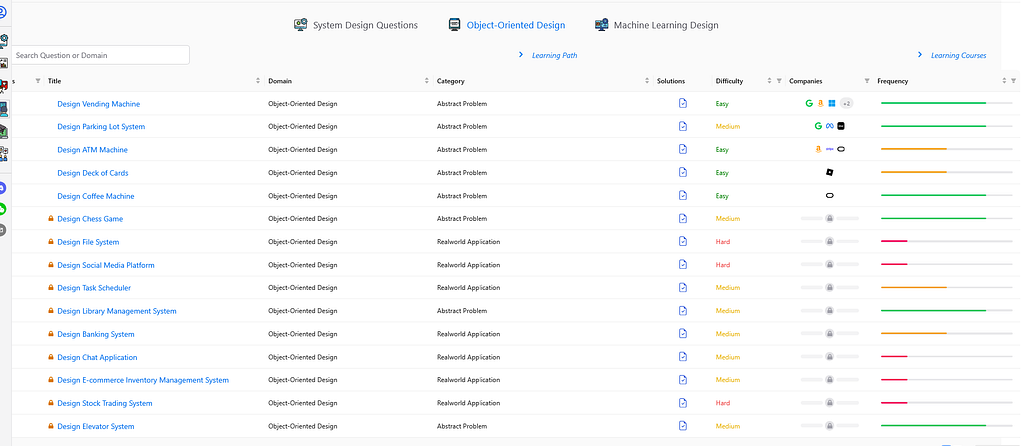
5. Object-Oriented Design (OOD) Practice
System design isn’t the only thing tested at FAANG. Object-Oriented Design (Low-Level Design) is a critical round, especially for senior roles.
BugFree.ai covers this comprehensively:
Classic OOD Problems:
- Parking Lot System
- Elevator System
- ATM Machine
- Library Management System
- Hotel Booking System
- Vending Machine
What you get:
- Step-by-step class design guidance
- UML diagrams and relationships
- Design pattern applications
- SOLID principles in practice
- Trade-offs between different approaches
If you’ve struggled with OOD interviews (many developers do), this is invaluable preparation.
You can see all the OOD problem here.
6. Resume Analysis and Optimization
Here’s an unexpected bonus: AI-powered resume review.
Upload your resume and get:
- ATS optimization — Make sure your resume passes applicant tracking systems
- Keyword suggestions — Align with job descriptions for roles you’re targeting
- Formatting feedback — Professional structure and readability
- Content improvements — Stronger bullet points highlighting impact
Why this matters: Your resume gets you the interview. BugFree.ai helps you get past the first filter.
Resume Builder for Software Engineers – AI-Powered Optimization
Getting Started: My Recommendations
If you’re completely new to system design:
Week 1: Easy Problems
- Start with URL Shortener
- Focus on understanding the framework
- Don’t worry about perfect solutions
- Get comfortable with the platform
Week 2: Build Fundamentals
- Solve 3–4 easy problems
- Learn capacity estimation
- Practice API design
- Understand database selection
Week 3: Medium Problems
- Tackle real-world scenarios
- Focus on scalability patterns
- Learn caching strategies
- Practice load balancing
Week 4: First Mock Interview
- Take your first mock interview
- Don’t expect perfection
- Learn from the feedback
- Identify gaps in knowledge
Then: Continue cycling through problems, mock interviews, and focused learning in weak areas.
What I Wish I Knew Before Starting
1. Don’t Skip the Easy Problems
Even if you’re experienced, start with easy problems. They teach the framework for approaching system design that applies to harder problems.
2. Mock Interviews Are Essential
Solving problems alone isn’t enough. Mock interviews teach:
- Time management (45–60 minute constraints)
- Communication under pressure
- Handling ambiguous requirements
- Explaining trade-offs clearly
3. Review Community Solutions
After solving a problem, always check how others approached it. You’ll discover patterns and optimizations you missed.
4. Focus on Communication
System design interviews test communication as much as technical knowledge. Practice explaining your thinking process clearly.
5. Use the AI Feedback
Don’t just collect problem checkmarks. Study the AI feedback carefully. That’s where real learning happens.
The Bottom Line: Is BugFree.ai Worth It?
After three months of intensive preparation using BugFree.ai, here’s my honest assessment:
What BugFree.ai does exceptionally well:
- Hands-on practice — Actually design systems, don’t just read about them
- AI-powered feedback — Get expert-level guidance on every design
- Unlimited mock interviews — Practice as much as you need
- Structured progression — Clear path from beginner to expert
- Cost-effective — Fraction of traditional mock interview costs
- Comprehensive coverage — System design + OOD + resume help
What could be improved:
⚠️ Human interaction isn’t quite the same (supplement with 1–2 human mock interviews)
⚠️ Community features could be stronger (though improving)
My verdict:
For system design interview preparation, BugFree.ai is the most effective platform I’ve found. It’s truly the LeetCode for system design — combining structured practice, expert feedback, and unlimited mock interviews in one place.
The ROI is obvious: The platform costs less than one traditional mock interview session but provides unlimited practice and comprehensive preparation.
Start here: BugFree.ai
Master System Design & Behavioral Interviews Like Leetcode
Final Thoughts
System design interviews are intimidating, but they’re also learnable and masterable with the right approach.
What doesn’t work:
- Reading endless blog posts without practicing
- Watching YouTube videos passively
- Hoping to “wing it” in interviews
- Paying for expensive mock interviews you can’t afford to repeat
What works:
- Structured hands-on practice
- Regular feedback on your designs
- Mock interviews simulating real conditions
- Systematic improvement over time
BugFree.ai provides all of this in one platform.
After using it to pass FAANG system design interviews, I can confidently say: this is the platform I wish had existed when I first started preparing.
Don’t make the same mistakes I did — scattered preparation across fragmented resources, expensive one-off mock interviews, and no systematic way to validate improvement.
Start practicing on BugFree.ai today. Your future self (and your compensation package) will thank you.
Other System Design Resources You May Find Useful:
- Is DesignGuru’s System Design Course Worth It?
- 16 Best Resources to Prepare for System Design Interview
- Is Exponent’s System Design Course Worth It?
- ByteByteGo Review: Is It Really Worth the Hype?
- 10 Best System Design Courses for Coding Interviews
- Top 5 System Design YouTube Channels
- 3 Best Mock Interview Platforms for System Design
- 10 Reasons to Learn System Design
P.S. — I used BugFree.ai while working full-time. The focused, interactive practice was far more effective than months of random article reading. Share this with engineers preparing for senior roles.
Ready to start? Visit BugFree.ai and begin your system design journey today.
Master System Design & Behavioral Interviews Like Leetcode

I Found LeetCode for Software Design and It’s Awesome was originally published in Javarevisited on Medium, where people are continuing the conversation by highlighting and responding to this story.
This post first appeared on Read More