

Beyond the Lakehouse: Why Your Microsoft Fabric Strategy Needs Neo4j Graph Intelligence

Turning OneLake Data into Connected Intelligence
Today’s data leaders are facing a common paradox: they have more data than ever, centralized in powerful platforms like Microsoft Fabric, yet their AI systems still struggle with complex reasoning. While Fabric’s OneLake provides an incredible foundation for unified data, traditional table-based structures often fail to capture the one thing AI needs most: contextual relationships.
To build truly “AI-ready” foundations, enterprises are moving beyond static data storage. They are integrating Neo4j Graph Intelligence directly into their Fabric environment to turn siloed rows into a connected web of intelligence.
The Missing Link in Enterprise AI
Most data platforms were designed for aggregation and reporting, not the complex, multi-hop reasoning that modern AI demands. If you ask a standard database about “Customer A,” it can tell you their last purchase. If you ask a Graph-powered AI about “Customer A,” it can tell you how their behavior influences “Customer B,” identify potential churn patterns across a shared supply chain, and suggest the next best action based on real-world dependencies.
By adding a graph layer to Microsoft Fabric, businesses can move from simply storing data to modeling the complex, interconnected dependencies of a modern enterprise.
Unlocking Business Value in Microsoft Fabric
Integrating Neo4j with Microsoft Fabric isn’t just a technical upgrade; it’s a value multiplier for your existing data investments.
- Accelerated Time-to-Insight with Text2Cypher: One of the biggest barriers to data democratization is the technical gap in querying. With Text2Cypher capabilities, users can turn natural-language questions into complex graph insights directly from their OneLake data. This allows business analysts to ask “Show me all suppliers impacted by this regional delay” without writing a single line of code.
- Operationalizing Complex Networks: Graph algorithms turn static data into a living model of your business. This is the foundation for Digital Twins in manufacturing, real-time fraud detection in banking, and churn prediction in retail. By mapping these physical and logical dependencies, you can simulate outcomes and optimize performance directly within the Fabric ecosystem.
- Breaking Down Silos: Surface hidden patterns across previously siloed data without the “extract, transform, load” (ETL) nightmares of the past. Your data stays in OneLake, but your insights become exponentially more connected.
Relationship First Architecture
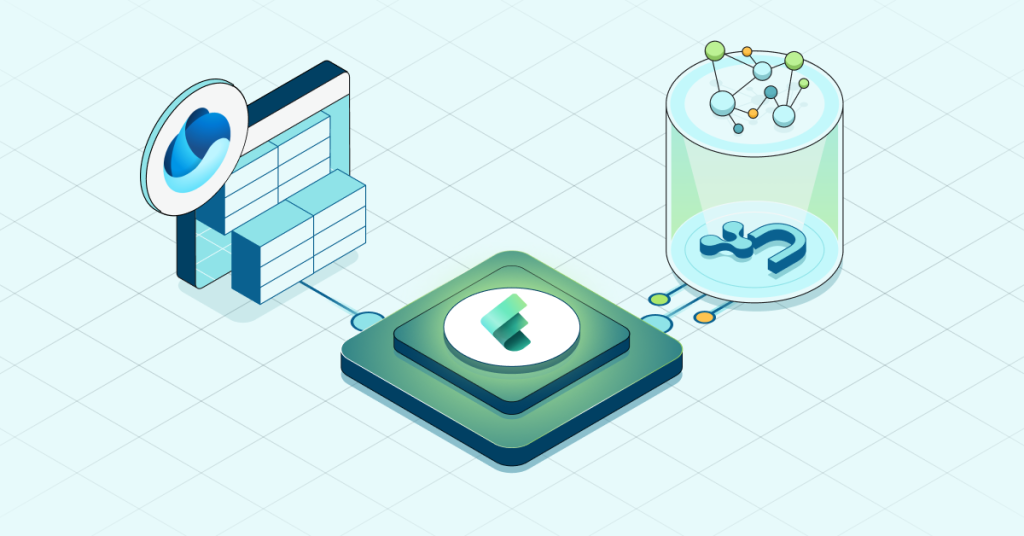
The power of this solution lies in its architectural simplicity. You don’t need to move your data out of the Microsoft ecosystem to gain graph intelligence; instead, Neo4j sits alongside OneLake to provide a specialized high-performance relationship layer.
- Unified Storage in OneLake: Your structured and semi-structured data lives in Microsoft Fabric’s OneLake, ensuring a single source of truth.
- Zero-ETL Graph Projection: Using native connectors, Neo4j “projects” the relevant relationships from Fabric into a graph schema. This avoids the overhead of traditional data movement.
- Graph Data Science & Inference: Once the data is in Neo4j, you can run graph algorithms—like centrality or community detection—to find hidden bottlenecks or high-risk nodes that traditional SQL queries would miss.
- Actionable Insights in Fabric: The resulting graph-enhanced insights (like risk scores or recommendation clusters) are written back to Fabric, where they can be visualized in Power BI or used to ground your Azure OpenAI models.
Ready to see graph in action?
Walk through architectural best practices for connecting OneLake to Graph Intelligence, watch a live Digital Twin demo, and explore the future of unified data analytics in this webinar.
A Foundation Built for the Future
The goal for 2026 isn’t just to have a “data strategy”—it’s to have an “intelligence strategy.” By combining the unified power of Microsoft Fabric with the relationship-first approach of Neo4j, organizations are building systems that don’t just store information, but actually understand it.
Whether you are looking to evolve your data schemas automatically or provide more structural grounding for your LLMs, the combination of Fabric and Neo4j provides the structural foundation that modern AI systems rely on for reasoning and decision support. Get started for free on the Azure Marketplace.
This article first appeared on Read More