

Ethereum vs Solana in 2026: Let’s Talk About Which Blockchain Is Actually Winning
The Crypto Debate Everyone Is Having Right Now
Last week, something interesting happened in the crypto market.
While traders were watching price charts and developers were shipping new updates, two blockchain ecosystems were quietly dominating the conversation: Ethereum and Solana.
On one side, billions of dollars continued flowing through DeFi protocols running on Ethereum.
On the other, Solana processed millions of fast and low-cost transactions as NFT traders, meme coin communities, and gaming projects flooded the network.
If you spend even a few minutes in crypto communities, whether on X (Twitter), Discord, or developer forums, you’ll see the same question repeated again and again:
Is Ethereum still the king of blockchain, or is Solana becoming the new powerhouse?
This question isn’t just about technology.
It’s about the future of decentralized finance, Web3 applications, and the next generation of internet infrastructure.
So let’s break it down in a practical and realistic way.
Instead of hype or speculation, we’ll focus on real data, market activity, and what’s actually happening in crypto today.
What Happened in the Crypto Market Recently?
Over the past week, several indicators highlighted the growing competition between the two ecosystems.
• DeFi platforms on Ethereum processed billions in lending and liquidity transactions.
• NFT marketplaces on Solana saw a surge in trading activity.
• New meme coins launched on Solana attracted thousands of new wallets in hours.
This illustrates something important. Different types of applications prefer different blockchain environments.
For example:
A high-frequency trader may prefer Solana because of its low fees and speed. A DeFi protocol managing billions in liquidity might prefer Ethereum because of its stability and security.
These differences explain why the Ethereum vs Solana debate is more complex than simply choosing the “better” blockchain.
Understanding Ethereum and Solana: Two Different Blockchain Visions
At first glance, both Ethereum and Solana appear to do the same thing. They allow developers to build decentralized applications and run smart contracts. But their technical philosophies are very different.
Ethereum focuses on:
• decentralization
• long-term security
• financial infrastructure
Solana focuses on:
• extreme performance
• scalability
• consumer-level applications
Think of it like comparing two types of cities.
Ethereum is like a global financial capital, full of institutions and established infrastructure.
Solana is more like a fast-growing tech hub, attracting startups and high-speed innovation.
Both are important, but they serve different roles.
Market Capitalization: Why Ethereum Still Leads the Blockchain Economy
One of the clearest indicators of blockchain adoption is market capitalization. In 2026, Ethereum still holds a commanding lead.
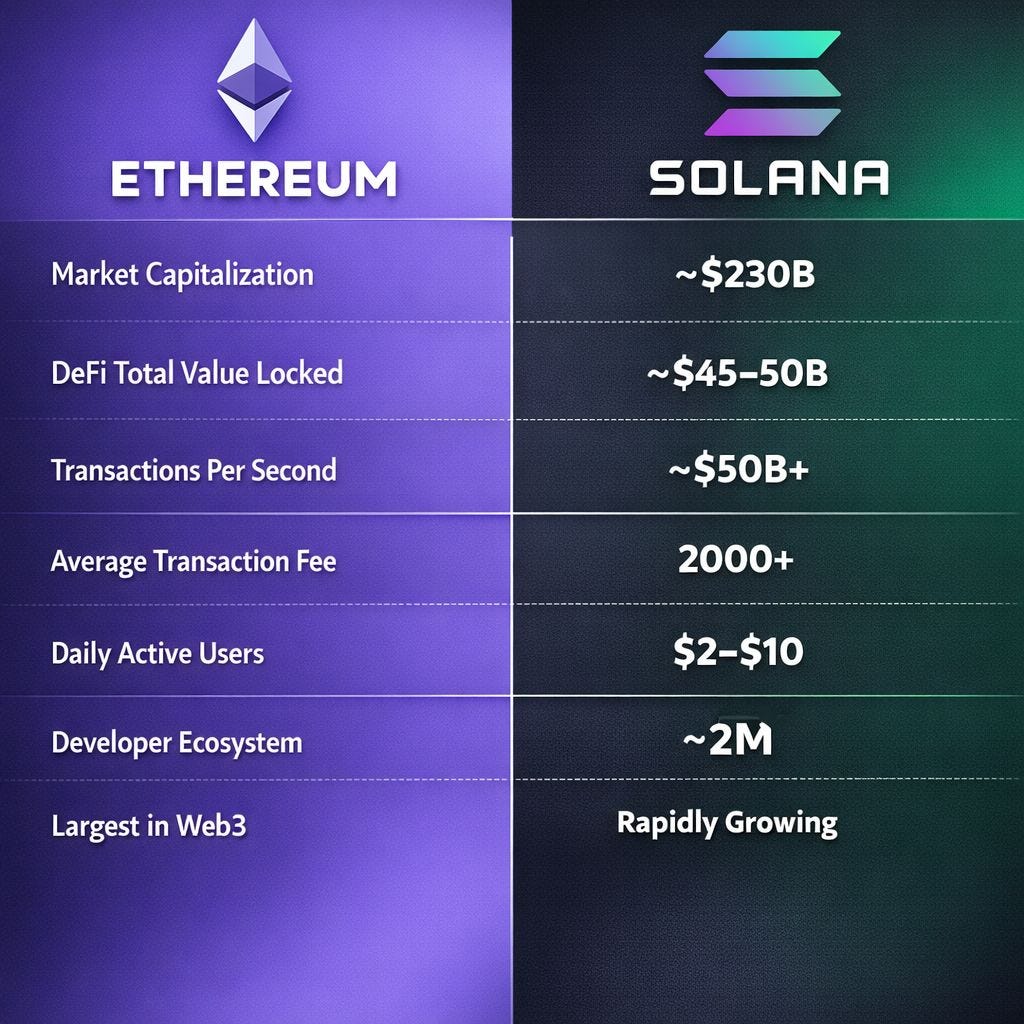
Ethereum’s market capitalization is estimated at over $230 billion, while Solana’s market cap sits around $45–50 billion. This gap exists for several reasons:
Ethereum has been operating longer, giving it more time to build trust and liquidity. It also hosts a massive ecosystem of decentralized applications, financial protocols, and stablecoins.
These factors create strong network effects. The more developers and users build on Ethereum, the stronger its ecosystem becomes.
Quick Comparison Table: Ethereum vs Solana
DeFi Dominance: Where Billions of Dollars Are Flowing
Decentralized finance remains one of the most important sectors in the blockchain industry.
Platforms built on Ethereum allow users to:
• lend assets
• borrow funds
• trade tokens
• earn yield
According to data from DeFiLlama, Ethereum continues to dominate DeFi liquidity.
Ethereum’s total value locked in DeFi protocols exceeds $50 billion.
Solana’s DeFi ecosystem is smaller, with approximately $7–8 billion locked in various protocols.
While Solana is growing rapidly, Ethereum still acts as the primary financial settlement layer for decentralized finance.
Transaction Speed and Scalability: Solana’s Biggest Advantage
Where Solana truly shines is performance.
Solana was designed to process extremely high numbers of transactions.
Its architecture allows it to handle thousands of transactions per second, making it one of the fastest blockchains available.
This performance makes Solana particularly attractive for applications like:
• blockchain gaming
• NFT marketplaces
• payment platforms
• social media dApps
For these types of applications, speed and low transaction costs are critical.
Gas Fees vs Low Fees: The Cost Battle
Transaction costs have always been a controversial topic in blockchain.
Ethereum transactions often involve gas fees, which fluctuate depending on network demand.
During periods of heavy activity, Ethereum transaction fees can reach several dollars.
Solana, in contrast, typically charges fractions of a cent per transaction.
This difference makes Solana ideal for high-volume applications.
For example, if a gaming platform processes thousands of in-game transactions per minute, paying several dollars per action would be impossible.
Low fees allow developers to build consumer-friendly applications at scale.
User Growth: Why Solana Is Attracting Millions
Another area where Solana excels is daily user activity.
Solana frequently processes millions of daily transactions, and its network attracts a rapidly growing number of active wallets.
Recent blockchain analytics suggest that Solana has over two million active users on busy days, compared to roughly 600,000 daily active wallets on Ethereum.
This doesn’t necessarily mean Ethereum is losing.
Instead, it reflects the different types of users each network attracts.
Ethereum attracts financial infrastructure and large liquidity pools.
Solana attracts high-activity consumer applications.
Stablecoins: Ethereum’s Financial Infrastructure
Stablecoins are one of the most important components of the crypto economy.
They enable fast digital payments while maintaining price stability.
Ethereum hosts the largest stablecoin ecosystem.
More than $160 billion worth of stablecoins circulate on Ethereum-based networks.
Solana’s stablecoin supply is smaller but growing, currently estimated at around $15 billion.
Because stablecoins are essential for trading and lending, this gives Ethereum a significant advantage in financial markets.
Developer Ecosystem: Where Innovation Happens
Developers are the backbone of blockchain ecosystems. As the demand for Web3 engineers grows, many companies rely on experienced blockchain development teams to design secure and scalable decentralized platforms.
Ethereum currently has the largest developer community in Web3.
Thousands of engineers contribute to Ethereum-based projects, building decentralized applications, financial protocols, and infrastructure tools.
Solana’s developer ecosystem is growing quickly, supported by venture funding, grants, and global hackathons.
However, Ethereum still maintains a strong lead in terms of overall development activity.
Security and Stability: Trust Matters
Security is critical when billions of dollars are involved.
Ethereum has been operating for nearly a decade and has proven highly resilient.
Its large validator network and mature ecosystem contribute to its reputation as one of the most secure blockchains.
Solana has experienced several network outages in the past, though improvements in infrastructure continue to strengthen its reliability.
For large financial applications, security and stability remain top priorities.
The Future of Web3: Can Both Blockchains Win?
The crypto industry often frames blockchain competition as a battle with a single winner.
But reality is more nuanced.
Different networks specialize in different areas.
Ethereum may continue dominating decentralized finance and institutional blockchain infrastructure.
Solana may lead high-speed consumer applications and real-time decentralized platforms.
Instead of replacing each other, these ecosystems may evolve to support different layers of the Web3 economy.
Final Verdict: Which Blockchain Is Winning in 2026?
After analyzing the data, a clear pattern emerges.
Ethereum leads in:
• market capitalization
• DeFi liquidity
• stablecoin infrastructure
• developer community
• institutional adoption
Solana leads in:
• transaction speed
• network throughput
• user activity
• low transaction costs
In simple terms:
Ethereum dominates financial infrastructure, while Solana dominates performance and scalability.
Both ecosystems are expanding rapidly, and both will likely remain major players in the future of blockchain technology.

Ethereum vs Solana in 2026: Let’s Talk About Which Blockchain Is Actually Winning was originally published in Javarevisited on Medium, where people are continuing the conversation by highlighting and responding to this story.
This post first appeared on Read More