

Someone Forked Systemd to Strip Out Its Age Verification Support
systemd is the init system and service manager that most major Linux distributions ship with by default. It boots the system, manages services, and has taken on more responsibilities over the years than a lot of people think it should. For some, running a distro that avoids it entirely is a feature.
The project’s latest move has not helped its reputation among the skeptics. Last week, developers merged a pull request adding a birthDate field to its user records, tied to age verification laws in California, Colorado, and Brazil.
Earlier, we covered what that actually means, but to recap, the field is optional, can only be set by an administrator, and systemd itself does nothing with the data. It is simply a standardized field in the user record file that other projects like xdg-desktop-portal can build age verification compliance on top of—distros that do not need it can ignore it entirely.
But “optional” has not been enough to stop people from treating it as a line being crossed, and now a solo developer has responded the way the open source community usually reacts: by forking.
Liberated as in?
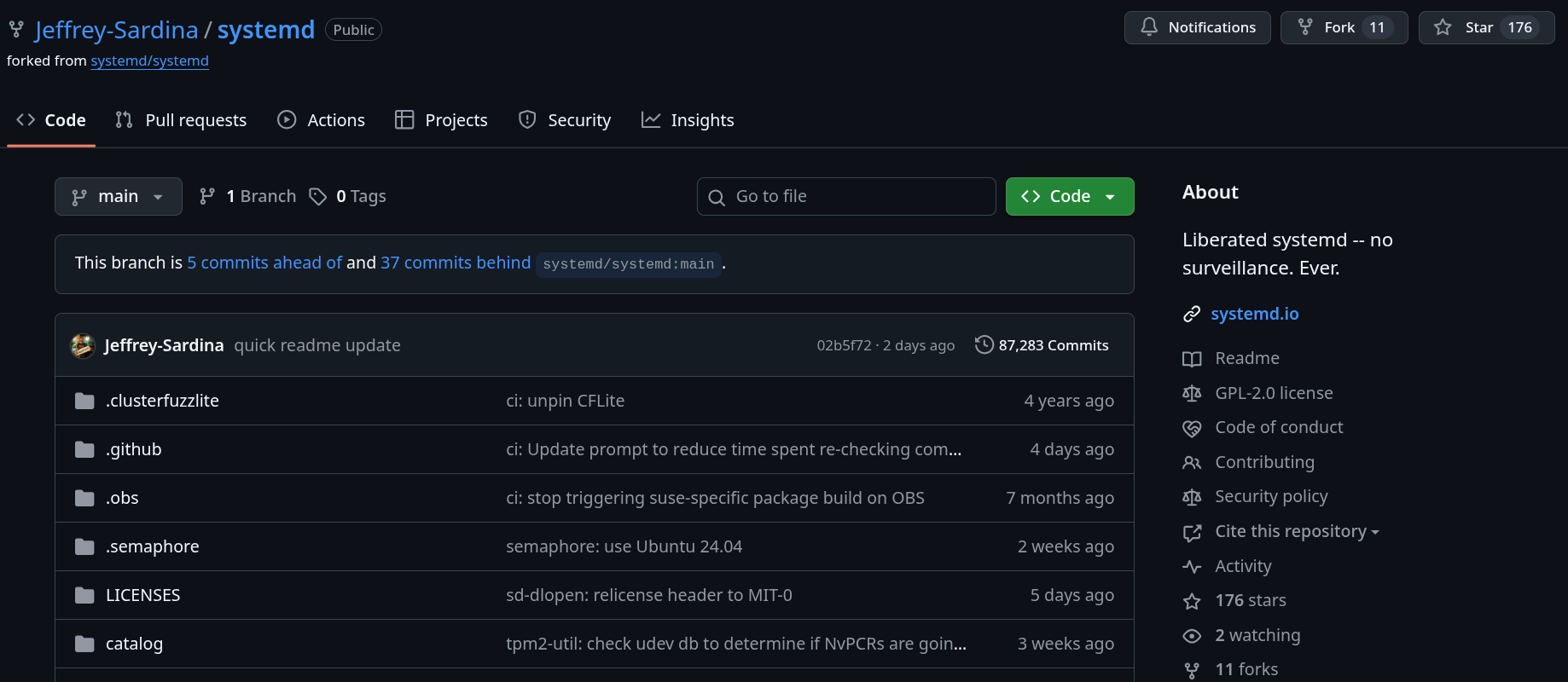
Liberated systemd is a fork of mainline systemd started by Jeffrey Seathrún Sardina, a machine learning/AI researcher who apparently had enough of where things were heading. The project is straightforward about its purpose; strip out what it considers surveillance-enabling code, keep everything else intact, and stay in sync with upstream as it develops.
The repository puts it bluntly:
Mass surveillance is bad, actually. So here’s a fork of
systemdwith surveillance enablement removed, which will be kept up-to-date with other changes insystemd/main. However you use this, or do not, is your choice and yours alone.
Compared to mainline systemd, the fork changes 12 files across 5 commits, all focused on scrubbing out everything related to the birthDate addition. That means not just the field itself but also the option to set a birth date via homectl, the relevant man page entries, display code, and tests.
Though, as of writing this, it was 37 commits behind from systemd, so that is something to keep in mind if you are hoping to implement this on a general-use or production system.
Jeffrey also maintains a companion repository, systemd-suite, which is meant for testing the fork. So, while this is very much a one-person project, there seems to be at least some technical groundwork behind it beyond the birthDate revert.
Some thoughts…
Whether Liberated systemd becomes anything more than a protest fork is a fair question. It is a one-person project with no releases, and keeping a revert rebased against an actively developed codebase is not a trivial long-term commitment. If you are thinking about building a distro around it right now, you probably should not.
But that might not be the point. Forks like this are meant to ignite conversation rather than ending up as a significant open source project. If age verification requirements tighten, and given the direction things are headed, that is not a wild assumption, then the community forking its way out of an uncomfortable situation makes sense.
And one of these forks might actually make it into some Linux distribution in the near future; who knows?
Suggested Read 📖: Ageless Linux emerges to resist OS-level age verification

This article first appeared on Read More