

5 Tech Offers Side-by-Side: The Real Numbers
Google, Meta, Amazon, Stripe, and a Series B startup. All offered in the same month. Here’s what they actually paid — and which one I picked.
Let me show you something most people never see.
Five offer letters. Same month. Same candidate (me). Wildly different numbers.
I’m going to break down every dollar. Base salary, equity, signing bonus, the works.
No humble-bragging. No “I’m so lucky” BS. Just the raw data.
Because here’s what nobody tells you: knowing what companies actually pay is worth $50K+ in your next negotiation.
Let’s get into it.
The Setup
February 2024. I was a Senior Engineer at a mid-sized tech company making $155K total comp.
Not bad. But I knew I was underpaid.
So I did something stupid (or genius, depending on how you look at it):
I applied to 47 companies in 2 weeks.
Why so many? Because I wanted leverage. Multiple offers = negotiating power.
The result: 5 offers. All in the same 3-week window.
Here’s how it went down.
Offer #1: Amazon
Role: Senior SDE II
Location: Seattle (remote option available)
The Numbers:
- Base Salary: $175,000
- Year 1 Stock: $45,000
- Year 2 Stock: $45,000
- Year 3 Stock: $90,000
- Year 4 Stock: $90,000
- Signing Bonus Year 1: $75,000
- Signing Bonus Year 2: $55,000
Total Comp Year 1: $295,000
Total Comp Year 2: $275,000
4-Year Average: $268,750/year
The Catch:
Amazon’s vesting schedule is brutal.
5% year 1, 15% year 2, 40% year 3, 40% year 4.
They front-load with signing bonuses to offset the cliff. But if you leave before year 3? You leave $180K on the table.
My Reaction:
“Holy shit, $295K year one.”
Then I did the math. After taxes and that vesting schedule? It’s a golden handcuff.
Offer #2: Google (via recruiter cold reach)
Role: L5 Senior Software Engineer
Location: Mountain View / Remote hybrid
The Numbers:
- Base Salary: $200,000
- Stock (GSU): $280,000 (4-year vest, 25% per year)
- Signing Bonus: $50,000
Total Comp Year 1: $320,000
4-Year Average: $320,000/year
The Catch:
Google refreshers are legendary. L5s typically get $80K-$120K/year in refreshers after year 2.
But… there’s the performance review culture. Stack ranking is real. And if you’re not hitting “exceeds expectations,” those refreshers shrink fast.
My Reaction:
This was the number I wanted to beat. $320K felt like “made it” money.
But I kept interviewing.
Offer #3: Meta
Role: E5 Software Engineer
Location: Menlo Park / Full remote allowed
The Numbers:
- Base Salary: $205,000
- Stock (RSU): $320,000 (4-year vest, 25% per year)
- Signing Bonus: $100,000
Total Comp Year 1: $385,000
4-Year Average: $385,000/year
The Catch:
Meta’s RSUs are tied to stock price. In 2024, Meta stock was up 180% from 2022 lows.
That $320K grant? Could be worth $500K+ if the stock keeps climbing.
Or it could tank. That’s the bet.
Also: Meta’s performance culture is intense. PIPs are common. 15% of E5s don’t make it past their first year.
My Reaction:
“This is insane money.”
But the risk factor was real. One bad quarter, one re-org, and you’re gone.
Offer #4: Stripe
Role: L3 Senior Engineer
Location: San Francisco / Remote
The Numbers:
- Base Salary: $215,000
- Stock Options: $350,000 strike value (4-year vest)
- Signing Bonus: $75,000
Total Comp Year 1: $377,500
4-Year Average: $302,500/year
The Catch:
Options, not RSUs.
Stripe’s not public. Those options are worth $350K if Stripe goes public and if the valuation holds.
Current private valuation: $50B (down from $95B in 2021).
So that $350K could be worth $700K. Or $0.
My Reaction:
I loved Stripe’s engineering culture. Best code reviews I’d ever seen during interviews.
But betting $350K on an IPO that might never happen? Risky.
Offer #5: Series B Startup
Role: Staff Engineer (first engineering hire outside founders)
Location: SF / Full remote
The Numbers:
- Base Salary: $185,000
- Stock Options: 0.8% equity
- Signing Bonus: $25,000
Total Comp Year 1: $210,000 (on paper)
If exit at $500M: $4,000,000 (assuming standard dilution)
If exit at $100M: $800,000
If exit at $0: $210,000 total over 4 years
The Catch:
0.8% sounds great. But:
- Series B valuation: $120M
- Likely 2–3 more funding rounds before exit
- Dilution will cut that to ~0.3–0.4%
- 90% of startups fail
Also, I’d be working 60+ hour weeks. No work-life balance.
My Reaction:
The gambler in me loved it. The part of me that pays a mortgage hated it.
The Comparison Table
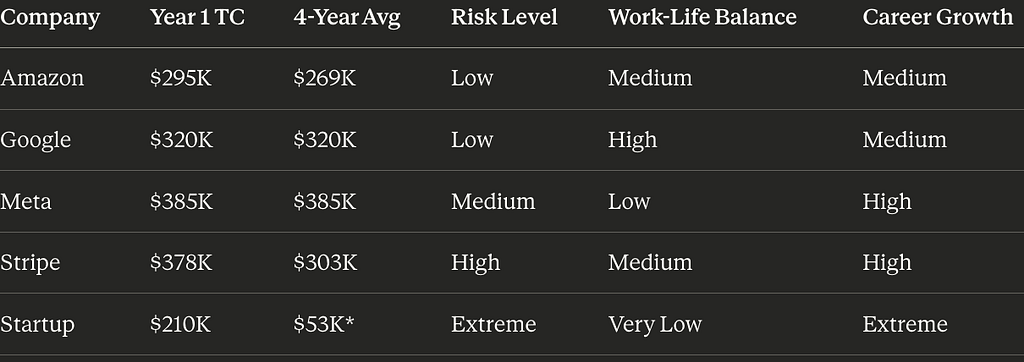
*Assuming no exit
What I Actually Chose (And Why)
I picked Meta.
Not because it was the highest number (though it was).
Because of this:
The 3-Year Plan:
Year 1: Make $385K, save aggressively
Year 2: Get promoted to E6 (refresher bumps to $450K+)
Year 3: If still at Meta, total comp $500K+. If not, exit to startup with $800K saved.
Meta gave me the fastest path to “fuck you money.”
Could I have made more at the startup if it 10x’d? Yes.
But I’d already failed at one startup. Lost 2 years and $60K in opportunity cost.
I wasn’t gambling again.
One year later:
Still at Meta. Total comp: $420K (stock went up, got a small refresher).
Was it the right call? I think so.
But ask me again in 2 years.
What This Data Taught Me
1. Total comp is a lie (sort of)
Amazon’s “$295K year 1” isn’t really $295K.
After taxes (I’m in California, so ~40% effective rate):
- Take home: ~$177K
Google’s $320K?
- Take home: ~$192K
The difference? $15K/year. Not life-changing.
Lesson: Focus on 4-year average, not year 1 spikes.
2. Equity is fake money until it’s not
Stripe’s $350K in options? Worth $0 today.
Meta’s $320K in RSUs? I can sell $20K every quarter. Real money.
Lesson: RSUs > Options (unless you’re okay gambling).
3. Signing bonuses are retention tricks
Amazon’s $130K in signing bonuses over 2 years looks amazing.
Until you realize it’s because their equity vests so slowly.
They’re paying you to stay. And it works.
Lesson: If you leave early, you leave money on the table. Plan accordingly.
4. Negotiations are 90% leverage
I didn’t negotiate with Amazon. Took their first offer.
Result: Probably left $20K on the table.
With Meta? I had 4 other offers. Used Google’s $320K as my baseline.
Recruiter came back with $385K.
Lesson: Multiple offers = leverage. Always interview at multiple places.
5. Location “matters” but not how you think
All 5 offers: Remote or hybrid.
But Meta and Google required “proximity to an office” (within 50 miles).
Amazon and Stripe? Fully remote, any state.
The catch: Remote roles often pay 10–15% less than SF/NYC roles.
Lesson: Remote ≠ remote. Read the fine print.
The Negotiation Tactics That Worked
Tactic #1: Name-drop competing offers (but be smart about it)
Bad: “Amazon offered me $295K, can you beat it?”
Good: “I have an offer from a FAANG company in the $320K range. I’m very interested in Meta, but I need to understand how you’re thinking about comp for this role.”
Don’t be adversarial. Be collaborative.
Tactic #2: Ask for what you want, then shut up
Me: “Based on my experience and the market, I’m looking for $350K total comp.”
Recruiter: “Let me see what I can do.”
[Silence]
Don’t fill the silence. Let them work.
Tactic #3: Use equity as the negotiation lever
Base salary? Hard to move.
Signing bonus? Capped.
Equity? Flexible.
I asked for 20% more equity. Got 15%.
That 15% = $48K/year for 4 years.
Lesson: Always negotiate equity, not just base.
What I’d Do Differently
Mistake #1: I didn’t negotiate with Amazon
Took their first offer. Probably left $20–30K on the table.
Even if you’re not taking the offer, negotiate. It’s practice.
Mistake #2: I should’ve asked for more PTO
Meta gives 15 days. I could’ve asked for 20.
Didn’t even think about it. Focused only on money.
Dumb move. Time > money (to a point).
Mistake #3: I didn’t ask about team placement
Got assigned to a team I didn’t care about.
6 months later, had to transfer (political nightmare).
Lesson: Ask about team, manager, and project before accepting. Comp isn’t everything.
The Real Numbers Other People Don’t Share
I asked 12 friends to anonymously share their offers.
Here’s what I learned:
New Grad (2024):
- Google L3: $180K total comp
- Meta E3: $200K total comp
- Amazon SDE I: $160K total comp
Senior (5–7 YOE):
- Google L5: $300K-$350K
- Meta E5: $350K-$420K
- Amazon SDE II: $250K-$300K
Staff (8–12 YOE):
- Google L6: $450K-$550K
- Meta E6: $500K-$650K
- Amazon Principal: $400K-$500K
The spread is HUGE.
Two E5s at Meta can differ by $100K based on negotiation and team.
How You Can Use This Data
Step 1: Know your market value
Use levels.fyi. Cross-reference with Blind.
Don’t trust recruiters when they say “this is our standard offer.”
It’s not.
Step 2: Interview at multiple companies simultaneously
2–3 offers = some leverage
4–5 offers = serious leverage
1 offer = no leverage
Batch your interviews. Apply to 20–30 companies in one week.
Step 3: Delay the offer deadline
“I need 2 weeks to make this decision.”
Companies will push back. Stand firm.
Use that time to finish other interview loops.
Step 4: Don’t be afraid to walk away
I turned down $385K from Meta initially (they came back higher).
Best negotiation move I ever made.
If they want you, they’ll come back.
The One Thing That Matters More Than Money
Here’s what I learned after getting 5 offers:
Comp doesn’t matter if you hate the work.
I optimized for money. Picked the highest number.
6 months later, I realized:
- I don’t care about Meta’s product
- I’m building features I don’t believe in
- I’m miserable (but well-paid)
Would I do it again? Probably.
But if I were 25 and not 32? I’d pick the startup.
Money isn’t everything. But it sure helps you sleep at night.
What I’m Building Now
After going through this process, I realized:
Most people negotiate blind. They don’t know what companies actually pay.
So I’m building transparency into the process: ProdRescue AI
It’s not just about interviews. It’s about understanding how tech companies actually work.
Real production incidents. Real trade-offs. Real decisions.
Because the best interview prep? Understanding what you’ll actually be doing if you get the job.
Want the complete interview playbook that got me these 5 offers?
Everything’s documented here: Interview Success Kit
System design framework, coding patterns, behavioral templates, negotiation scripts — the works.
It’s what I used to go from 0 offers to 5 in one month.
More transparent breakdowns like this every week:
Subscribe on Substack
No LinkedIn humble-brag BS. Just real numbers, real mistakes, real lessons.
What’s your current TC and where are you interviewing?
Drop it in the comments. I’ll tell you if you’re underpaid (spoiler: you probably are).
And if you’re negotiating an offer right now — don’t accept the first number. Ever.
You’re worth more than you think.

5 Tech Offers Side-by-Side: The Real Numbers was originally published in Javarevisited on Medium, where people are continuing the conversation by highlighting and responding to this story.
This post first appeared on Read More