

How Codemia.io Mock Interviews Helped Me Crack System Design Interviews?
A practical guide to using peer practice and structured learning for FAANG interview success
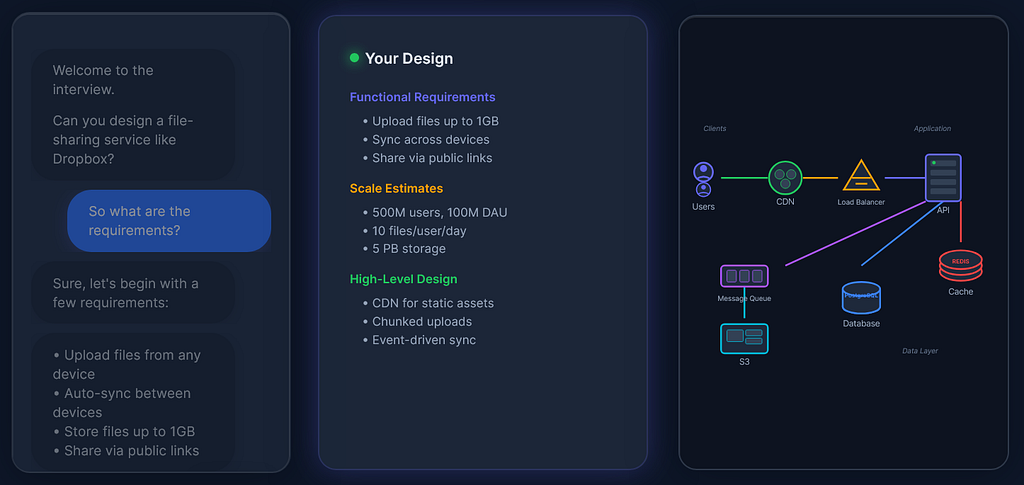
Hello friends, I’d been preparing for system design interviews for about few months. I watched countless YouTube videos, read blog posts, sketched architectures on paper, and memorized common patterns.
On paper, I felt prepared.
Then I did my first mock interview with a friend.
It was awkward.
I stumbled through my explanation. Forgot to ask clarifying questions. Couldn’t articulate trade-offs clearly. My 45-minute practice session felt like an hour of confusion.
The wake-up call: Knowing concepts and actually interviewing are completely different skills.
I could design systems on paper. But I couldn’t:
- Communicate my thinking process clearly
- Handle unexpected follow-up questions
- Manage time effectively (spent 30 minutes on requirements gathering)
- Explain trade-offs without sounding uncertain
I needed practice. Real practice. With real people.
That’s when I discovered Codemia.io and their structured approach to mock interviews.

What Makes Codemia.io Different?
Most interview prep platforms give you courses and questions. Codemia.io does something more valuable: it connects you with real people for practice interviews or mock interviews.
How It Actually Works
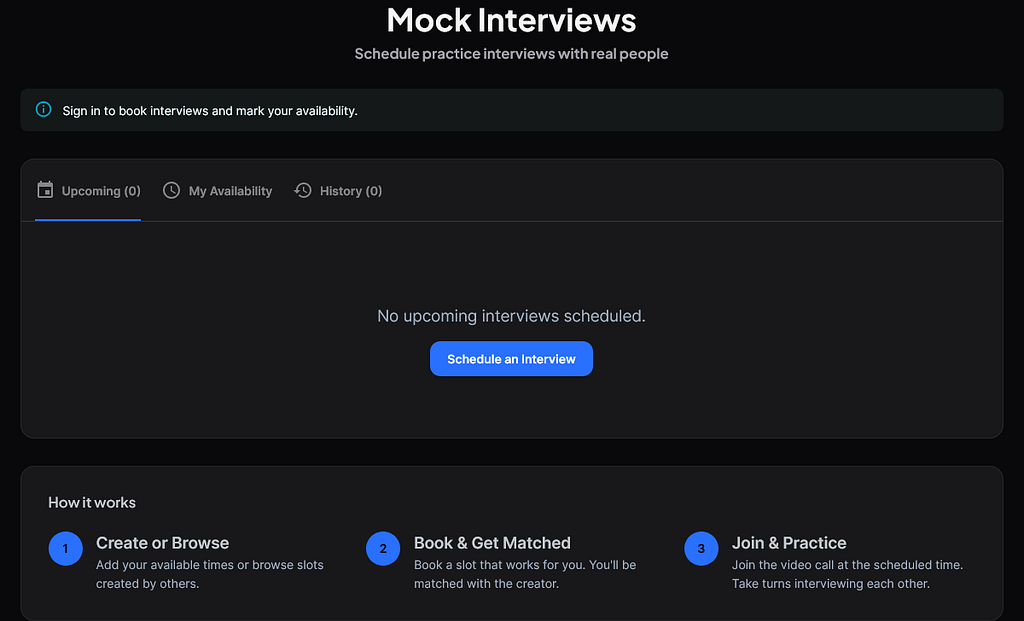
The process is surprisingly simple:
1. Create or Browse Available Slots
You can either:
- Create your own slot: Set your availability (e.g., “Saturday 2 PM — System Design Practice”)
- Browse existing slots: Find times that work for your schedule
2. Book & Get Matched
- Choose a slot that fits your calendar
- Get matched with the person who created it
- Receive confirmation with meeting details
3. Join & Practice
- Join the video call at scheduled time
- Take turns interviewing each other (45 min each)
- Give and receive feedback
- Both people benefit from the practice
The brilliance: Everyone’s both interviewer and candidate. You learn from both perspectives.
Here is the link — book your first mock interview
My First Codemia Mock Interview Experience
Session 1: Reality Check
I booked a system design mock interview with another engineer preparing for Meta interviews.
My turn as candidate:
Question: “Design a URL shortener like bit.ly”
I thought this would be easy. I’d seen this problem dozens of times.
What went well:
- Defined functional requirements (shorten URL, redirect)
- Sketched basic architecture
- Discussed database choice
What went poorly:
- Didn’t ask about scale until 20 minutes in
- Forgot to discuss how to generate short URLs (important detail!)
- Couldn’t explain why I chose SQL over NoSQL convincingly
- Ran out of time before discussing caching
My turn as interviewer:
I asked: “Design Instagram’s feed”
This was eye-opening.
Watching someone else go through the problem, I noticed:
- Good candidates ask lots of clarifying questions upfront
- They think out loud, even when uncertain
- They discuss multiple approaches before choosing one
- They manage time by setting mini-deadlines (“I’ll spend 10 min on high-level design”)
Feedback I received:
My partner said:
- “You know the concepts, but you need to structure your answer better”
- “Ask about scale first — it changes everything”
- “Discuss trade-offs for each choice, don’t just pick one solution”
This 1-hour+ session taught me more than 2 weeks of solo study.
How I Used Codemia to Improve Systematically?
After that first session, I created a structured practice plan using Codemia.io.
Week 1–2: Fundamentals + First Mocks
Study:
- Took System Design Fundamentals course
- Learned basic building blocks (load balancers, caches, databases)
- Reviewed common patterns
Practice:
- 2 mock interviews on basic designs (URL shortener, Pastebin)
- Focus: Getting comfortable explaining my thinking
- Learned: I talk too fast when nervous
Improvement: Started practicing “pause and think” before answering.
Week 3–4: Pattern Recognition + More Mocks
Study:
- Completed Tackling System Design Interview Problems
- Studied common patterns for social networks, messaging, storage
Practice:
- 3 mock interviews (Twitter, Instagram, WhatsApp)
- Started recording sessions (with permission) to review later
- Noticed patterns in interviewer questions
Key insight: Interviewers always ask about scale, failure handling, and trade-offs. I prepared better answers for these.
Week 5–6: Complex Systems + Advanced Topics
Study:
- Explored problems on Codemia’s System Design section
- 120+ problems covering different complexity levels
- Practiced estimation (QPS, storage, bandwidth)
Practice:
- 4 mock interviews (YouTube, Uber, distributed cache, recommendation system)
- Alternated between being interviewer and candidate
- Started timing each section (requirements: 5 min, high-level: 15 min, deep-dive: 20 min)
Breakthrough: My explanations became clearer. I could handle curveball questions.
Week 7–8: Polish + Weak Areas
Study:
- Reviewed object-oriented design patterns on OOP Design section
- Many system design interviews also test OOP design
- Learned: Class diagrams, design patterns, API design
Practice:
- 3 system design mocks focusing on areas I struggled with
- 2 OOP design mocks (design parking lot, design chess game)
- Mock interview with someone who works at Google (found through Codemia)
Result: Felt confident enough to schedule real interviews.
What I Learned From Being the Interviewer?
Unexpected benefit: Interviewing others taught me as much as being interviewed.
Insights From the Other Side
1. Good candidates think out loud
When I interviewed people, the best candidates:
- Verbalized their thought process
- Explained why they considered and rejected certain approaches
- Asked me if they were on the right track
Lesson: Communication > perfect solution
2. Clarifying questions show expertise
Candidates who asked smart questions impressed me:
- “What’s the read/write ratio?”
- “Do we need strong consistency or is eventual consistency okay?”
- “Are we optimizing for low latency or high availability?”
These questions showed they understood trade-offs.
3. Time management is crucial
I noticed when candidates:
- Spent too long on basics
- Rushed through important details
- Didn’t leave time for scale discussion
Lesson: I started using a mental timer for each interview section.
4. Explaining trade-offs matters
When candidates said “We’ll use Redis for caching,” I’d ask “Why Redis over Memcached?”
The best candidates explained:
- Redis has persistence options
- Supports complex data structures
- But uses more memory than Memcached
Lesson: Never state a choice without explaining the trade-off.
The Codemia Advantage: Complete Preparation
What made Codemia.io effective wasn’t just mock interviews. It was the complete ecosystem for interview prep.
1. Structured Learning Path
Courses I took:
- Core building blocks (CDN, Load Balancer, Cache, Database)
- When to use each component
- Common patterns
Tackling System Design Interview Problems:
- Step-by-step approach to any design problem
- Framework for requirements gathering
- How to structure your answer
- This is free — great starting point
- Modern AI system design
- Relevant for companies building AI products
- Helped me stand out in interviews
2. Practice Problems
- Organized by difficulty and type
- Covers social networks, storage systems, messaging, etc.
- Similar to real interview questions at FAANG
Object-Oriented Design Problems:
- Design parking lot, elevator, chess game, etc.
- Important for mid-level+ interviews
- Often combined with system design round
- Data structures and algorithms
- Coding round preparation
- Good for warming up before system design practice
3. Mock Interview Platform
Schedule Practice with Real People:
The platform made it easy to:
- Find practice partners at my level
- Schedule around my work schedule
- Practice specific types of problems
- Get immediate feedback
Community aspect: Met engineers from Google, Meta, Amazon preparing for interviews. We formed a study group.
Common Mistakes I Made (And How to Avoid Them)
Here are few things which you can learn from my experience, don’t repeat it and you will be in better shape.
Mistake 1: Starting Mock Interviews Too Late
What I did wrong: Studied for 6 weeks before first mock
What I should’ve done: Mock interview in week 1
Why: Early mocks show you what you don’t know
Fix: Do your first mock within first week, even if you feel unprepared
Mistake 2: Not Taking Notes After Mocks
What I did wrong: First 5 mocks, no notes
What I should’ve done: Write down feedback immediately
Why: I forgot valuable insights
Fix: Keep a doc with feedback from each mock interview
Mistake 3: Practicing Same Problems
What I did wrong: Did URL shortener 5 times
What I should’ve done: Varied problem types
Why: Real interviews won’t repeat
Fix: Practice different categories (social media, storage, messaging, etc.)
Mistake 4: Ignoring OOP Design
What I did wrong: Only practiced system design
What I should’ve done: Practiced both
Why: Many companies test both in same round
Fix: Alternate between system design and OOP design mocks
Mistake 5: Not Timing Practice
What I did wrong: Took 1.5 hours for 45-min problems
What I should’ve done: Used timer from day one
Why: Real interviews are time-constrained
Fix: Always time your practice (45 minutes max)
Final Advice: Make Mock Interviews Your Superpower
Here’s what I know now that I wish I knew then:
1. You can’t learn interviewing from books
Reading about system design ≠ Explaining system design to another person
You need live practice with real people.
2. Being the interviewer is as valuable as being interviewed
You learn:
- What good answers sound like
- How to evaluate trade-offs
- What questions reveal understanding
3. Feedback accelerates learning
One piece of feedback saves hours of study.
“You’re spending too much time on requirements” → Changed my approach immediately
4. Consistency beats intensity
2 mocks per week for 8 weeks > 16 mocks in one week
Your brain needs time to process feedback.
5. The confidence compounds
Mock 1: Nervous, unsure
Mock 5: Less nervous, more structured
Mock 10: Confident, articulate
Mock 20: Feels natural
The confidence you build in mocks transfers directly to real interviews.
Conclusion
That’s all about how mock interviews can really help you on System design interviews and how Codemia.io got a great platform to connect with right people. I went from stumbling through mock interviews to passing 4/4 real system design interviews in 8 weeks using Codemia.io.
The combination of structured learning, practice problems, and peer mock interviews gave me the confidence to tackle any system design question. If you’re serious about cracking FAANG interviews, this is the most practical way to prepare.
If you want to do one thing today, just Start with the free course today. Book your first mock interview this week. You’ll thank yourself when you ace your real interview.
Codemia | Master System Design Interviews Through Active Practice

How Codemia.io Mock Interviews Helped Me Crack System Design Interviews? was originally published in Javarevisited on Medium, where people are continuing the conversation by highlighting and responding to this story.
This post first appeared on Read More