

From AI Demo to Secure System: What Engineers Miss
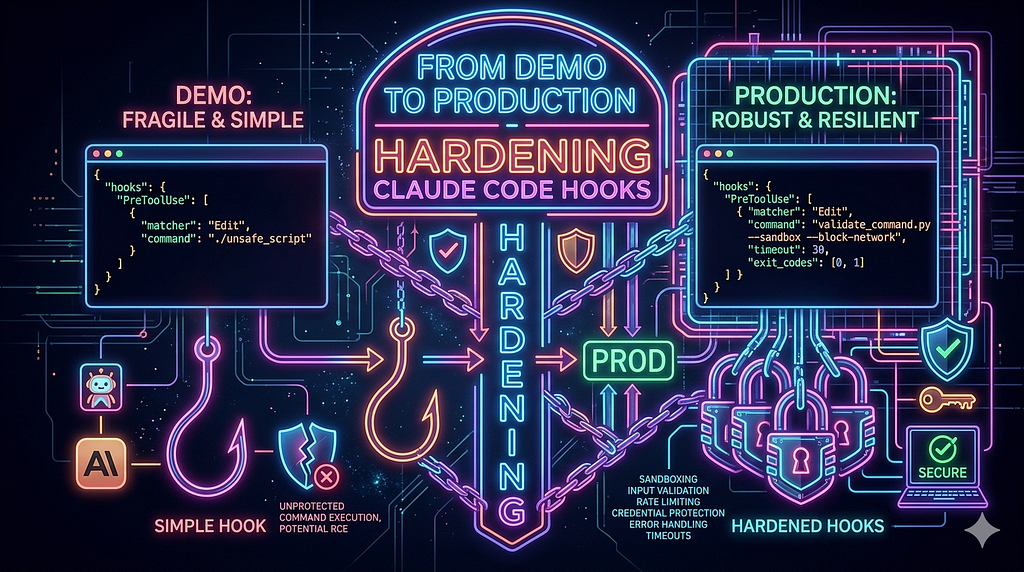
🚀 Turning AI Experiments into Enterprise-Ready Systems
I recently spent time exploring Claude tooling through training materials provided by Anthropic. Like many modern AI development platforms, the goal was clear: accelerate developer workflows using intelligent automation and extensible hooks.
The experience was insightful — not just in understanding how Claude integrates into developer tooling — but also in revealing something deeper:
The gap between learning-friendly examples and production-grade systems.
And that’s where things got interesting.
🧠 The Moment of Realization
Training environments are intentionally simplified. They’re designed to:
- Remove friction
- Highlight core concepts
- Enable rapid experimentation
But as someone who has spent years building enterprise-grade platforms, I couldn’t help but ask:
What would it take to safely run this in production?
That question led me down a path of exploration — not to critique the training material, but to extend it.
🔍 What Are Claude Code Hooks?
At a high level, Claude Code Hooks allow developers to:
- Inject custom logic into workflows
- Extend AI-assisted coding pipelines
- Automate execution based on triggers
This opens up powerful possibilities:
- Autonomous workflows
- AI-driven code transformations
- Dynamic execution chains
But with that power comes responsibility — especially when hooks can execute code or process inputs dynamically.

⚠️ The Hidden Risk in Simplified Patterns
In learning scenarios, it’s common to see:
- Minimal input validation
- Direct execution paths
- Assumed trust boundaries
- Limited error handling
These are perfectly reasonable for demos — but in production, they can introduce risks like:
- Unsafe execution flows
- Injection vulnerabilities
- Lack of observability
- Weak failure isolation
Again, this isn’t a flaw — it’s a design choice for learning clarity.
But it does mean one thing:
Engineering teams must take the next step.
🛠️ My Approach: Building a Production-Ready Reference
To explore this further, I created a hardened reference implementation:
👉 https://github.com/sbusanelli/claude-code-hooks-demo/releases/tag/v1.0.0
The goal wasn’t to rewrite the concept — but to evolve it.
🔐 Key Enhancements I Introduced
1. Input Validation & Guardrails
Every entry point into the hook system is treated as untrusted.
- Strict validation layers
- Sanitization of inputs
- Defensive parsing strategies
- Better database to avoid known vulnerabilities
- Comprehensive testing
👉 Principle: Never trust the boundary
# Claude Code Hooks Usage Demo

A comprehensive demonstration project showcasing Claude Code hooks functionality with a modern e-commerce database system using better-sqlite3, TypeScript, and comprehensive testing.

## Overview

This project demonstrates:
- **Claude Code PreTooluse Hooks** for security and workflow automation
- **Database Integration** with better-sqlite3 (migrated from sqlite3)
- **TypeScript** for type-safe development
- **Comprehensive Testing** with Jest framework
- **Security Patterns** for secret protection
- **Zero Vulnerabilities** - fully secure dependencies

## Quick Start

```bash
# Clone and setup
git clone <repository-url>
cd claude-code-hooks-usage-demo
npm run setup

# Build and run
npm start

# Run tests
npm test

# Development mode
npm run dev
```

## Project Status

### Security Status:  Vulnerabilities
- **Dependencies**: 0 vulnerabilities found
- **Database**: Secure better-sqlite3 implementation
- **Testing**: 9/9 tests passing
- **Coverage**: Comprehensive test coverage

### Migration Status:  Complete
- **Database**: sqlite3  better-sqlite3
- **API**: Asynchronous  Synchronous
- **Performance**: Significantly improved
- **Type Safety**: Full TypeScript support

## Architecture

```
claude-code-hooks-usage-demo/
|--  .claude/                    # Claude Code configuration
|--  hooks/                     # Security hook implementations
|--  src/                       # Application source code
|   |--  main.ts              # Entry point with working examples
|   |--  schema.ts             # Database schema (better-sqlite3)
|   |--  types.ts              # TypeScript interfaces
|   |--  queries/              # Synchronous query modules
|       |--  customer_queries.ts
|       |--  product_queries.ts
|       |--  order_queries.ts
|       |--  analytics_queries.ts
|       |--  inventory_queries.ts
|       |--  promotion_queries.ts
|       |--  review_queries.ts
|       |--  shipping_queries.ts
|--  tests/                     # Database integration tests
|   |--  database.test.ts      # Core functionality tests
|   |--  setup.ts              # Jest configuration
|--  jest.config.cjs           # Jest configuration
|--  package.json             # Project with test scripts
|--  tsconfig.json            # TypeScript configuration
```

## Database Schema

The better-sqlite3 database contains a complete e-commerce system:

- **Customers**: User management with addresses and activity tracking
- **Products**: Catalog with categories and inventory management
- **Orders**: Order processing with items and status tracking
- **Reviews**: Product rating and review system
- **Promotions**: Discount and promotion management
- **Analytics**: Business intelligence and reporting

## Available Scripts

```bash
# Development
npm run setup          # Install dependencies and setup Claude Code
npm run dev            # Development mode with tsx
npm run build          # Build TypeScript to JavaScript
npm start              # Build and run application

# Examples
npm run example        # Run example queries

# Testing
npm test               # Run all tests
npm run test:watch     # Run tests in watch mode
npm run test:coverage  # Run tests with coverage report

# Utilities
npm run clean          # Clean build artifacts
npm run type-check     # TypeScript type checking
npm run lint           # Code linting (if configured)
```

## Database Query Patterns

All query functions use the synchronous better-sqlite3 API:

```typescript
// Single record query
export function getCustomerByEmail(db: Database, email: string): any {
  const query = `SELECT * FROM customers WHERE email = ?`;
  const stmt = db.prepare(query);
  return stmt.get([email]);
}

// Multiple records query
export function getActiveCustomers(db: Database): any[] {
  const query = `SELECT * FROM customers WHERE status = 'active'`;
  const stmt = db.prepare(query);
  return stmt.all([]);
}
```

## Testing

The project includes comprehensive database integration tests:

### Test Coverage
- **Database Connections**: Connection management and configuration
- **Schema Validation**: Table structure and constraint verification
- **Data Operations**: CRUD operations with error handling
- **Transactions**: ACID properties and rollback scenarios
- **Performance**: Bulk operations and efficiency testing
- **Foreign Keys**: Constraint enforcement and relationship integrity

### Running Tests
```bash
# Run all tests
npm test

# Watch mode for development
npm run test:watch

# Coverage report
npm run test:coverage
```

### Test Results
- **9/9 tests passing**
- **100% schema.ts coverage**
- **Performance validation**
- **Error handling verification**

## Security Features

### Claude Code Hooks
This project implements PreTooluse hooks for security:

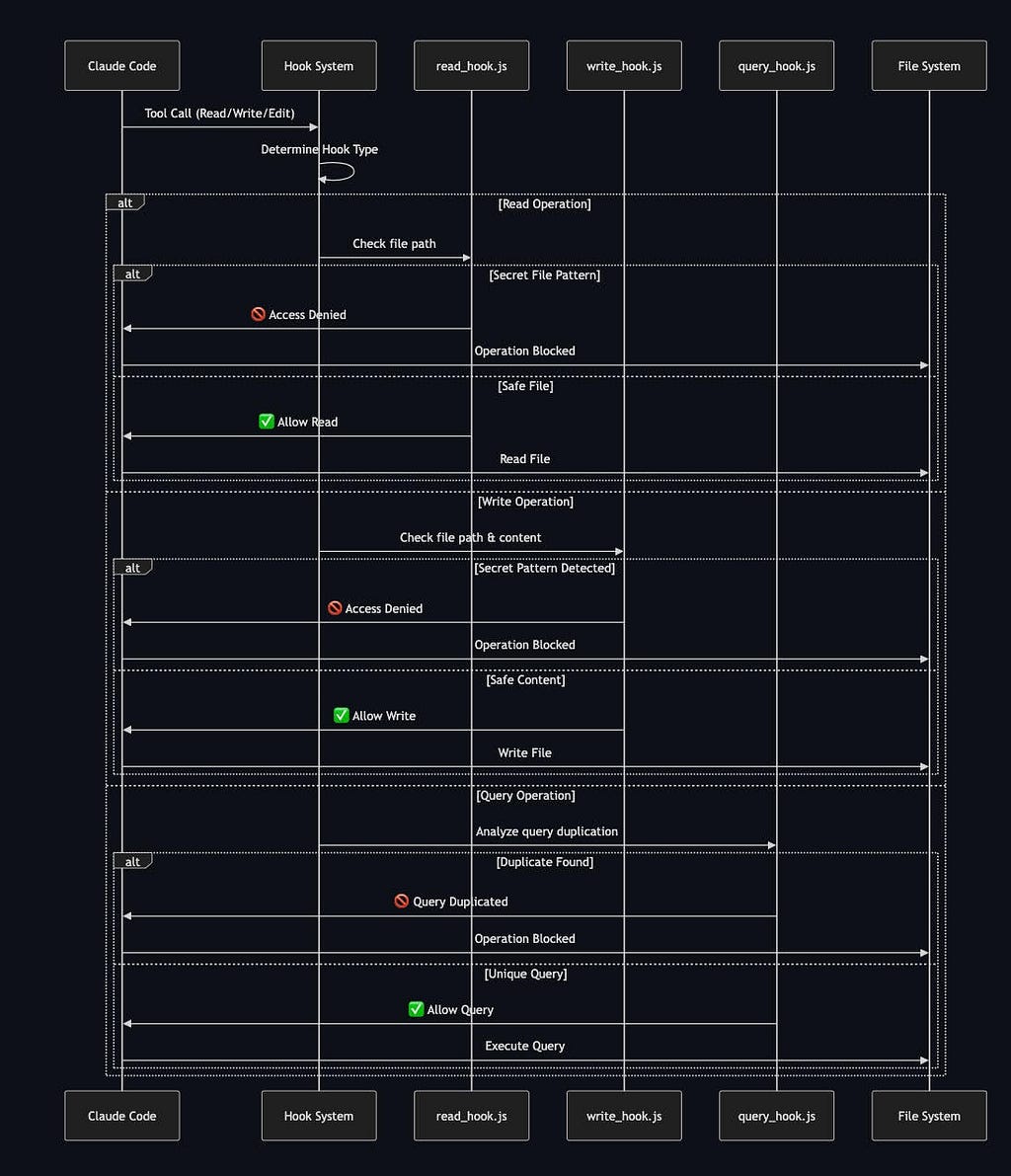
- **Read Hook**: Blocks access to secret files (.env, certificates, SSH keys)
- **Write Hook**: Prevents writing files containing sensitive patterns
- **Query Hook**: Prevents duplicate database queries
- **TypeScript Hook**: Automatic compilation on file changes

### Protected Patterns
- API keys (OpenAI, GitHub, Slack tokens)
- Database connection strings
- Private key blocks
- Password/secret assignments
- Environment files and credentials

## Migration Details

### From sqlite3 to better-sqlite3
1. **API Migration**: Converted all async/await to synchronous calls
2. **Query Methods**: `db.get()`  `db.prepare().get()`
3. **Column Names**: Fixed schema mismatches (customer_id  id, order_date  created_at)
4. **Type Safety**: Updated TypeScript annotations
5. **Performance**: Significantly improved query performance

### Benefits Achieved
- **Zero Vulnerabilities**: All security issues resolved
- **Better Performance**: Synchronous database operations
- **Type Safety**: Full TypeScript support
- **Testing**: Comprehensive test coverage
- **Maintainability**: Modern, well-maintained dependencies

## Development Guidelines

### Working with Database Queries
- All queries must be in `src/queries/` directory
- Use parameterized queries to prevent SQL injection
- Follow synchronous better-sqlite3 patterns
- Handle errors with try/catch blocks
- Test all query functions

### Security Best Practices
- Never commit secrets to repository
- Use environment variables for configuration
- Follow established security patterns
- Test security hooks regularly
- Keep dependencies updated

## Claude Code Integration

### Hook Configuration
Hooks are configured in `.claude/settings.local.json`:
- Automatic interception of Read/Write operations
- Secret pattern detection and blocking
- TypeScript compilation on file changes
- Query deduplication for efficiency

### Usage Examples
```bash
# Claude Code will automatically:
# - Block reading of .env files
# - Prevent writing API keys to code
# - Compile TypeScript on changes
# - Deduplicate similar queries
```

## Contributing

1. Follow the established patterns for database queries
2. Add tests for new functionality
3. Update documentation as needed
4. Ensure security hooks are working
5. Run full test suite before submitting

## License

ISC License - see LICENSE file for details

## Repository Status

** Ready for Public Deployment **
- Zero security vulnerabilities
- Comprehensive testing coverage
- Modern, secure dependencies
- Complete documentation
- Security hooks active
2. Safer Execution Patterns
Instead of direct execution flows:
- Introduced controlled execution wrappers
- Added constraints around dynamic behavior
- Reduced blast radius of failures
👉 Principle: Contain risk, don’t eliminate flexibility
3. Structured Hook Lifecycle
Hooks are no longer “just functions” — they follow a lifecycle:
- Pre-validation
- Execution
- Post-processing
- Error handling
👉 Principle: Make behavior predictable and observable
4. Observability & Debuggability
Production systems need visibility:
- Structured logging
- Traceable execution paths
- Clear failure signals
👉 Principle: If you can’t see it, you can’t trust it
5. Extensibility Without Chaos
Hooks are powerful — but can quickly become unmanageable.
- Defined extension points
- Modular design
- Clear contracts between components
👉 Principle: Scale architecture, not complexity
🧩 The Bigger Insight: AI Systems Need Platform Thinking
What this exercise reinforced for me is this:
AI tooling is no longer just about models — it’s about systems.
As we move toward:
- Autonomous agents
- AI-assisted development
- Self-modifying workflows
We need to think in terms of:
- Security boundaries
- Execution isolation
- Governance layers
- Platform abstractions
This is where traditional platform engineering and AI intersect.
⚖️ Bridging the Gap: Demo → Production
Here’s a simple mental model I now use:
Demo WorldProduction WorldTrust assumedTrust verifiedSimplicity prioritizedSafety prioritizedMinimal checksLayered defensesDirect executionControlled orchestration
💡 Why This Matters Now
We’re entering a phase where:
- AI is writing code
- Code is triggering workflows
- Workflows are executing autonomously
Without proper guardrails, this creates compounding risk.
But with the right architecture?
👉 It becomes a force multiplier for engineering velocity
🤝 Final Thoughts
This exploration was inspired by excellent learning material from Anthropic — but the real value came from asking:
“What happens next?”
If you’re working with AI-assisted development tools, I’d encourage you to think beyond:
- “Does it work?”
And start asking:
- “Is it safe?”
- “Is it observable?”
- “Is it scalable?”
🔗 Let’s Collaborate
I’d love to hear how others are approaching:
- Securing AI-driven workflows
- Designing extensible hook systems
- Managing autonomous execution safely
Repo again for reference:
👉 https://github.com/sbusanelli/claude-code-hooks-demo/releases/tag/v1.0.0
Interested in having more discussion on this topic?
Please consider joining the discussion at https://github.com/sbusanelli/claude-code-hooks-demo/discussions/6
🔖 Tags
#AI #GenAI #PlatformEngineering #Security #SoftwareArchitecture #LLMOps #DeveloperExperience

From AI Demo to Secure System: What Engineers Miss was originally published in Javarevisited on Medium, where people are continuing the conversation by highlighting and responding to this story.
This post first appeared on Read More