
The Google Home Mini launched in 2017 as Google’s smallest, cheapest smart speaker. Millions were sold, handed out, and given away as promotional gifts.
Many of them still work, but it being in the last phase of its lifecycle means that while it still functions for basic tasks, it doesn’t have any kind of customizability or local processing capabilities.
The hardware was fine for the time but has become less relevant in Google’s lineup over time, with the Nest Mini, its successor, also discontinued. And more recently, there’s been talk of new Gemini-powered smart speakers.
But what if you could bring your Home Mini (1st Generation) device up to 2026 standards with local processing by paying only $85?
Tired of AI fluff and misinformation in your Google feed? Get real, trusted Linux content. Add It’s FOSS as your preferred source and see our reliable Linux and open-source stories highlighted in your Discover feed and search results.
📝 MiciMike Home Mini PCB: Key Specifications
Two chips do the heavy lifting on this board. You get an Espressif ESP32-S3 as the main processor, paired with an XMOS XU316 chip dedicated entirely to audio. The Espressif unit brings 8 MB of PSRAM and 16 MB of flash to the table, while the XMOS one carries 4 MB of its own.
The ESP32-S3 covers Wi-Fi, Bluetooth, and wake word detection via microWakeWord, with none of the voice data leaving your device. Audio cleanup falls to the XU316, which runs through two on-board microphones to scrub out noise and echo before anything gets processed.
And the Home Mini’s original speaker still works, which can be plugged back in via the included FPC cable.
For software, ESPHome is already preinstalled, ready to work with Home Assistant’s Assist, Music Assistant, and Snapcast. A cloud LLM can also be dropped in as the conversation agent if you want one, but the whole thing runs fine without it.
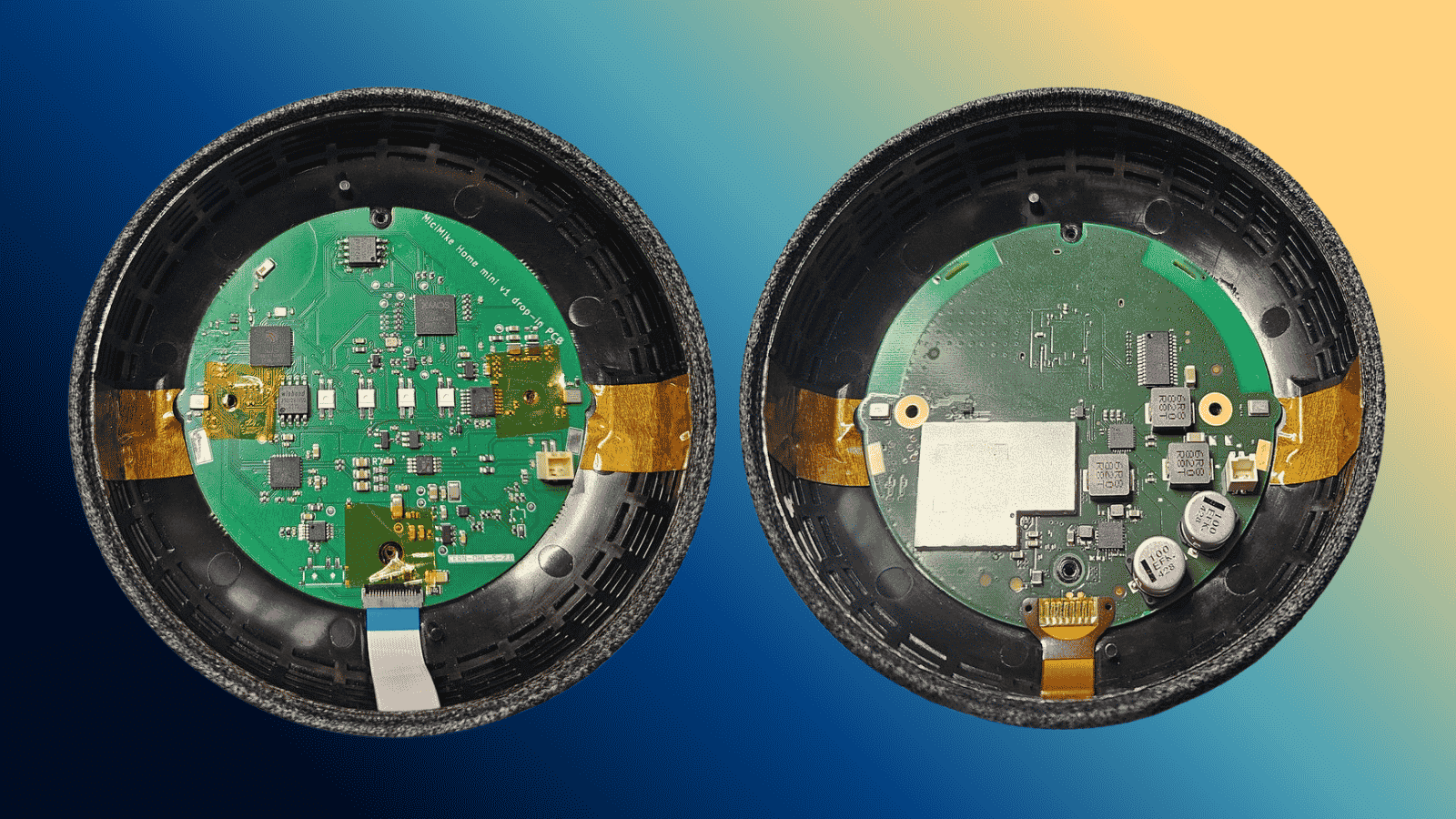
Plus, the mute button on the device makes a physical disconnection at the hardware level, following what the original Home Mini did. You will likewise find four SK6812 RGB LEDs (for reference) sitting in the same positions, acting as status indicators.
Here are the full specs for you to go through:
- Main processor: ESP32-S3 (dual-core Xtensa LX7, 240 MHz), 8 MB PSRAM, 16 MB flash.
- Audio processor: XMOS XU316, 4 MB flash.
- Microphones: 2× MEMS (placed in the same location as the Home Mini)
- LEDs: 4× SK6812 RGB
- PCB: 4-layer, 72 × 70 mm, HASL lead-free.
- Connectivity: Wi-Fi 802.11 b/g/n (2.4 GHz) and Bluetooth 5.0 LE.
- License: CERN-OHL-S v2
Get Yours
At $85, the MiciMike board is available on Crowd Supply, with orders estimated to ship around October 1, 2026. US shipping is free, but international buyers must pay an additional $12.
The company behind it is the Ireland-based MiciMike ReV Devices, led by Imre László, who has put up the schematics, PCB design files, and the Bill of Materials on GitHub. The boards themselves are manufactured by Elecrow, a Shenzhen-based outfit behind a range of DIY and maker-focused hardware that we have covered a fair bit.
Before you go, know that there are plans for a drop-in replacement PCB for the Nest Mini. You can read about it on the official website.
👉 Related project you can explore: AsteriodOS is giving new life to old smartwatches.

This article first appeared on Read More