
Accurate demand forecasting is essential across industries like retail, manufacturing, logistics, and healthcare. Predicting future demand helps organizations drive procurement, inventory management, staffing, and even customer satisfaction. However, traditional forecasting methods struggle to address the complexities of modern supply chains, where global trends, shifts in consumer behavior, and external events often influence demand in real time.
AI is rapidly transforming demand forecasting, enabling businesses to predict demand with greater accuracy and responsiveness. Unlike traditional models that rely heavily on historical data, AI models integrate a wide range of factors — such as consumer behavior, weather, geopolitical events, and social media trends — into a unified forecasting model. This enables real-time, continuous updates to forecasts, allowing organizations to adapt to emerging trends and make more informed decisions.
Why AI in demand forecasting matters
The value of accurate demand forecasting extends beyond reducing inefficiencies; it’s about maintaining competitiveness in an increasingly fast-paced market. Traditional forecasting approaches like ARIMA (AutoRegressive Integrated Moving Average) or exponential smoothing often fail to account for the vast amounts of unstructured data that influence demand. These models are typically based on historical sales data, limiting their ability to adapt to sudden market changes.
Generative AI (GenAI) offers a solution by integrating both structured and unstructured data — such as sales history, weather patterns, social media activity, and geopolitical events — into the forecasting process. This approach enables businesses to update their forecasts in near real time, respond to market shifts, and forecast demand across multiple product categories, regions, and channels.
AI’s evolution in demand forecasting
The integration of AI in demand forecasting happens in three layers:
- Structured ML models (e.g., LSTM, GBM, SVM) enhance accuracy by analyzing historical sales and time-series data.
- Generative AI can generate assumptions, conduct scenario analysis, and provide executive narratives, thereby helping refine forecasts and facilitate decision-making.
- Agentic AI orchestrates the workflow by coordinating specialized agents to gather signals, run forecasts, and propose corrective actions. This continuous workflow enables real-time adjustments, enabling more adaptive operations.
Approaches to integrating AI into demand forecasting
Organizations have several strategies for integrating AI into their demand forecasting processes, each suited to different operational scales and technical capabilities.
- Building a custom in-house AI stack: For companies with specific forecasting needs or those operating in regulated industries (such as pharmaceuticals or defense), building a custom in-house AI stack might be the best option. This approach allows full control over data handling, model selection, and governance, ensuring the system meets specific requirements. However, it involves significant upfront development costs and requires a dedicated team for ongoing maintenance.
- Adopting point solutions: Point solutions are standalone AI tools designed to address specific forecasting tasks — such as demand sensing, inventory optimization, or price prediction. While these solutions offer rapid deployment and lower initial investment, they may not be as integrated, which could lead to data silos and inefficiencies when scaling across multiple business functions.
- Implementing an AI orchestration platform: For many enterprises, it offers a scalable, effective solution. These platforms provide low-code environments for developing, deploying, and managing demand forecasting workflows. They can integrate seamlessly with existing enterprise systems (e.g., ERP, WMS, CRM) to deliver end-to-end automation. By streamlining the entire process — from data ingestion to model execution — AI orchestration platforms help organizations improve forecast accuracy while minimizing human intervention.
Use cases for AI in demand forecasting
AI’s ability to process and analyze vast amounts of data enables it to transform demand forecasting in various sectors. Below are key use cases where AI is making a substantial impact:
- Retail and E-commerce: Retailers must continually optimize inventory to avoid stockouts or excess inventory. AI-driven demand forecasting models can analyze sales data, promotions, weather, and social media activity to predict demand at the SKU level. Real-time demand sensing enables retailers to adjust inventory levels daily, ensuring that products are available when needed while preventing overstocking.
- Supply chain and logistics: AI is helping streamline transportation planning and optimize warehouse space in supply chains. For example, AI can forecast demand at the route level, enabling logistics teams to optimize capacity and mode selection. Demand forecasts also help allocate warehouse space effectively, ensuring that high-demand SKUs are stored near dispatch zones for quicker shipping.
- Manufacturing: Manufacturers use AI-driven demand forecasting to optimize production scheduling, inventory management, and staffing. AI models can predict seasonal demand changes and component requirements, enabling dynamic adjustment of production schedules. In industries like automotive, where long lead times and complex supply chains are the norm, AI forecasting helps ensure timely production and part availability.
- Healthcare: Hospitals and pharmaceutical companies use AI to forecast demand for medical supplies, medications, and vaccines. These forecasts rely on historical usage data, disease prevalence, and seasonal patterns, allowing healthcare providers to optimize stock levels and prepare for demand surges during health crises.
- Finance: In the financial sector, AI-driven demand forecasting predicts customer demand for financial products such as loans and credit cards. By anticipating client needs, financial institutions can proactively adjust marketing efforts and service delivery, optimizing resource allocation.
Benefits of AI-driven demand forecasting
The benefits of integrating AI into demand forecasting are substantial:
- Improved accuracy: AI models leverage a broader range of data inputs, resulting in more accurate and dynamic forecasts than traditional methods.
- Real-time adaptation: AI models update forecasts as new data becomes available, enabling businesses to respond quickly to changing market conditions.
- Operational efficiency: By automating routine forecasting tasks, AI enables teams to focus on more strategic activities, such as decision-making and planning.
- Cost savings: With more accurate forecasts, businesses can reduce excess inventory, improve order fulfillment, and minimize operational costs.
- Scalability: AI systems scale as business operations grow, adapting to new product categories, regions, and channels without requiring significant manual adjustments.
Challenges and considerations
While AI offers tremendous advantages, there are challenges that organizations must address:
- Data privacy and security: AI models require access to large amounts of data, including sensitive customer information. Financial institutions and other businesses must ensure robust security measures to protect this data.
- Integration with legacy systems: Integrating AI with existing legacy platforms can be complex, requiring significant resources and expertise.
- Model maintenance: Regular updates and monitoring are necessary to ensure AI models continue to produce accurate forecasts, especially as market conditions change.
How ZBrain Builder supports demand forecasting operations
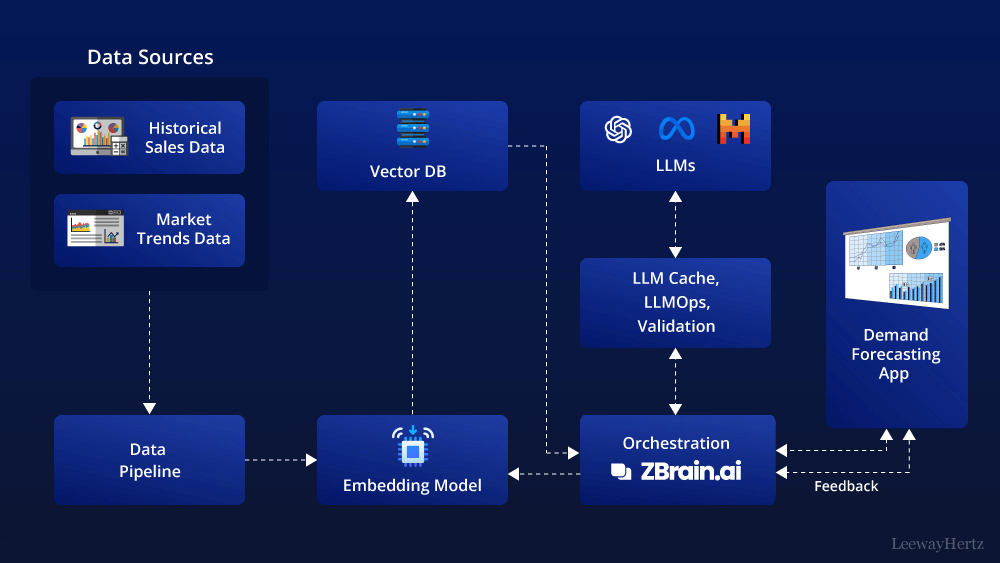
ZBrain Builder is a powerful AI orchestration platform by LeewayHertz that helps organizations efficiently implement demand forecasting systems. The platform offers a low-code environment that enables teams to design and deploy AI-driven forecasting workflows. ZBrain Builder’s capabilities support organizations in automating end-to-end forecasting processes — from data ingestion to model execution — ensuring accuracy and scalability.
With ZBrain Builder, businesses can integrate multiple data sources and leverage AI to continuously update forecasts. Its multi-agent orchestration framework allows specialized agents to collaborate at each stage of the forecasting workflow, ensuring adaptability to market changes and ongoing improvements in forecasting accuracy.
Endnote
Integrating AI into demand forecasting represents a significant transformation for industries seeking to stay competitive in today’s fast-paced market. By leveraging AI-driven solutions, businesses can improve forecast accuracy, reduce operational inefficiencies, and make more informed decisions. Partnering with an experienced AI development company ensures that organizations implement AI effectively and align it with their long-term goals.

AI-Driven Demand Forecasting: Transforming the Supply Chain was originally published in Javarevisited on Medium, where people are continuing the conversation by highlighting and responding to this story.
This post first appeared on Read More