
Welcome to This Week in Neo4j, your fix for news from the world of graph databases!
If you’re building with Neo4j at a startup, we now have dedicated field engineers ready to talk schema design, production scaling and getting your prototype moving.
This edition also covers how to keep your agent’s knowledge graph clean as it scales; a GraphRAG semantic layer built from BigQuery and GCP Knowledge Catalogue; all NODES AI sessions browsable in the Neo4j Showroom and GraphTalk Pharma & Life Sciences on July 2, with practitioner talks from Bayer, BASF, Insel Spital Bern and more.
Share your experiences and influence the future of Neo4j products: Join the Neo4j User Research panel! It’s a chance to connect directly with product development teams, get paid compensation, hear about what we are working on and more!
Happy Graphing,
Alexander Erdl
COMING UP!
- Livestream: Virtual Graph: Graph Intelligence for Your Existing Data on June 23, AI Governor: Quality gates for agentic workflows on June 25 & GraphTalk pharma & life sciences on July 2
- Conferences: Find us at MLCon, Munich on June 23-25, AI Engineer World’s Fair, San Francisco on June 29 – July 2, AWS Summit, Washington D.C. on June 30 – July 1 & WeAreDevelopers, Berlin on July 8-10
- Meetup: Meet us in Munich, DE on June 26, Gurgaon, IN on June 27, San Francisco, US on June 28, San Francisco, US on June 30, San Francisco, US on July 1 & London, UK on July 2, Berlin, DE on July 8
- All Neo4j Events: Webinars and More
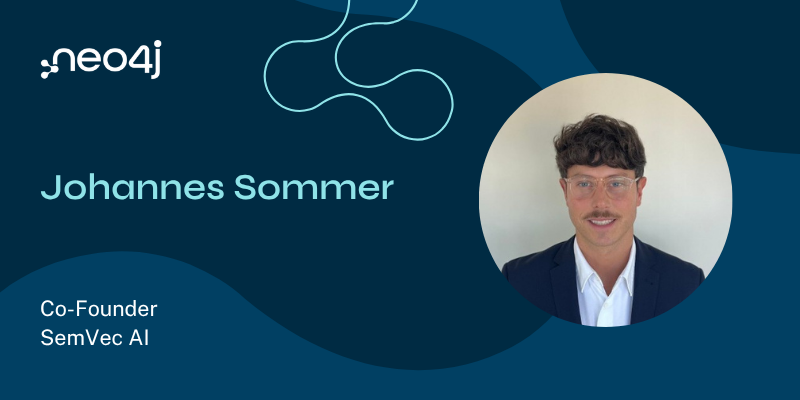
FEATURED COMMUNITY MEMBER: Johannes Sommer
Johannes is Co-Founder of SemVec AI and the architect of one of Germany’s most active AI practitioner networks.
Connect with him on LinkedIn.
He has one of the first confirmed sessions at NODES 2026 “Using semvec AI for detecting agentic drifts”, where he will present a hybrid architecture combining SemVec AI’s Persistent Semantic State with Neo4j’s graph-based knowledge representation to detect and recover from semantic drift autonomously.
KNOWLEDGE GRAPH: How to Keep Your AI Agent’s Knowledge Graph Clean
Paul Iusztin’s follow-up to his agent memory architecture piece focuses on the part most tutorials skip: keeping the graph clean as it grows. He separates entity resolution from deduplication, explains why collapsing the two is what silently corrupts graphs and adds two safety nets: a human review queue modelled as pending SAME_AS edges in the graph itself and a nightly dream pass that re-runs deduplication over recently ingested nodes to catch concurrent-write collisions.
LIFE SCIENCES: GraphTalk pharma & life sciences
GraphTalk Pharma & Life Sciences returns on July 2 – again as a hybrid event so that you can join in person or online. The day follows the pharma product life cycle with practitioner talks from Bayer (GraphRAG for drug target discovery), KWS Group (explainable candidate gene identification), BASF (knowledge graphs for non-model plants), Insel Spital Bern (multilingual EHR mapping in Neo4j) and more.
GRAPHRAG: Build a Semantic Layer from GCP with Neocarta
Alex Gilmore walks through Neocarta, a Neo4j Labs Python library that builds a graph-backed semantic layer by pulling schema metadata from BigQuery and business glossary terms from GCP Knowledge Catalogue – two CLI commands, and you have a traversable graph of databases, tables, columns and business terms with vector and full-text indexes built in. The post then wires the result to an MCP server so that any agent can perform a hybrid semantic search across your data landscape, rather than dumping raw schemas into the context window.
NODES: Neo4j Showroom
Alani Connect lets you discover curated talks, groundbreaking research and visionary leaders and connects you to the ideas, people and solutions driving real change. The Neo4j Showroom by Athulya Anil, William Lyon & Ashok Vishwakarma has all the sessions from NODES AI for you to explore.
STARTUPS: Now available: Dedicated Neo4j field engineers empowering AI startups
Brian O’Keefe explains what he’s hearing from founders: credits are fine, but what they actually need is a real technical conversation about schema design, production scaling and getting a prototype running fast enough to convince sceptical co-founders.
We want to give startup founders the right tools and support to succeed when building with Neo4j. From now on, I will also showcase a few of our Startup Program Members – First up: QuantumSpace
QuantumSpace is using Neo4j AuraDB to combat art forgery by extracting up to 60,000 data points from a single painting. They map elements such as colour, brushstroke physics and historical provenance as a graph. The relationships between these data points help establish authenticity, with Neo4j serving as their knowledge layer to connect verifiable facts with inferred signals such as tonal similarity and geographic context. What began as a thesis experiment has now attracted interest from the fashion industry, automotive sector, and even a European space agency.

CONTINUOUS LEARNING
- GraphAcademy: Join the “Cup“, complete Courses and win prizes
- Learn on Your Schedule: Go deeper into graph intelligence on Neo4j’s On-Demand webinar library
- Workshops: Join our virtual classrooms workshops from Fundamentals to GenAI
- New Webinar: Build the ontology at the core of your semantic layer – Americas, Europe, Middle East & Africa, Asia Pacific
POST OF THE WEEK: Spring I/O
Thinking in Relationships: Practical Graph Database Modelling in Java with Neo4j by @paulienvanalst.bsky.social @ Spring I/O 2026
— Spring I/O (@springio.net) 9. Juni 2026 um 18:40
 Thinking in Relationships: Practical Graph Database Modelling in Java with Neo4j by @paulienvanalst.bsky.social @ Spring I/O 2026
 Video: youtu.be/ImdfQzopSkg
 Slides: www.slideshare.net/slideshow/pr… #springio26
Please share it if you like it!
This article first appeared on Read More