
My Favorite Udemy Courses to learn Agentic AI and AI Agents in 2026
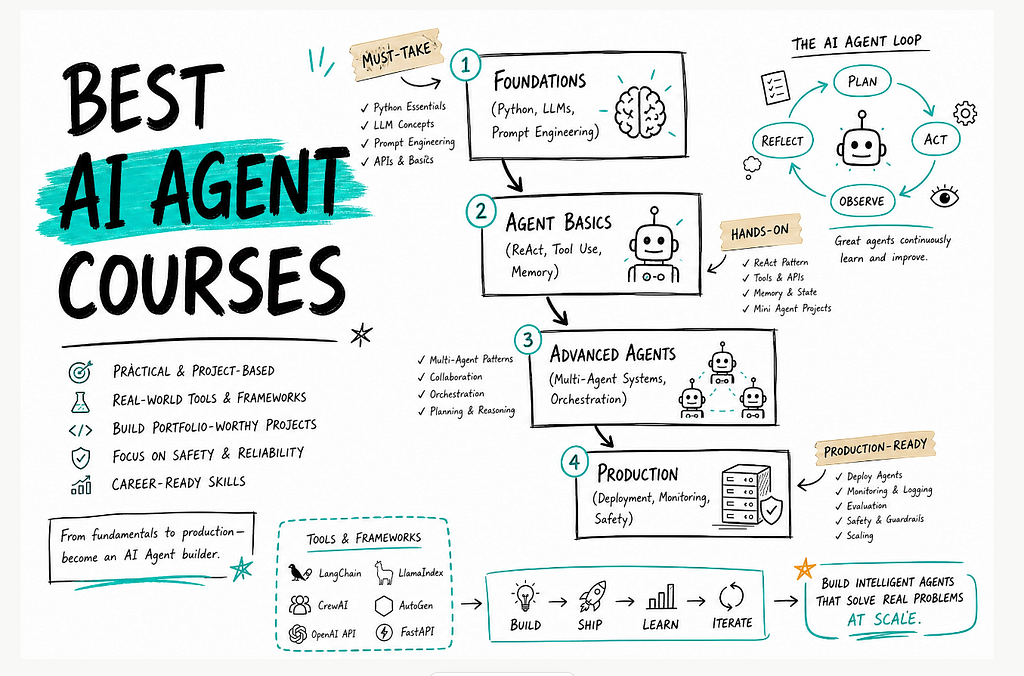
Hello everyone — AI Agents are no longer science fiction. They’re the most important skill in software engineering right now, and the gap between developers who understand them and those who don’t is widening fast.
Companies are racing to build autonomous systems that can research, analyze, make decisions, and execute tasks without human intervention.
From AI sales representatives to automated research assistants, agentic AI is actively reshaping how businesses operate — and the engineers who can build these systems are commanding salaries of $150,000–$250,000+ in the US.
I’ve spent the last few months testing 20+ AI agent courses on Udemy. Most were either outdated, framework-specific with no broader context, or just plain shallow. A handful were genuinely excellent — taught by practitioners who’ve shipped real agent systems to production.
Here are the five I’d actually recommend.
💡 In a hurry? Start with The Complete Agentic AI Engineering Course — it’s the most comprehensive course on this list and the one I’d pick if I could only choose one.
AI Engineer Agentic Track: The Complete Agent & MCP Course
5 Best AI Agent Courses on Udemy for 2026
Without any further ado, here are the best Udemy courses you can join to learn Agentic AI and how to build production grade AI Agents in 2026. This is one of the hottest skill in the market and its right time to learn it to stay relevant and even excel in current AI boom.
1. The Complete Agentic AI Engineering Course (2026)
Students: 141,746 | Rating: 4.7/5 (19,102 ratings) | Level: Beginner to Advanced

If you only take one course from this list, make it this one. There is nothing else on Udemy that comes close to this level of breadth, depth, and practical output for AI agent engineering.
With 141,746 students and a 4.7/5 rating, this is the most popular and most trusted AI agent course on the platform — and after going through it myself, I understand why. The instructor takes you from zero to building eight production-ready AI agent projects in just 30 days. These aren’t toy demos — they’re applications you could launch as SaaS products.
What sets this apart from everything else is the coverage of the latest frameworks. While other courses teach outdated patterns, this one uses OpenAI’s brand-new Agents SDK, the latest versions of LangGraph, CrewAI, AutoGen, and the Model Context Protocol (MCP). You’re learning what’s actually used in production right now.
The projects alone justify the price. The Deep Research Agent builds a multi-agent system that conducts comprehensive research on any topic — comparable to how Perplexity operates. The SDR Agent creates an AI sales representative that crafts and sends professional emails — a tool companies pay thousands per month for. The Career Digital Twin builds an AI agent that represents you to employers, which is simultaneously a portfolio piece and a job-hunting tool.
What you’ll learn:
- OpenAI Agents SDK — OpenAI’s official framework for building agents
- CrewAI — collaborative multi-agent systems that work as a team
- LangGraph — complex agent workflows and state machines
- AutoGen — Microsoft’s framework for conversational agents
- Model Context Protocol (MCP) — enabling agents to interact with computers
- 8 production projects: Career Digital Twin, SDR Agent, Deep Research Agent, Stock Picker, and more
- Full deployment: ship your agents to production
Best for: Developers wanting comprehensive agent training, entrepreneurs building AI-powered products, engineers at companies adopting AI agents, anyone serious about becoming an AI agent expert
→ Join The Complete Agentic AI Engineering Course
AI Engineer Agentic Track: The Complete Agent & MCP Course
2. LangChain — Develop AI Agents with LangChain & LangGraph
Students: 132,571 | Rating: 4.6/5 (38,816 ratings) | Level: Beginner to Advanced

LangChain and LangGraph are the most widely adopted frameworks in production AI agent systems today. If you want to be immediately valuable to any company building with AI, this is where to build your foundation.
With 132,571 students and 38,816 ratings, this is the most reviewed AI agent course on Udemy — a number that’s impossible to fake and reflects genuine, long-running quality.
The instructor doesn’t just teach you how to use LangChain; they explain why it’s designed the way it is, which means the understanding transfers to any framework you pick up afterward.
The course covers LangChain 1.0+ — the current version with significant architectural changes from earlier iterations. You won’t be learning outdated patterns. The LangGraph section is particularly valuable, covering state machines, complex branching, looping workflows, and the patterns that power production-grade agents.
What I appreciated most is the focus on theoretical foundations alongside the practical work. You’ll learn Chain of Thought reasoning, ReAct patterns, and Few-Shot prompting — concepts that make you a better agent engineer regardless of which framework you’re using. This is transferable knowledge, not just tool-specific muscle memory.
What you’ll learn:
- LangChain fundamentals: chains, prompts, memory, and tools
- LangGraph for state machines and complex agent workflows
- ReAct, Chain of Thought, and Few-Shot prompting patterns
- Tool integration — connect agents to APIs, databases, and external services
- Memory systems: give agents long-term and short-term context
- RAG implementation for knowledge-grounded agents
- Production patterns and best practices for reliable agents
Best for: Developers new to LangChain, engineers building complex agent workflows, anyone wanting deep understanding of agent architectures, teams standardizing on LangChain
→ Join LangChain — Develop AI Agents with LangChain & LangGraph
LangChain- Agentic AI Engineering with LangChain & LangGraph
3. AI in Production: Gen AI and Agentic AI at Scale
Students: 9,456 | Rating: 4.8/5 (656 ratings) | Duration: 18.5 hours | Level: Intermediate to Advanced
Building an AI agent that works on your laptop is impressive. Building one that serves ten million users reliably at reasonable cost? That’s career-defining. This is the only course on Udemy that takes that second challenge seriously.
With a 4.8/5 rating — the highest on this list — this course bridges the gap between “it works in my terminal” and “it’s running in production at scale.” Most AI courses skip this entirely. This one makes it the whole point.
You’ll learn cloud deployment across AWS, GCP, and Azure, infrastructure-as-code with Terraform, CI/CD for AI applications using GitHub Actions, and production-specific concerns that most engineers only discover the hard way: bursty traffic, LLM cost management, caching strategies, latency optimization, and how to prevent your agents from hallucinating in front of real users.
The Terraform and GitHub Actions sections are particularly valuable — you’ll implement proper infrastructure-as-code and continuous deployment pipelines for AI applications, the same patterns used by engineering teams at scale.
What you’ll learn:
- Cloud deployment across AWS, GCP, Azure, and Vercel
- MLOps: CI/CD for AI applications using Terraform and GitHub Actions
- Amazon Bedrock and SageMaker for managed LLM deployment
- RAG at scale: retrieval-augmented generation that performs under load
- Multi-agent system deployment to production
- Observability: monitoring and debugging AI systems in production
- Security: authentication, authorization, and data protection for agents
- Cost optimization for LLM APIs at scale
Best for: AI engineers moving from prototype to production, DevOps engineers working with AI teams, architects designing AI infrastructure, anyone building commercial AI products
→ Join AI in Production: Gen AI and Agentic AI at Scale
AI Engineer Production Track: Deploy LLMs & Agents at Scale
4. Master LLM Engineering & AI Agents: Build 14 Projects
Students: 5,752 | Rating: 4.6/5 (383 ratings) | Level: Beginner to Advanced
If you learn best by building — not by watching theory — this is your course. Fourteen complete AI agent projects, each one teaching different patterns, frameworks, and production techniques. It’s a coding bootcamp compressed into one Udemy course.
The 14-project structure means you’re always building, never just watching. Early projects build core fundamentals. Middle projects introduce complex patterns and multi-agent coordination. Final projects combine everything into complete, production-ready applications. The progression is deliberate and it works.
What makes this course particularly valuable in 2026 is the framework breadth. You’ll work with Hugging Face, LangGraph, CrewAI, AutoGen, N8N, and the OpenAI Agents SDK — covering the entire landscape of current tools. When the AI ecosystem shifts (and it will), you’ll have the adaptability to move with it rather than starting over.
By the time you finish, you’ll have 14 portfolio projects demonstrating diverse frameworks and use cases. That breadth of demonstration matters to employers far more than depth in a single tool.
What you’ll learn:
- 14 complete projects spanning different agent patterns and use cases
- Hugging Face for open-source model integration
- LangGraph for state-based agent workflows
- CrewAI for collaborative multi-agent teams
- AutoGen for conversational multi-agent systems
- N8N for no-code agent automation workflows
- RAG systems, MCP integration, and OpenAI Agents SDK
- LLM foundations: how models are trained, fine-tuned, and deployed
Best for: Developers who learn by building, anyone wanting broad exposure to multiple AI frameworks, engineers targeting a portfolio-heavy job search
→ Join Master LLM Engineering & AI Agents: Build 14 Projects
LLM Engineering, RAG, & AI Agents Masterclass [2026]
5. AI Agents Crash Course: Build with Python & OpenAI
Students: 2,202 | Rating: 4.7/5 (127 ratings) | Duration: 3.5 hours | Level: Beginner
Short on time but need to understand AI agents fast? This 3.5-hour crash course delivers more practical value per minute than almost anything else on Udemy.
In just 3.5 hours you’ll go from zero to building functional AI agents — covering tool calling, memory, streaming responses, RAG, and crucially, guardrails (the safety constraints that prevent agents from producing harmful outputs in production). That last topic is often skipped in beginner courses and it’s the thing that bites you hardest when you ship to real users.
The focus on OpenAI’s SDK is the right call for a beginner course — best-documented APIs, most capable models (GPT-4, GPT-4o), and the most employer-relevant starting point. The course proves that you don’t need months of study to build agents that actually work; you need focused fundamentals and the right starting point.
Use this as your entry point. After completing it, you’ll know exactly whether you want to invest in one of the deeper courses above — and you’ll start that deeper learning with real context instead of starting cold.
What you’ll learn:
- OpenAI SDK — build agents using OpenAI’s official tools
- Tool calling — enable agents to use external APIs and services
- Memory systems — give agents context and conversation history
- Streaming responses — real-time agent outputs for better UX
- Prompt and context engineering for reliable agent behavior
- RAG implementation basics for grounded responses
- Guardrails — ensure agents behave safely in production
- AgentBuilder for rapid prototyping
Best for: Busy developers wanting quick AI agent fundamentals, beginners evaluating the field before committing to a longer course, anyone who wants to build something functional this weekend
→ Join AI Agents Crash Course: Build with Python & OpenAI
AI Agents Crash Course: Build with Python & OpenAI
How to Choose Your Learning Path?
Not sure where to start? Here’s the quick decision guide based on your situation:
If you’re a complete beginner → Start with the AI Agents Crash Course (3.5 hours to validate your interest), then move to The Complete Agentic AI Engineering Course for full training.
If you want framework depth → Go straight to LangChain & LangGraph. It’s the most widely adopted framework in the industry and the best foundation before exploring others.
If you’re already building agents but struggling to deploy → Jump to AI in Production. It solves exactly the problems that appear when you move from laptop to real users.
If you learn by building → Master LLM Engineering: 14 Projects gives you the broadest portfolio and framework exposure in the shortest time.
If you want everything → Follow this path:
- AI Agents Crash Course → fast foundation (3.5 hrs)
- The Complete Agentic AI Engineering Course → comprehensive training
- AI in Production → deploy at scale
AI Engineer Production Track: Deploy LLMs & Agents at Scale
Getting the Most From These Courses
Code along, don’t just watch.
Type every line yourself. Don’t copy-paste. The learning happens when you debug errors and understand why something works — not while watching it work on someone else’s screen.
Build variations after every section.
After learning CrewAI, build a marketing team of agents. After learning RAG, build a personal knowledge assistant. After learning deployment, ship something — even to yourself.
Focus on one framework first.
Don’t try to master LangGraph, CrewAI, AutoGen, and the OpenAI Agents SDK simultaneously. Pick one, build 3–5 projects with it, then branch out.
Share what you build.
Post projects on GitHub and LinkedIn. The AI community is active and supportive. You’ll get feedback, connections, and opportunities you wouldn’t find otherwise.
Final Word
AI agents aren’t the future — they’re right now. Companies are building them today. Startups are raising millions for agentic products. The engineers who understand how to build and deploy these systems are the most in-demand in the industry.
These five courses represent the best of what Udemy has to offer on the topic — from the comprehensive 30-day project course to the 3.5-hour fast track. Pick the one that matches where you are today and where you want to be in 90 days.
Start this week. The gap between early movers and everyone else widens every month.
Happy building!
P.S. — If you plan to take multiple courses on Udemy, consider the Udemy Personal Plan at ~$20–30/month. It gives you access to 25,000+ courses including all five on this list — and for AI engineers who’ll want to explore Python, cloud platforms, and databases alongside these courses, the plan pays for itself quickly.
Online Courses – Learn Anything, On Your Schedule | Udemy

I Tried 20+ AI Agent Courses on Udemy: Here Are My Top 5 Recommendations for 2026 was originally published in Javarevisited on Medium, where people are continuing the conversation by highlighting and responding to this story.
This post first appeared on Read More