
My favorite resources to learn Microservices architecture for Senior developers
If you’re a senior developer who has spent years working in monolithic codebases, you’ve probably heard the word “microservices” more times than you can count.
Maybe your company is actively migrating to microservices.
Maybe you’ve been tasked with architecting a new service and you’re not sure where to draw the boundaries. Or maybe you’re watching colleagues move into architect and tech lead roles and wondering what they know that you don’t.
Here’s the honest answer: microservices architecture is not just a trend, and it’s not going away. It’s the dominant architectural paradigm for scalable, cloud-native systems — and senior developers who don’t understand it deeply are starting to hit ceilings in their careers that their peers are moving past.
This article explains why that matters specifically for senior developers, and then gives you 7 tried-and-tested Udemy courses to close the gap.
Why Microservices Matter More for Senior Developers Than Juniors?
Junior developers follow the architecture. Senior developers shape it. And in 2026, that means you need to understand microservices not just well enough to build a service — but well enough to argue for the right decomposition strategy, anticipate operational failure modes, design for resilience, and lead a team through the complexity that distributed systems introduce.
Here’s what’s at stake for senior developers specifically:
1. Architecture decisions now have business consequences When you’re senior, the choice between microservices and a well-structured monolith isn’t just technical — it affects deployment velocity, team autonomy, operational costs, and time-to-market. You need to understand the real trade-offs well enough to defend a recommendation to non-technical stakeholders.
2. You’re being evaluated on distributed systems thinking Senior and staff engineer interviews increasingly include system design rounds that assume familiarity with service decomposition, event-driven communication, distributed tracing, and failure isolation. If you’ve never designed a system where services talk to each other over the network, you’ll feel that gap.
3. The tools have matured — and so has the learning curve Kubernetes, Kafka, Spring Cloud, service meshes, distributed tracing with Zipkin — these are now expected knowledge at the senior level. Companies hiring senior engineers in 2026 expect you to have opinions about these tools, not just awareness that they exist.
4. Microservices expose the limits of monolithic thinking The patterns that work beautifully in a monolith — shared state, synchronous calls, centralized configuration — can become catastrophic failure modes in a distributed system. Senior developers who haven’t worked with microservices often make these mistakes when they first do. Learning the patterns before you need them is how you avoid expensive production incidents.
The Architecture Worth Understanding
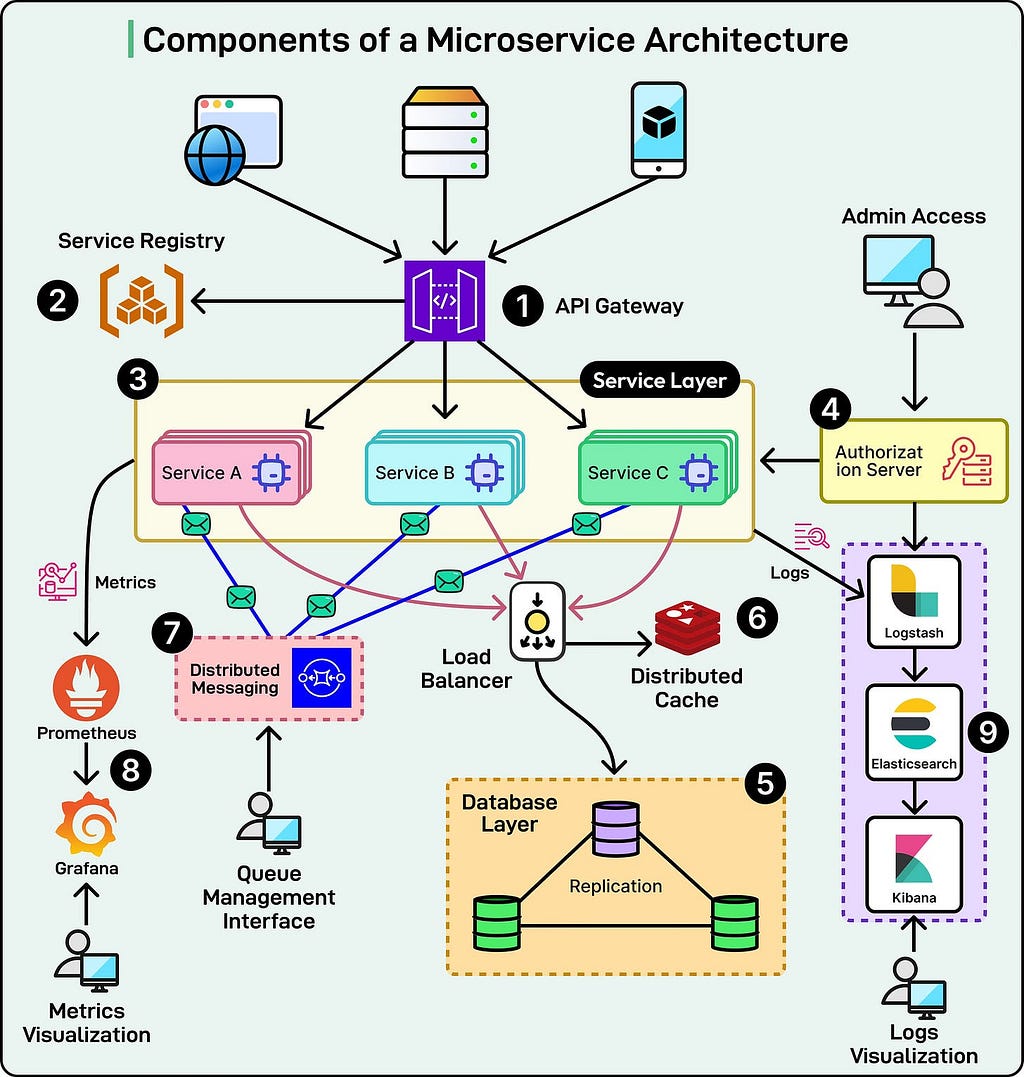
Before diving into the resources, here’s a quick picture of what microservices architecture actually looks like in practice:
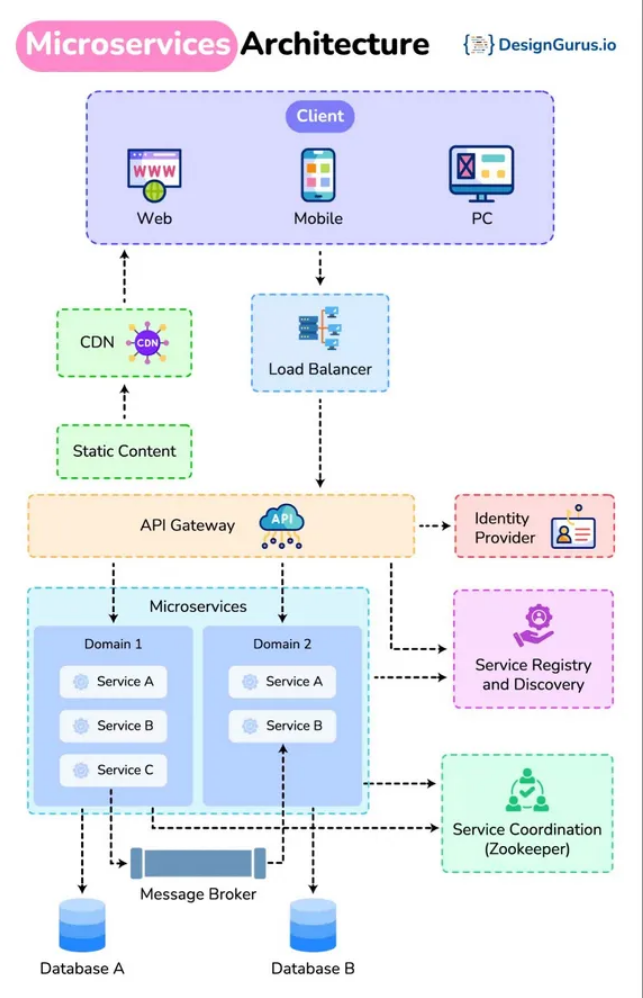
Each service owns its own data, communicates through well-defined APIs or events, and can be deployed, scaled, and updated independently. Simple to describe, genuinely complex to implement well — which is exactly why the right learning resources matter.
If you’re in a hurry and want one course to start with, go straight to Master Microservices with Spring Boot, Docker, Kubernetes. It covers architecture, implementation, and deployment in one comprehensive package.
7 Tried and Tested Microservices Courses for Senior Developers
Now, let’s checkout some online resources, particularly online courses to learn and master Micorservices for senior developers. I have included courses for both Java and non-Java developers.
1. Design Microservices Architecture with Patterns & Principles
Students: 43,667 | Instructor: Mehmet Ozkaya

This is the course I’d put first for senior developers specifically — because it focuses on design and architecture, not just implementation.
Most microservices courses teach you how to build a service. This one teaches you how to design a system of services — how to decompose a domain into well-bounded contexts, how to choose communication patterns, how to handle distributed transactions, and how to apply the patterns (Saga, CQRS, API Gateway, Circuit Breaker) that make microservices systems resilient rather than fragile.
For senior developers who already know how to code, the architectural thinking is the gap — and this course closes it better than anything else on this list.
What you’ll learn:
- Microservices architecture design using Domain-Driven Design principles
- Core distributed systems patterns: Saga, CQRS, API Gateway, Circuit Breaker, Sidecar
- Distributed transaction management — one of the hardest problems in microservices
- Distributed caching strategies for performance and consistency
- Service mesh patterns and their role in production microservices
- Kubernetes deployment and scaling strategies for cloud-native microservices
- Best practices from real-world enterprise microservices systems
Best for: Senior developers and architects who want to think about microservices at the design level, not just the implementation level
Here is the link to — Join Design Microservices Architecture with Patterns & Principles
Design Microservices Architecture with Patterns & Principles
2. The Complete Microservices & Event-Driven Architecture
Students: 11,246 | Rating: Bestseller | Instructor: Michael Pogrebinsky

Event-driven architecture is where microservices get genuinely interesting — and genuinely complex. When services communicate asynchronously through events rather than synchronous API calls, you unlock the ability to build systems that are loosely coupled, highly scalable, and resilient to partial failures. You also introduce a whole new class of challenges around ordering, consistency, and observability.
Michael Pogrebinsky is one of the most respected software architecture instructors on Udemy, and this course reflects that. The Kafka integration is particularly strong — covering not just how to use Kafka, but how to design event-driven systems that stay coherent as they grow.
For senior developers who want to understand the architectural shift from request-response to event-driven communication, this is the course to take.
What you’ll learn:
- Event-driven architecture principles and when to use them over synchronous communication
- Apache Kafka for distributed event streaming in microservices systems
- Designing for loose coupling and high cohesion in event-driven systems
- Building scalable, resilient systems that degrade gracefully under load
- Industry-proven design patterns for modern software architecture
- Real-world implementation of event-driven microservices from scratch
Best for: Backend engineers designing systems that need to handle high volumes of transactions, senior developers transitioning from synchronous to event-driven architectures
Here is the link to — Join The Complete Microservices & Event-Driven Architecture
The Complete Microservices & Event-Driven Architecture
3. [NEW] Master Microservices with Spring Boot, Docker, Kubernetes
Students: 67,933 | Rating: Bestseller | Instructor: Madan Reddy

The highest-enrolled course on this list — 67,933 students and a Bestseller badge — and for Java developers, it’s the most comprehensive single resource available for going from microservices concepts to production deployment.
What distinguishes this course from other Spring Boot microservices courses is the end-to-end production focus. You’re not just building services — you’re deploying them with Docker, orchestrating them with Kubernetes and Helm, and securing them properly. The addition of microservices security is particularly valuable; it’s a topic most courses skip but every production system needs.
If you’re a Java developer and want to do the full journey from architecture to deployment in one course, this is the one.
What you’ll learn:
- Building microservices with Spring Boot — the current industry standard for Java microservices
- Container packaging and deployment with Docker
- Container orchestration at scale with Kubernetes and Helm
- Microservices security — authentication, authorization, and API gateway security
- Service discovery, load balancing, and circuit breakers in Spring
- Cloud-native deployment patterns for production readiness
Best for: Java developers who want comprehensive hands-on coverage from building to deploying to securing microservices
Here is the link to — Join [NEW] Master Microservices with Spring Boot, Docker, Kubernetes
[NEW] Master Microservices with SpringBoot,Docker,Kubernetes
4. Spring Boot Microservices and Spring Cloud. Build & Deploy
Students: 44,463 | Instructor: Sergey Kargopolov

Sergey Kargopolov’s course takes the most methodical approach to Spring-based microservices on this list — building from scratch, step by step, with careful attention to the architectural patterns that hold Spring microservices systems together in production.
The Spring Data coverage is particularly good, because one of the practical challenges in microservices that often gets underestimated is database management: how do you handle a database per service? How do you query across services? How do you manage migrations? This course addresses those questions with more depth than most alternatives.
If you want deep insight into how Spring’s ecosystem handles the production realities of microservices — not just the happy path — this is the course for that.
What you’ll learn:
- Building Spring Boot microservices from scratch with rigorous step-by-step guidance
- Spring Data for microservices database management — per-service databases, data access patterns
- Applying microservices architecture patterns in real-world Spring applications
- Service-to-service communication, discovery, and load balancing
- Security, API gateway patterns, and cross-cutting concerns in Spring microservices
- Microservices testing strategies and deployment best practices
Best for: Java developers committed to mastering the Spring ecosystem for microservices, engineers who want the most thorough build-from-scratch Spring microservices experience
Here is the link to — Join Spring Boot Microservices and Spring Cloud. Build & Deploy
Spring Boot Microservices and Spring Cloud. Build & Deploy.
5. Master Microservices with Spring Boot and Spring Cloud
Students: 266,845 | Instructor: Ranga Karanama and In28Minutes
Over 266,000 students have taken this course — the largest enrollment on this list by a significant margin. That level of adoption doesn’t happen without consistently delivering results, and Ranga Karanama’s In28Minutes courses have earned that reputation through quality and clarity.
This course is strong on the cloud-native side of Spring microservices: Netflix OSS components, Eureka service discovery, Hystrix circuit breakers, and the full Spring Cloud ecosystem.
For senior developers who’ve heard these tools mentioned in architecture discussions and want to actually understand and implement them, this is the clearest path to that knowledge.
What you’ll learn:
- Building and deploying microservices with Spring Boot and Spring Cloud
- Service discovery and registration with Netflix Eureka
- Client-side load balancing and circuit breakers with Hystrix
- Distributed configuration management with Spring Cloud Config Server
- API gateway patterns with Zuul and Spring Cloud Gateway
- Building distributed systems that scale and fail gracefully
Best for: Java developers who want the most widely proven Spring Cloud microservices curriculum, engineers targeting cloud-native Java development
Here is the link to — Join Master Microservices with Spring Boot and Spring Cloud
Master Microservices with Spring Boot and Spring Cloud
6. Microservices with Spring Cloud
Students: 45,136 | Instructor: Ken Krueger
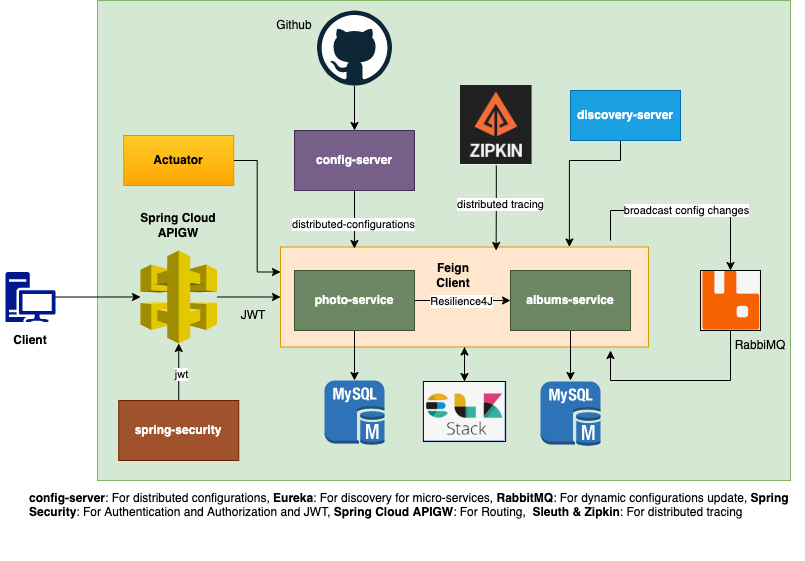
This course has the most focused and comprehensive coverage of distributed tracing and monitoring of anything on this list — and that’s a genuinely underserved topic in microservices education.
Distributed tracing with Spring Cloud Sleuth and Zipkin is one of those things that nobody tells you about until you’re staring at a production issue that spans five services and have no idea where the failure originated.
Ken Krueger also goes deep on Ribbon for client-side load balancing and Eureka for service registration — topics that are fundamental to understanding how microservices find and talk to each other in a Spring Cloud environment. If observability and resilience are the gaps you need to close, this is the course for that.
What you’ll learn:
- Service registration and discovery with Netflix Eureka
- Client-side load balancing with Ribbon — how services choose which instance to call
- Distributed tracing with Spring Cloud Sleuth and Zipkin — following a request across services
- Monitoring production microservices systems — metrics, health checks, alerting
- Building resilient Spring Cloud microservices that handle partial failures gracefully
- Production observability patterns for distributed systems
Best for: Senior developers who want to understand the observability and resilience side of Spring Cloud microservices, engineers responsible for maintaining production distributed systems
Here is the link to — Join Microservices with Spring Cloud
Microservices with Spring Cloud
7. Microservices with Node JS and React
Students: 24,452 | Instructor: Stephen Grider

Microservices are not a Java-only concern — and this course proves it. Stephen Grider (one of the highest-rated technical instructors on Udemy) builds a complete full-stack microservices application using Node.js for the backend services and React for the frontend, with Docker handling containerization throughout.
For JavaScript and full-stack developers, this is the course that applies microservices architecture patterns to the stack they actually work in. The React integration also addresses a question many frontend-leaning developers have: how does a React application work in a microservices environment? How do you handle authentication, shared state, and routing when your backend is distributed?
What you’ll learn:
- Building production microservices with Node.js — JavaScript all the way down
- Integrating a React frontend with a microservices backend architecture
- Docker containerization for Node.js microservices
- Event-driven communication between services using message queues
- Authentication and authorization in a distributed Node.js system
- Full-stack microservices deployment including both frontend and backend services
Best for: JavaScript and full-stack developers, React engineers who want to understand how microservices backends are structured and how their frontend fits in
Here is the link to — Join Microservices with Node JS and React
Microservices with Node JS and React
Which Microserivces Course Should You Start With?
If you’re a senior developer focused on architecture and design → Design Microservices Architecture with Patterns & Principles is where to start. The conceptual foundation it builds makes everything else click faster.
If you want to understand event-driven systems → The Complete Microservices & Event-Driven Architecture is the clearest path to mastering asynchronous, Kafka-based microservices.
If you’re a Java developer who wants comprehensive coverage → Master Microservices with Spring Boot, Docker, Kubernetes covers the full journey from development to production deployment in one course.
If you want depth on Spring Cloud and observability → Microservices with Spring Cloud goes deepest on distributed tracing and monitoring — the production skills most developers are missing.
If you’re a JavaScript or full-stack developer → Microservices with Node JS and React is the only course on this list built around the JavaScript stack end-to-end.
Get More With Udemy Personal Plan
If you plan to take more than two courses from this list — which I’d recommend for serious architectural upskilling — Udemy’s Personal Plan at ~$30/month gives you unlimited access to 11,000+ courses. For senior developers building multiple skills simultaneously across microservices, Kubernetes, cloud, and system design, the plan pays for itself easily.
You can also try it free for 7 days to see if it fits how you learn.
Final Word
Microservices architecture isn’t something senior developers can afford to understand only superficially in 2026. The distributed systems challenges it introduces — service decomposition, inter-service communication, distributed transactions, observability, and resilience — are now the domain of senior engineers, not just architects.
The good news: the learning resources to close this gap have never been better. The seven courses above cover microservices from every angle — architecture and design, event-driven patterns, Spring Cloud and Kubernetes, observability, and full-stack implementation across Java and JavaScript stacks.
Pick the one that closes your biggest gap first. Build something with it. Then go deeper.
P.S. — You can often get individual Udemy courses for $10–15 during their frequent sales. But if you’re planning to take multiple courses across microservices, Kubernetes, system design, and cloud — the Udemy Personal Plan at ~$30/month is significantly more cost-effective. Worth checking before you buy individual courses.

Why Senior Developers Should Learn Microservices Architecture? With 7 Tried and Tested Resources was originally published in Javarevisited on Medium, where people are continuing the conversation by highlighting and responding to this story.
This post first appeared on Read More