
There’s a line from Google’s Site Reliability Engineering practice that should be tattooed on the inside of every engineer’s eyelids: roughly 70% of production outages are caused by a change to a live system. Not exotic hardware failures. Not cosmic rays. Us, shipping something.
That single statistic is the reason rollout strategy exists as a discipline. If deploying were free of risk, we’d all just push to production and go home. The entire field of blue-green, canary, feature flags, rings, and the rest is an answer to one question: how do we introduce change into a running system without betting the whole system on it being correct?
Before we get into the catalog, it helps to internalize the idea that quietly underpins all of it.
Deploy is not the same as release
The most important conceptual move in modern delivery is separating two things we used to treat as one event:
- Deployment is a technical act: new code is now running in production.
- Release is a product act: users are now experiencing that code.
For most of software history these happened simultaneously — the moment the binary went live, everyone got the new behavior. Decoupling them is what makes every advanced strategy below possible. As James Governor of RedMonk (who coined the term progressive delivery) likes to frame it, engineers can deploy whenever they want; the business decides when to actually turn something on.
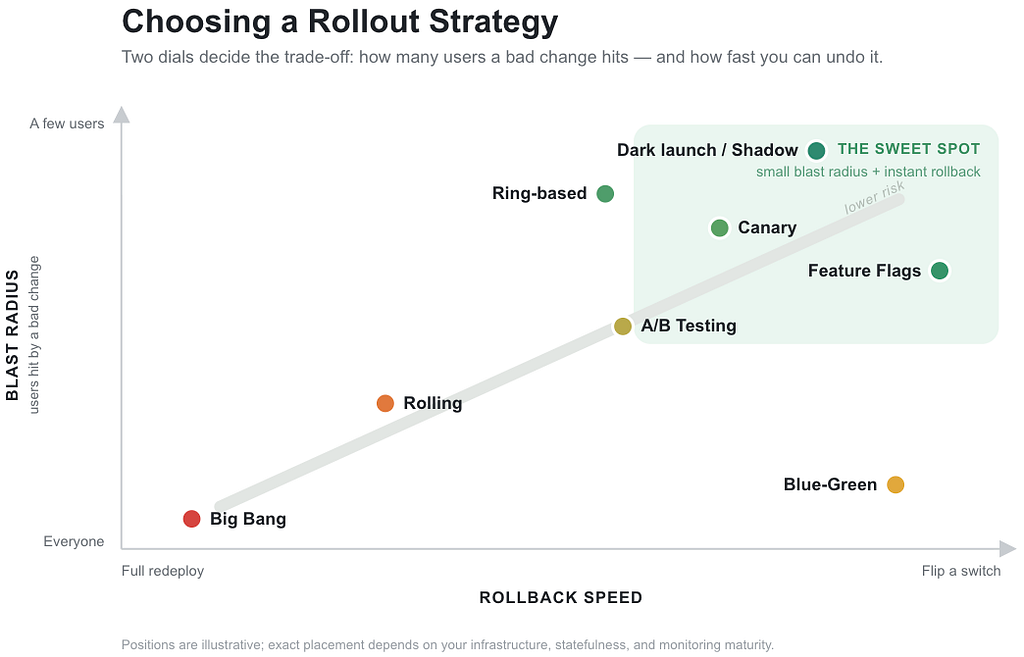
Once you hold those two ideas apart, every rollout strategy becomes a way of turning two dials:
- Blast radius : if this change is bad, what fraction of users or traffic gets hurt before you notice?
- Reversibility : how fast, and how cheaply, can you undo it?
A “good” strategy for a given situation is simply the one that keeps blast radius small and rollback fast at a cost you’re willing to pay. Let’s walk the spectrum, roughly from the crudest and riskiest to the most controlled.
1. Big Bang (a.k.a. Recreate / All-at-Once)
What it is: Stop the old version, start the new one, everybody gets it at once. In Kubernetes this is literally called the Recreate strategy. Terminate all old pods, then bring up the new ones.
The trade-off: It’s the simplest thing that can possibly work, and there’s genuine value in that. There’s exactly one version live at any moment, so no compatibility juggling, no split-brain state. But blast radius is 100% and rollback means another full deploy. There’s usually a slice of downtime during the cutover, and if the release is bad, everyone finds out simultaneously.
When to reach for it: Small applications, internal tools, batch systems, or anything where a maintenance window is acceptable and the cost of complexity outweighs the cost of a few minutes of downtime. It’s a perfectly reasonable default until your user base or uptime requirements make it not one.
2. Rolling Deployment
What it is: Replace instances of the old version with the new one incrementally. One at a time, or in small batches. Until the whole fleet is updated. The service stays available throughout because there are always healthy instances serving traffic.
The trade-off: No dedicated second environment, so it’s resource-efficient. You’re updating the fleet you already have. The catch is that for a window of time, two versions run side by side serving real users, which means your changes need to be backward-compatible (more on that later). Rollback is slower than blue-green because you have to roll the fleet back instance by instance, and a subtle bug can spread across the fleet before monitoring catches it. This is the bread-and-butter default of most container orchestrators.
When to reach for it: Large, horizontally-scaled, stateless services where a full duplicate environment would be wasteful and you can tolerate brief version coexistence.
3. Blue-Green Deployment
What it is: Run two production-identical environments call them Blue and Green. One is live; the other is idle. You deploy the new version to the idle environment, test it there, then flip the router so all traffic moves to it in one atomic switch. The old environment stays warm as your instant rollback.
Martin Fowler popularized this pattern back around 2010, building on Jez Humble and Dave Farley’s Continuous Delivery, precisely to solve the cut-over problem — that nervous moment of taking software from final testing into live production.
The trade-off: Rollback is close to instantaneous and low-drama: flip the switch back. You also get a realistic place to smoke-test the release before it takes traffic. The price is real, though — you’re running (and paying for) two full environments, and the shared database becomes the hard part. You typically don’t duplicate the database (users would be writing to two of them), so both versions of your code end up talking to the same schema, which forces backward-compatible migrations.
When to reach for it: Systems where downtime is unacceptable and instant rollback is worth the cost of doubled infrastructure — and where you’ve done the work to make schema changes backward-compatible.
4. Canary Release
What it is: Deploy the new version alongside the old, then route a small slice of real users to it 1%, then 5%, then 20% watching metrics at each step. If it misbehaves, you roll back having exposed only a sliver of your users. If it’s healthy, you widen the flow until it’s serving everyone.
The name comes from the grim old mining practice of carrying a canary underground: if toxic gas leaked in, the bird succumbed first, giving miners a warning. Your canary instances play the same role for a bad release. Google’s SRE Workbook defines canarying crisply as a partial and time-limited deployment of a change, evaluated to decide whether to proceed the part getting the change is “the canary,” the rest is “the control.”
The trade-off: This is arguably the best blast-radius-to-cost ratio available. You catch problems under real production traffic real load, real edge cases, real weird inputs staging never reproduces while limiting exposure. It even doubles as capacity testing. The cost is operational sophistication: you need traffic-splitting infrastructure, and you absolutely need good monitoring. Google has internal postmortems whose root cause was, in effect, “the canary graph wasn’t wiggly enough to make the release engineer worried” which is why mature shops automate the analysis and the rollback rather than trusting a human staring at a dashboard.
When to reach for it: Large user-facing services with solid observability, where you’d rather find out about a regression from 1% of users than 100%.
5. Feature Flags (Feature Toggles)
What it is: Wrap new behavior in a runtime conditional. The code ships to production dormant; you switch it on later for everyone, or for a chosen cohort without a redeploy. This is the purest expression of “deploy ≠ release,” and it’s the mechanism that powers most of the other progressive strategies.
Pete Hodgson’s canonical article on Martin Fowler’s site makes a point that’s easy to miss and expensive to ignore: flags are not one thing. He sorts them by intent and expected lifespan, and conflating the categories is the root of most flag-related pain:
Toggle type Purpose Lifespan Who controls it Release Hide in-progress work so it can merge to trunk and ship dark Days to weeks remove after launch Developers Experiment Split traffic for A/B tests and multivariate testing As long as it takes to reach significance Product / data Ops Operational control — degrade or kill a feature under load Short-lived; a few become permanent kill switches Ops / SRE Permission Gate features by user (premium tiers, beta, internal) Long-lived, often permanent Product / account teams
The trade-off: Enormous flexibility and instant rollback (flip the flag — no redeploy, seconds not minutes). It’s also what enables trunk-based development: unfinished code can live on the main branch behind an off flag. The danger is flag debt. Flags are cheap to create and multiply fast; Hodgson’s advice is to treat the toggles in your codebase as inventory that carries a cost, and to keep that inventory as low as you can. A release toggle that silently graduates into a permanent config value never reclassified, never removed — becomes dead-code-path clutter that makes the system harder to reason about. Discipline around removing flags is not optional.
When to reach for it: Almost everywhere in a continuous-delivery shop but with a naming convention, an owner per flag, and a cleanup process baked into the workflow.
6. Dark Launch & Shadow (Traffic Mirroring)
What it is: Deploy a feature to production but keep it invisible to users while you validate it under real conditions. Facebook coined “dark launch” for its Chat rollout the code ran and handled requests, but results weren’t shown to users, letting engineers watch it cope with real production traffic before anyone could see it.
A closely related, more infrastructure-flavored sibling is shadow deployment (traffic mirroring): you duplicate a portion of live requests and send the copy to the new version in parallel, discarding its responses. Users are served entirely by the old version and never see the shadow’s output; you compare the shadow’s behavior latency, errors, correctness against production. Service meshes like Istio and gateways like NGINX support this natively.
The trade-off: You get production-realistic validation with essentially zero user-facing risk, which is gold for backend rewrites, new ML models, and algorithm changes where correctness is hard to prove offline. The sharp edge is side effects. Shadowing a stateless read path is safe; shadowing anything that mutates state or calls third parties is a trap. Mirror a checkout service naively and you can double-charge a customer’s card and ship two orders. Shadowed writes must be sandboxed, and irreversible operations (payments, emails, account creation) have to be stubbed or suppressed on the shadow path.
When to reach for it: Validating performance and correctness of backend services or models before they ever touch a user provided you can guarantee the new path has no unintended side effects.
7. A/B Testing
What it is: Run two (or more) variants simultaneously, split users between them, and compare a business metric conversion, click-through, revenue-per-user. Variant A gets one experience, B gets another; the winner is decided by data.
The trade-off: This is where a subtle but important distinction lives. A/B testing looks like canarying both split traffic between versions but they answer different questions and shouldn’t be conflated. Fowler’s guidance is explicit: a canary is there to detect regressions (“is this release broken?”) and should complete in minutes or hours; an A/B test is there to validate a hypothesis (“which design converts better?”) and may need days or weeks to reach statistical significance. Run the same rollout as both and the experiment’s slow business-metric readout interferes with the canary’s need for a fast go/no-go signal.
When to reach for it: Product and design decisions where you want evidence about user behavior — not as a substitute for release-safety canarying, but alongside it.
8. Ring-Based / Phased Rollout
What it is: Concentric circles of users, each a stage of the rollout. Ring 0 might be your own engineers and internal users (a “canary” cohort); Ring 1 a small set of data centers or beta users; Ring 2 a larger sampling; and outward until everyone has it. A feature must clear its performance and quality bar in one ring before advancing to the next, and the stakes rise with each ring.
This is Microsoft’s model : Sam Guckenheimer’s description of it (choosing rings by blast radius, widening gradually) is literally the conversation that sparked Governor’s coining of “progressive delivery.” GitHub does a version of this too, with “staff ships” that expose new functionality to employees first, using their own dogfooding population as the canary.
The trade-off: Ring-based rollout gives you a policy for widening exposure, which is especially valuable when the reasons are organizational rather than purely technical — regulatory constraints, geographic staging, or contractual commitments about who gets what when. It’s more of an orchestration pattern layered on top of the mechanisms above (usually flags + canary analysis) than a distinct low-level technique.
When to reach for it: Large organizations shipping to diverse populations, where “who gets this next, and what must be true before they do” is a decision worth formalizing.
The umbrella: Progressive Delivery
If you look at canary, feature flags, rings, and observability and think these all feel like facets of one idea. you’re right, and there’s a name for it. Progressive delivery is the term James Governor introduced in 2018 for exactly this basket of techniques. Carlos Sanchez’s working definition captures it well: progressive delivery is the step after continuous delivery, where new versions go to a subset of users, are evaluated for correctness and performance, and are rolled out further or rolled back based on key metrics.
The framing has two defining characteristics worth remembering:
- Release progression — widening exposure at a pace that fits the business, via canaries, percentages, and rings.
- Progressive delegation — handing control of a feature to whoever is closest to the outcome. Engineers own it during rollout; product or ops owns it once it’s live.
The practical upshot for your day-to-day: these strategies are not mutually exclusive, and mature systems layer them. A very normal setup is a canary rollout, running on blue-green-style infrastructure, gated by feature flags, with automated metric analysis deciding whether to widen or roll back. Governor also points out a real advantage of the flag-centric approach: if you ship five features in one deploy and one is bad, blue-green or a raw canary forces you to roll back all five but flags let you kill the one broken feature while the other four keep rolling.
The part everyone forgets: data and rollback
Here is the failure mode that humbles teams who’ve nailed everything above: your rollout is only as reversible as your database migrations. You can have flawless blue-green infrastructure and a beautiful canary pipeline, and still be unable to roll back, because the new version already changed the schema in a way the old version can’t read.
The discipline that fixes this is backward-compatible, incremental schema change Fowler calls the underlying pattern parallel change (expand / contract). You never make a breaking schema change in the same release that depends on it. Instead you split it:
- Expand — add the new column/table, in a release that still works with the old shape.
- Migrate — backfill and dual-write.
- Contract — only once the new code is fully live and proven, remove the old shape.
Google’s SRE writing describes the same move as a “feature-free release”: if version v needs a new schema, first ship v+1 identical to v but able to tolerate the new schema then ship v+2 with the features that use it. Now you can roll either binary back without also having to unwind the database.
And whatever you do, have a rollback ready before you roll out. Google’s blunt house rule “rollback early, rollback often” exists because the instinct to debug-in-place while users suffer is almost always the wrong one. The fastest path to recovery is usually to get back to the known-good state first and diagnose after. A rollout strategy without a matching rollback strategy is just a nicely-decorated way to cause an incident.
How to choose
There’s no single best strategy there’s the one that fits your constraints. A few questions cut through most of the decision:
If this is true… …lean toward Small app, internal tool, downtime is fine Big bang / recreate Large stateless fleet, no budget for a duplicate environment Rolling deployment Zero-downtime required, want instant rollback, can afford 2× infra Blue-green Big user base, strong monitoring, want to limit blast radius Canary release Need to decouple deploy from release, ship dark, kill features fast Feature flags Backend rewrite or new model, correctness hard to prove offline Dark launch / shadow Deciding between product variants on a behavioral metric A/B testing Large org, diverse users, staged exposure with policy Ring-based rollout
Some honest guiding principles behind the table:
- Match the strategy to the risk profile of the change, not to fashion. A config tweak and a payments rewrite do not deserve the same ceremony.
- You cannot do safe progressive rollout without observability. If you can’t measure error rate, latency, and the business metrics that matter, a canary is just a slower big bang. Monitoring is the prerequisite, not the nice-to-have.
- Automate the go/no-go decision as you scale. Humans rationalize noisy graphs; automated canary analysis with automatic rollback doesn’t.
- Layer, don’t pick. The interesting question is rarely “canary or flags” — it’s how to combine them.
Common ways this goes wrong
A short list of the potholes, drawn from the same sources:
- Flag debt. Toggles that outlive their purpose and never get removed. Classify each flag at birth; delete release toggles on schedule.
- Conflating canary and A/B. Different questions, different timescales. Don’t let a weeks-long experiment gate a minutes-long release decision.
- Shadowing side-effecting services. Mirrored writes and third-party calls cause double-charges and duplicate emails. Sandbox them.
- The un-wiggly canary. Rollouts where the monitoring wasn’t sensitive enough — or the human wasn’t paying attention — to catch the regression. Automate.
- No rollback path, especially in the database. The most common way a “safe” rollout becomes an outage.
The goal is boredom
The through-line across every good source on this topic is almost anticlimactic: the point of all this machinery is to make deployment unremarkable. Elite teams ship constantly and it’s a non-event — not because their code is magically bug-free, but because their rollout strategy gives them small blast radius, fast rollback, and enough observability to know which is which. If your deploys are exciting, that’s not a badge of honor; it’s a signal that your strategy has room to grow.
Start where you are. A small team with a big-bang deploy and a solid rollback is in fine shape. When uptime pressure or user count makes that painful, reach for rolling or blue-green. When blast radius becomes the thing that keeps you up at night, add canaries and flags. And somewhere along the way, without any single dramatic decision, you’ll notice you’ve been doing progressive delivery for a while.
Sources & further reading
- Martin Fowler — BlueGreenDeployment, CanaryRelease, FeatureFlag, and ParallelChange
- Pete Hodgson — Feature Toggles (aka Feature Flags), martinfowler.com
- Google — Site Reliability Engineering and the SRE Workbook: Release Engineering, Canarying Releases, and the CRE life-lessons posts on canaries and reliable releases and rollbacks
- Jez Humble & David Farley — Continuous Delivery (Addison-Wesley) — the foundational text for blue-green, deployment rings, and decoupling deploy from release
- James Governor — Towards Progressive Delivery, RedMonk
- LaunchDarkly — What Is Progressive Delivery? and The Only Guide to Dark Launching

A Practical Guide to Software Rollout Strategies was originally published in Javarevisited on Medium, where people are continuing the conversation by highlighting and responding to this story.
This post first appeared on Read More