
AI agents could transform enterprise productivity with their ability to handle complex workflows, make decisions, and act autonomously toward business goals. But this promise can’t be fulfilled if agents sound confident while getting things wrong, miss critical context, or lose the intent halfway through.
Often, the root cause is due to the context (or lack of context) that the agent is working from: what it knows, what it remembers, and whether it can connect those things to make a reliable decision.
When AI agents act on incomplete or disconnected context, the downstream consequences are real: tickets are created in error, messages get sent to the wrong person, records are updated incorrectly. And without visibility into why an agent decided what it did, there’s no clear path to fixing it.
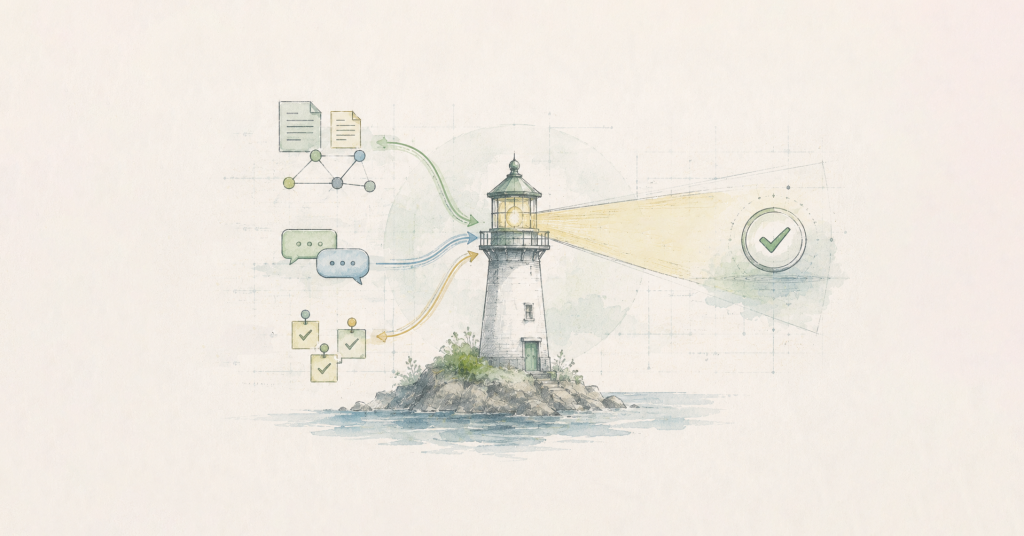
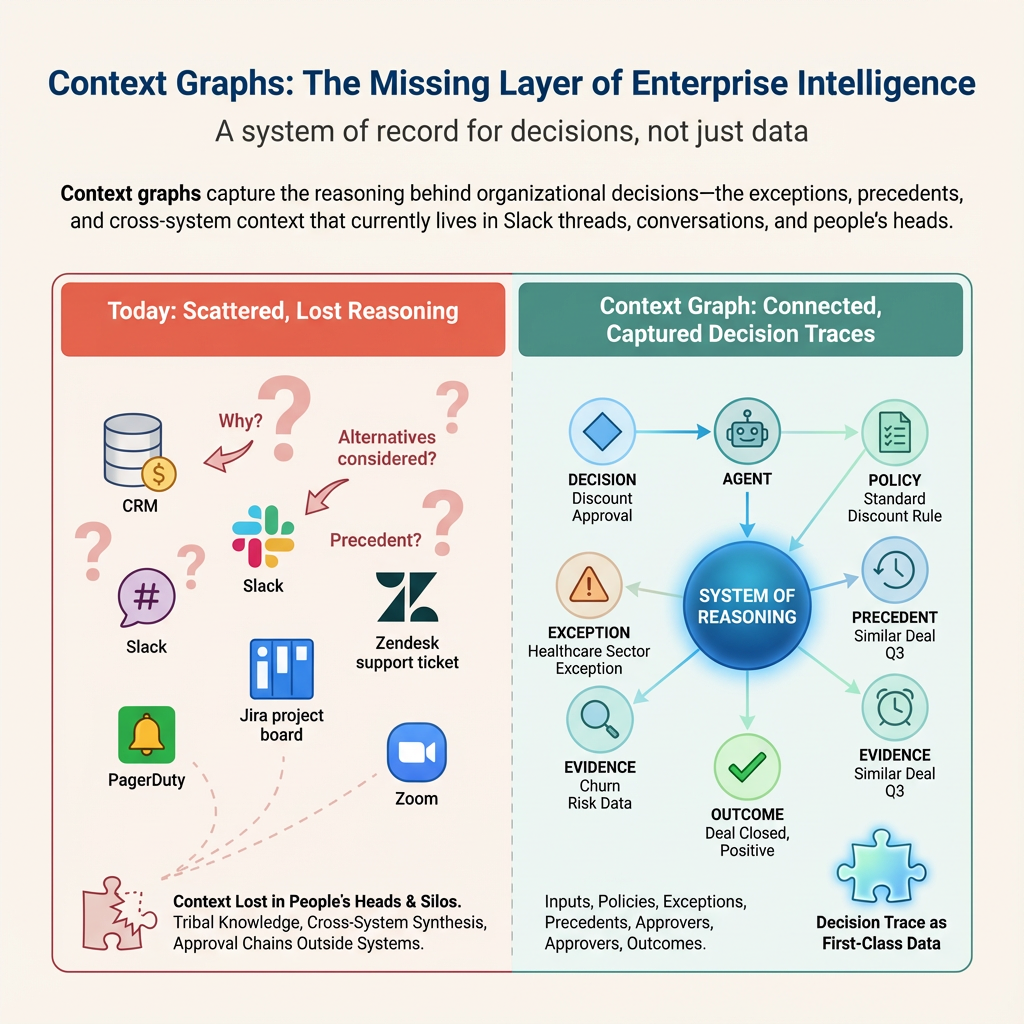
This is where a context graph can help. A context graph gives AI agents a holistic, connected memory of everything they need — business knowledge, conversation history, and decision traces — to make decisions that are grounded, explainable, and improvable.
To understand why a context graph is so important and how it works with your AI agent, you first need to understand the decision-making process of AI agents.
More in this guide:
How does an AI agent make decisions?
AI agents make decisions through a continuous loop. This loop can vary, but it generally cycles through five stages: understanding the goal, gathering context, deciding on the next best step, executing, and learning. Each stage creates a dependency on the one before it. When any stage breaks down, the decision downstream breaks with it.
1. Understand the goal
Every task starts with interpreting the user request, objective, or workflow trigger. The clearer the goal, the better every downstream decision will be, so effective agent design makes the desired outcome, constraints, permissions, and success criteria explicit.
Where it breaks: A vague or underspecified goal gives the agent room to drift at every subsequent stage. If success criteria aren’t defined here, the agent also has no reliable basis for evaluating its own output.
2. Gather context
Before choosing a course of action, the agent retrieves information relevant to the task, including business knowledge, current state, available tools, prior decisions, and the goal itself.
Where it breaks: Every downstream decision depends on what context the agent retrieves here. Incomplete, inaccessible, or disconnected data at this stage causes a slippery slope in reasoning. This is the stage where most failures begin.
3. Decide on the next step
With the goal and context in view, the agent weighs its available options and decides on the best next step. That might mean answering directly, retrieving more information, calling a tool, routing the task to another agent, asking for clarification, escalating to a person, or stopping altogether.
Where it breaks: Decision quality depends directly on context and evaluation logic. If the instructions or context retrieved in step 2 are missing key information, the agent’s reasoning operates on an incomplete picture, and even sound logic produces the wrong result.
4. Act
After committing to the next best step, the agent acts on it. Actions might include querying a database, calling an API, sending a message, creating a ticket, updating a workflow, returning a recommendation, or invoking another service.
Where it breaks: Actions taken on a flawed decision in step 3 can have real downstream consequences: records updated incorrectly, messages sent to the wrong recipient, workflows triggered out of sequence.
5. Learn
Once the action produces a result, the agent compares the outcome against the goal defined in step 1. When results appear incomplete, conflicting, or incorrect, that triggers another pass through the loop with different context, tools, or plans.
Where it breaks: Without persistent memory, every loop iteration starts from scratch. There’s no way to identify which step introduced the failure. The agent can’t recognize that a similar task failed last week, that a policy exception was already rejected, or that the current plan repeats a known dead end. Long-term improvement requires recording decisions, actions, evidence, and outcomes in persistent memory so future loops can learn from past experience.
How agentic decisions compare to ML predictions and rule-based systems
The AI agent loop described above is one approach to automated decision-making, but it isn’t the only one.
Traditional software uses if-then rules to arrive at a decision. Machine learning (ML) makes predictions based on learned patterns. Agentic decision-making is different: The agent reasons over available context to determine the best next action, which gives it the flexibility that the other two approaches don’t have.
Each approach has distinct strengths and limitations. You can combine them to make use of their strengths and cover for their weaknesses.
| Dimension | Rule-based | ML | AI agent |
|---|---|---|---|
| Logic | Static if-then conditions | Patterns learned from training data | Autonomous LLM-based reasoning over goals, available context, and constraints |
| Output | A deterministic action or result | A score, label, ranking, or probability | A selected next step, action, recommendation, or plan |
| Adaptability | Requires manual updates | Usually requires new data, retraining, or a pipeline update | Can adapt when new context, tools, memory, and feedback are available |
| Handling ambiguity | Breaks when conditions are missing or unexpected | Generalizes from training data but struggles outside expected distributions | Can reason through new context with the right guardrails |
| Explainability | High when rules are documented | Often limited to a score, label, or feature explanation | Limited by default; stronger when decisions are recorded in a context graph |
| Scale | Degrades as rule complexity grows | Scales with data volume but degrades on out-of-distribution inputs | Scales better when context, memory, feedback, and evaluation are built into the system |
In a production system, these three approaches often work together to make better decisions. For example, a fraud detection system might use deterministic rules to block prohibited actions, an ML model to score risk, and an AI agent to investigate the case, gather evidence, decide whether to escalate, and explain its decision.
Agentic decision-making remains the most powerful and flexible option since AI agents can also run scripts with if-then rules or machine learning models to inform their decisions. But without the right setup in place, agentic decision-making can easily go wrong.
Why agentic decision-making goes wrong
AI decision-making usually goes astray not because agents lack access to information, but because they can’t connect it. An agent might have a CRM record, a policy document, and a prior ticket all available, but without structure and memory, it has no reliable way to understand how those pieces relate to the current task or to each other. Let’s explore four major reasons why agentic decision-making fails.
Context fragmentation
Enterprise context rarely lives in one place. Customer data sits in a CRM, product information in a catalog, policy documents in a wiki, transactions in a warehouse, and conversations in a support tool. When an agent queries across these sources, it retrieves fragments. Fragments don’t carry the relationships needed to make a reliable decision.
A support refund decision, for example, may depend on the customer, account tier, order history, product issue, policy exception, open ticket, and prior concessions. A search result can sound relevant while still leaving out the relationships needed for a decision. When those relationships are missing, the agent has to fill in the gaps — and it may fill them incorrectly.
Reasoning without structure
Some patterns are visible only through relationships and metadata. Fraud rings, access risk, supply chain dependencies, and policy exceptions often depend on paths across entities. Text can mention the right entities, while the relationship patterns carry the signals the agent needs.
In an access-risk workflow, each source shows only part of the pattern. An identity system shows a user’s role, an application log shows unusual access, and a policy document defines which permissions require review. To make a reliable decision, the agent needs to perform multi-step reasoning by retrieving data connected across the user, device, application, role, policy, and recent activity. While each source is accurate on its own, an agent working from disconnected sources may clear an access request that a connected view would flag.
No durable memory
An agent needs durable memory to support consistent behavior. Without memory, it can treat every task as a first encounter or lose the reasoning behind earlier steps in the same workflow.
A procurement agent might approve a supplier exception without realizing that a similar exception was rejected the previous week for the same compliance issue. The problem goes beyond recall. The agent lacks a reliable record of what happened, what it decided, why it decided that way, and what outcome followed.
No decision trace
A decision without a trace creates a trust problem. When someone asks why an agent recommended a rejection, escalation, discount, policy exception, or next best action, the system needs to show more than a generated explanation.
Teams need to see what context the agent retrieved, which policies applied, which tools ran, what reasoning path the agent followed, and what outcome occurred. Without that trace, teams struggle to explain decisions, debug bad decisions, reproduce past results, enforce governance, or improve the system.
How context graphs improve AI decision-making
Larger models and longer context windows don’t solve fragmented context, missing memory, or absent decision traces on their own. Reliable decision-making requires a context graph that connects what the agent knows, what it has done, and why each decision was made.
To make a reliable decision, an AI agent needs to piece together all available context that lives across different systems. That context provides a record of past organizational decisions, the reasoning behind them, and the outcomes. Instead of piecing together isolated records at runtime, a context graph allows agents to follow relationships between people, systems, documents, events, and decisions, enabling them to understand the full context of a situation.
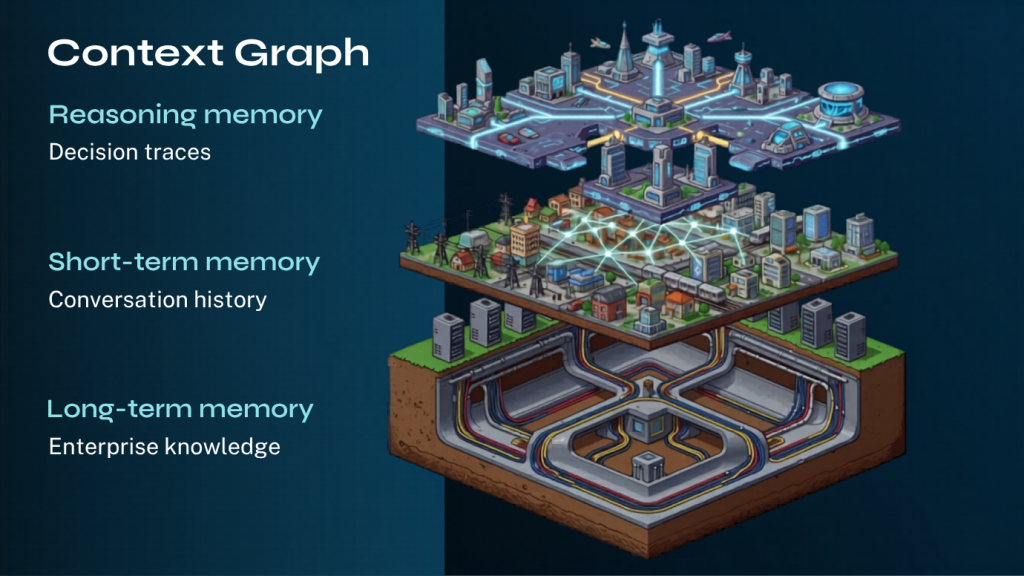
A context graph gives agents three types of memory to make reliable decisions:
- Long-term memory stores enterprise knowledge, including durable business facts, entities, relationships, policies, and domain knowledge.
- Short-term memory stores conversation history, session state, recent tool results, and what the agent has already done, helping the agent avoid context drift.
- Reasoning memory stores decision traces, tool calls, reasons, observations, and outcomes so people and other agents can inspect how a decision was made.
Agents retrieve information from the context graph via GraphRAG. Graph traversal helps the agent assemble that broader picture before taking action. The agent can start with a relevant entity and then traverse relationships to gather surrounding context, such as relevant knowledge, conversation history, and decision traces.
Take a supplier risk review. An agent needs to examine the supplier, affected products, facility locations, open orders, compliance requirements, route dependencies, prior exceptions, and similar disruptions that have been reviewed in the past. The graph structure makes decisions easy to explain. Teams can see which documents, entities, policies, tool calls, and prior decisions influenced the result. That visibility helps developers troubleshoot errors, auditors review decisions, and organizations enforce governance requirements.
The context graph also records new conversations, decisions, and outcomes as the agent works through them. This way, the agent can learn from past decisions, compare similar situations, avoid known failed paths, and explain why a new decision aligns with or differs from previous ones. These capabilities help the agent improve its decision-making over time.
In short, when they’re provided with a connected context, agents can make decisions with a clearer view of the facts, relationships, and prior outcomes behind each choice. Teams also get a record they can inspect, debug, and govern.
Building a context graph to improve AI decisions
The quality of context separates reliable AI decisions from confident guesses. A context graph provides agents with connected memory they can use to make better decisions, trace reasoning, and learn from past outcomes.
To build a context graph, use Neo4j Agent Memory, an open-source library that gives you a direct path to implementing all three memory types in the context graph. It fits into existing agent stacks, with integrations for LangChain, LlamaIndex, Pydantic AI, CrewAI, OpenAI Agents, and other frameworks, along with Python and TypeScript SDKs — which means you can add graph-native memory to an existing agent architecture without rebuilding the whole application around a new framework.
If you’re starting with graph retrieval, take the free course Context Graphs: Agent Memory with Neo4j to learn how to build a context graph that enables AI agents to make grounded, explainable, and improvable decisions.
Free course: Agent memory with Neo4j
Learn how to build a context graph that enables AI agents to make grounded, explainable, and improvable decisions.
This article first appeared on Read More