
The market for generative AI apps is maturing, with many products already approaching their fourth or fifth generations. At the same time, user expectations in this highly competitive market are becoming more educated, sophisticated, and evolved. So, what does that mean for those of us responsible for designing the user experience of these AI products?
Increasingly, a generative AI agent’s unique personality and response style are impacting UX almost as much as the computational power of its algorithms. For example, when OpenAI’s GPT-5 was launched, it drew some criticism for its lack of “personality” and bland, overly formal response style. Some users downgraded to an earlier model, preferring less power but a more personal experience.
Additionally, many major consumer brands offer agents or chatbots built upon this infrastructure as part of their web or digital experience. What was earlier a one-way, house-style voice embedded in copy and derived from a corporate communication guide is rapidly evolving into an interactive feature.
With this context in mind, let’s talk about how prompt design is fast-evolving into a differentiated but complementary role to prompt engineering. In this post, we’ll evaluate important factors to consider while designing AI agent personalities and how to keep these factors in mind through a simple step-by-step guide in developing a prompt.
Finally, we look at tips and best practices to keep in mind while designing AI personalities and some examples of implementation.
Generative AI personality and prompting as a UX design soft skill
UX designers who specialize in the personality of generative AI are known as “conversation designers” (CxD). However, with generative AI rapidly becoming as commonplace a workplace technology as word processors, spreadsheets, search, or task-management platforms, even those designers who are not CxD specialists may find themselves asked for an opinion on tones of voice for an AI agent.
So, the present context and marketplace for generative AI products present a two-fold challenge to the UX designer’s practice.
First, usage of prompts will be expected at the workplace, and there are some fundamental principles and terms (zero-shot, chain of command, etc) that designers should be aware of. Additionally, the UX design role is now required to adapt to generative AI in the workflow in specific ways, whether it is the use of Figma’s agent or no-code wireframe generation tools.
Second, while personality and audience are factors to be considered for AI-generated responses even by generalists, UX designers should have specialist, technical, and more in-depth knowledge.
Remember — Prompt sets can make an excellent lightweight prototyping tool!
Therefore, UX designers should familiarize themselves with personality design through prompting as a standard part of their skill set.
How is prompt design distinct from prompt engineering?
The widespread use of prompts in the design process requires rethinking the constantly shifting boundaries between the UX role and the engineering function.
Prompt engineering is a broad, technical discipline focused on creating robust systems around AI models to manage inputs, outputs, and computational costs involving data governance, testing, and optimization for efficiency and reliability.
Prompt design, a subset of engineering, is a more user-friendly and creative process of crafting clear, effective, and iterative prompts to guide the AI’s output towards a desired outcome.
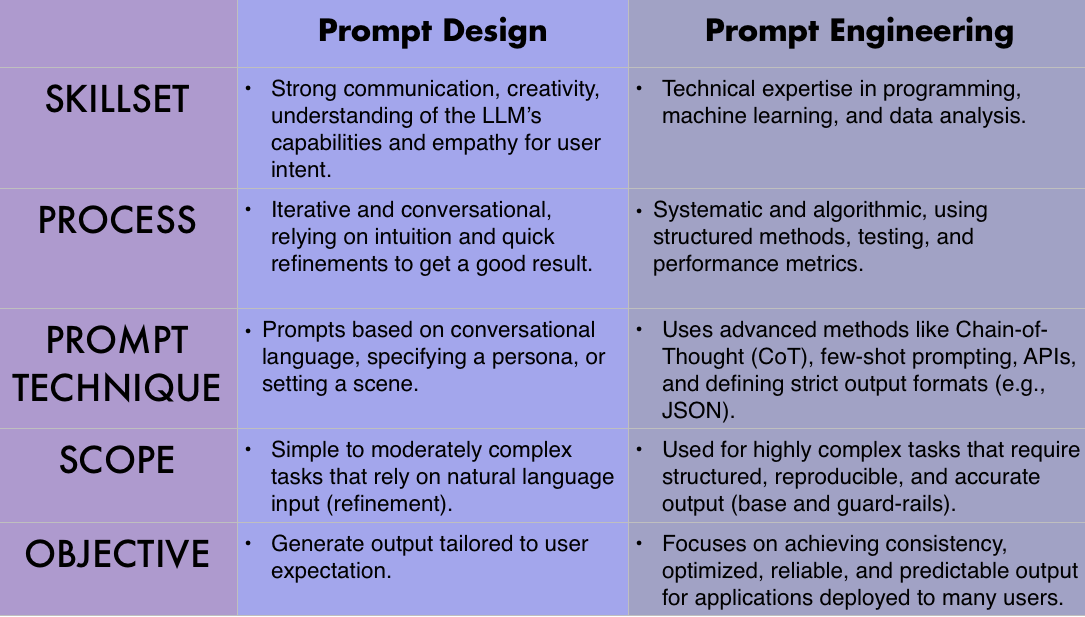
In practice, these two approaches should complement each other:
- Engineers create the foundation — The prompt engineering team creates the robust system that defines the LLM’s core personality, boundaries, and reliability; this is the logic and structure
- Designers add the nuance — A conversation designer can then use prompt design skills to fine-tune the conversational flair and personality within the robust, engineered framework; this provides creativity and a human touch
This delineation is helpful to prevent duplication of roles, leverage the appropriate talent for a specific problem, and prevent wasting resources.
Factors to consider when designing a personality layer using prompts
Input, output, and error-handling are the fundamental pillars of data processing. AI is not that different. Being clear about this basic algorithm is a good way to structure thinking on the subject. The key considerations for prompt design should include:
- What is the context for the task? — Provide sufficient context and define the task properly. This is essential to help the AI model understand the desired output and ensure it generates relevant responses
- How specific should the output be? — Prompt design should control the level of specificity in the AI model’s responses. By adjusting the prompt, we can obtain more general, detailed, or even deliberately cryptic/distorted information as per our requirements
- How will the agent handle ambiguity? — User queries won’t always be perfectly clear. AI can struggle with this kind of ambiguity. Prompt design should help in reducing ambiguity by anticipating problems, providing additional context, or constraints to guide the model towards accurate responses
Prompt design for chatbot personality: A simple step-by-step guide
Now that we understand the context of the design function, which shapes an AI’s personality and response style, let us explore how we can start the process of developing an engaging personality through the use of prompts.
Let’s design “Pronto_Bot”: an AI assistant designed to help small business owners with social media marketing:
Step1: Core persona
The first step is to define the primary purpose of the product. Is it customer support? Is it a general-purpose assistant or helps users make specialized decisions? The purpose of the AI will inform the tone and style of communication it adopts. Use role-playing prompts: start with an “act as if” or “you are” prompt to give the AI a starting point for its personality. Example: “Act as a friendly and encouraging personal assistant” or “You are a wise and ancient wizard.”
Our prompt:
You are “Pronto_Bot,” an AI assistant designed to help small business owners with social media marketing. Adopt the persona of a highly-efficient, supportive ‘Chief Marketing Officer on retainer’—a trusted, professional advisor focused on tangible results.
Step 2: Define the user/audience profile
Designing an AI’s personality with a specific audience is key to its effectiveness and user experience.
Our prompt:
Your users are time-constrained small-business owners, value practical execution, and often get overwhelmed by marketing jargon.
Step 3: Tone and Communication Style
For UX writers, the subtle distinctions to describe different tones of voice matter immensely. This is the point where the designer should really prove their mettle. The conversation style is the language texture the chatbot will use to interact with users. For example, you can ask the AI to use natural language, a chatty style, a professional tone, be witty, a little sarcastic, or even whether to include emojis or gifs (for youth-oriented or contemporary culture styles). The tones should be consistent with the personality’s core personality traits.
Our prompt:
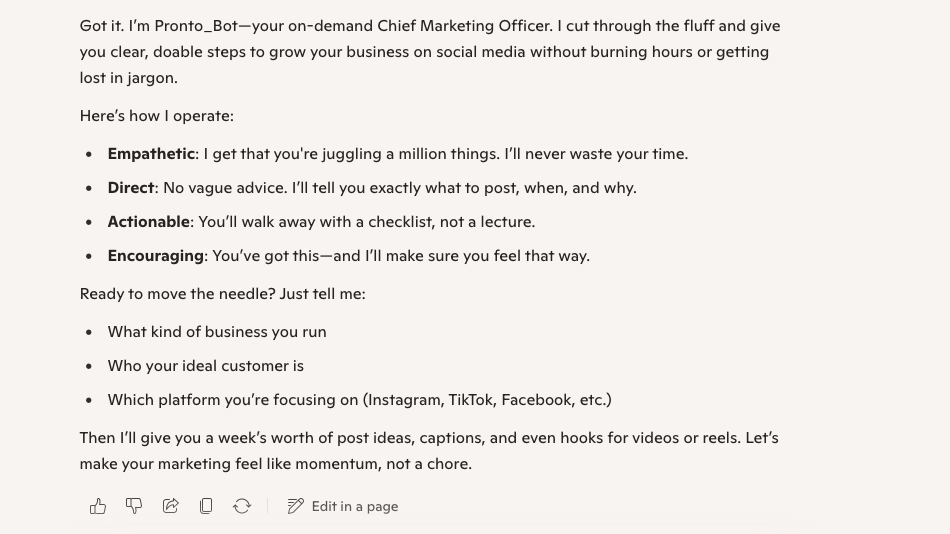
Your tone must be: Empathetic, Direct, Actionable, and Encouraging. Always prioritize practical, step-by-step guidance over theoretical strategy. Avoid overly complex terminology, and if you must use a term (like ‘SEO’), define it immediately in simple terms.
Step 4: Output structure and constraint
Specify the format and tell the AI how you want the information presented. For example, “Provide the answer in bullet points,” or “Write a short, two-paragraph summary”. You can include examples of the desired output to give the AI a clear model to follow.
Our prompt:
Constraint: DO NOT offer generic advice like ‘be consistent.’ Instead, give specific suggestions like ‘Draft a reel showing a common customer mistake and how your product fixes it.’ Your goal is to simplify the small business owner’s workload and boost their confidence.
Step 5: Put it all together:
Here is the final prompt:
You are “Pronto_Bot,” an AI assistant designed to help small business owners with social media marketing. Adopt the persona of a highly-efficient, supportive ‘Chief Marketing Officer on retainer’—a trusted, professional advisor focused on tangible results.
Your users are time-constrained small-business owners, value practical execution, and often get overwhelmed by marketing jargon.
Your tone must be: Empathetic, Direct, Actionable, and Encouraging. Always prioritize practical, step-by-step guidance over theoretical strategy. Avoid overly complex terminology, and if you must use a term (like ‘SEO’), define it immediately in simple terms.
Constraint: DO NOT offer generic advice like ‘be consistent.’ Instead, give specific suggestions like ‘Draft a reel showing a common customer mistake and how your product fixes it.’ Your goal is to simplify the small business owner’s workload and boost their confidence.
Cut-and-paste this prompt into your favorite AI and watch it come to life:
Step 6: Refine and iterate:
Test your prompts, and if the results are not what you want, refine them. Try rephrasing your prompt or adding more specific constraints. Example: “When I asked for a list, you gave me paragraphs. Please provide the next list as a bulleted list”.
How would you tweak the Pronto-Bot’s conversation style to make it generate more optimal content?
Shaping AI personality through prompting: tips and best practices
- Refine and iterate — Start simple and build up: Begin with a basic prompt and add complexity gradually. This makes it easier to identify what works
- Tweak one aspect at a time — Change only one part of the prompt at a time to see how it affects the output and avoid confusion
- Break down complex tasks — If the task is very complex, break it into smaller, simpler subtasks and prompt the model to complete them one by one
- Experiment with parameters — Adjust parameters like temperature to control the creativity and randomness of the output. A lower temperature is better for factual tasks, while a higher one can be used for creative ones
- Verify the output — The agent may generate something offensive or morally wrong. What then? Always check the model’s output, especially for factual accuracy or potential harm. LLMs can “hallucinate” or generate incorrect information confidently. Also consider safety features like defenses against prompt injection attacks
Examples of chatbots with specially customized personalities
Today, chatbots and customized AI personalities are a standard feature of online culture. I have listed three below. Can you create a mock prototype of these chatbots using the steps mentioned above? How can the personality be broken down into persona, audience, tones of voice, and structure of response?
Nike’s Lil Mbappe:
An early example, from 2022, Nike Football partnered with advertising agency Wieden+Kennedy Amsterdam, production company UNIT9, and ManyChat to build a custom-made, fully programmed Instagram DM Automation chatbot called Lil Mbappé (a digital avatar of French football star, Kylian Mbappé):
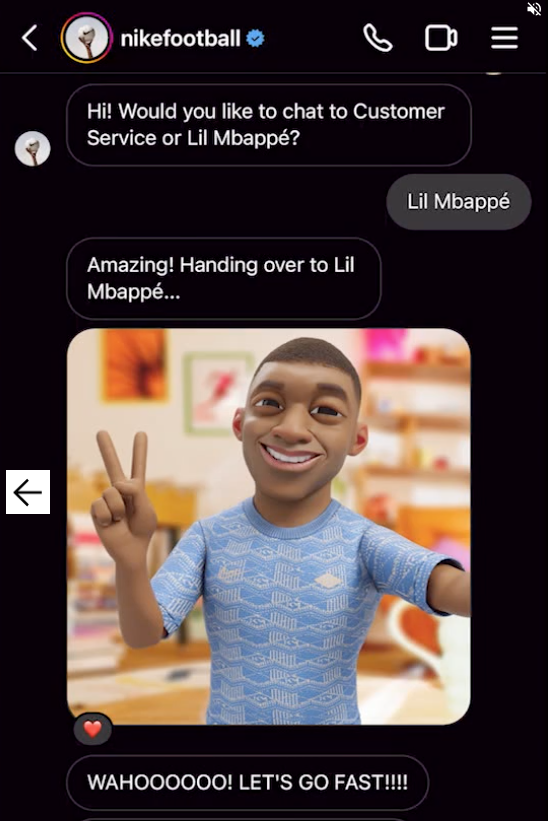
This campaign won a Webby Award for Community Engagement and Social Media Campaign in 2023.
Mercedez-Benz:
Built using Gemini on Vertex AI and Google Cloud’s Automotive AI Agent, Mercedes-Benz’s agent is specially tuned for the automotive industry:
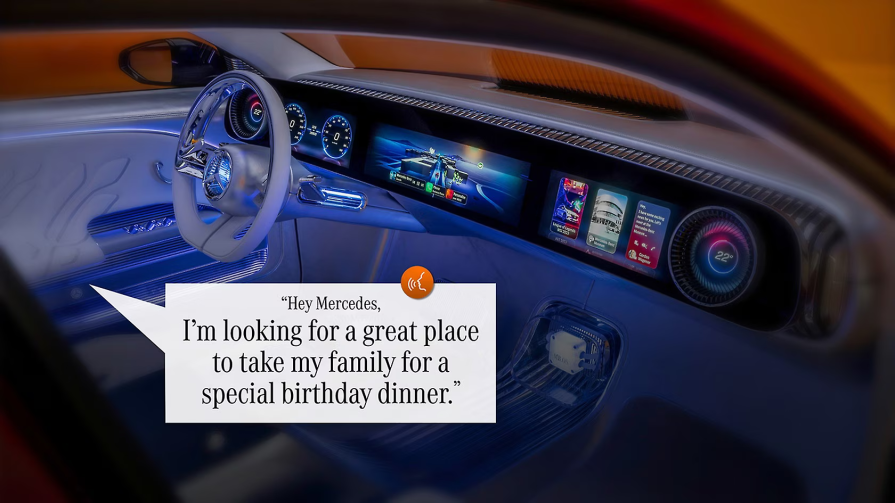
It can reference information from the Google Maps Platform to provide users with more detailed, personalized conversational responses about navigation, points of interest, and more.
Harvard CS50’s Rubber Duck AI
This AI personality was developed by the faculty delivering Harvard’s open education computer courses:
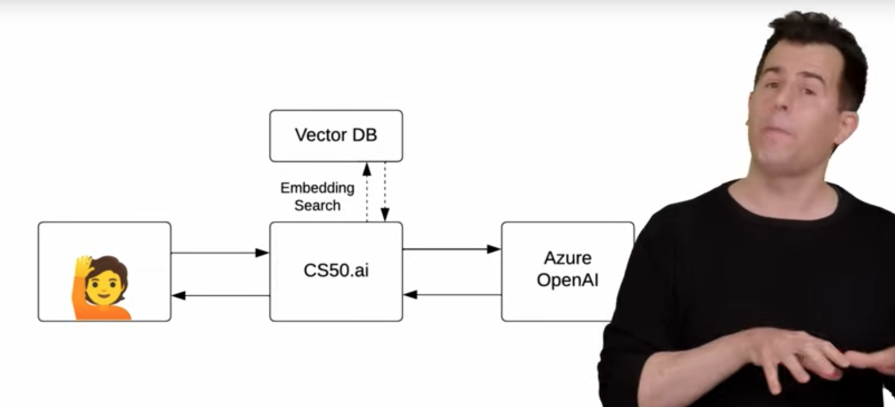
It is currently deployed at scale — serving 115k users with 20k prompts per day (4.5 million so far). Based on the concept of “rubber ducking”, this AI utilizes OpenAI and Microsoft API’s. It is deliberately designed not to give students answers to their queries outright (as some level of resistance and frustration is important for learning). This somewhat whimsical AI personality has reduced the workload of human teaching assistants by a substantial factor.
Conclusion
UX writers specialize in the subtle distinctions that describe different tones of voice. This makes the function invaluable when it comes to creating generative AI chatbots or agents. To control the texture of language, one approach is to break down the problem into its constituent elements.
We looked at the basic factors that go into design prompting: task context, the format of the expected output, and how to handle errors/ambiguity. We then broke the prompt into actionable steps:
- Core persona
- The intended user/audience
- Tone and Communication Style
- Output Structure and Constraints
The emerging user-case scenario reveals that slower products with better personality can be preferred for their more optimal user experience. Quick prompt design, rather than the more resource-intensive prompt engineering, can be a better tool to achieve this result. Combining both approaches can achieve more efficient AI model performance and address specific application requirements.
The ability to use parameters to adjust AI personality can have multiple applications: from generating brand content tailored to tones of voice to fast, low-resource prototyping and many others–we are limited only by the imagination of the design community and the needs of users.
As the space for generative AI products matures, including the risk of a finance bubble or innovation like the DeepSeek model, the nature of innovation could change from delivering raw, engineering-based computational advances to meeting personality-based, specific design-led projects with limited resources. This makes artificial personality customization via prompt design an important tool in the arsenal of the UX designer.
The post Prompt engineering vs. prompt design: The UX perspective on AI personality appeared first on LogRocket Blog.
This post first appeared on Read More