
By this point, AI agents have to be one of the most hyped and frequently used words of this decade. From LinkedIn to YouTube videos, everyone’s talking about them. So out of curiosity, a month back, I tried to get to the bottom of what’s so special about AI agents and how I could use them to make my day-to-day work as a product manager easier.
I’ve now built two AI agents that are used by 13 users. I understand this isn’t a big number, but I would argue that building something from scratch and having even a few users use it without paid marketing is an achievement. I want to share a few things I learned about them in the process to show how you, as a PM, can leverage this interesting technology and what you can do to learn more about how to build AI agents.
We’ll start with a brief overview of what AI agents are and how they can improve your personal and business workflows. Then, I’ll talk about how I built my AI agents, compare a few different agent builders, and explain why I chose the one I ended up using. We’ll also cover when and when not to use AI agents, some of the risks you may want to consider as a PM, and how to measure their impact and effectiveness.
By the end of the article, you should have a strong understanding of this impactful technology and how you can benefit from it.
What are AI agents?
First, let’s decode the word “agent”. If you’re from the pre-dotcom era, you might be familiar with the role of a “travel agent.” A travel agent is a person who helps you book your vacation. They would ask for your travel goals and help you with booking everything from travel tickets to accommodations.
With the rise of online portals such as booking.com, fewer people use these agents now, but to understand the context of agents, a travel agent is a perfect example. You tell the agent what you want, and the agent will do that particular thing for you.
An AI agent works similarly. But instead of a person, we have software that performs actions to help you achieve your goals. In some cases, a human also comes in between the process, which I will explain later, but overall, the goal of the AI agent is to act anonymously and achieve a goal. This goal might require talking to multiple tools, which the AI agent can do very easily.
How I built an AI agent
A few weeks back, I decided to understand AI agents by actually building one. I believe the best way to learn any new technology is by using it. But before that, you also need to understand the technology’s constraints.
What AI agents can do
AI agents are great at handling repetitive tasks that require data from different tools and connecting them. They can:
- Pull data from different tools (like Jira, Notion, or Slack)
- Summarize updates or feedback
- Send reports or reminders automatically
- Do the same process every day, without mistakes
Below are some practical examples:
- Check Jira every morning and send you a summary of tasks that are delayed
- Read user feedback from Zendesk or Typeform and group similar issues
- Monitor competitor websites and alert you when a new feature goes live
- Write a short weekly report based on analytics dashboards
- Update a Notion roadmap or Slack channel automatically when something changes
Basically, they can automate anything that looks like a checklist.
What AI agents can’t do
However, AI agents struggle with tasks that need judgment, creativity, or empathy. Below are some examples:
- Create a product strategy that aligns with company goals
- Decide which feature is worth building next
- Handle messy user problems with incomplete context
- Understand team dynamics
- Write vision docs or convincing narratives that need a human voice
So anything that’s more unstructured and requires critical thinking would not benefit from AI agents.
The pain point I chose to automate with an AI agent
Considering these points, I brainstormed multiple ideas and found one problem in my personal workflow that an AI agent could help with.
I love Reddit. I use it, especially to understand what’s happening in the product management world, what problems other PMs are having, and how they’re solving them. I do this by browsing r/Reddit for 20-25 mins a day.
The problem is, whenever I browse a post from r/productmanagement, I get into the rabbit hole of Reddit. Sometimes I spend 30 minutes browsing content from other subreddits that aren’t helpful.
So I thought to build an AI agent that sends me an email everyday at 7 AM, of the top 10 posts considering the number of upvotes and comments. That way, I could click on those URLs that would be interesting to me instead of getting distracted by content from other subreddits, potentially saving me 10-15 minutes everyday.
Now I understand this isn’t a big impact, but my goal was to understand how AI agents work. Taking this simple task off my plate was almost just an afterthought with the bonus of saving me a small amount of time.
I used n8n to build the AI agent. It’s a tool where you can connect different tools via nodes and get the desired output. The flow looks like below:
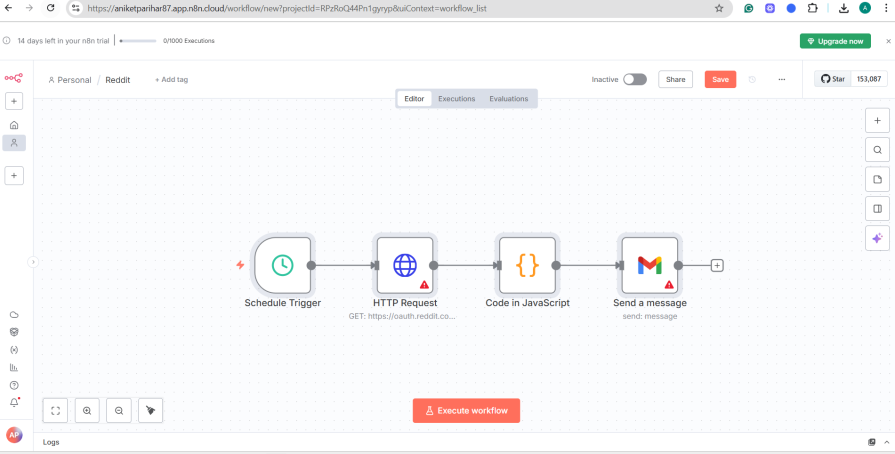
Here’s how the agent I built works:
- At 7 AM, it automatically triggers the workflow
- It first connects with my Reddit account
- Then it calculates which 10 posts yesterday had the highest upvotes and comments, and sorts them out
- Lastly, it sends me the link to these 10 posts
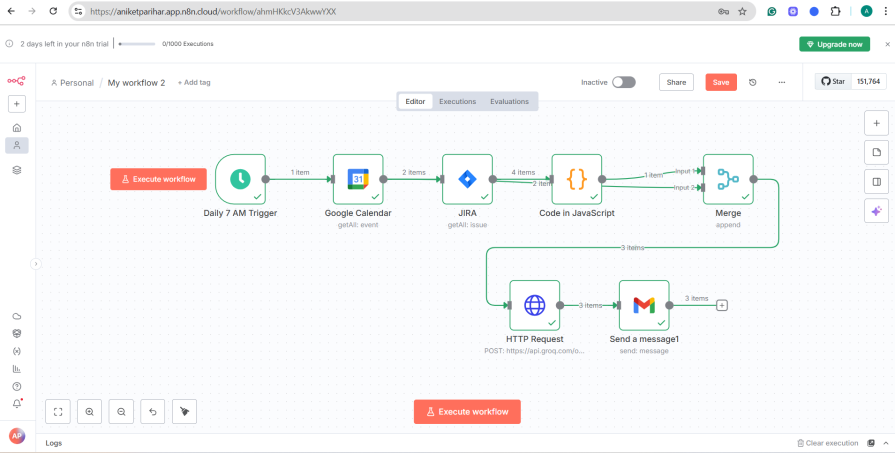
My second AI agent was about sending a daily summary to PMs about:
- What are the upcoming meetings they have by integrating with Google Calendar?
- Important updates from JIRA. For example, the status of high-priority tickets
Here’s how the flow I set up looks:
Comparison of various AI agent builders
I used n8n for both AI agents but there are plenty of other agent builders out there. Let’s take a quick look at some of the most popular ones and why I picked n8n:
| Platform | What it is | Best for | Learning curve |
| Make (Integromat) | No-code automation tool that now supports AI agents | PMs who want to automate workflows fast without coding | Easy |
| n8n | Open-source automation tool for custom, advanced AI workflows | PMs who want flexibility, full control, or to self-host | Moderate |
| Zapier + AI Actions | Beginner-friendly automation platform with AI integration | Solo PMs or small teams who want quick results | Easy |
| LangChain | Developer framework for building complex AI agents | PMs working closely with developers on AI products | Hard |
| OpenAI (Assistants API) | Core AI engine providing reasoning, memory, and tool-use | PMs are building AI features directly into their own products | Medium |
My recommendation: start with n8n. Here are a few reasons why I picked it:
- Easy to create workflows — After using n8n, I can tell that you can indeed create your first workflow without any technical knowledge but if you plan to create complex workflows, you would need to learn coding
- Simple UX — You can drag and drop the nodes for any integration that you need
- Active community — Any questions asked are quickly answered. When I built my first agent, I had a question. I posted it in the community and someone answered in the first 30 mins. Top community members who help the community are paid monthly
- Open source — Other developers can help build the product faster
Guardrails for PMs building AI agents
While AI agents are incredibly helpful in automating manual tasks, there are certain points that PMs need to consider. This’ll also help you to decide whether or not going with an AI agent is the right solution or not:
1. Use AI agents for inputs, not decisions
As I shared earlier, AI agents are assistants and not decision makers. It’s best to build them when you have a checklist of items and the data is well-structured.
But in the end, the decision should be of the PM. Treat it like an intern PM. An intern PM, because of their professional stage, will only help you in making a decision, but won’t make a decision themselves.
2. Always add a human review at important steps
All AI agent builders have the option of adding a human in the review process. So any point that’s important in the process step and might require a human should be reviewed by a human.
Some instances where you can add a human:
- Is the output correct?
- Are there any hallucinations or incorrect factual details
- Is the tone right for the audience?
3. Understand the problem clearly
Your AI agents are as good as the problem statement. Agents fail when goals are unclear and tasks are vague.
They perform best when the goal is specific, measurable, and bounded. Also, make sure that you don’t focus on problems that are creative or require critical thinking.
4. Document all the touch points
As PMs, you need to have a clear understanding of what all systems an AI agent is using. Also, you need to keep a track of where AI is being used in your workflows.
This ensures transparency if something breaks or a decision needs to be explained later.
5. Measure
AI agents mostly focus on productivity. So, unlike DAUs or conversion rate, the best way to measure AI agents is by understanding their impact.
A few metrics that you can consider to measure the performance of AI agents:
- Time saved
- Quality of output
- Adoption
- Human corrections
Final thoughts
AI agents are here, and here to stay. This shows in the fact that a lot of top AI companies, including OpenAI, are focusing on helping users build AI agents. So my recommendation would be to first find a problem in your day-to-day life and try to automate it.
Once you get the hang of it, you can extend and try to think of a business problem. But the only way to learn about AI agents is to build them.
Also, keep an eye on this space since a lot of AI agent builders are coming up with a prompt-based AI building (n8n released their prompt-based AI agent builder in beta a few weeks back). So now, it’s even easier, especially for PMs who don’t code, to build these AI agents.
Have you built an AI agent? How has your experience been? Please feel free to comment and share your views.
Featured image source: IconScout
The post How PMs can build custom AI agents to make life easier appeared first on LogRocket Blog.
This post first appeared on Read More