
Visual foundations are an art that must be mastered, but stable cognitive patterns, the ones widely used in design, marketing, and behavioral science, are a law that we need to follow.

For us as designers, this means diving deeper into psychology and user cognition. For our users, applying these principles and laws translates into simpler, more intuitive interactions and a smoother overall experience.
What may seem like ordinary observations or best practices from experienced designers are, in fact, scientific findings from the world of psychology. Researches we can easily integrate into our work to make our users’ journey much simpler. Today we’re going to talk about:
- Hick–Hyman Law
- Cognitive Load Theory
- Fitts’s Law
Briefly, without unnecessary fluff. But I’ll allow myself to add to the dry definitions not just examples from Apple designers, who are almost always a great source of inspiration for beginners. I’d like to bring this down to an everyday level we all encounter, so you can explain these laws even to a 6-year-old. We’ll take a walk through the restaurants in your neighborhood and see what they can teach us.
Hick–Hyman Law
Many of us, myself included, have probably found ourselves sitting in a restaurant, staring at a menu for far too long, unable to decide what to order. This usually happens when the menu is extensive and the dishes don’t differ much from one another.
The reason behind this lies in the Hick–Hyman Law, which states that the time required to make a decision increases with the number of available choices. In other words, the more options we offer our users, the harder it becomes for them to make a confident decision and the longer it takes.
William Edmund Hick, in his study On the Rate of Gain of Information, examines entropy and bits in the context of perception. Through his experiment, he concludes that human perception functions as a channel through which information flows, and the capacity of this channel is limited. Therefore, the more bits of information that need to be transmitted, the longer the transmission will take.
Ray Hyman, in his subsequent article Stimulus Information as a Determinant of Reaction Time, not only experimentally confirms Hick’s findings but also refines them. He adds that not only the amount of information but also different combinations of information chunks influence the speed at which it is transmitted. This is how the Hick–Hyman Law was born.

The restaurant industry uses this law consciously: for instance, high-end restaurants often limit the number of dishes on their menu to reduce decision time and the stress that customers experience at the moment of choice.
But both approaches work. It all depends on the business model.
Lower-priced restaurants rely on the idea that you’ll order as many dishes and snacks as possible. Given the lower prices, the time spent browsing the menu can actually increase the average check, which is why they’ll often leave an extra menu on your table, inviting you to keep exploring.

In “fancy restaurants”, however, it’s much harder to raise the average check this way. The focus shifts instead to creating a memorable experience that makes the guest want to return. And to do that, the goal is to pull the customer away from the menu as early as possible and start “delivering the show”: the sommelier, the open kitchen, the service, the atmosphere. It’s all part of the same psychological choreography.
We can apply the same logic to the world of design. For example, by hiding secondary filters under an accordion, we can reduce the delay before the first user action by roughly one-third.
Apple uses a similar principle. On their website, you can’t compare more than three products at once. You’re always making a choice among a maximum of three options. For Apple, the time from the start of the user flow to the moment of purchase is one of a key metrics and offering more alternatives would only slow down decision-making.

Cognitive Load Theory
Of course, I think the title already gives it away. John Sweller in Cognitive Load During Problem Solving: Effects on Learning states that our working memory is limited and this directly affects both how we process information and how we make decisions. In other words according to Cognitive Load Theory we’re not comfortable solving large or complex problems all at once.

Have you ever noticed that when you go to an upscale restaurant, the food menu and the wine list are presented separately and often by different people? The waiter handles the main menu, while the sommelier, trained specifically to guide and advise on wine, takes care of the rest.

Even in more casual restaurants, the waiter usually approaches the table with a specific question: “Have you decided what you’d like to drink?”
For context: I live in Germany, and this is a standard part of the customer flow here. In my home culture, however, the question usually goes the other way around: “Have you decided what you’d like to eat?” but not what to drink. So I often catch German waiters off guard when I say: “Please come back later for the drinks, but I’m ready to order the food.”
But the real lesson here is that everyone in this process knows their role and timing. You’re not expected to make all your choices at once. You start by focusing on the drinks (a small, simple decision) and only afterward the waiter gives you additional time to choose your meal.
And, of course, in design we try to take this natural limitation of the brain into account. That’s why we often split long registration forms into three short steps. This way, the user isn’t overwhelmed by a wall of questions on a single page. Instead, they move through the process gradually, with focused attention at each step, which reduces cognitive load and increases completion rates.
Or take Apple, for example. When you’ve already compared three different devices, chosen your new desired iPhone, and clicked the Buy button, a new quest begins: the configuration page.

The magic of this page lies in the fact that you’re never asked one big, abstract question like “What do you want?”. Instead, you’re guided through a series of small, sequential choices, where each step is a separate task. The entire process is designed to prevent you from overthinking how your final selection will look. Everything unfolds gradually, with minimal complexity, and without showing all the options at once.
And even when we can see several questions on the page at once, they make all inactive options unselectable, as if showing us the only correct path for configuring the device.

Apple, in general, uses plenty of clever tricks to sell us what they want us to buy, rather than what we initially came for. One good example is the Pricing Ladder a tactic perfectly explained by MKBHD in a one-minute video that I highly recommend watching before you buy your next Apple device.
At the same time, other companies can use these techniques against us, essentially bombarding us with constant stimuli and information. Take the AliExpress app, for example. Before you even reach the actual products, you’re overloaded. You’ll see a spinning prize wheel three times, be told about two free gifts, be invited to play a game to win an extra discount, and only after all these circles of hell will you finally reach the main page. And even there, you’re hit with a dozen more psychological triggers, all carefully designed to wear down your cognitive defenses and fill your cart with things you never intended to buy.
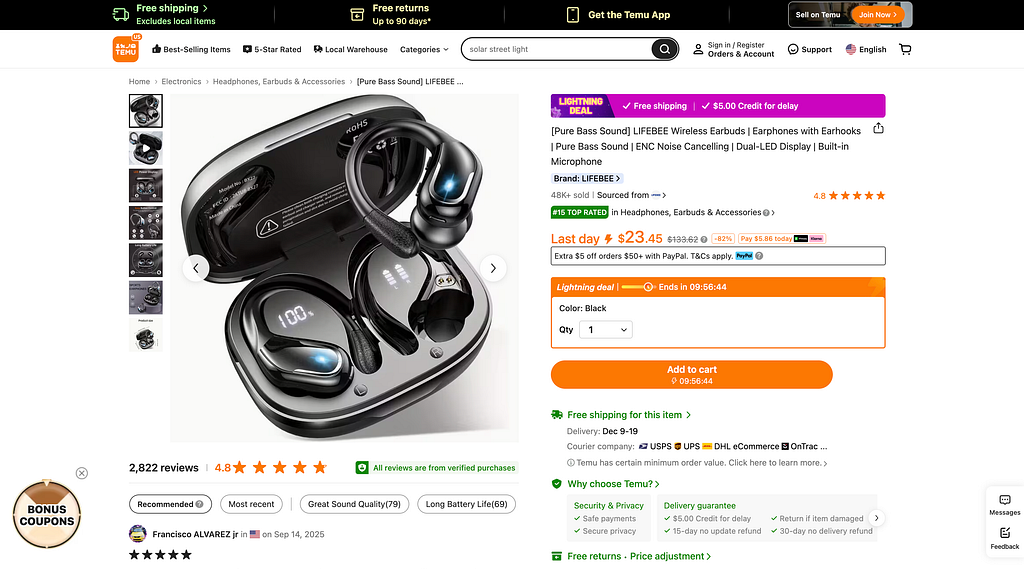
The same approach is used by Temu and other simillar apps. Some might say this is just a regional design style common in Asian markets, but I’d counter that argument with Candy Crush, which uses the same cognitive overload mechanics and was created by a Swedish company for a Western audience.
Fitts’s Law
The time it takes for a person to reach or interact with a target depends on the distance to the target and its size, according to Fitts’s Law. The closer and larger the target is, the faster and easier it is to click or tap on it.
In his article The Information Capacity of the Human Motor System in Controlling the Amplitude of Movement, Paul Fitts not only quantitatively measured the influence of target size and distance on the action performed with it, but also argued that the motor–nervous system has a limited processing capacity, which imposes constraints on the speed and accuracy of our reactions.
In our restaurant example, this could be something like a table tent featuring the dishes of the week, the chef’s recommendations, or the daily lunch specials.
The manager may not be consciously thinking about Fitts’s Law, but they instinctively know that if a guest sees the lunch specials right away during lunchtime, it can influence how quickly they place an order. Since this option is physically close to the customer and visually prominent, it perfectly satisfies both conditions of Fitts’s Law: proximity and target size.

Let’s take Apple again as an example. When we walk into an Apple Store, we see a large number of devices neatly arranged on tables. And there’s a clear logic behind how they’re placed, including the influence of Fitts’s Law.

Notice the height of the tables and the way the devices are positioned: everything is arranged so that it’s as easy and natural as possible for you to reach out and touch them. After all, the store’s primary goal isn’t just to sell devices, it’s to let you experience them. Ideally, Apple wants you to pick them up, test the new iPhone Pro or Air, listen to the headphones, or sketch on an iPad. Apple designs the entire environment so that you never have to stretch or hesitate. The devices seem to magically fall into your hands.
Bringing it all together
We saw how limiting the number of choices can accelerate decision-making, how breaking complex processes into smaller steps can reduce cognitive strain, and how proximity and scale can influence the speed and ease of action.
From restaurant menus to digital interfaces, from Apple’s carefully guided flows to AliExpress’s sensory chaos, the same psychological mechanisms are at play. They remind us that design is never neutral: every pixel, choice, and delay subtly shapes human behavior.
Of course, these are only a few examples. There are many more behavioral laws and cognitive principles worth exploring such as: Von Restorff effect, Tesler’s Law, of course, the well-known Occam’s Razor, which we as designers should always keep close and others that I recommend you take a look at on this very handy website — https://lawsofux.com/.
I encourage you not only to look into them, but to experiment with it your self, and find the right balance for your product. And let’s always approach our users with respect and empathy, using our understanding of human nature for good, not manipulation.

Designing decisions: Behavioral psychology that moves users was originally published in UX Collective on Medium, where people are continuing the conversation by highlighting and responding to this story.
This post first appeared on Read More