
UX is often described as a mix of art and science, but that definition is too simple. The truth is, UX is a spectrum made up of three distinct but interlinked lenses:
- Creativity: Bringing clarity, emotion, and imagination to how we solve problems.
- Science: Applying evidence, psychology, and rigor to understand behavior.
- Business: Focusing on relevance, outcomes, and measurable value.
Every UX professional looks through these lenses differently. And that’s exactly how it should be.
Why the three lenses matter
UX isn’t one thing. It’s a discipline of perspectives, a blend of skills that shift depending on your role, your background, and the kind of problems you’re solving.
However, the industry often blurs those distinctions. Job titles like “UX/UI Designer” suggest a single, catch-all capability when, in reality, each role operates through a different balance of the three lenses.
This misunderstanding leads to frustration on both sides:
- Designers feel they’re being asked to do everything from research to analytics.
- Hiring managers struggle to identify what kind of UX expertise they actually need.
- Researchers and strategists are often overlooked because their impact isn’t as visible on a screen.
So, rather than chasing the myth of the “unicorn,” the smarter approach is to recognize which lens you lead with and how to collaborate with others who bring the rest.
Different lenses, different brains
The reason these lenses exist isn’t arbitrary — it’s neurological. Some people are naturally wired for analytical, data-driven thinking; others are more attuned to spatial or visual reasoning.
Cognitive scientist Howard Gardner, in his theory of Multiple Intelligences, argued that there isn’t one kind of intelligence but several, from logical–mathematical and linguistic to spatial and interpersonal. That same idea maps perfectly to UX:
- Those high in spatial or interpersonal intelligence tend to excel in visual design, storytelling, or facilitation, bringing emotion and clarity to complex ideas.
- Those strong in logical or linguistic intelligence often thrive in research and analysis, happily buried in spreadsheets, transcripts, or behavioral data all day.
- And those with strategic or intrapersonal intelligence often find themselves drawn to the business lens, connecting patterns, motivations, and outcomes.
Understanding this doesn’t just validate personal preference; it highlights that UX requires different kinds of brains working together. Diversity of thinking isn’t a luxury; it’s the foundation of good design.
How the lenses play out in practice
The UI designer (creativity-led)
UI Designers lead with the creative lens. Their strength lies in turning complex ideas into interfaces that feel intuitive, elegant, and emotionally engaging. But the best UI Designers also understand the science of usability and the business context behind what they’re designing.
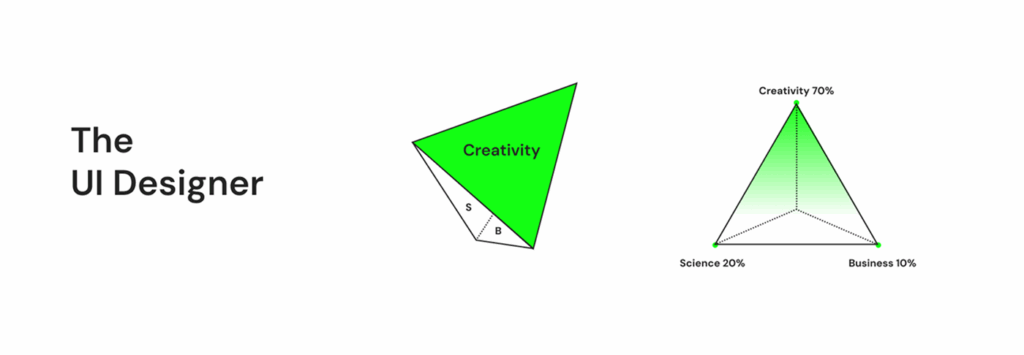
Example: A UI Designer might use the Creativity lens to craft a clear visual hierarchy, the Science lens to apply principles like color theory, or Gestalt psychology to guide perception, and the Business lens to ensure the design supports key goals such as conversion, clarity, or engagement.
The UX architect (business-led)
UX Architects operate at the intersection of business and science, combining analytical evidence with strategic foresight to define how products achieve both user and organizational goals, focusing not on UI design but on spreadsheets, frameworks, and presentations that translate research, priorities, and systems into a clear, scalable plan for meaningful experience delivery.

Example: A UX Architect might use the Science lens to model user behavior and map journeys, and the Business lens to prioritize features, structure information, or design pathways that align with strategic outcomes. The Creativity lens plays a supporting role, helping communicate systems and ideas in ways others can grasp.
The UX researcher (science-led)
UX Researchers bring the science lens to life through evidence, observation, and human understanding. Their work grounds design decisions in reality, not assumptions.

Example: A UX Researcher may use the Science lens to uncover unmet needs through interviews, the Creativity lens to frame findings in compelling narratives, and the Business lens to influence stakeholders by linking insights to commercial impact.
The goal isn’t balance; it’s awareness
It’s unrealistic (and unnecessary) to be equally strong in all three lenses. The value lies in awareness: knowing your natural strengths, understanding where you have gaps, and appreciating the perspectives others bring.
A creative mind benefits from learning behavioral science. A strategist gains influence by visualizing ideas clearly. A researcher grows by linking findings to measurable results.
That’s how you move from being good at your craft to being impactful in your career.
Why this perspective matters beyond UX
For hiring managers and recruiters, recognizing these lenses helps in building balanced teams, not just hiring for titles. A well-rounded UX function has representation across all three lenses:
- Creativity ensures emotional connection.
- Science ensures behavioral truth.
- Business ensures commercial impact.
Without that balance, UX risks being seen as either decoration or documentation, neither of which delivers lasting value.
The article originally appeared on LinkedIn.
Featured image courtesy: Michael Dziedzic.
The post The Three Lenses of UX: Because Not All UX Is the Same appeared first on UX Magazine.
This post first appeared on Read More