
Editor’s note: This blog was updated by Clara Ekekenta in December 2025 to reflect the latest performance landscape across Angular, React, and Vue, including updates on signals-based reactivity, bundle size, hydration, and SSR tooling.

In this article, we’ll explore how React, Angular, and Vue.js continue to dominate the frontend ecosystem, and how the performance conversation around them has evolved. While these frameworks are still the top three open-source choices, the focus in 2025 has shifted away from basic component logic toward reactivity models, hydration strategies, and compiler-driven performance optimizations.
What is Angular?
- Google’s open-source framework has seen a clear resurgence, driven by its move toward a zoneless architecture
- Angular now relies on Signals for fine-grained reactivity, reducing its dependence on
zone.jsand delivering roughly 20–30% runtime performance gains - It provides a well-defined, opinionated toolset, including Signal-based forms and the
inject()pattern, making it a strong fit for large, multi-team enterprise applications that value consistency - Built on strictly typed TypeScript, Angular emphasizes long-term maintainability and predictable codebases
What is React?
- The industry-standard framework from Meta is widely adopted by companies like Airbnb and Reddit
- React now pairs the React Compiler (formerly known as React Forget) with the
use()hook, automating memoization and reducing the need for manualuseMemoanduseCallbackusage - It features aggressive automatic batching that consolidates multiple state updates into a single render pass, helping minimize main-thread work
- While React is still built around a Virtual DOM, the compiler optimizes the render tree by skipping unnecessary calculations and re-renders
What is Vue?
- A progressive framework created by Evan You for building user interfaces and single-page applications
- Vue introduces an optional Vapor Mode, which compiles components into highly efficient code that manipulates the DOM directly, bypassing the Virtual DOM for near-native performance
- It uses a fine-grained reactivity system that later influenced Angular’s Signals, enabling precise dependency tracking and targeted updates
- Lightweight and modular by design, Vue scales comfortably from small widgets to full-scale SPAs
Angular vs. Vue vs. React: Comparing ease of build
The question of how easy a framework is to build with still comes down to the same fundamentals: scaffolding, conventions, developer experience, and the learning curve. What’s changed with recent releases is how each framework approaches these tradeoffs. Angular 20, React 19.2, and Vue 3.5 have all smoothed over long-standing friction points, but they continue to optimize for very different types of teams and workflows.
At-a-glance
- Angular 20 – Opinionated and batteries-included. Best suited for teams that value standardization and predictable scaling across large codebases. Signals and Signal-based Forms (v21 preview) significantly reduce boilerplate compared to earlier Angular versions
- React 19.2 – Flexible and widely adaptable. The compiler and
use()hook removes much of the need for manual optimization, allowing teams to achieve strong performance without reinventing common patterns - Vue 3.5 – Progressive and quickest to onboard. Vapor Mode previews introduce compiler-generated DOM operations that close the performance gap while preserving Vue’s approachable developer experience
Angular’s enterprise scaffolding and consistent DX (Angular 20)
Angular continues to offer the most “everything included” developer experience, with a built-in CLI, routing, forms, HTTP client, dependency injection, testing tools, and a strongly recommended architecture. With Angular 20’s move toward a zoneless model and a more mature Signals API, teams get clearer state flows and fewer global side effects.
The learning curve remains steep for developers unfamiliar with TypeScript and RxJS. The tradeoff is a highly predictable structure, fewer architectural debates across large teams, and tangible gains from TypeScript-first design, reduced boilerplate, and standardized scaffolding via ng new.
When to choose Angular – Large, multi-team environments with strict architectural requirements, complex enterprise applications, and a need for a uniform, opinionated developer experience across teams.
React’s flexible, powerful, and increasingly auto-optimized approach (React 19.2)
React remains the default choice for many new applications thanks to its massive ecosystem and the growth of meta-frameworks like Next.js and Remix. With React 19.2, the compiler and use() hook remove much of the manual optimization work, reducing useMemo and useCallback antipatterns, simplifying async data handling, and enabling smarter automatic batching.
The learning curve is moderate. JSX tends to feel natural once adopted, though React introduces more conceptual surface area through hooks, server components, and client–server boundaries.
When to choose React – Projects that need broad ecosystem support (mobile, web, hybrid), when you value flexibility and many mature third-party solutions, or when meta-framework features (RSCs, ISR) are important.
Vue’s fast ramp-up and progressive adoption (Vue 3.5)
Vue continues to offer the lowest barrier to entry. It can be progressively introduced into an existing site, used to enhance specific parts of a page, or scaled up into a full SPA. With Vue 3.5, ongoing refinements to the Composition API and compiler-driven DOM updates through Vapor Mode previews further narrow the performance gap with React and Angular.
Thanks to its gentle learning curve, familiarity with HTML templates is often enough to get started, making Vue the fastest framework to onboard for many teams. Vue-based templates or create-vue make setup quick, while Nuxt remains the preferred choice for SSR and hybrid applications.
When to choose Vue – Small-to-medium applications, rapid prototyping, teams that prioritize strong DX and ease of adoption, or projects that may gradually evolve into larger systems.
Reactivity and change detection
Reactivity is now the primary performance battleground in 2025. Angular 20’s Signals paired with a zoneless architecture, React 19.2’s compiler-assisted batching, and Vue 3.5’s fine-grained reactivity all aim to eliminate unnecessary work, but they achieve this through very different models.
Angular 20: Signals and zoneless change detection
Angular’s Signals-based reactivity removes the need for zone.js and shifts change detection toward explicit dependency tracking. This approach reduces global side effects and, according to internal benchmarks, delivers roughly 20–30% faster UI updates.
Example:
import { signal, computed } from '@angular/core';
const count = signal(0);
const doubled = computed(() => count() * 2);
count.set(1); // triggers only dependents
Perf trace (Zoneless):
Before (Zone.js):   ~1.5ms per update
After (Zoneless):   ~0.9–1.1ms per update
React 19.2: Automatic batching + compiler pruning
React 19.2 batches all state updates automatically, even in promises and event handlers, and the new compiler eliminates many unnecessary re-renders via structural memorization.
Example (with jsx):
setA(1);
setB(2);
// React 19.2 batches this automatically → 1 render, not 2
Perf trace (Auto-batching)
React 18:   2–4 renders per async chain
React 19.2: 1 render consistently
Vue 3.5: Fine-grained tracking + vapor mode preview
Vue tracks reactivity at the property level, not per component, so updates are ultra-targeted. Vapor mode (preview) goes further by compiling components into direct DOM operations for even smaller update costs.
Example:
import { ref, computed } from 'vue';
const count = ref(0);
const doubled = computed(() => count.value * 2);
count.value++;
Perf trace (Fine-grained deps)
Vue 3.5: Updates only subscribed DOM nodes
Vapor Mode: Sub-1ms DOM patching on small components
Bundle size & hydration
Bundle size and hydration time now matter as much as raw rendering speed, especially for edge-rendered and mobile-first apps. Angular 20, React 19.2, and Vue 3.5 show clear differences in default output size, tree-shaking efficiency, and hydration latency.
Bundle size comparison (minified, no polyfills)
Vue 3.5
- Typical starter bundle – 18–22KB
- Notes – Smallest core footprint with excellent tree-shaking when paired with Vite 6
- Typical hydration time – 25–45ms
- Meta-framework – Nuxt 3
React 19.2
- Typical starter bundle – 32–40KB
- Notes – Includes both compiler and runtime; bundle size can vary based on JSX transforms and configuration
- Typical hydration time – 40–70ms
- Meta-framework – Next.js (RSC with partial hydration)
Angular 20
- Typical starter bundle – 110–130KB
- Notes – Ships with router, dependency injection, and forms out of the box, with heavy optimization handled by the build system
- Typical hydration time – 70–120ms
- Meta-framework – Angular Universal with zoneless previews
Hydration trace example
Simple SSR page with a button and counter:
Vue 3.5 (Nuxt):      hydrate → 32ms
React 19.2 (Next):   hydrate → 51ms
Angular 20 (Universal): hydrate → 89ms
Developer experience (DX) & performance impacts
DX improvements in modern frameworks increasingly have direct performance effects. Angular v21’s Signal Forms reduce template churn, React’s new error boundaries stabilize rendering, and Vue’s Teleport optimizes DOM portals.
Angular 20 → 21: Signal forms & reduces boilerplate
Angular’s emerging Signal forms simplify form state, eliminate heavy control classes, and reduce change detection noise. Angular 15 style:
form = new FormGroup({
  name: new FormControl('')
});
Signal Forms (v21 preview):
form = signalForm({ name: '' });
Performance impact
- Approximately 15-25% fewer template updates for large forms
- Less RxJS and fewer subscription leads to lower memory overhead
- Cleaner migration path, which means the existing forms API continues to work alongside Signals
React 19.2: Improved error boundaries & stable trees
React 19.2’s updated error boundaries and compiler-assisted stability reduce re-renders during failure and recovery states.
Example (New boundary pattern)
<ErrorBoundary fallback={<Retry />}>
  <Dashboard />
</ErrorBoundary>
Performance impact
- Failed subtree no longer forces full tree re-renders
- Compiler prunes unstable nodes → smaller hydration scope
- Async server components use the new
use()pattern
Vue 3.5: Teleport efficiency & composition API stability
Vue’s Teleport API moves DOM nodes without re-rendering parent components, reducing layout thrash for modals, drawers, and overlays.
Example:
<Teleport to="#modal-root">
  <Modal />
</Teleport>
Performance impact
- Avoid reflow in the parent container
- Only Teleported subtree updates → reduced DOM cost
- Works extremely well with fine-grained reactivity for micro-portals
Ecosystem integrations
Framework choice increasingly comes down to how well it integrates with modern tooling. TypeScript 5.6+, Vite 6, AI-assisted development, and the surrounding meta-framework ecosystem all play a role. In 2025, React continues to dominate meta-framework adoption, Angular is steadily tightening its CLI and build pipeline, and Vue offers the smoothest Vite-native developer experience.
TypeScript 5.6+ compatibility
All three frameworks support key TypeScript 5.6 features such as isolated declarations, faster incremental builds, and decorator stability, but the depth of integration varies.
Angular is the most TypeScript-centric of the three, with its compiler and CLI tightly coupled to TS. The move to Signals also reduces reliance on complex RxJS typing patterns, with strict mode recommended for the best template type inference.
React’s TypeScript experience depends heavily on the surrounding tooling, whether that’s Vite, Next.js, or a custom setup. React 19’s compiler improves inference for JSX and hook return types, though enterprise configurations still tend to be more involved.
Vue offers strong TypeScript ergonomics through Volar and <script setup>. Single File Components compile into typed render functions with minimal configuration, making Vue the easiest entry point for teams new to TypeScript.
Vite 6 and build tooling
Vite 6 has become the default build tool for Vue and React, with Angular 20 offering partial but rapidly improving support. Each framework approaches build tooling differently, reflecting their broader design goals and ecosystem maturity.
Vue
- Native integration, fastest HMR, and build cycles
- Nuxt 3 compiles directly through Vite, with very short reload cycles
React
- Standard React templates use Vite
- Next.js is migrating parts of its pipeline to Vite-compatible dev servers
Angular
- Vite support is experimental but accelerating
- Angular CLI remains the default with optimizations like esbuild + zoneless rendering
AI-assisted tooling
AI-assisted tools increasingly shape modern development workflows by automating repetitive tasks, generating code, improving quality, and offering intelligent guidance across the lifecycle. Each framework supports these ecosystems differently, influencing how effectively teams can integrate AI into their day-to-day development.
Vue
- AI performs well with SFCs because the structure is predictable
- Popular for startups using AI-generated component libraries
React
- Most Copilot coverage, thousands of snippet patterns, templates, and plugin examples
- Strong ecosystem around linting, code mods, and migrations
Angular
- Stronger AI support after Signals reduced the RxJS complexity
- CLI schematics make AI-assisted scaffolding more accurate
Meta-framework ecosystem
Meta-frameworks extend the capabilities of core UI frameworks like Vue, React, and Angular by adding higher-level features for building more complex and production-ready applications. Below, we outline how each framework fits into and supports its surrounding meta-framework ecosystem.
Vue
- Nuxt is now highly stable with edge-ready rendering
- Superior developer onboarding for SSR compared to Next
React
- Dominant: Next.js, Remix, Gatsby, Expo (web), Hydrogen, Redwood
- Best choice when you need SSR, RSC, or hybrid rendering out of the box
Angular
- Angular is universally improving, but still heavier
- Strong story for enterprise apps with server-driven forms and DI
Community and maintenance velocity
A framework’s long-term performance story is closely tied to the strength and momentum of its community. Adoption, contributor activity, and release velocity influence everything from ecosystem tooling to bug resolution times; these are factors that directly shape real-world performance outcomes.
React
React continues to dominate the community landscape by a wide margin. With 230k+ GitHub stars and over 25 million weekly npm downloads, React’s sheer usage volume drives a fast-moving ecosystem where optimizations, compiler experiments, and meta-framework innovations appear at a rapid pace.
This momentum translates into practical performance advantages: issues are identified quickly, third-party libraries iterate faster, and new features like React Compiler and use() gain ecosystem support almost immediately.
An interesting thing about React’s ecosystem is the number of libraries and frameworks that are built on top of it. React is not just a great tool itself, but it is also the foundation of performant frameworks like Next.js, Gatsby, Preact, React Native, and Remix, all of which are highly performant. In fact, the React team officially recommends React-powered frameworks as the starting point for building applications.
Angular
Angular shows a different but equally meaningful pattern. Its community is smaller, around 92K GitHub stars and 2 million weekly downloads, but highly structured. Google’s stewardship ensures predictable release cycles and thorough RFC processes.
This stability matters for enterprise teams who value long-term maintenance guarantees and consistent performance behavior across major versions. Angular’s open issues and pull request activity show steady velocity, with spikes around milestone releases like v20’s signal adoption.
One of the key factors contributing to Angular’s success is the strong community and ecosystem support it offers. Its ecosystem provides troubleshooting assistance and support in the form of blog posts, videos, sample projects, templates, and other learning materials.
Angular’s community also boasts a wide range of third-party libraries and tools that enhance the development experience. These libraries provide additional functionalities, components, and utilities that we can integrate into our applications.
Vue
Vue’s community sits between the two in size but often leads in enthusiasm. With 45K GitHub stars and 4 million weekly downloads, Vue benefits from a passionate contributor base that rapidly experiments with new patterns, most recently around vapor mode and compiler-level optimizations.
While smaller, Vue’s community maintains one of the highest satisfaction ratings in the ecosystem (per the latest State of JS), reflecting strong alignment between user expectations and framework evolution.
Vue’s community provides several custom solutions and packages for Vue 2 and Vue 3. Some great third-party libraries from the Vue ecosystem include Pinia for state management and vee-validate for form validation.
Server-side rendering vs. client-side rendering
Rendering in Angular
By default, Angular runs applications in the browser and renders views directly in the DOM. Client-side rendering can introduce drawbacks, including slower initial load times and limited visibility for search engine crawlers. To address this, Angular supports server-side rendering through Angular Universal, its official SSR solution.
Angular Universal renders applications on the server using Node.js and sends pre-rendered HTML to the browser. This allows users to see the page structure immediately, rather than waiting on a blank screen while JavaScript loads and executes.
Server-side rendering improves SEO, enables richer social media previews, and generally enhances perceived performance and user experience, while also contributing to better overall application performance.
Rendering in React
Similar to Angular, React also supports client-side rendering. The server sends a bare-bones HTML file to the client that includes a reference to a JavaScript bundle containing the React.js code. The client then fetches this bundle, which includes the necessary components and logic to render the page.
React’s client-side rendering suffers from the same pitfalls as Angular. However, we can address them by working with server-side rendering. We can also opt for SSR by using frameworks like Next.js and Gatsby, which provide out-of-the-box SSR capabilities.
While it is not technically SSR, we can also take advantage of servers by working with React Server Components. They allow us to write server-side code, like database queries, directly in React components. This approach reduces the amount of data that must be transferred between the client and server, resulting in improved performance and faster loading times.
Rendering in Vue
Like Angular and React, Vue also supports client-side rendering and server-side rendering. With client-side rendering, the entire rendering process is done on the client, which requires more processing power and memory compared to server-side rendering. This can lead to slower initial page load times and affect performance, especially for larger applications.
We can enable SSR in Vue applications by manually adding custom SSR functionality with Express or by working with Nuxt.js, which provides out-of-the-box SSR support.
Community and ecosystem support
Angular’s ecosystem
One of the key factors contributing to Angular’s success is the strong community and ecosystem support it offers. Its ecosystem provides troubleshooting assistance and support in the form of blog posts, videos, sample projects, templates, and other learning materials.
Angular’s community also boasts a wide range of third-party libraries and tools that enhance the development experience. These libraries provide additional functionalities, components, and utilities that we can integrate into our applications.
Some great third-party libraries that the community has produced include Angular Material for UI components, NgRx for state management, and ngx-translate for internationalization.
React’s ecosystem
One thing that stands out from React’s history and creation is the power of open source projects and an active community. React’s ecosystem provides a vast array of third-party libraries and tools that extend its functionality and make it easier to create performant applications.
This ecosystem includes Redux Toolkit and Zustand for state management, React Router (and TanStack Router) for routing, React Hook Form for form validation, and Tailwind CSS or styled-components for styling.
An interesting thing about React’s ecosystem is the number of libraries and frameworks that are built on top of it. React is not just a great tool itself, but it is also the foundation of performant frameworks like Next.js, Gatsby, Preact, React Native, and Remix, all of which are highly performant. In fact, the React team officially recommends React-powered frameworks as the starting point for building applications.
Vue’s ecosystem
Vue has a thriving ecosystem with a wide range of third-party libraries and plugins available for extending its functionality. These libraries cover everything from state management to routing, making it easy for developers to find solutions to common problems and enhance their development workflow.
Vue’s community provides several custom solutions and packages optimized for Vue 3 and the Composition API. Some great third-party libraries from the Vue ecosystem include Pinia for state management and vee-validate for form validation.
Integrating Angular, React, and Vue.js with other tools
The tech ecosystem offers a myriad of tools to enhance frontend framework performance and streamline development. Let’s explore some of these tools for Angular, React, and Vue.
Angular-based tools
- ng-animate – An animation module for Angular applications that provides a collection of reusable and flexible animations and transitions. Its bundle size is 27.9kb minified and 3.3kb gzipped
- ng2-charts – A library for integrating Chart.js into Angular applications. It covers several chart types, including line, bar, pie, and donut charts. Its bundle size is 18.2kb minified and 5.9kb gzipped
React-based tools
- SWR – A React Hooks library for remote data fetching. It supports features like caching, revalidation, error handling, prefetching, pagination, and support for SSG and SSR. Its bundle size is 10kb minified and 4.4kb gzipped
- React Hook Form – A powerful and lightweight form management and validation library designed to make form development more efficient. Its bundle size is 26.6kb minified and 9.6kb gzipped
- Zustand – A lightweight alternative to popular state management solutions like Redux and MobX. It eliminates the complexities of state management by providing a minimal API that doesn’t require tons of boilerplate code. Its bundle size is 3kb minified and 1.1kb gzipped
Vue-based tools
- Pinia – A Vue state management solution. Its bundle size is 21.2kb minified and 7.6kb gzipped
- Vuelidate – A lightweight library that provides a simple and intuitive way to handle form validation. It has a small footprint and minimal impact on an application’s overall size and performance. Its bundle size is 12.4kb minified and 3.7kb gzipped
Framework-agnostic tools
- Valibot – A lightweight schema declaration and validation library. Its bundle size is less than 1 KB
- Vite – A build tool that provides a faster and smoother workflow for developing web applications. It supports code splitting and breaks down codebases into smaller chunks, leading to more efficient loading and execution of JavaScript. It also supports lazy loading and ensures modules are only loaded when required, which reduces initial load times and improves performance. Its bundle size is 18.2kb minified and 5.9kb gzipped
Impact of architecture on performance
Architecture patterns play a crucial role when it comes to performance. Let’s explore the impact popular architecture patterns have on the Vue, React, and Angular frameworks and how the patterns help enhance performance and efficiency.
Flux
Flux is an architecture pattern that focuses on unidirectional data flow. It separates the application into four main components: actions, stores, views, and the dispatcher. This pattern ensures that data flows in a single direction, making it easier to understand and manage an application’s state. When implemented correctly, Flux can provide enhanced performance.
One of the major advantages of Flux is its ability to efficiently handle complex data flows. By using a central dispatcher, data changes are propagated throughout the application predictably. This eliminates the need for complex data synchronization and reduces the chances of data inconsistencies. As a result, the application becomes more responsive and performs better.
Flux’s unidirectional data flow also simplifies debugging and testing. Because data changes occur predictably, it becomes easier to identify and fix any issues or bugs that may occur.
Model-View-Controller (MVC)
The MVC pattern separates the application into three components: the model (data and business logic), the view(presentation layer or user interface), and the controller (manages the interaction between Model and View).
MVC can also enhance the performance of frontend frameworks by providing a clear separation of concerns. Each component has its own responsibility, making the codebase more modular and maintainable. This allows us to easily update or modify specific components without affecting the entire application, making our applications more scalable and efficient.
MVC also promotes code reusability. By separating the application into different components, we can reuse existing models, views, and controllers across different parts of the application. This reduces the amount of redundant code and improves performance.
Model-View-ViewModel (MVVM)
MVVM is a pattern that separates the application’s data (Model) from the UI logic (View) using an intermediary component called ViewModel. The ViewModel acts as a bridge between the View and the Model, allowing for seamless data binding and synchronization. This pattern helps in decoupling the UI from the underlying data, making it easier to manage and test the code.
One of the key advantages of the MVVM architecture pattern is its two-way data binding feature. It ensures that any changes made in the View will automatically update the underlying data in the Model, and any changes in the Model will be reflected in the View. This eliminates the need for manual data synchronization, reduces the chances of bugs, and improves performance by reducing the amount of code needed for data manipulation.
<h2id=”performance-comparison-sample-apps”>Performance comparison for sample apps built with Angular, React, and Vue
Let’s use PageSpeed Insights to analyze the Core Web Vitals (CWVs) of landing pages built with Vue, React, and Angular to understand their performance differences. Grab the source code for the landing pages from their respective GitHub repositories: Angular, React, and Vue. We will work with Angular v13, React v18, and Vue 3
Here are the links to the live versions of the landing pages:
Here’s an image of the landing page:

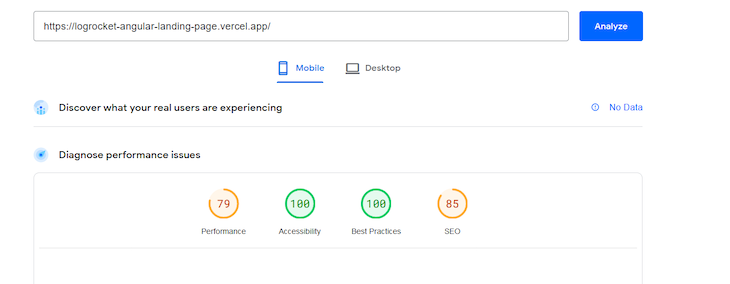
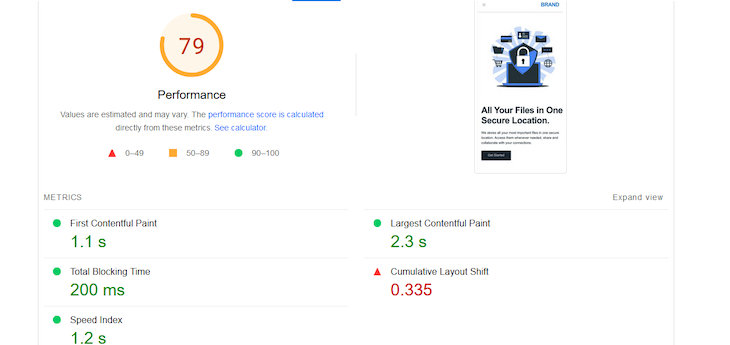
And here is an audit of Angular’s landing page performance:
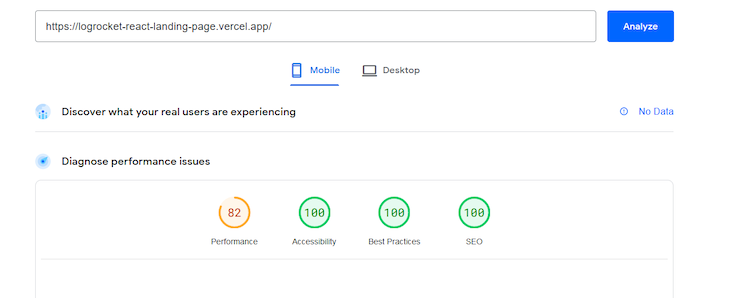
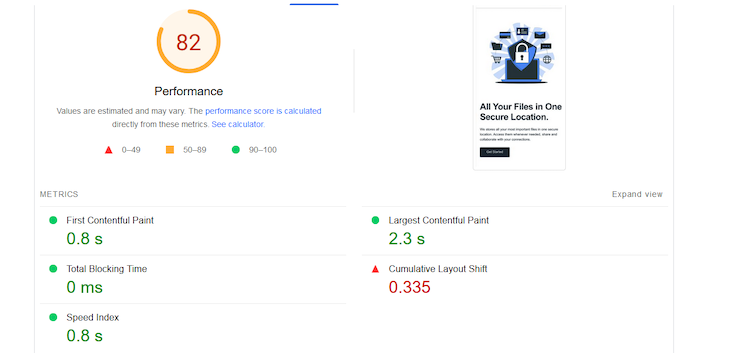
Here’s an audit of React’s landing page performance:
Finally, here is an audit of Vue’s landing page performance:
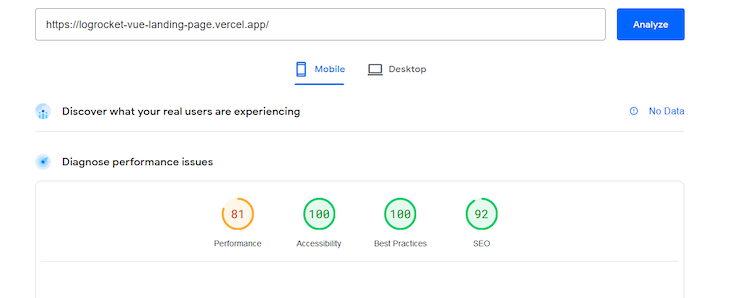
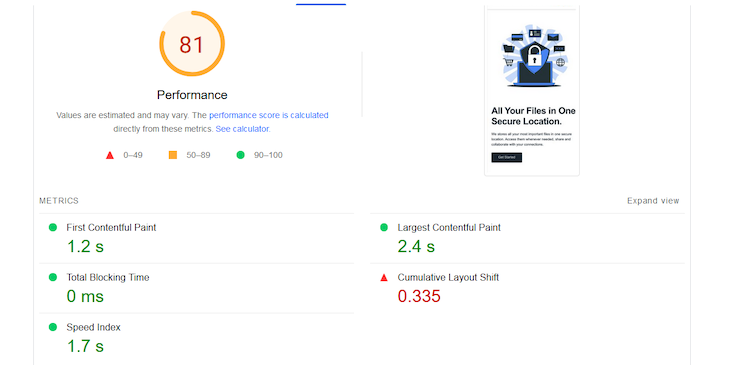
Even though the code for the landing pages is exactly the same, the results from their performance audits are different. Let’s explore the performance data in detail:
- First contentful paint – React takes first place with 0.8s, with Angular coming second at 1.1s, and Vue coming last at 1.2s
- Total blocking time – React and Vue had no TBT, while Angular had a TBT of 200ms
- Speed index – React has the fastest Speed Index at 0.8s, with Angular taking second place at 1.2s and Vue coming last at 1.7s
- Largest contentful paint – Angular and React had the same LCP of 2.3s, while Vue’s LCP was 2.4s
- Cumulative layout shift – They all had the same cumulative layout shift since the shift occurred because of the image and not the frameworks themselves
- Overall performance – PageSpeed Insight gives the React landing page the highest performance rating of 82, with Vue coming next at 81, and Angular coming last at 79
- Bundle size – While we’re at it, let’s explore the bundle size of the frameworks because that is another factor that affects performance. Angular’s gzipped size is 62.3kb. React and React DOM’s gzipped size is 44.5kb. Vue’s gzipped size is 34.7kb
Optimization techniques for Angular, React, and Vue
Let’s explore some optimization techniques we can utilize when developing applications with these frameworks.
Angular optimization techniques
- Use Ahead-of-Time (AOT) compilation to improve performance by reducing the amount of work that the browser has to do at runtime
- Reduce the number of times that Angular has to re-render a component with the OnPush change detection strategy. It only checks for changes when the component’s inputs or outputs change, which can improve performance by avoiding unnecessary re-renderings
- Unsubscribe from Observables because while they are powerful for asynchronous programming, they can also negatively impact performance if we do not properly unsubscribe from them. When you are finished with an Observable, be sure to unsubscribe from it to prevent it from continuing to emit events
React optimization techniques
- Use React Memoization via the
useMemoHook to cache the results of expensive function calls. This avoids unnecessary re-renders and ensures that the cached result will be returned, except if the function’s dependencies change - Make state updates more efficient by working with immutable data structures. This strategy can lead to significant performance improvements, especially for large applications with complex state
Vue optimization techniques
- Lazy load routes and their associated dependencies with Vue Router. We can also lazy-load specific components with the
defineAsyncComponentmethod - Optimize event handling for events like
window.scrolland@mouseoverto avoid performance lags. We can perform the optimization by using thedebouncefunction, which limits the number of times events are processed
Comparing the framework migration experience
While these three frameworks are great, there are different scenarios and reasons why development teams may want to migrate from one to another. Let’s briefly explore some steps to work with when migrating.
Reasons for migrating from Angular
- Low or lack of Angular expertise in development teams – Angular’s popularity has declined, making it harder to find expert developers. Teams may migrate to React or Vue, which have broader talent pools
- Future-proofing tech stack – These days, React and Vue are in greater demand than Angular, with greater ecosystem support and third-party solutions. For example, you are more likely to see a React- or Vue-based component library than you are to see an Angular-based library. This means that developers who want to future-proof their tech stack and benefit from the latest innovations may need to migrate from Angular
- Mobile app development – React Native and Vue Native offer more straightforward mobile development than Angular, prompting teams to migrate for native mobile app solutions
Reasons for migrating from React
- Opinionated development – One major double-edged sword of React is that it has so many options. From state management to data fetching and form management, many solutions are available. However, for teams that prefer opinionated frameworks like Angular, this abundance of choices in React can be difficult to navigate
- Feature compatibility – React is a great framework, but it doesn’t have all the features that every project needs. For example, if a project requires two-way data binding, Angular might be a better choice
Reasons for migrating from Vue
- Larger ecosystem – React has a larger and more active ecosystem than Vue, and React provides more third-party libraries, tools, and support. Developers who find Vue’s current ecosystem lacking libraries or integrations may switch to React to take advantage of its more extensive ecosystem
- Mobile app development – While Vue has its solution for developing mobile applications – Vue Native – it is not as popular or battle-tested as React Native. Also, Vue Native has been deprecated and is no longer being maintained. On the other hand, React Native is actively maintained, has 119k GitHub stars, and is used in building several Android and iOS applications like Coinbase, Discord, Pinterest, and Bolt Food
Decision matrix: Which framework fits your 2025 needs
Now that we’re all familiar with these frameworks, their functionality, and the experience, how do you decide which is best for your needs? We’ve dissected the criteria, the best choice, and why.
| Criteria | Best Choice | Why |
|---|---|---|
| Enterprise scalability | Angular 20+ | Predictable architecture, strong TypeScript alignment, signals + zoneless mode for stable performance, long-term maintenance guarantees. |
| Rapid prototyping & fast iteration | Vue 3.5 | Lightweight (~20KB), fine-grained reactivity, Vapor Mode previews, minimal boilerplate for quick builds. |
| Ecosystem breadth & flexibility | React 19 | Largest ecosystem (Next.js, Remix, Expo), rapid library evolution, automatic batching, strong community momentum. |
A final comparison
Here’s a side-by-side comparison of their features, ideal team size, use cases, language support, and learning curve. This detailed table should help you make a more informed decision going forward.
| Feature | Vue.js | Angular | React |
|---|---|---|---|
| Primary use case | Small to medium applications | Large-scale enterprise applications | Wide range, from websites to enterprise apps |
| Language support | JavaScript | TypeScript (with JavaScript support) | JavaScript |
| Learning curve | Low, easy to learn | Steep due to reliance on RxJS and framework conventions | Moderate, especially with JSX and ecosystem choices |
| Built-in tools | Fewer built-in tools, relies more on third-party libraries | Comprehensive set (routing, forms, HTTP, CLI) | Fewer built-in tools, but highly flexible via libraries |
| Rendering | SSR via Nuxt.js | SSR via Angular Universal | SSR via Next.js, Gatsby, React Server Components |
| State management | Pinia, Vuex | NgRx | Context API, Redux, MobX |
| Performance optimization | Lazy loading, event handling optimization | AOT compilation, OnPush change detection | Memoization with useMemo, immutable state patterns |
| Community and ecosystem | Thriving, but smaller than React | Strong enterprise-focused ecosystem | Vast ecosystem with extensive community support |
| Mobile development | Vue Native (deprecated) | Possible, but not mobile-first | React Native for cross-platform mobile apps |
| Bundle size (gzipped) | 34.7 KB | 62.3 KB | 44.5 KB |
Where framework performance is heading
Some major changes and performance improvements in Angular include the introduction of Signals — a new state management solution inspired by Solid.js — making inputs required, and automatic route param mapping.
Likewise, React 19.2 has many new features and performance improvements, like concurrent mode, server components, automatic batching, and a new start transition API that make our applications more responsive. All of these new features provide improved performance and scalability.
The Vue team also made some major updates with the release of Vue 3.5 making it faster, smaller, and more maintainable. The updates include improving rendering performance, adding the composition API, and introducing simpler state management with Pinia, which is now the official state management solution.
Frontend performance in 2026 is shaping up to be defined less by framework choice and more by convergence around shared architectural ideas. The clearest trend is the industry-wide move towards signal-like reactivity. Angular has already standardized signals, Vue is advancing fine-grained tracking through Vapor mode, and React’s compiler is pushing the ecosystem towards more declarative, reactive patterns. As these approaches mature, developers can expect more predictable updates, smaller reactive footprints, and fewer unnecessary renders across all major frameworks.
Another major shift is the growing dominance of edge-side rendering and streaming. Frameworks are increasingly optimizing for sub-100s TTFP by pushing hydration and routing logic closer to the edge. Next.js, Nuxt, and Angular Universal are all evolving to support granular streaming, partial hydration, and edge-native caches by default. This will significantly narrow performance differences between frameworks, making the delivery strategy as important as framework internals.
Build tooling and AI-assisted development are something to look out for as they will influence performance more directly. Vite 6, esbuild, and Turbopack are reducing build times while improving tree-shaking and bundle analysis.
Generally, framework tools will look more alike under the hood; leaner reactivity models, smarter hydration strategies, and AI-aware tooling. The practical performance differences between Angular, React, and Vue will narrow, placing more emphasis on ecosystem fit, team expertise, and development strategy.
Conclusion
Two things are certain about the web development industry. First, change is constant. Once upon a time, JQuery was one of the most in-demand tools for developing websites and applications. However, the industry has changed since then. This shows that frameworks and libraries will come and go.
There is no one-size-fits-all answer to the question, “Should I use Angular, React, or Vue?” The right answer will always be, “It depends.” It depends on factors like the type of application we are building, the developers in our team, and their preferred tech stack. Ultimately, make sure you choose a framework that provides the best performance based on your specific needs and requirements.
The post Angular vs. React vs. Vue.js: A performance guide for 2026 appeared first on LogRocket Blog.
This post first appeared on Read More