
On stepping away and leaning in.

We don’t talk enough about how we feel about creating in the age of AI. I feel a lot, as a writer by profession and heart.
I’ve gone through the seven stages of grief with AI a couple of times.
Shock. It can write better than many.
Denial. It’s not going to affect me.
Anger. When my first clients started using it instead of paying me to write.
Guilt. When I started using it myself.
Depression. Realizing what it’s done to the quality of writing. Experiencing the downside of giving everybody a cheap tool to post whatever they want, without a human edit, everywhere I scroll. Its impact on the environment, people, the economy.
Acceptance. I have to deal with it; there is no turning back.
Hope. Some days, like today, I have a glimmer of hope.
Maybe, between the repetitive phrasing and slightly off tone, maybe, somewhere between the word “groundbreaking” and exhaustive punctuation, there it is: an opportunity for writers to claim back their art.
To finally separate writing as a tool to create content, from writing, the art, the act itself, the beauty.
This post is about how to get there.
It doesn’t have to be perfect. It has to be real.
I’ve always loved writing, and I’ve always been frustrated with the number of typos that get away from me. My brain thinks quickly. I hate re-reading what I’ve written, so it happens. People might think I’m dumb for correcting typos too late or not at all, especially in the days of auto-correct. But I have embraced the typo. It’ll be there, maybe next to a comma that’s in the wrong place, but instead of thinking I’m no skilled writer, I hope you appreciate that I actually did write that. I didn’t tell a machine to. It came out as intended. It lived a little.
A lot of our linguistic developments originate from typos and that laziness that makes you not want to write certain words: definitly (how do you spell that?) becomes def, to be honest, becomes tbh, going to gonna, because to cuz. Other changes stem from a word not fully saying what it has to say: girl becomes gurl or giiiirl. Meaning on a “if you know you know basis”. That if is what makes us human. That nuance is realness.
A machine simply knows, or it doesn’t.
How to embrace this: Apply fewer filters to your own writing and more to the writing you consume.
Format matters.
For me, the worst thing about AI writing isn’t the takeover of the em dash, or that everything sounds the same, it’s that so much is written that really shouldn’t be. Why write about your rebrand when you can show me? Why tell me about your course when you could just give me a snippet of your teaching?
With AI, it’s easier to create content that passes most people’s bar for what’s good enough. And so more content is created. We scroll our way through it. We barely take it in. Most of that content shouldn’t be. Or it could be something else. Just because writing is easy doesn’t mean that’s what you should be doing.
How to embrace this: Ask yourself (or your boss) does this have to be? And if yes, how does this have to be?
Effort is a good thing.
Imagine writing would take the effort it used to take: coming up with an idea for what you want to put out there. Thinking of what you want to say. Breaking it down into pieces. Structuring it. Finding the right tone. Drafting it. Editing it. Putting parts of yourself in there. Wondering if that sentence comes across right or if you should use a different word there.
If this were still the required effort, you might post less. Companies would too: if every piece of content they published still took a few hours to create, sign-off and distribute, they’d think twice before creating it.
How to embrace this: Remind yourself that effort is good. Keep a personal bar for quality and don’t let the pressure of easier with AI get to you.
I try to only write stuff that I think is worth the effort. Why would AI change that?
Believe in your voice.
Everything AI writes does sound the same. It’s recognizable for most. If you’re a writer, you can easily spot the patterns. If you aren’t, you can still sense them.
That’s not inherently a bad thing. AI writing follows certain formats and structures because those have been proven to be easy to read, fast to take in, and drive the point home. It’s learned from the best: Hemingway to copywriters, accessibility specialists to lyricists.
The thing is: writing was never supposed to be the sum of its best parts.
Writing is meant to be personal.
That’s why even today, companies invest in tone and voice, trying to find a way to create content that feels like them, that others can recognize. That’s why you like some writers, and can’t get through a page by others.
What makes reading AI content tiresome is not the mass; it’s the lack of meaning, intention, personality, and yes, also humility.
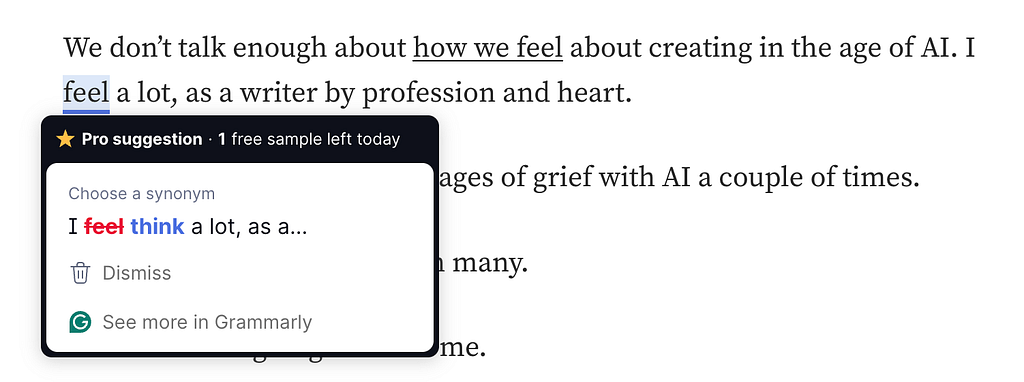
How to embrace this: Turn off Grammarly, auto-correct, and don’t ask ChatGPT to edit your work. Just write. Edit it yourself or ask a friend or colleague. Make a deliberate effort not to let AI touch your output and (re)learn how you write. And remind yourself: it’s OK to be unsure and say (write) that.
Exit the machine and consume.
Even before AI, I would seek inspiration in the analog. I‘d read poetry, write some of my own, pen on paper. I’d read books from various authors about different things, cultures, times: Dostoevsky. Kafka. Didion. Kerouac.
I almost always go back to my favorite recommendation for any writer, Rilke’s Letters to a Young Poet, a quick (re)read.
It works with other forms of media and art too: Ingmar Bergman movies, music from past decades, art museums.
If you have the means to, go beyond media. Travel. Visit museums. Talk to strangers. Learn a new skill. Cook a complicated meal (not something you found on TikTok).
Turn off your phone. It’s going to feel uncomfortable and wrong. Trust me, it’s right. Especially if you want to create something meaningful.
The internet may be artificial intelligence’s turf – but that’s all it has.
We have everything and everywhere else.

AI has made me a greater writer.
That’s what it’s done to me.
Not because it makes my work faster or easier. And not because it suggests different terms or corrects my punctuation. But because it has forced me to create with more intention than ever before. To reconsider each word carefully, to ensure it means what I want it to mean. To think, in every syllable, is this human?
I write slower now than I have in years.
That’s made me better.
It’s helped me separate creating content from creating. It’s the distinction that makes all the difference.
In a world held together by doomscrolling and fake news, stepping away is a privilege. Creating is power.
Allow yourself.
Nicole is a Content Designer turned Design Director based in Stockholm, Sweden. She potters, writes poetry, and raises little girls in a house by a meadow. You can follow her writing here or get it directly to your inbox via her publication, eggwoman. Nicole is on Linkedin.

What AI has done to me as a writer was originally published in UX Collective on Medium, where people are continuing the conversation by highlighting and responding to this story.
This post first appeared on Read More