
We’re consuming more content than ever, and remembering less of it. Here’s what the research says about our shrinking focus — and what’s fuelling the problem.
You settle in for a quick scroll through your feed, maybe just to unwind for a minute or two. But somewhere between a cooking hack and a clip you’ve already forgotten, forty minutes vanished. It’s all a blur. Welcome to the era of infinite content and finite attention, where our brains are working overtime just to keep up with the deluge.
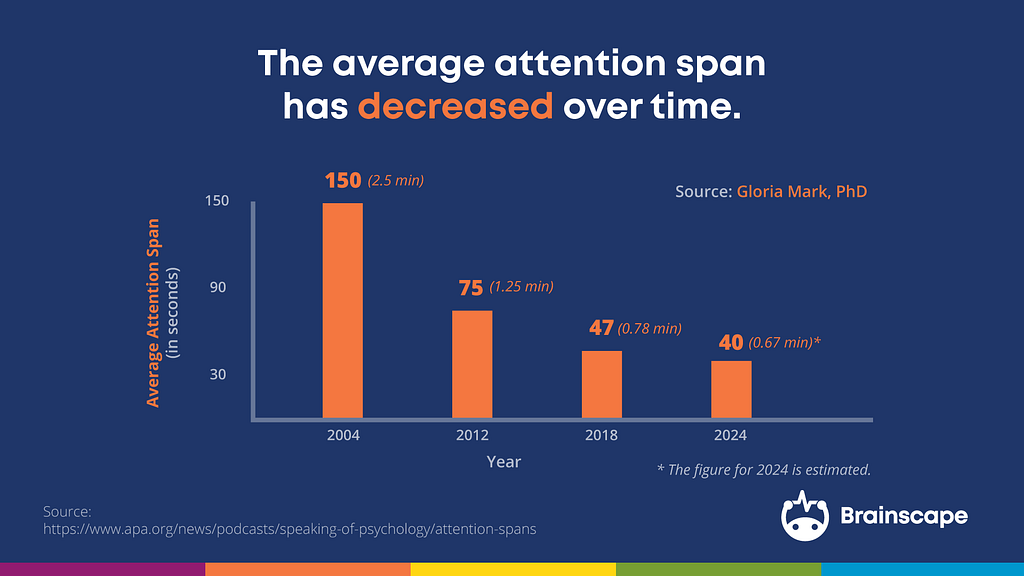
Here’s the uncomfortable truth: our ability to focus is dwindling at a startling rate. According to Gloria Mark, a professor of informatics at the University of California, the average attention span on any screen has plummeted from around two and a half minutes in 2004 to just 47 seconds in recent years. That’s not a typo. Forty-seven seconds. The median is even lower at 40 seconds, which means half of the time we’re switching our focus faster than it takes to microwave popcorn.
And in case you were wondering whether AI is helping or hindering the situation, well, the plot thickens.
The content tsunami
If you’ve ever felt like the internet is getting, shall we say, noisier, your instincts aren’t deceiving you. Recent data from Graphite, an SEO firm that analysed 65,000 English-language articles published between 2020 and 2025, found that over half of all written content on the internet is now generated by AI. Before ChatGPT launched in late 2022, that figure was hovering around 5%. Talk about an explosion.
A separate study from Ahrefs painted an even more dramatic picture, finding that a staggering 74% of newly created web pages in April 2025 contained AI-generated content. Meanwhile, research published on arXiv suggested that roughly a third to almost half of the text on active web pages now originates from AI sources. Suffice to say, we’re swimming in machine-made material, and our cognitive lifeboats are getting cramped.
The trouble is, more content doesn’t necessarily mean better content. In fact, the sheer volume creates what researchers call “attention fragmentation,” a relentless toggling between tasks, tabs, and tools that leaves us perpetually half-focused. Gloria Mark describes this phenomenon as “kinetic attention,” where our mental state becomes dynamic and restless, flitting from screen to screen like a caffeinated hummingbird.
The dopamine machine
It would be somewhat unfair to pin all of this on AI alone. Short-form video platforms like TikTok, Instagram Reels, and YouTube Shorts have been doing a phenomenal job of hijacking our neural reward systems well before the generative AI boom. But here’s where things get interesting: AI is now supercharging these platforms’ ability to serve up hyper-personalised content at unprecedented scale.
Dr John Hutton, a pediatric neuropsychologist and director of the Reading & Literacy Discovery Center at Cincinnati Children’s Hospital, has described TikTok as a “dopamine machine.” The platform delivers quick hits of novelty and pleasure with every swipe, reinforcing cravings in much the same way a tasty meal or, less pleasantly, an addictive substance might. Each scroll triggers a little burst of feel-good neurochemistry, and our brains quickly learn to want more.
The neurological evidence behind this is pretty eye-opening. In 2025, researchers at Tianjin Normal University in China scanned the brains of more than 100 university students and found that those most hooked on short-form videos had noticeable differences in their brain structure. Specifically, they had more grey matter in the orbitofrontal cortex, the part of your brain that processes rewards and pleasure. The researchers suspect these students are simply more sensitive to the dopamine hits these platforms are designed to deliver, meaning they’re getting a stronger buzz from every personalised video that lands on their feed.

Meanwhile, a large meta-analysis linked heavy use of TikTok and Instagram Reels to poorer cognitive and mental health outcomes, including higher levels of anxiety, depression, and, crucially, attention difficulties. Users with addiction symptoms showed decreased activity in brain regions responsible for self-reflection and risk evaluation, making them more prone to impulsive, short-term thinking.
When the brain goes on autopilot
So what exactly happens when we marinate our minds in bite-sized, algorithmically-curated content day after day? According to emerging research, the prefrontal cortex starts to feel the strain. This is our brain’s control centre for executive function, impulse restraint, and focused attention.
A 2024 study by Yan and colleagues found that individuals with high short-video use tendencies showed weaker executive function and poorer self-control. It’s a bit like training for a marathon by exclusively doing 10-second sprints: the sustained-focus muscle simply doesn’t get the workout it needs.
But how does this translate in real life? When young people’s brains grow accustomed to the constant environmental changes delivered by an infinite scroll of 15-second clips, they may struggle to adapt to activities that don’t move quite as fast.
The term “TikTok brain” has emerged to describe this pattern: impulsivity, preference for novelty, low tolerance for delayed gratification, and difficulty maintaining attention. It’s not exactly the cognitive toolkit you’d want for, say, reading a novel, sitting through a lecture, or tackling complex problems at work.
The AI amplifier effect
Here’s where AI-generated content adds a particularly spicy ingredient to this already potent cocktail. Traditional content creation had natural bottlenecks: someone had to actually write, film, or design things, which took time and effort. AI has essentially removed those constraints, enabling content to be produced at a scale and speed that would make any human creator’s head spin.
The result? An endless buffet of highly engaging, hyper-personalised material designed to capture and hold our attention. AI algorithms analyse vast amounts of user data, from search history and social media behaviour to physiological signals, crafting recommendations so compelling that stepping away feels almost painful. TikTok’s algorithm alone tracks over 300 data points per user to tailor content within the first hour of usage, making recommendations increasingly irresistible.
And here’s the kicker: some research suggests that even AI itself isn’t immune to the effects of junk content. A pre-print study from researchers at Texas A&M, the University of Texas at Austin, and Purdue University found that when large language models were trained on short, viral social media posts, they exhibited lasting cognitive decline, including increased “thought-skipping” and reduced reasoning abilities. If the machines are getting “brain rot” from low-quality content, what does that say about us?
The 25-minute problem
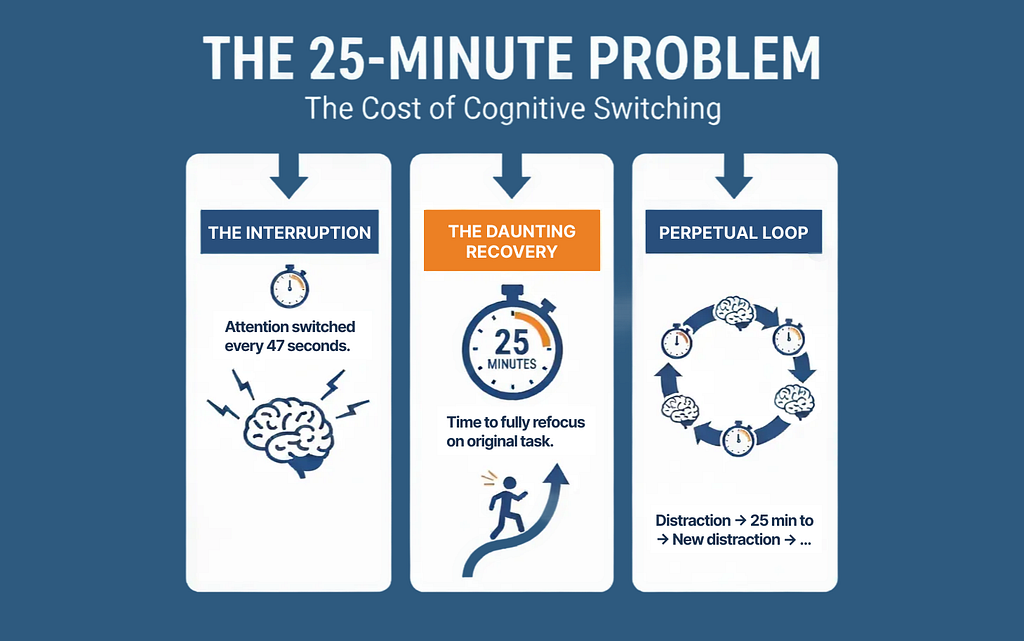
Perhaps the most concerning finding from Gloria Mark’s research is what happens after we get distracted. On average, it takes about 25 minutes to fully refocus on the original task after an interruption. Given that we’re switching our attention every 47 seconds or so, the maths becomes rather grim. We’re essentially living in a perpetual state of cognitive switching, never quite present, never quite focused.
The consequences ripple outward. Laboratory studies consistently show that people make more errors when they switch their attention frequently. Performance suffers: tasks take longer to complete, and the quality of work declines. Medical professionals, pilots, and other high-stakes workers have long known this; now the rest of us are discovering it in our daily digital lives.
A 2025 NTU Singapore study found that over two-thirds of young people reported difficulty focusing, with many struggling to engage with content lasting more than a minute. Heavy users (those clocking five or more hours daily) were significantly more likely to experience what researchers call “attention fragmentation symptoms,” alongside weaker working memory. These aren’t just numbers; they represent real-world impacts on how we think, learn, and work.
Can we reclaim our focus?
Before you throw your phone into the nearest body of water, there is some cause for optimism. Gloria Mark emphasises that our ability to focus isn’t lost; it’s just changing. The key, she argues, is developing what she calls “meta-awareness”: the skill of catching yourself mid-drift, mid-scroll, or mid-sentence, and consciously deciding whether to follow that impulse or pull your attention back.
In one study, participants were asked to estimate how often they switched tasks. They guessed around 15 times per hour. The actual number? Over 30. Simply becoming aware of how fragmented our attention really is can be a powerful first step toward change.
She also champions the value of what she calls “rote activity,” meaning simple, mindless tasks like playing a quick game or doing something repetitive. These give our overtaxed minds a genuine break. Think of it as cognitive snacking: strategic mental downtime that can actually help replenish our attentional resources rather than deplete them further.
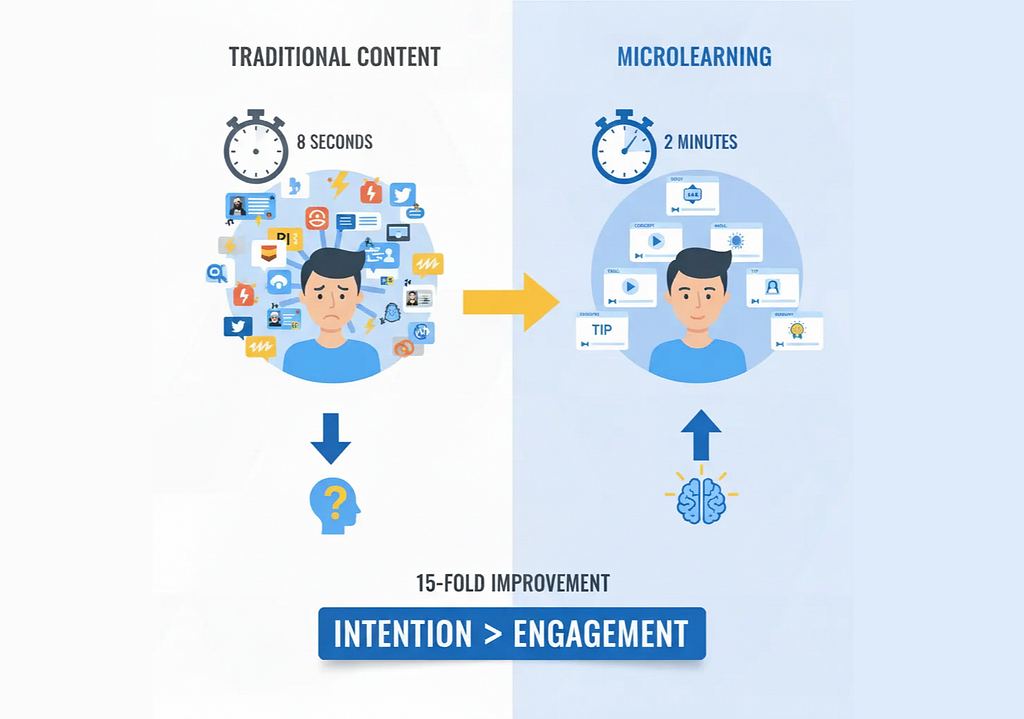
There’s also evidence that microlearning can actually stretch attention spans from 8 seconds to 2 minutes. This type of short, focused video content is designed with intention rather than just engagement, and the results speak for themselves: a 15-fold improvement simply by changing how content is delivered. The difference between content designed to capture attention and content designed to build it may well be the cognitive battleground of the coming years.
The bottom line
We are, in many ways, living through an unprecedented experiment in human attention. AI-generated content is flooding the internet, algorithms are becoming ever more sophisticated at predicting and exploiting our psychological vulnerabilities, and our brains, evolved for a very different information environment, are scrambling to adapt.
The research shows it’s not a simple story. Yes, our attention spans are shrinking, and yes, the combination of short-form video platforms and AI-generated content appears to be accelerating this trend. The neurological evidence suggests real changes in how our brains process information, particularly among younger users whose prefrontal cortices are still developing.
But humans have always been remarkably adaptable creatures. The challenge now is to become intentional about our relationship with technology: to recognise when we’re being pulled into patterns that don’t serve us, and to actively cultivate the focused attention that deeper thinking requires.
After all, the irony would be too rich if we couldn’t even pay attention long enough to notice we’d lost it.
Thanks for reading! 📖
If you liked this post, follow me on Medium for more!
References & Credits
- Mark, G. (2023). Attention Span: A Groundbreaking Way to Restore Balance, Happiness and Productivity. Hanover Square Press.
- Yan T, Su C, Xue W, Hu Y and Zhou H (2024). “Mobile phone short video use negatively impacts attention functions: an EEG study.” Frontiers in Human Neuroscience, 18:1383913.
- University of California, Irvine. (2023). Can’t pay attention? You’re not alone. https://www.universityofcalifornia.edu/news/cant-pay-attention-youre-not-alone
- Microsoft WorkLab. (2023). Regain Control of Your Focus and Attention with Researcher Gloria Mark. https://www.microsoft.com/en-us/worklab/podcast/regain-control-of-your-focus-and-attention-with-researcher-gloria-mark
- Dropbox Blog. (2025). Behold, the 47-second workday (and how to get your attention span back). https://blog.dropbox.com/topics/work-culture/gloria-mark-how-to-get-your-attention-span-back
- Graphite. (2025). AI-generated articles study. As reported in Futurism: Over 50 Percent of the Internet Is Now AI Slop, New Data Finds. https://futurism.com/artificial-intelligence/over-50-percent-internet-ai-slop
- Ahrefs. (2025). 74% of New Webpages Include AI Content (Study of 900k Pages). https://ahrefs.com/blog/what-percentage-of-new-content-is-ai-generated/
- Spennemann, D. H. R. (2025). Delving into: the quantification of AI-generated content on the internet (synthetic data). arXiv. https://arxiv.org/abs/2504.08755
- Gao, X., et al. (2025). Neuroanatomical and functional substrates of the short video addiction and its association with brain transcriptomic and cellular architecture. ScienceDirect. https://www.sciencedirect.com/science/article/pii/S105381192500031X
- PsyPost. (2025). Large meta-analysis links TikTok and Instagram Reels to poorer cognitive and mental health. https://www.psypost.org/large-meta-analysis-links-tiktok-and-instagram-reels-to-poorer-cognitive-and-mental-health/
- Coleman, T. (2024). ‘TikTok brain’ may be coming for your kid’s attention span. The Week. https://theweek.com/health-and-wellness/1025836/tiktok-brain-and-attention-spans
- ResearchGate. (2025). Short-form Video Use and Sustained Attention: A Narrative Review (2019–2025). https://www.researchgate.net/publication/397712802_Short-form_Video_Use_and_Sustained_Attention_A_Narrative_Review_2019-2025
- Fortune. (2025). Just like humans, AI can get ‘brain rot’ from low-quality text and the effects appear to linger, pre-print study says. https://fortune.com/2025/10/22/ai-brain-rot-junk-social-media-viral-addicting-content-tech/
- SQ Magazine. (2025). Social Media Attention Span Statistics 2025: By Platform, Age, and Content Type. https://sqmagazine.co.uk/social-media-attention-span-statistics/
- Amra & Elma. (2025). Best User Attention Span Statistics 2025. https://www.amraandelma.com/user-attention-span-statistics/

AI won’t (re)generate your focus was originally published in UX Collective on Medium, where people are continuing the conversation by highlighting and responding to this story.
This post first appeared on Read More