
The seduction of the blank prompt: The cognitive atrophy of instant gratification

Istill remember the distinct smell of markers and the faint squeak of a fresh pen on a pristine whiteboard. That was (still is) the starting line for every great project I’ve been a part of, from global campaigns at top advertising agencies to complex digital transformation strategies in consulting. The blank canvas wasn’t a hurdle; it was an invitation. An invitation to think, to wrestle, to connect disparate dots until a clear, compelling strategy emerged.
Today, that invitation often comes in the form of a blinking cursor in a prompt box. The promise is seductive: speed, efficiency, and democratized creativity. AI design tools can generate a thousand user flows in the time it takes to sketch one. They can produce UI mockups, suggest copy, and even create entire brand identities. And as product designers, we’ve eagerly adopted these powerful assistants.
But in our rush towards efficiency, we are outsourcing something far more valuable than tasks. We are outsourcing our thinking.
The hidden cost of these tools isn’t the subscription fee; it’s the slow, almost imperceptible erosion of the very cognitive processes that make us valuable strategists and creators. We’re not just automating grunt work; we’re abdicating the deep, messy, and profoundly human act of problem-solving.
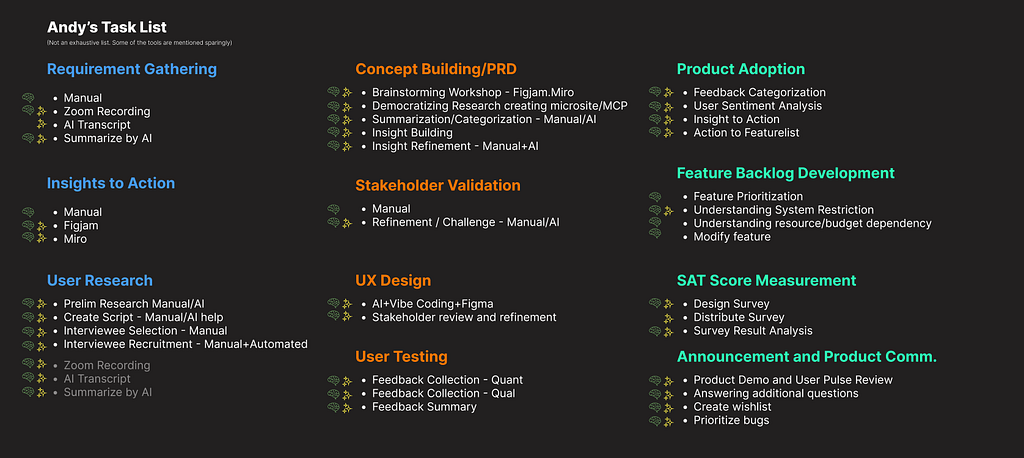
I am blessed with almost all tools as provided by my workplace and using them to their fullest of capabilities. Still while doing a fun exercise of mapping where exactly I, as a human, add value for an Internal project, I find myself contributing almost everywhere. From almost all funnel and lenses, human eyes and mind are essential for product success. However, what’s interesting is, the area where I find myself contributing significantly lesser nowadays is the “Design”.
The point I am trying to make here is, as a Designer/Researcher/Product Person, our heaviest contribution is not in the UI or UX of the product but how it’s shaping up to be a delightful experience. And we can not skip that thoughtful craft phase and directly gets our hands dirty in vibe coding.
From “Tool” to “Crutch”: The erosion of “Deep Work”
The evolution is subtle. It begins by using AI to overcome a creative block or to explore rapid variations. This is a fantastic use case. But the line blurs quickly. When the first step isn’t “What is the core problem we are solving for the user?” but “What prompt will get me the best-looking result?”, we’ve already outsourced our strategic intent.
Cal Newport defined “deep work” as the ability to focus without distraction on a cognitively demanding task. For designers, this is the strategic heart of our craft. It’s the act of staring at a user journey map and identifying a point of friction not because the data says so, but because you can feel the user’s frustration. It’s the messy sketching, the iterative prototyping, the conversations with engineers that reveal a constraint, which in turn sparks a more elegant solution.
This messy, non-linear process is where innovation lives. It’s filled with “happy accidents” — the unexpected line on a sketchpad that suggests a new interaction, the misinterpreted feedback that uncovers a deeper user need. AI operates on a linear logic of input and output. It is a master of remixing what has been done, but it cannot yet invent what should be done. By relying on it for our primary creative impulses, we are shortcutting the deep work that leads to breakthrough ideas, trading the potential for genuine insight for the guarantee of a quick, competent result.
The dangerous feedback loop: Aesthetic monoculture and the uncanny valley of empathy
The consequences go beyond devaluing our own process; they actively risk creating worse experiences for our users.
First, we are engineering an aesthetic monoculture. When thousands of designers use the same generative models, trained on the same datasets of Dribbble and Behance, our products begin to look and feel the same. The unique character of a brand — the very thing that builds emotional connection — is replaced by a sanitized, generic, AI-pleasing aesthetic. Differentiation, a core tenet of marketing and brand strategy, becomes a casualty of convenience.
More dangerously, we are creating an “uncanny valley of empathy.” AI does not have lived experience. It doesn’t know the anxiety of a user checking their bank balance after a big purchase or the subtle frustration of a multi-step form that feels just a little too long. It can mimic patterns of empathetic design it has seen before, but it cannot generate genuine empathy.
Imagine an AI tool designing an error message for a failed payment. It might generate something technically clear: “Payment Error: Transaction Declined.” A human designer, drawing on experience and user research, would craft something entirely different: “It looks like there was an issue with that payment. No worries, it happens to the best of us. You can try again or update your card details here.”
The first message triggers stress. The second de-escalates it. The AI provides information; the human provides an experience. When we outsource these micro-interactions to AI, we risk creating interfaces that are functionally flawless but emotionally hollow, deepening negative sentiment at the very moments we should be building trust and loyalty.
Just to check where I can add value as a human, I did this quick mapping for an internal project I was involved recently. This is not an exhaustive list, not an exact reflection of tools/technologies that I use but a draft of every aspect I touch as a Principal Product Designer.
The new mandate for designers: From creators to conductors
This is not a Luddite’s plea to abandon AI. That would be foolish. These tools are here to stay, and their power is undeniable. The mandate for us as Principal Designers is not to reject them, but to redefine our role in their presence.
Our value is shifting from making to judging. We must become the curators-in-chief, the strategic validators who ensure the outputs of our AI collaborators serve the user and the business, not just the algorithm. This aligns with the principles of human-centered design, where technology serves human goals, not the other way around.
This means three things:
- Lead with the Problem, Not the Prompt: The most critical work must happen before we ever engage an AI tool. Deep user research, strategic framing, and clear hypothesis-setting are now more important than ever. AI is an amplifier, not a substitute for strategy.
- Champion the Human-in-the-Loop: We must build rigorous validation processes into our workflow. Every AI-generated element must be scrutinized not just for aesthetics, but for emotional resonance, ethical implications, and brand alignment. We are the final arbiters of taste and empathy.
- Cultivate Critical Thinking as a Core Skill: The most vital design skill of the next decade will not be proficiency in Figma or Midjourney, but the ability to ask incisive questions. To look at an AI-generated solution and ask: “Why is this the right solution? What assumptions does it make? Who does it exclude? What are we not seeing?”
The blank canvas was never about the perfect final stroke; it was about the journey of discovery to get there.
We must not let the illusion of an instant destination rob us of that journey. In a world of infinite AI-generated options, our most valuable contribution isn’t the answers we create, but the wisdom of the questions we ask. That is something we can never afford to outsource.
Further Reading & References:
- Cal Newport, Cal Deep Work: Rules for Focused Success in a Distracted World. Grand Central Publishing. The foundational text on the importance of undistracted, cognitively demanding work, which is a core theme of this article.
- Jakob Nielsen “AI Bias: The Silent Saboteur of Great User Experiences.” Nielsen Norman Group. NN/g explores the tangible risks of AI, including bias, and the critical need for human oversight in the design process.
- Michael Huang “How Generative AI Changes the Rules for Strategy.” Harvard Business Review This HBR article provides a high-level business perspective on how AI is reshaping strategic thinking, reinforcing the need for human leadership.
- Tim Brown “Design Thinking” IDEO – A classic primer from IDEO on the human-centered approach that champions empathy, iteration, and problem framing – elements that AI alone cannot replicate.
- Shannon Liao “The ‘McDonalds-ification’ of App Design.” The Verge. An article exploring the trend of homogenous, templated app design, which serves as a real-world example of the aesthetic monoculture discussed.
- Google AI “Responsible AI Principles” . A look into how a leading tech company frames the ethical development and use of AI, providing a framework for responsible implementation.
- “The Algorithmic Impact Assessment (AIA) Framework.” Partnership on AI. This framework provides a practical methodology for assessing the potential impact of AI systems, emphasizing the importance of human evaluation throughout the product lifecycle.
Thank you for your time. If you read till here, we have created a human bonding through this article :).
✔️Find me on LinkedIn or ☕ Buy me a coffee
See you in the next article 👋🏻

The hidden cost of AI design tools – What we’re outsourcing without noticing was originally published in UX Collective on Medium, where people are continuing the conversation by highlighting and responding to this story.
This post first appeared on Read More