
What happens to UX specialists with narrow skills when AI collapses the distance between idea and execution, and depth alone no longer pays the rent? Here’s what you need to do.
Polymath (n.): a person whose knowledge and ability span many different subjects, who can draw on a broad base of learning to make something whole rather than one piece of it. For most of history it was simply what a skilled maker was.
For thirty years, the advice to UX professionals was a letter. Go deep in one discipline, the vertical stroke, and stay broad enough to collaborate, the horizontal one, to understand their context.
The T-shaped designer. McKinsey used the phrase internally in the 1980s, David Guest put it in print in 1991, and Tim Brown at IDEO made it the hiring standard.
“They have a principal skill that describes the vertical leg of the T — they’re mechanical engineers or industrial designers. But they are so empathetic that they can branch out into other skills, such as anthropology, and do them as well.”
– Tim Brown, IDEO CEO
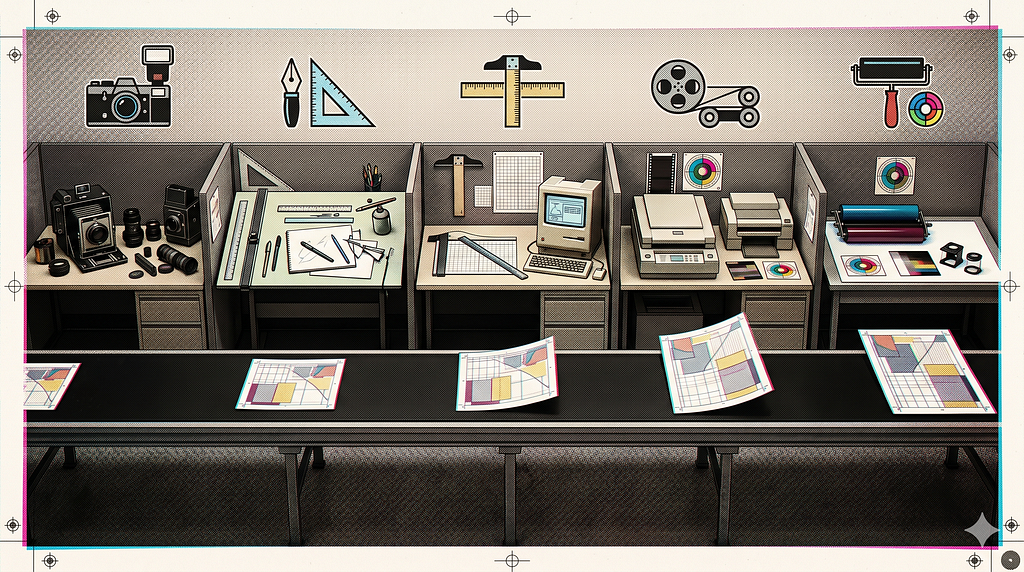
It worked for the world it described: a human assembly line, where a researcher handed insight to a designer, who handed mockups to an engineer, and the handoffs were where the work happened.
That world is evolving in light speed because the human assembly line is being replaced by an AI one, and we can be the humans who manage it.
Knowledge is cheap now, skill can be accelerated at light speed, and judgment is where the real value is.
The shape people now describe is the polymath: someone who runs the line rather than working one station on it, because the tools finally let them. The polymath is not new, though — ask Leonardo da Vinci or Benjamin Franklin—specialization was the detour from what is our craft, especially over the last 10 years.
For most of history one person carried a craft end to end and now that’s quickly reverting to that as the norm for our field.
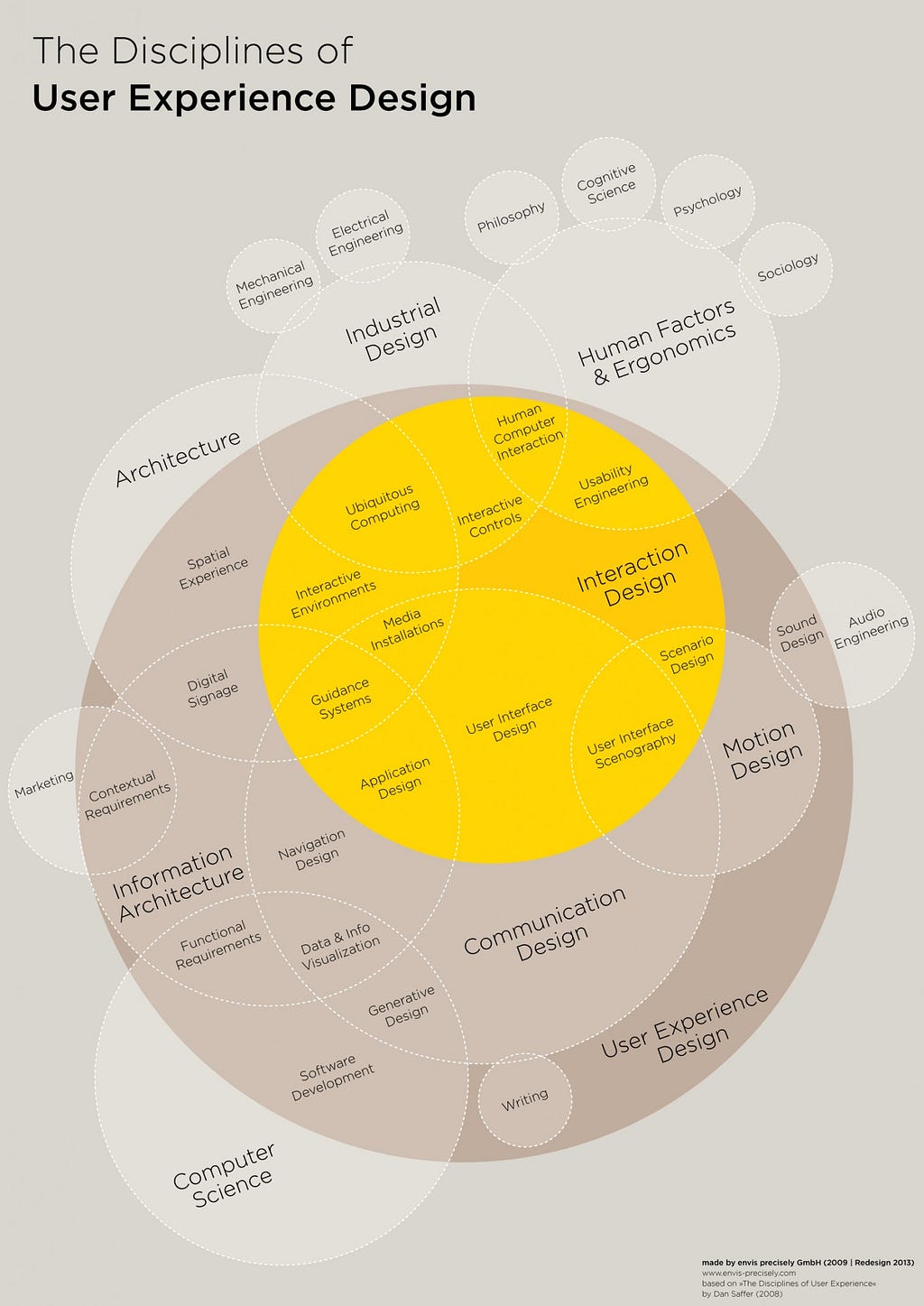
We split the work into research, content design, information architecture, interaction design, and design systems, and we staffed large specialized teams to match, each one owning a sliver of the user’s experience, as documented in Fast Company.
And frankly, some of the roles that the professionals have where they think of themselves as Swiss Army Knives are truly are not, because of their limits other than their ability to talk about what they cannot do.
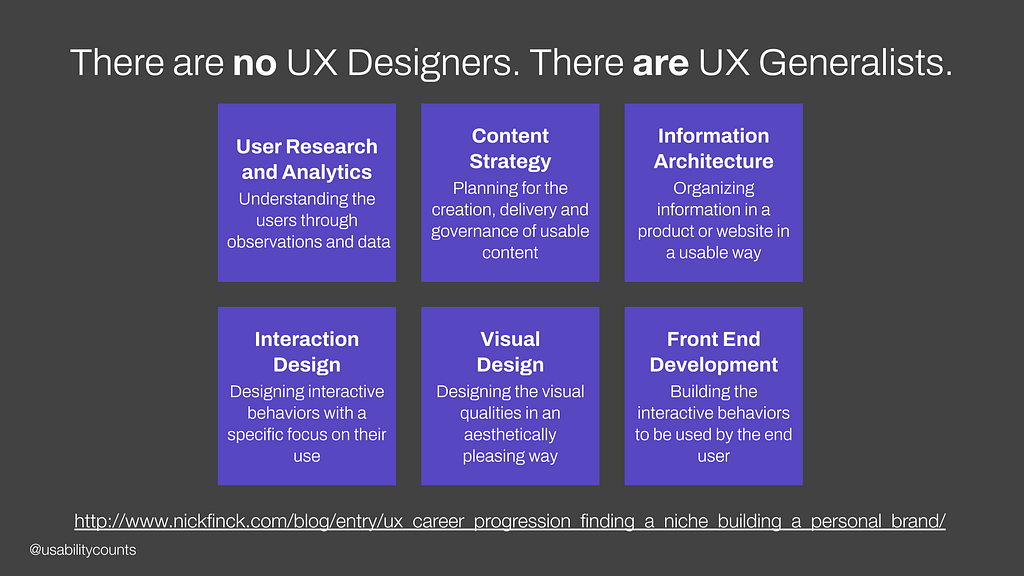
Product Management and Engineering did the split too, but in less distinct groups (Technical Product Manager, for example), which is why they have the advantage.
The old big-agency approach that ran on that split, rooms of specialists, endless handoffs, a line item for every craft that can be billed back to the client, is not coming back. For example, when working for Microsoft soft, I had the job title of Social Media User Experience Consultant. That barely fits on a business card.
Now we have to unwind that specialization, the same way product management did when it stopped fragmenting into ever-narrower owners and put one person back in charge of the whole product.
The new goal is not headcount, but outcomes.
“Managers can confuse themselves that the way to grow and get ahead is to accumulate large teams. Our best leaders get the most done with the least number of resources required to do the job. They pride themselves on being lean.”
– Andy Jassy, Amazon CEO
For example, Directly Responsible Individual is coming back in a big way over matrixed approaches, and they are empowered to make, too.
What that means is if you have user experience leader that talks about growing headcount, they are sending the wrong message; being in the business for themselves and no one else, which means you are disposable in their mind. Being pod based is the new black.
But let’s move on from the soap box.
This piece is about what that unwinding means if your skills are deliberately narrow, and what to do about it.
The T Was Built For Teams
The T-shaped model rewarded depth plus enough breadth to collaborate. But the version most designers carry around is a distortion of the original. When Tim Brown described T-shaped people at IDEO, the horizontal bar was not competence in adjacent crafts.
It was empathy and curiosity, someone I spoke about years ago: the disposition to stand in someone else’s shoes, the enthusiasm for other people’s disciplines, the breadth of different life knowledge and experience that let you work well alongside people in fields you would never practice yourself.
The vertical stroke was deep skill in one thing, and that thing could be almost anything. The horizontal stroke was a way of being in the world, not a second and third skill set.
Somewhere along the way the meaning narrowed. The horizontal bar got read as a skills checklist: a researcher who can also wireframe, a visual designer who can also prototype. That version, depth in one craft plus competence in the neighbors, is the one that hardened into job ladders, and it is the one AI is now dismantling. The original reading, the empathy and the range of experience, is harder to automate; we will come back to why.
Underneath both sat the same premise: a relay. A researcher handed insight to a designer, who handed mockups to an engineer, who handed a build to QA.
The T optimized you to own one seat at a crowded table; when the table shrinks, a narrow seat becomes a liability.
That logic was sound when the table was full. It gets dangerous when the seats start disappearing, and they are: in the UXPA salary survey analyzed by MeasuringU, a self-selected professional poll, the recent net cut in UX staffing was the worst on its record, with 37% of organizations reporting layoffs and 9% of respondents laid off themselves.
We have a lot of narrow seats and need to fix that.
Action items:
- Map your work as a relay. List the handoffs you receive and the handoffs you produce. The ones a model can now generate are the parts of your role most exposed.
- For each handoff you wait on, build a rough version yourself once, by hand or with a model, so you know what good enough looks like on both sides of you.
- Stop describing your value as a discipline (“I’m a researcher”). Start describing it as an outcome you can carry further than one seat.
AI Took The Tax Off Breadth
Breadth used to be expensive, which is the whole reason the T made sense. If you were a researcher, learning to prototype well cost months. If you were a visual designer, learning to write production copy cost months more.
Every step outside your lane meant a slow climb up someone else’s learning curve, and the whole time you were worse at that thing than the specialist next to you.
So you didn’t climb.
You specialized, because going wide was slow and the math rewarded depth because execution was a tax.
AI has cut the tax to near zero.
In a self-selected survey of designers run by Designer Fund and Foundation Capital, 91% now use AI in their design work at least weekly and 75% use it daily, the average tool stack has gone from three tools to seven, and half of respondents say they have shipped code to production.
Even with all those tools, they’re moving faster.
One respondent described being able to own work end to end that would have taken a full team a year ago. It is not only designers: in Stack Overflow’s 2025 survey of more than 49,000 developers, 84% now use or plan to use AI tools, up from 76% a year earlier, with half of professionals using them daily. The climb up the adjacent learning curve did not get gentler. It got skipped.
When the cost of acting outside your specialty falls to near zero, the strategic logic of staying inside it falls with it.
The design figures come from people who opted into an AI survey, so they skew toward the already-converted and are probably high. The Stack Overflow numbers are independent and far larger, and the direction is hard to argue with either way. When the cost of acting outside your specialty falls to near zero, the strategic logic of staying inside it falls with it.
Action items:
- Pick disciplines adjacent to yours and ship one real thing in it this quarter, using AI to cover what you don’t know. Not a course. A shipped artifact.
- Audit where the tax used to stop you. Wherever you once said “that’s not my job,” test whether a model just made it your job.
- Treat your tool stack as part of your craft, not overhead. If it is still the three tools it was a year ago, that is a signal, not a comfort.
We Have Seen This Movie Before
Step back far enough and the specialist is the recent invention, not the polymath. For most of the history of making things, one person carried a craft from end to end. The printer set the type and ran the press. The architect drew the building and worked out whether it would stand.
Deep, narrow specialization is what you get when the work grows big enough that handoffs become cheaper than range. It was a phase tied to a particular cost structure, and that cost structure is now changing back.
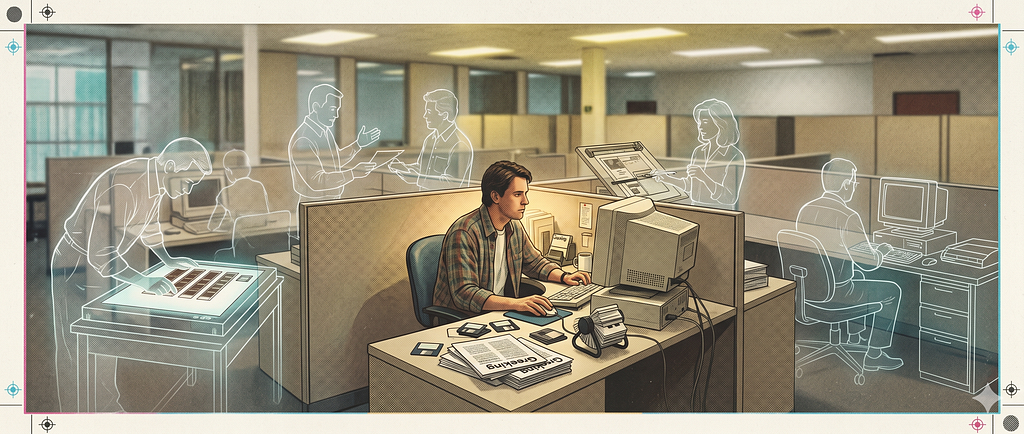
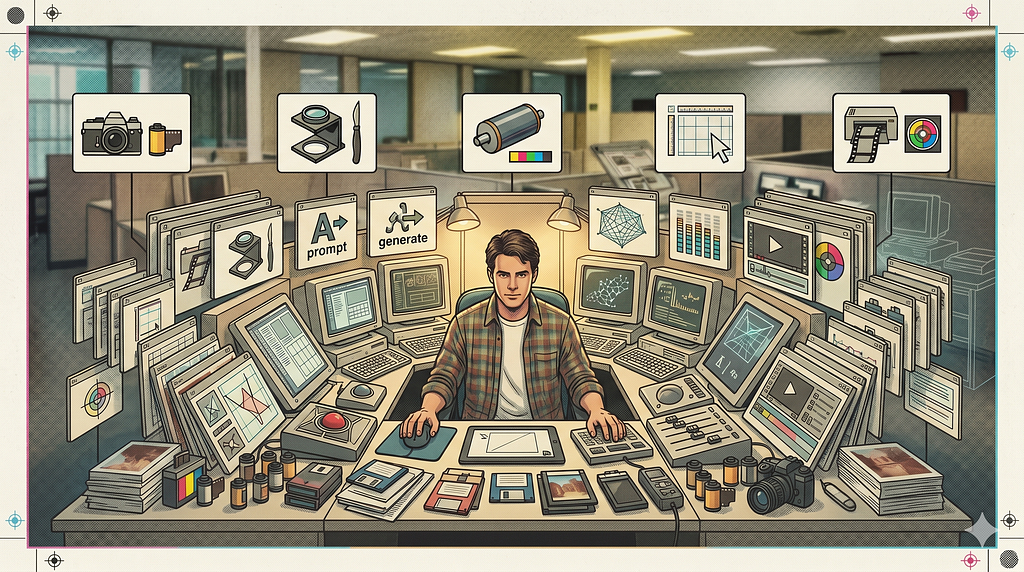
This is not even the first time it has changed back inside a single working life. In the 1980s, putting a magazine page together took a chain of specialists: typesetters, paste-up artists, keyliners, color separators, camera operators. Each one owned a narrow, deep skill, and the page moved between them like a baton, with a tax in time and money at every exchange.
Then the Mac, PageMaker, and a laser printer arrived, and within a few years one person at one desk did the whole page. The specialists who survived were not the fastest at the old craft. They were the ones who understood what the page was for and let the machine handle the production.
The narrow trades did not get promoted. They got absorbed.
AI is doing to interface and product work what desktop publishing did to print production. The relay of specialists was an assembly line made of people; AI is becoming the line itself. It is not destroying the judgment. It is automating the handoffs.
Action items:
- Find the person in your organization already working the new way, end to end, and watch what they do differently. The pattern transfers faster than any framework.
- Audit your week for work that is production versus work that is judgment. Move your hours toward the judgment and let the tools take the production.
- Write down what your discipline is for, beneath the artifacts you make. That sentence is what survives the collapse. The artifacts may not or will feed the machine so they own it.
The Polymath Is Not Omniscient
It is worth being precise about the word, because polymath sounds like a person who is excellent at everything, and that is not the claim.
The claim is narrower and more useful: range plus judgment plus the ability to direct tools across the whole stack. It is the difference between knowing how to do every job and knowing what each job is for and when it has been done well.
The same survey notes that designers are now evaluated on both their output and the workflows they build, which is taste encoded into infrastructure, not just artifacts shipped.
This is where the original IDEO idea quietly comes back. When specific knowledge is retrievable and executable on demand, it stops being the scarce resource. The model can recall the spec, write the query, draft the component as a complete product brain.
What it cannot do is decide what is worth making, or look at a plausible result and know that it is wrong.
That takes empathy, context, and a feel for quality, which is exactly the breadth of experience Brown was pointing at. Judgment is the thing that does not come on tap. The future rewards the person who knows what good looks like over the person who has memorized the most.
The exposed person is not the generalist who is mediocre everywhere. It is the specialist who is excellent at exactly one thing and silent on the rest. That is uncomfortable for anyone who built a career on depth, and there is a real cost on the other side of it. Skill atrophy shows up as a named worry in the same survey.
The response is to widen the surface you can act on without abandoning the depth that made you good in the first place.
Action items:
- Encode your judgment, not just your output. Turn the way you make a decision into a prompt, a checklist, or a small tool a teammate can run. That is the new evidence of seniority.
- Take one project and run the whole line yourself. Direct AI through the parts you used to hand off, so you learn where your judgment changes the outcome and where you were only doing manual labor.
- Guard against atrophy on purpose. Keep doing the deep thing by hand often enough that you can still tell when the model’s output is wrong.
Where Depth Still Wins Outright
Do not overcorrect. Depth has not stopped mattering, and the same survey that shows breadth exploding also shows where depth still rules. In the State of Design study, 80% of designers say reliable, high-quality output is what makes a tool stick, and 62% name inconsistent output as their biggest problem.
That gap, between what people want and what the tools reliably deliver, is exactly where deep skill lives. Designers describe using Figma as a precision instrument now, pulling a single region out of a coded prototype to fix the spacing a model cannot quite nail.
Research depth, accessibility judgment, typographic precision, knowing not just that something is wrong but why: these get more valuable as raw production gets cheap, not less. When making things is easy, the bottleneck moves to telling which of them is any good.
Everyone now produces, and fewer people can tell good from plausible and that’s where we can shine.
The polymath with no deep stroke at all is just fast and shallow. The shape that wins is still a T. It just grew a much wider top, and the vertical stroke has to be real.
Action items:
- Name the things you are deep in that gets more valuable, not less, when production is free. Protect it, sharpen it, and make it legible to people who cannot see it.
- Use your depth as the quality bar for AI output in your area. Be the person who can say why the plausible thing is still wrong.
- Do not trade depth for breadth. Stack breadth on top of it. A wide top with no stem is not a polymath. It is a dilettante with good tools.
Conclusion
The T-shaped designer was right for a world of teams and handoffs. AI is dismantling the handoffs, and the breadth that used to be a luxury is becoming the baseline. The narrow specialist is not doomed, but the old bargain, go deep and stay narrow and let the team cover the rest, has expired. The team that covered the rest is now partly a model you can call.
The move is not to panic, and not to abandon your craft. It is to keep the depth that made you worth hiring and widen the surface you can act on, so that when the table shrinks you are not the seat that gets cut.
Encode your judgment into something a tool can run.
Ship one thing outside your lane this quarter.
And keep your deep stroke sharp enough to know when the machine is confidently wrong, because that judgment is the part of the job getting more valuable, not less. Specific knowledge got cheap. Judgment did not. AI is the assembly line now, and the work that is left is running it with taste.
The letter is not so much changing shape as changing back, and the smart response is to grow the top of your T without sawing off the stem.

The T-shaped UX professional is giving way to the polymath architect was originally published in UX Collective on Medium, where people are continuing the conversation by highlighting and responding to this story.
This post first appeared on Read More