
My Favorite GitHub repository to learn and master System Design Interviews in 2026
System design interviews are consistently the hardest round in the hiring process for senior and lead engineering roles. They’re open-ended, ambiguous by design, and test a kind of thinking that you can’t develop by memorizing solutions. You have to actually build the intuition for how large-scale systems work.
The good news: the open-source community on GitHub has produced some of the best system design learning material available — much of it better than paid courses, and all of it free.
After bookmarking 30+ system design repositories over the years, I’ve narrowed it down to the 10 that are genuinely worth your time.
Quick tip before you start: reading GitHub repos alone is rarely enough. To actually develop system design skills, you need to practice answering questions, not just consume material. Sites like ByteByteGo, DesignGuru, Exponent, Codemia.io, and Educative pair well with everything below.
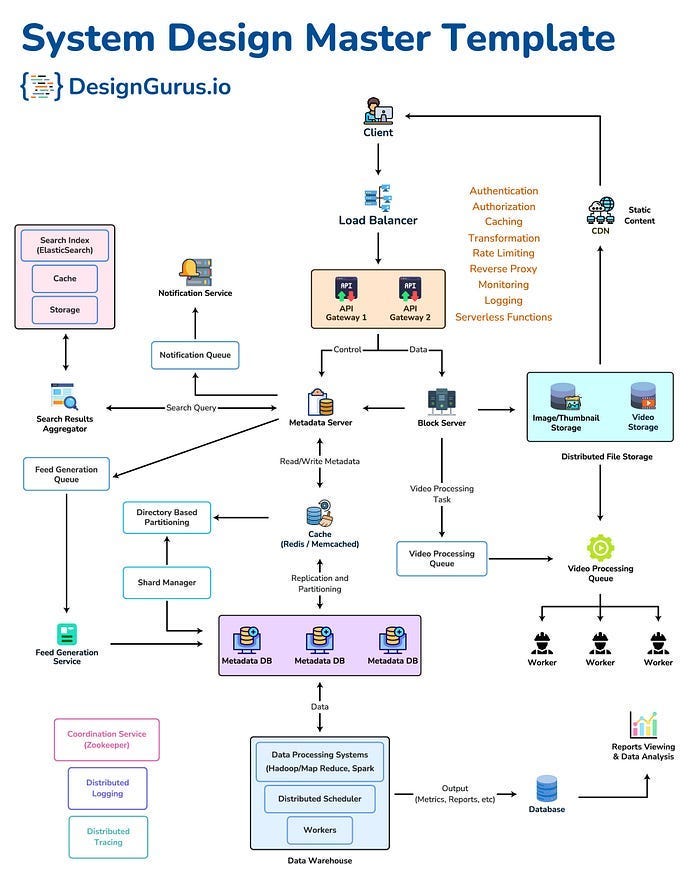
One of the best things you can do before your system design interview is have a framework for answering questions. Here’s the template from DesignGuru that I still use:
Clarify requirements → estimate scale → define the API → design the high-level architecture → deep-dive into components → identify bottlenecks → discuss trade-offs.
Follow this framework consistently and your answers will be dramatically more structured.
Now let’s get into the repositories.
10 Best GitHub Repositories for System Design Interview Preparation in 2026
Here are my 10 best GitHub repository you can bookmark to learn and master System Design in 2026, most of them contain free resources for interviews including case studies, problem and solutions:
1. ByteByteGoHq/system-design-101
If you could only bookmark one system design GitHub repository, make it this one.
Created by Alex Xu — author of the System Design Interview: An Insider’s Guide and creator of ByteByteGo — this repository is a visual encyclopedia of system design concepts. Every topic is explained with clear diagrams and infographics that make dense distributed systems concepts immediately intuitive.
It covers REST vs GraphQL, TCP vs UDP, how DNS works, what happens when you type a URL in a browser, CI/CD pipelines, database scaling patterns, cache strategies, and dozens of other core concepts — all in a visual-first format that sticks far better than walls of text.
Why it’s #1: It’s the most visually engaging, most comprehensive, and most actively maintained system design repository on GitHub. The diagrams alone are worth bookmarking.
Pair it with: ByteByteGo newsletter and courses for deeper structured coverage of the same concepts. They are also offering 50% discount now on their annual and lifetime plan.
System Design · Coding · Behavioral · Machine Learning Interviews
2. donnemartin/system-design-primer
The System Design Primer is the foundational repository in this space — one of the most starred engineering repositories on all of GitHub, with 85,000+ stars. This was one of the first system design repos I found, and years later it’s still the best starting point for building core fundamentals.
It provides a comprehensive, step-by-step guide to learning how to design large-scale systems — covering scalability vs performance trade-offs, latency vs throughput, CAP theorem, caching, load balancing, database scaling, consistency models, and much more.
It also includes worked system design interview examples with solutions and Anki flashcards for spaced repetition.
What makes this repository essential rather than just useful is the structure. It doesn’t just dump links — it builds a coherent learning path from first principles to interview-ready knowledge.
Why it’s essential: The single most complete foundational reference for distributed systems concepts and system design interview preparation.
Pair it with: Codemia.io — a LeetCode-style platform for practicing system design problems with editorial solutions for classic problems like designing Twitter, Pastebin, and URL shorteners. Reading about how systems work is one thing; practicing designing them under time pressure is another.
Codemia | Master System Design Interviews Through Active Practice
3. ashishps1/awesome-system-design-resources
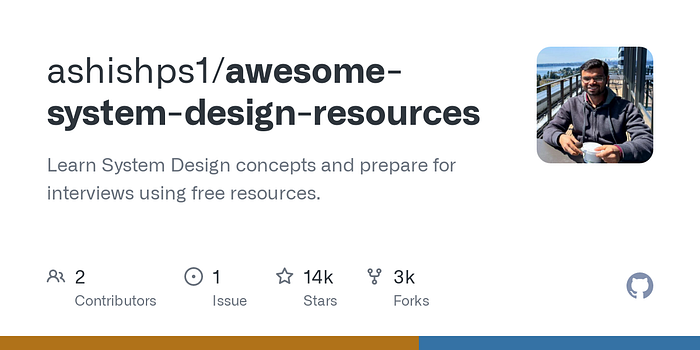
Created by Ashish Pratap Singh — ex-Amazon engineer and author of the AlgoMaster newsletter on Substack — this is the most actively maintained curated system design resource list available on GitHub in 2026.
The difference between this and generic “awesome lists” is curation quality. Ashish has personally vetted the resources and organized them by topic — system design concepts, interview problems, design case studies, and learning material — making it easy to drill into any specific area where you feel weak rather than reading from start to finish.
The newsletter is also excellent supplementary material: Ashish publishes deep-dives on system design concepts that complement the resources in the repository.
Why it stands out: Actively maintained, high curation quality, organized for targeted preparation rather than just comprehensive listing.
Pair it with: The Bugfree.ai, one of the best place to practice System Design problems. Also known as LeetCode for System Design.
Master System Design & Behavioral Interviews Like Leetcode
4. checkcheckzz/system-design-interview
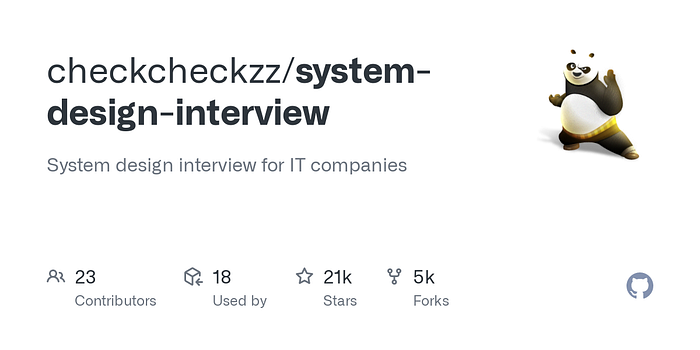
This is one of the broadest collections of system design interview questions, resources, and company-specific examples. It covers a wide range of design problems — URL shorteners, web crawlers, social feeds, chat systems, rate limiters — with approaches, tips, and links to relevant reference material.
The repo is particularly useful for breadth: if you want to survey the range of problems that come up in system design interviews across different companies and understand the key considerations for each type, this gives you that landscape.
A small caveat: it’s less actively maintained than some others on this list, so some links are dated. Use it for the question coverage and topic breadth, then go deeper on specific areas with the more current resources above.
Best used for: Understanding the range of system design interview questions across companies, quick orientation on a specific problem type before diving deeper.
Pair it with: Grokking the System Design Interview on DesignGurus for structured, in-depth solutions to the same types of problems. Use code GURU for 30% off their All Courses Bundle.
Grokking System Design Interview: Original Course
5. Jeevan-kumar-Raj/Grokking-System-Design
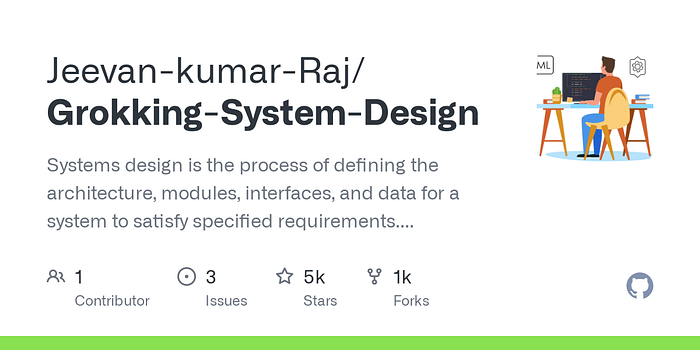
This repository provides a free companion to the famous “Grokking the System Design Interview” course from DesignGurus. It contains detailed explanations of system design concepts, case studies of real-world systems, and community discussions around the patterns covered in the course.
The value here is the community layer: seeing how other engineers think through the same problems, what questions they get stuck on, and how they reason about trade-offs. That meta-level perspective on system design thinking is genuinely useful prep.
Best used for: Supplementing the Grokking course with community insights, free access to a subset of the concepts covered in the paid course.
Pair it with: The full Grokking the System Design Interview course for complete coverage, interactive exercises, and the worked solutions the repo doesn’t include.
Grokking System Design Interview: Original Course
6. InterviewReady/system-design-resources
Created by Gaurav Sen — ex-Google engineer and one of the most popular system design educators on YouTube — this repository is a curated, topic-organized collection of the best system design resources available: books, courses, blogs, and video channels.
What distinguishes Gaurav’s curation from generic lists is the same thing that makes his YouTube channel excellent: he has genuine production experience building distributed systems at Google, and his recommendations reflect the things that actually matter rather than things that look impressive.
Why it stands out: Curated by a practitioner with real Google-scale experience. Organized by topic so you can navigate to exactly what you need.
Pair it with: Low Level System Design [An interview perspective] for complete LLD + HLD preparation with someone who has interviewed at and worked at top tech companies. His YouTube channel is also free and excellent.
7. binhnguyennus/awesome-scalability

This is the most technically deep repository on this list, and it’s focused on a single crucial topic: scalability — the skill of designing systems that stay fast, reliable, and cost-effective as they grow from thousands to millions to billions of users.
Most system design resources cover scalability at a surface level. This one goes deep: caching strategies, database sharding patterns, load balancing algorithms, CDN architectures, queue design, consistency models, and real case studies from companies that have actually solved these problems at scale.
If you want to go beyond “add a cache and a load balancer” in your system design answers, this repository gives you the substance to back up your claims.
Best used for: Deepening your understanding of specific scalability topics — especially caching strategies, database sharding, and load balancing — before your interview.
Pair it with: ByteByteGo for visual explanations of the same scalability patterns covered in depth here.
System Design · Coding · Behavioral · Machine Learning Interviews
8. javabuddy/best-system-design-resources
This is another great repository of system design resources — it brings together the best courses, books, websites, cheat sheets, practice problems, and roadmaps in one organized place.
It’s not just a list of resources, but a guide to how to use them at different stages of preparation. If you’re starting from scratch, there’s a path. If you’re a week out from an interview and need to revise fast, there’s a path for that too.
Best used for: Getting a comprehensive map of all system design preparation resources before deciding which specific courses, books, or websites to invest in.
→ Explore javabuddy/best-system-design-resources
9. yangshun/tech-interview-handbook
Created by Yangshun Tay — also the creator of Blind 75 — this handbook has helped over 500,000 engineers prepare for technical interviews. While it’s not exclusively a system design resource, it provides valuable context that pure system design repos miss: how to structure your entire interview preparation, how to approach behavioral rounds, algorithm cheat sheets, and resume guidance.
For system design specifically, it includes a solid framework for approaching design questions and links to curated resources. But its real value is as the connective tissue between your system design prep, your DSA prep, and your behavioral prep — making sure you’re ready for the complete interview loop, not just the design round.
Best used for: Completing your interview preparation beyond system design — behavioral questions, resume prep, and the algorithm rounds that come before the design round.
Pair it with: Exponent’s mock interview platform for practicing the full interview loop with real feedback from experienced interviewers.
Interview prep for product, engineering, data science, and more – Exponent
10. systemdesign42/system-design
Created by Neo Kim — author of the SystemDesign.one newsletter — this repository focuses on something most others skip: real-world case studies of how major companies actually scaled their systems.
How WhatsApp scaled to 500 million users with a tiny engineering team. How LinkedIn scaled its feed. How Twitter handles millions of writes per second. These aren’t theoretical examples — they’re drawn from public engineering blog posts, conference talks, and papers. Studying real scaling decisions gives you the vocabulary and the credibility to talk about trade-offs in interviews in a way that generic resources don’t.
Why it rounds out the list: Real-world case studies build the intuition that transforms “I know the patterns” into “I can reason about novel systems” — which is exactly what top-tier interviewers are testing.
Pair it with: The Bugfree.ai, one of the best place to practice System Design problems. Also known as LeetCode for System Design.
Master System Design & Behavioral Interviews Like Leetcode
How to Use These Repositories Effectively?
Reading GitHub repos is necessary but not sufficient. Here’s how to actually develop system design skills rather than just accumulating bookmarks:
Week 1–2: Build your foundation Start with system-design-primer for the core concepts. Learn CAP theorem, consistency models, caching, load balancing, database scaling, and message queues. Don’t rush this — understanding why these patterns exist matters more than memorizing what they are.
Week 3–4: Practice with the framework Start using the DesignGuru answer framework for any problem you encounter. Take a question — design Twitter, design a URL shortener — set a 45-minute timer, and work through it systematically. Then compare your approach against reference solutions from Grokking-System-Design or Codemia.io.
Week 5–6: Go deep on specific topics Use awesome-scalability and ByteByteGoHq/system-design-101 to deepen your understanding of the components that came up most often in your practice. Spend extra time on caching, database sharding, and event-driven architecture — these appear constantly in senior-level interviews.
Week 7–8: Real-world context and mock interviews Read case studies from systemdesign42/system-design to understand how real companies solve these problems. Then do live mock interviews on Pramp or Exponent. Nothing replaces practicing under time pressure with real feedback.
Additional Resources Worth Bookmarking
Beyond GitHub repositories, these are the system design resources I recommend alongside the repos above:
Courses and platforms:
- ByteByteGo — Alex Xu’s visual system design content and courses
- DesignGuru — Grokking System Design — the most popular structured system design course online; use code GURU for 30% off
- Codemia.io — LeetCode-style active practice for system design problems with AI-powered editorial solutions
- Exponent — mock interviews with real engineers for system design and behavioral rounds
- Educative — interactive text-based courses including Grokking System Design and OOP Design
- InterviewReady by Gaurav Sen — complete HLD + LLD preparation
Books:
- System Design Interview Vol. 1 & 2 by Alex Xu — the essential system design interview book
- Designing Machine Learning Systems by Chip Huyen — essential if ML system design comes up in your interviews
- Machine Learning System Design Interview — focused specifically on ML system design interview questions
Newsletters:
- ByteByteGo Newsletter — weekly visual explainers of system design concepts
- AlgoMaster Newsletter by Ashish Pratap Singh — deep dives on system design and algorithms
- SystemDesign.one Newsletter by Neo Kim — real-world scaling case studies
Final Word
System design is not something you can cram the night before an interview. It’s a thinking pattern — and the GitHub repositories above, used consistently over weeks, are how you build it.
The best approach: pick two or three repositories to go deep on rather than skimming all ten. Use the structured resources (ByteByteGo, DesignGuru, Codemia) for practice. Read the real-world case studies to develop intuition. And do mock interviews — the pressure of explaining your reasoning to another person is irreplaceable preparation for the real thing.
Good luck with your interviews!
P.S. — If you want one platform that bundles structured system design courses, practice problems, and visual diagrams, ByteByteGo is the best single investment. Their lifetime plan covers system design, OOP design, coding patterns, and dynamic programming at a significant discount. Use code JALJAD for an additional 10% off.
System Design · Coding · Behavioral · Machine Learning Interviews

I Bookmarked 30+ GitHub Repos for System Design: Here Are the 10 You Actually Need in 2026 was originally published in Javarevisited on Medium, where people are continuing the conversation by highlighting and responding to this story.
This post first appeared on Read More