
Why Codemia is the single best platform to learn System Design, OOD, DSA, and Agentic AI
Hello everyone , If you’re preparing for senior-level tech interviews in 2026, you’re probably juggling five different platforms. LeetCode or AlgoMonster for DSA. ByteByteGo or DesignGuru for system design. Educative for OOP design. Exponent for mock interviews.
And now, with Agentic AI questions appearing in FAANG rounds, yet another resource for that.
It’s expensive, fragmented, and exhausting.
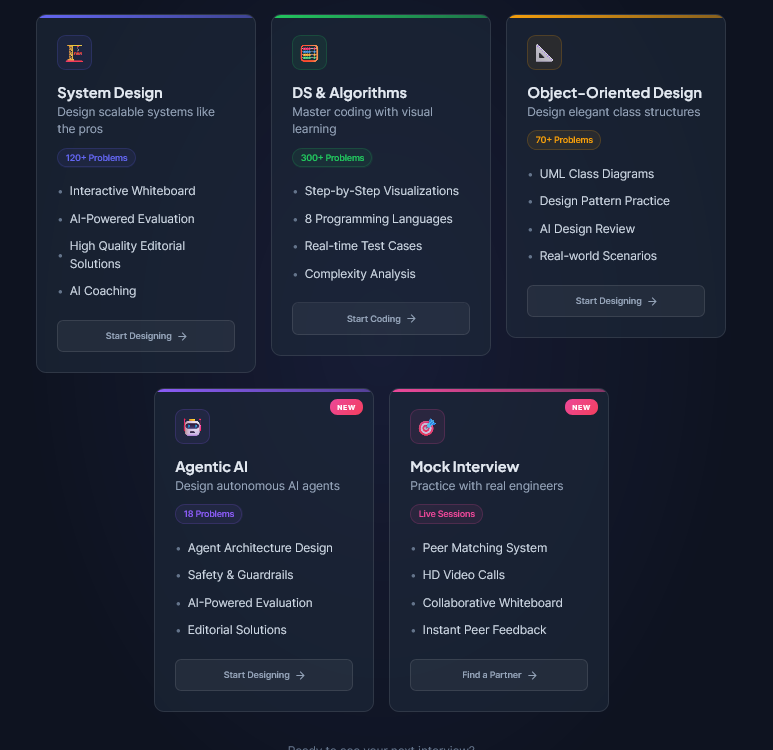
I’ve been testing Codemia.io for the past month, and it’s the first platform that genuinely consolidates all of these into one place — System Design, Object-Oriented Design, Data Structures & Algorithms, Agentic AI, and Mock Interviews.
This review covers everything: what works, what could be better, how it compares to alternatives, and whether it’s worth the money.
🔥 Quick note on pricing: Codemia Premium is currently $59/year (50% off from $119). That’s $5/month. If you’re targeting a senior role with a $200K–$400K package, the ROI is, frankly, absurd. Join Codemia.io here
Codemia | Master System Design Interviews Through Active Practice
Why One Platform Beats Five?
The senior tech interview loop in 2026 typically includes:
- DSA coding round — arrays, trees, graphs, dynamic programming
- System Design (HLD) — design Twitter, Netflix, Uber at scale
- Low-Level Design / OOD — design a parking lot, elevator system, vending machine
- Agentic AI round — increasingly common at companies building LLM-powered products
- Mock interviews — practice performing under real interview pressure
Preparing for all of these simultaneously with different platforms creates context-switching overhead, inconsistent quality, and an uncomfortable amount of subscription fees. Codemia.io is the first platform I’ve found that covers all five in a single, coherent environment.
What Codemia.io Actually Offers?
Now, let’s see how codemia helps you to prepare for coding interviews in 2026 with different range of topics like System Design, OOAD, DSA, and nowadays Agentic AI knowledge.
1. System Design — 150+ Problems with Structured Solutions
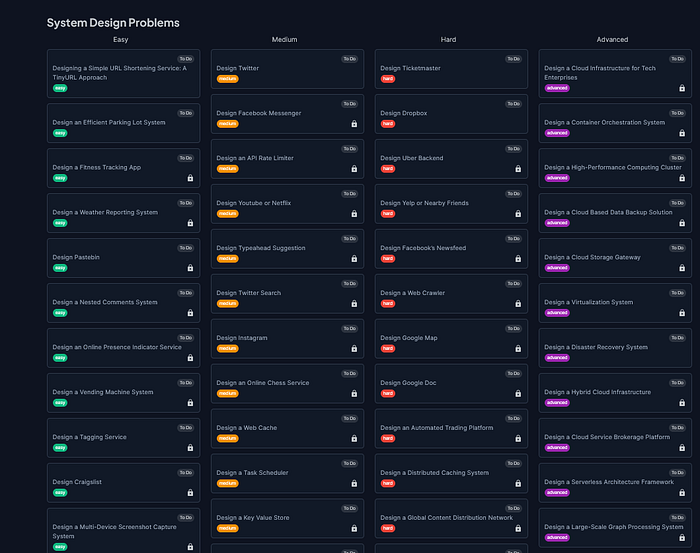
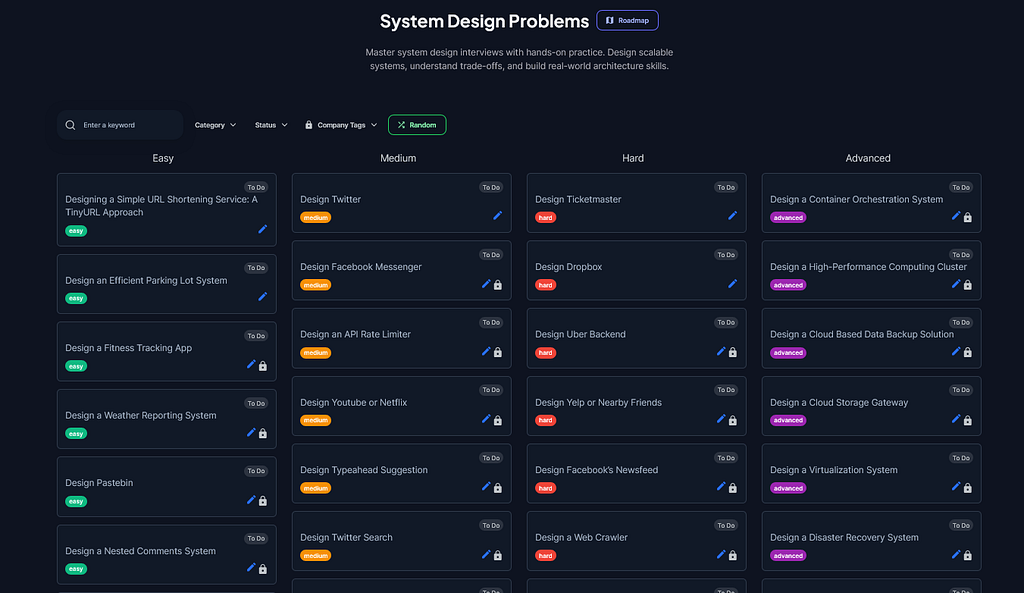
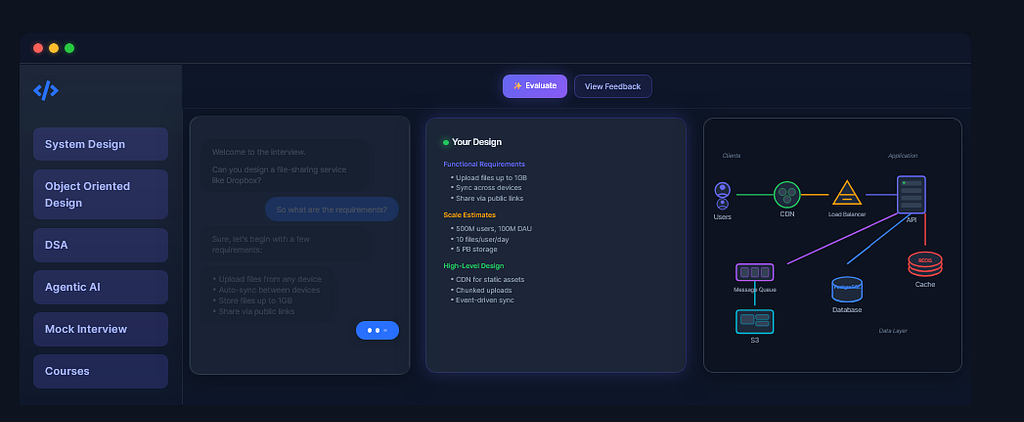
The System Design section is where Codemia started and where it’s strongest. With 150+ problems (and 2–3 new ones added every week), it’s the largest curated collection of system design interview problems I’ve found on any platform.
Problems span every domain you’ll encounter in FAANG interviews:
- Classic distributed systems: URL shortener (TinyURL), Twitter, Instagram, YouTube, Uber, WhatsApp
- Real-time systems: video view count, notification service, online presence indicator
- Data-heavy systems: analytics pipeline, recommendation engine, search system
- Domain-specific: conference room booking, parking lot system, Pastebin
What makes Codemia different from just reading these problems somewhere is the structured approach it enforces:
- Functional requirements
- Non-functional requirements
- Capacity estimation
- API design
- Database design
- High-level design
- Request flows
- Detailed component design
- Trade-offs and tech choices
- Failure scenarios and bottlenecks
- Future improvements
This 11-step framework mirrors what interviewers at FAANG actually evaluate. It’s not just a problem list — it’s a rehearsal for how interviews are structured.
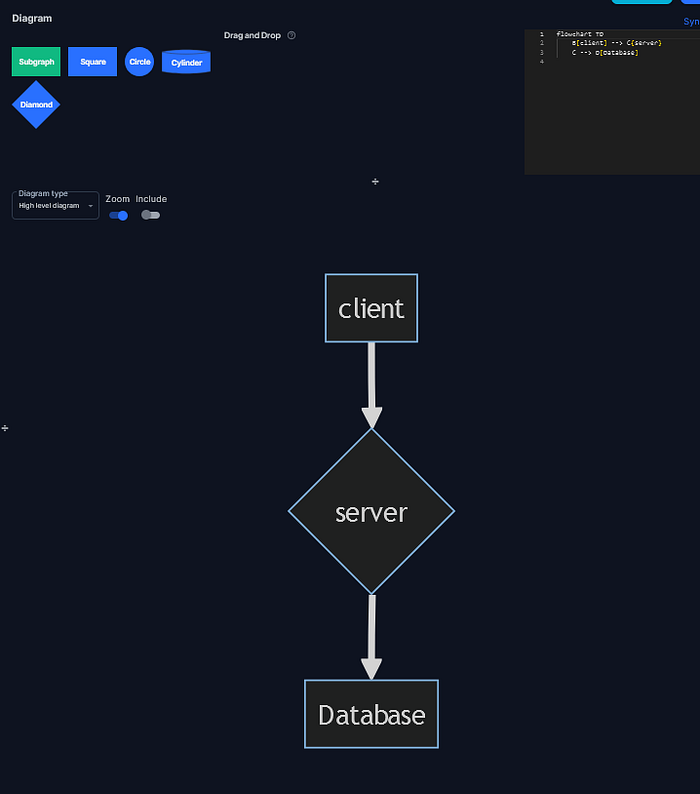
The built-in whiteboarding and diagram tool lets you draw architecture diagrams inline, which is exactly what you’ll need to do in a real interview.
AI feedback is the killer feature here. Submit your solution and get immediate, specific feedback on what you got right, what you missed, and how to improve — including scalability, fault tolerance, and efficiency. It’s not as nuanced as human mentorship, but it’s available at 2am and it’s consistent.
Editorial solutions are another strong addition — 80+ high-quality reference solutions that show you how experienced engineers approach each problem. You solve it yourself, compare against the editorial, identify the gaps. That feedback loop builds real competence faster than reading solutions passively.
Free structured courses:
- System Design Fundamentals — the conceptual backbone before you start solving problems
- Tackling System Design Interview Problems — practical framework for approaching any design question
YouTube walkthroughs (free): The Codemia YouTube channel has detailed video walkthroughs of popular system design problems:
- Ticketmaster System Design — how to design a high-scale ticketing system
- Short URL Service Design — TinyURL deep dive
- Twitter/X System Design — designing a social media platform at scale
These videos are excellent free entry points before committing to a subscription.
→ Explore System Design Problems on Codemia
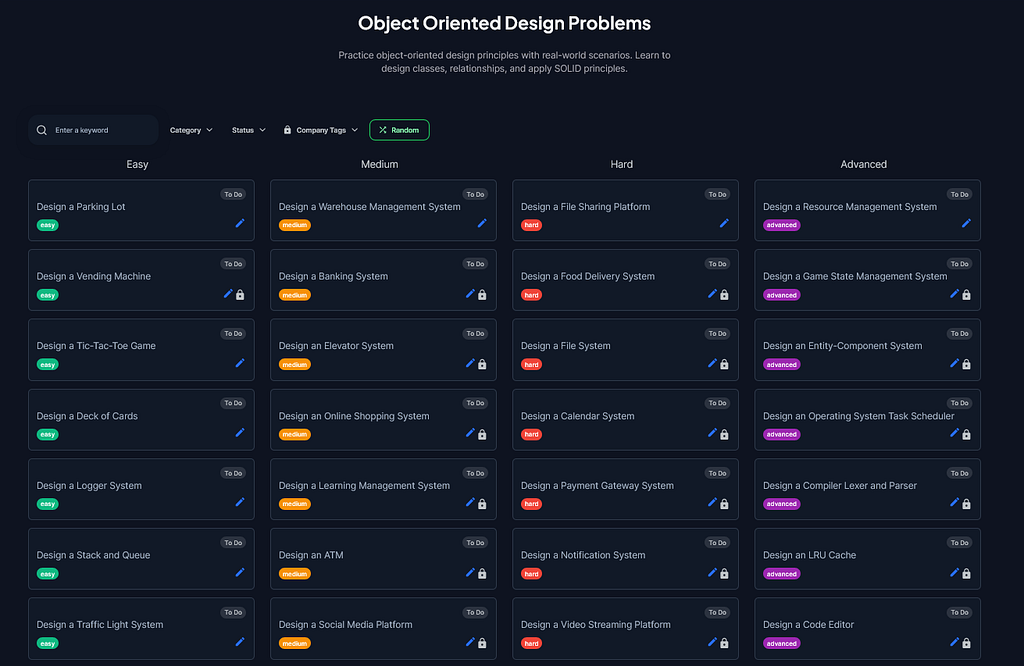
2. Object-Oriented Design (OOD / LLD) — The Often-Skipped Round
Most system design preparation focuses on HLD (high-level design). But senior interviews at Amazon, Google, and Meta also test LLD — your ability to design classes, relationships, design patterns, and SOLID principles at the code level.
Codemia’s OOD section covers the classic problems that come up in LLD interview rounds:
- Elevator system design
- Parking lot class hierarchy
- Vending machine design
- Design patterns in action
The same structured approach applies: you’re not just answering a question, you’re building a class diagram, defining relationships, justifying design pattern choices, and thinking through extensibility.
The AI feedback evaluates your OOP design against industry best practices.
For engineers who have strong system design skills but haven’t thought deeply about OOP design interview format, this section is a significant gap-filler.
It’s the same depth you’d get from Educative’s Grokking the Low Level Design Interview — but in the same platform as everything else.
Then there are also editorial solution for common problems like Parking Lot design. You can see all the OOP problems here
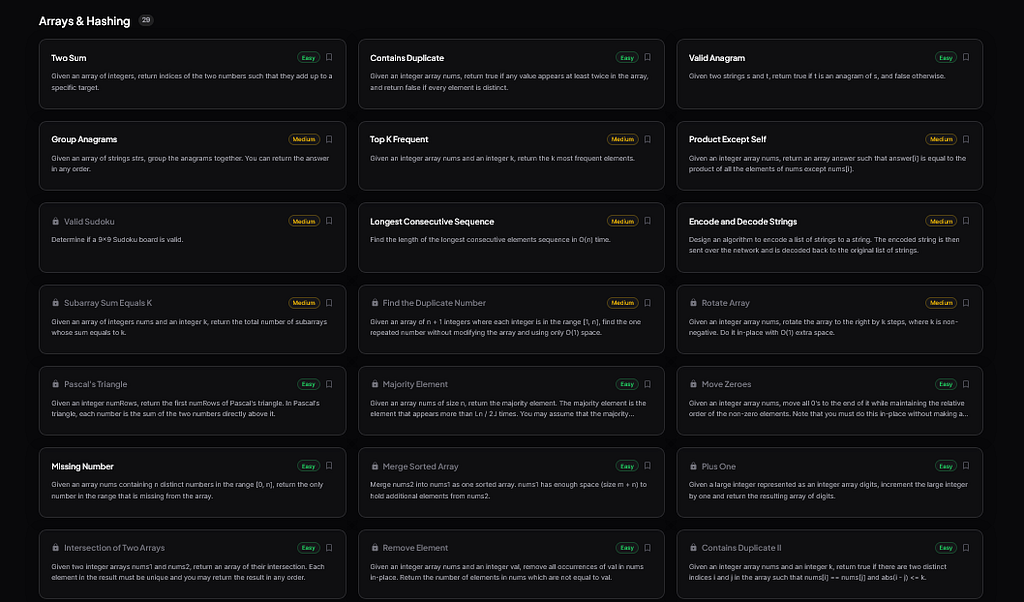
3. DSA (Data Structures & Algorithms) — 130+ Problems
Codemia’s DSA section adds 130+ algorithm and data structure problems to the platform, covering:
- Arrays and strings
- Trees and graphs
- Dynamic programming
- Sliding window, two pointers, BFS/DFS
- Sorting and searching
This isn’t trying to replace LeetCode’s 2,500-problem library. What it provides is a curated, quality-over-quantity selection of the problems that actually appear in FAANG interviews — organized by pattern, with AI feedback on your solutions.
For engineers who’ve already worked through Blind 75 or AlgoMonster’s pattern curriculum and want to continue practicing in the same environment as their system design prep, this is a genuinely useful addition. You don’t have to context-switch platforms mid-preparation.
You can see all 300+ DSA coding problem on Codemia.io here
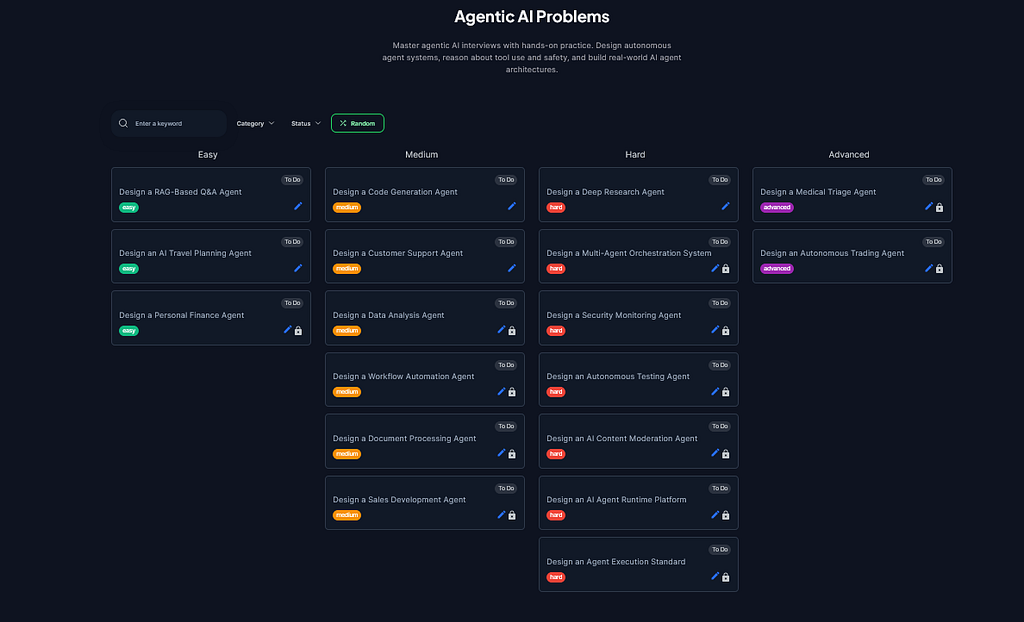
4. Agentic AI — Brand New for 2026 and Already Essential
This is the most forward-looking addition to Codemia’s platform — and the one that distinguishes it from every other technical interview prep resource I’ve used.
Codemia’s Agentic AI section covers the AI agent questions that are now appearing in engineering interviews at companies building LLM-powered products. This includes:
- Designing multi-agent systems
- LLM workflow architecture
- Agent memory and orchestration patterns
- Tool use and MCP integration
- Evaluation frameworks for AI agent reliability
The companion free course — Introduction to Agentic AI — provides the conceptual foundation before you tackle the practice problems. In 2026, this is genuinely cutting-edge content. No other interview prep platform I’ve found has built out agentic AI as a dedicated practice section.
For engineers interviewing at AI-first companies or teams building LLM products, this section alone justifies the subscription.
→ Explore Agentic AI on Codemia
5. Mock Interviews — Simulate Real Interview Pressure
The Mock Interview feature is what transforms Codemia from a learning resource into genuine interview preparation.
Reading about system design and actually performing system design in front of an interviewer are completely different experiences. The time pressure, the expectation to think out loud, the follow-up questions — none of that exists when you’re studying alone.
Mock interviews are the only way to practice that performance dimension.
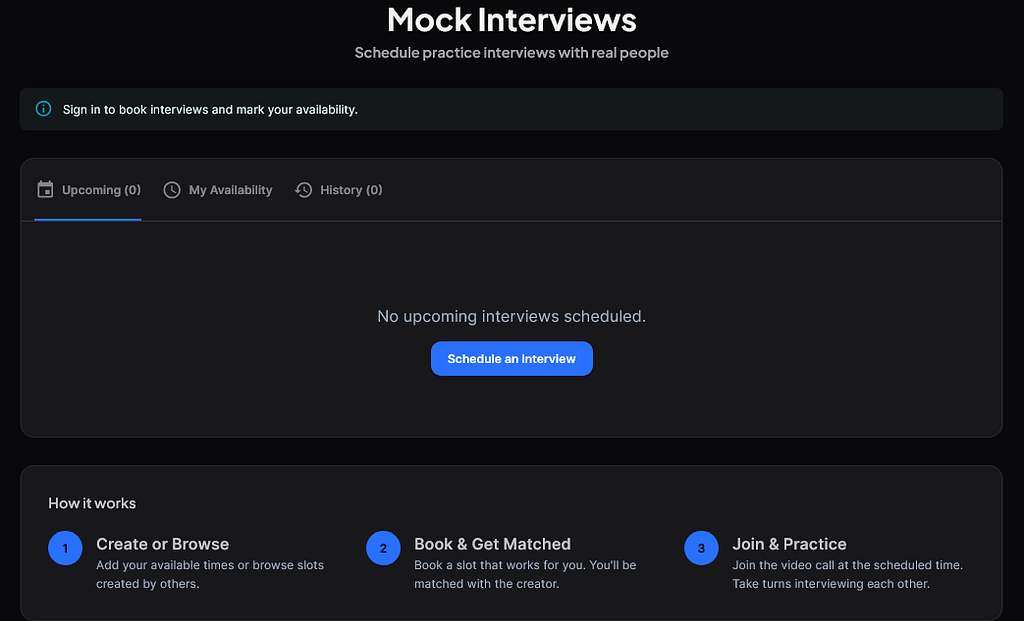
Codemia’s peer mock interview environment structures the session with:
- Time-boxed problem presentation
- Add your available times or browse slots created by others.
- Book a slot that works for you. You’ll be matched with the creator.
- Join the video call at the scheduled time. Take turns interviewing each other.
This won’t fully replace a proper mock interview with real FAANG interviewer or expert (platforms like Exponent still have an edge for that), but for engineers without easy access to qualified mock interview partners, it’s significantly better than practicing alone.
Here is the link to book your mock interviews with real people.
15 System Design Problems to Start With (Many Free)
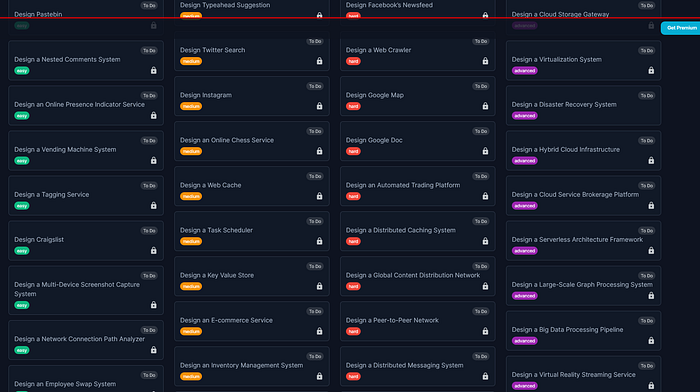
New to Codemia? Here’s a list of beginner-friendly problems to get started — many available without a subscription:
- Designing a Simple URL Shortening Service: A TinyURL Approach
- Design an Efficient Parking Lot System
- Design a Fitness Tracking App
- Design a Weather Reporting System
- Design Pastebin
- Design a Nested Comments System
- Design an Online Presence Indicator Service
- Design a Vending Machine System
- Design a Tagging Service
- Design Craigslist
- Design a Multi-Device Screenshot Capture System
- Design a Network Connection Path Analyzer
- Design an Employee Swap System
- Design a Conference Room Booking System
- Design a Video View Count System
→ See the Full Problem Library
Codemia vs. The Competition
Here is the detailed comparison of Codemia and other popular coding interview platforms like ByteByteGo, Design Guru, Exponent, Educative, Bugfree.ai, and Udemy.
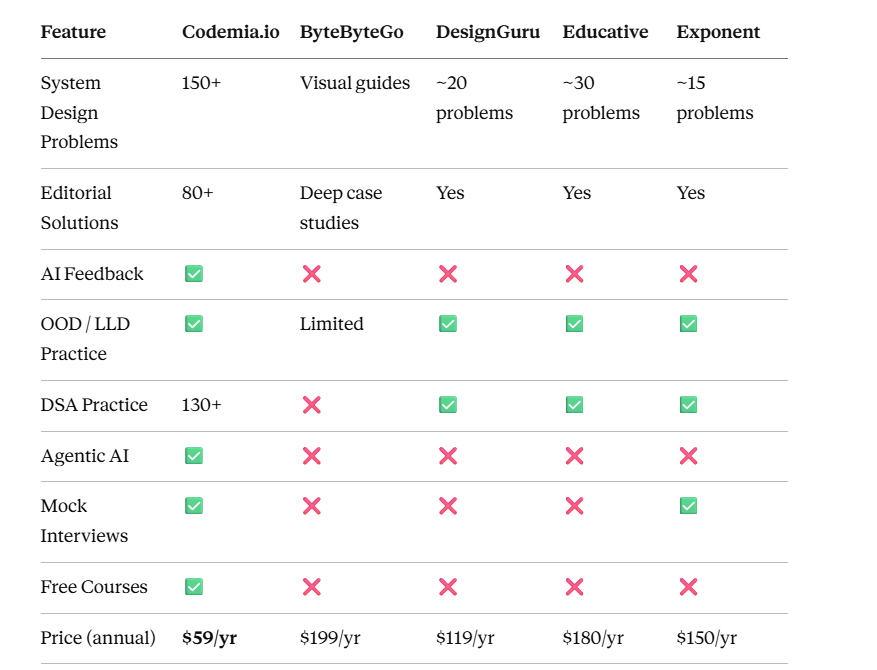
The comparison tells a clear story: Codemia covers more ground at a lower price point than any alternative, with the unique additions of AI feedback and Agentic AI that no other platform offers.
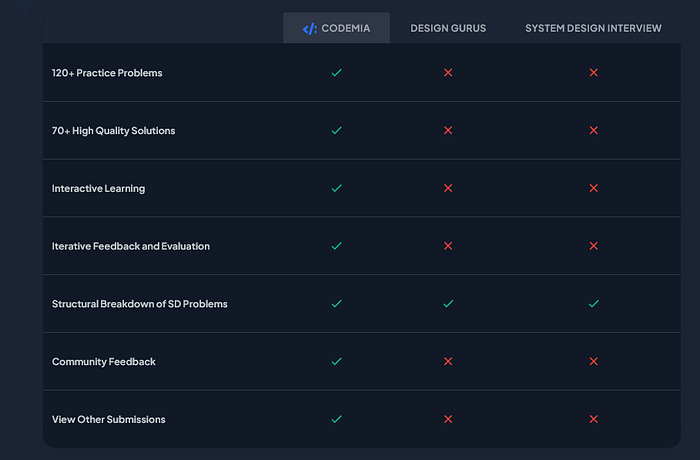
The one area where alternatives have an edge: conceptual depth. ByteByteGo’s visual case studies go deeper on the “why” behind architectural decisions than Codemia’s problem-first approach.
For developers who are new to system design and need the conceptual foundation built first, pairing Codemia with ByteByteGo’s content remains the most effective combination.
What Could Be Better?
I believe in honest reviews:
Pricing model for full access.
The free tier is meaningful — several problems and the fundamental courses are genuinely free. But AI feedback, editorial solutions, and the full problem bank require Premium at $59/year. This is reasonable (it’s not less than a Netflix subscription), but it’s worth knowing upfront.
No human mentorship.
AI feedback is surprisingly useful and available 24/7, but it can’t fully replace the nuance of a senior engineer explaining why your architectural choice is suboptimal. Platforms like Exponent still have the edge for genuine human mock interview feedback.
No deep conceptual video courses.
The free courses (System Design Fundamentals, Introduction to Agentic AI) are solid starting points, but Codemia isn’t trying to be ByteByteGo or a video lecture platform. It’s a practice-first environment. If you need deep conceptual teaching, supplement with ByteByteGo or a Udemy course.
User Feedback
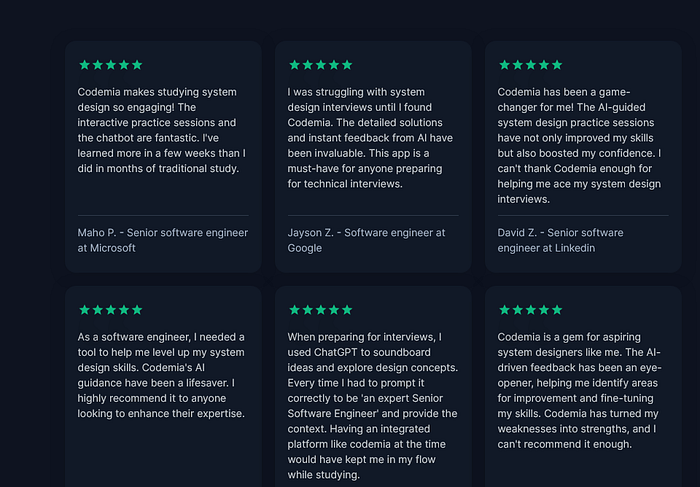
The community feedback is consistently positive — particularly around the AI feedback loop and the structured approach to problems. Engineers report that the habit of working through the 11-step framework and then receiving AI evaluation significantly improved both their solution quality and their confidence in interviews.
Is Codemia.io Worth It?
Yes — unambiguously for anyone preparing for senior-level tech interviews in 2026.
The value proposition is straightforward:
- 150+ system design problems with AI feedback and 80+ editorial solutions
- 130+ DSA problems for the coding round
- OOD section for the LLD round
- Agentic AI section for the emerging AI design round (unique on the market)
- Mock interviews for performance practice
- Free courses (System Design Fundamentals, Agentic AI Introduction)
- All for $59/year — currently 50% off
The structured 11-step problem-solving framework, the AI feedback loop, and the editorial solutions create a practice environment that’s genuinely more effective than passive reading. One successful senior engineering interview pays for years of Codemia subscription.
→ Join Codemia.io — $59/year (50% off)
Getting Started: The Recommended Approach
Week 1–2: Take the free System Design Fundamentals course to build your conceptual base. Watch the Codemia YouTube channel for visual walkthroughs — the Ticketmaster and Twitter videos are excellent free starting points.
Week 3–4: Start solving system design problems with the Tackling System Design Interview Problems course as your guide. Use the 11-step framework for every problem. Submit for AI feedback. Compare against editorial solutions.
Week 5–6: Add OOD and DSA practice alongside system design. Vary your problem types to build breadth. If you’re interviewing at AI-forward companies, start the Introduction to Agentic AI course and tackle Agentic AI problems.
Final 2 weeks: Mock interviews in timed, simulated conditions. Practice explaining your reasoning out loud. The goal isn’t to learn new content — it’s to convert everything you know into confident, structured performance.
Final Word
Codemia.io in 2026 is the most complete technical interview preparation platform available. It combines the active practice of LeetCode with system design, OOD, DSA, Agentic AI, and mock interviews — and does so with AI feedback and structured editorial solutions that accelerate the learning process.
The Agentic AI section is genuinely unique: no other prep platform has built this out, and it positions Codemia as the most forward-looking resource available for engineers targeting AI-adjacent roles in 2026.
At $59/year, the only real question is why you’d still be juggling five platforms.
→ Join Codemia.io and Start Practicing Today
P.S. — Start with the free System Design Fundamentals course and the Codemia YouTube channel before committing to a subscription. The free content alone will demonstrate the quality and structure that makes this platform worth it — and once you see how the AI feedback and editorial solutions work on a free problem, the $59/year decision becomes easy.

Codemia Review 2026: The All-in-One Platform for System Design, OOD, DSA & Agentic AI was originally published in Javarevisited on Medium, where people are continuing the conversation by highlighting and responding to this story.
This post first appeared on Read More