
You can also practice object oriented design online with real problems
There are certain skills in software engineering that never go out of fashion. Programming languages evolve. Frameworks come and go. Tools get replaced every few years.
But Object-Oriented Analysis and Design (OOAD) has been foundational to software development for over two decades and shows absolutely no sign of changing.
And here’s what’s interesting about 2026: the rise of AI coding tools like GitHub Copilot and Claude Code has actually increased the demand for engineers who understand OOAD deeply.
Companies aren’t just looking for people who can write code anymore — they can get code from an AI. They want developers who can think like architects, design scalable, maintainable systems, and communicate those designs clearly to both machines and humans.
That’s exactly why OOP design interviews at companies like Google, Amazon, and Meta are becoming more rigorous, not less.
When I started looking for resources to level up my OOP Design skills specifically for interviews, I discovered ByteByteGo — and it turned out to be exactly what I’d been looking for. Here’s an honest breakdown of why it works so well, where it has gaps, and how to use it most effectively.
🔥 Quick note: ByteByteGo is currently offering 50% off their Lifetime Plan — one of the rarest deals they’ve run. You can get lifetime access for $499 (normally $918+). For evergreen content you’ll reference throughout your career, this is exceptional value. Grab the 50% off deal here before it expires.
System Design · Coding · Behavioral · Machine Learning Interviews
Why OOP Design Still Matters — and Why It’s Being Tested More Rigorously?
Before getting into the platform, it’s worth understanding what OOP design interviews actually test and why they’ve become more important.
OOP design interviews typically ask things like:
- Design a Parking Lot
- Design a Coffee Machine
- Design a Hotel Booking System
- Design a Fitness Tracking App
These questions look like system design problems on the surface. But what interviewers are really evaluating is whether you can:
- Translate requirements into objects, classes, and relationships — the core of OOAD
- Apply SOLID principles — Single Responsibility, Open/Closed, Liskov Substitution, Interface Segregation, Dependency Inversion
- Choose the right design patterns — Strategy, Observer, Factory, Singleton, and others
- Draw class diagrams, sequence diagrams, and use case diagrams that communicate your design clearly
- Think about extensibility — how does your design handle future requirements without a rewrite?
Most developers understand OOP syntax. Far fewer understand how to design with objects at the level these interviews require. That gap is exactly what ByteByteGo’s OOP Design content closes.
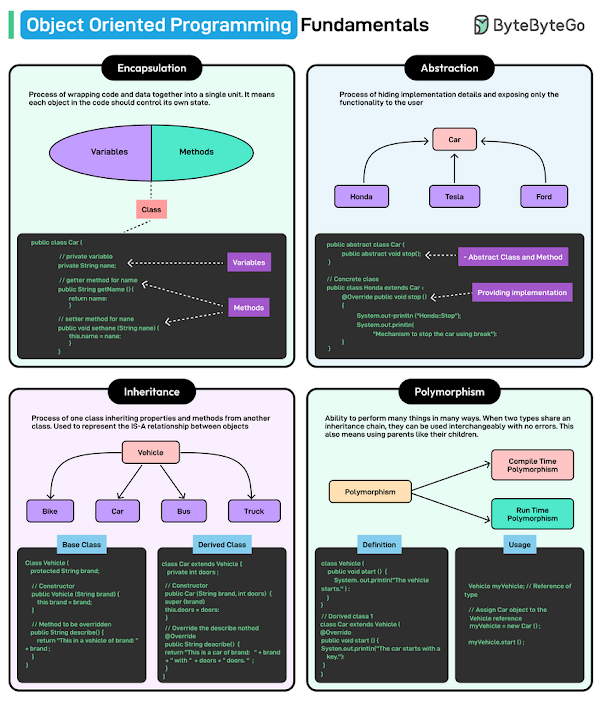
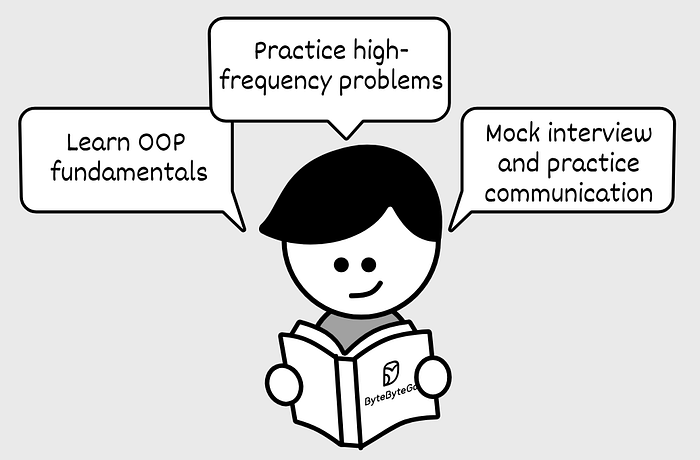
Here’s a glimpse of how ByteByteGo approaches OOAD fundamentals:
What Is ByteByteGo?
ByteByteGo was founded by Alex Xu — author of the bestselling System Design Interview book series — and has become one of the most trusted platforms for system design preparation.
Unlike general-purpose platforms like Udemy or Coursera, ByteByteGo focuses on a narrow but deep niche: system design, software architecture, and technical interview preparation, with a distinctly visual-first approach.
What ByteByteGo is known for:
- Visual-first content — rich animations, diagrams, and infographics that explain how real-world systems are designed in a way that actually sticks
- Architecture-driven depth — scalability, fault tolerance, load balancing, distributed systems
- Curated and current — regularly updated visual guides, newsletters, and case studies of large-scale real systems
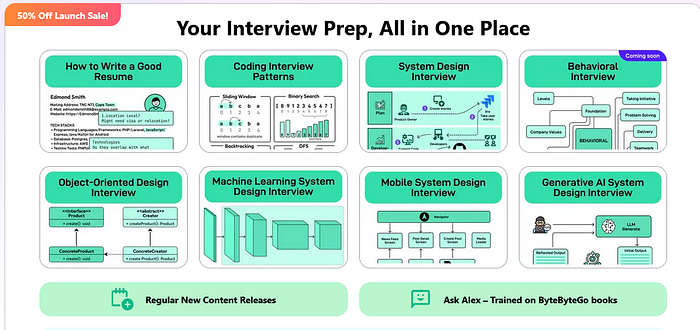
More recently, ByteByteGo expanded significantly beyond system design to cover OOP Design, Machine Learning System Design, Generative AI Design, and Coding Interview Patterns — making it a much more complete technical interview preparation package than it used to be.
Alex Xu has also integrated the full content of his book Object-Oriented Design Interview: An Insider’s Guide directly into the platform, which is a significant addition:
The OOP Design Content: What Actually Makes ByteByteGo Excellent Here
Now, let’s see some example of OOP Design problems and learning material which makes this resource awesome:
The Parking Lot Design — A Free Lesson Worth Checking Immediately
The best way to understand what ByteByteGo’s OOP design content delivers is to look at a specific example.
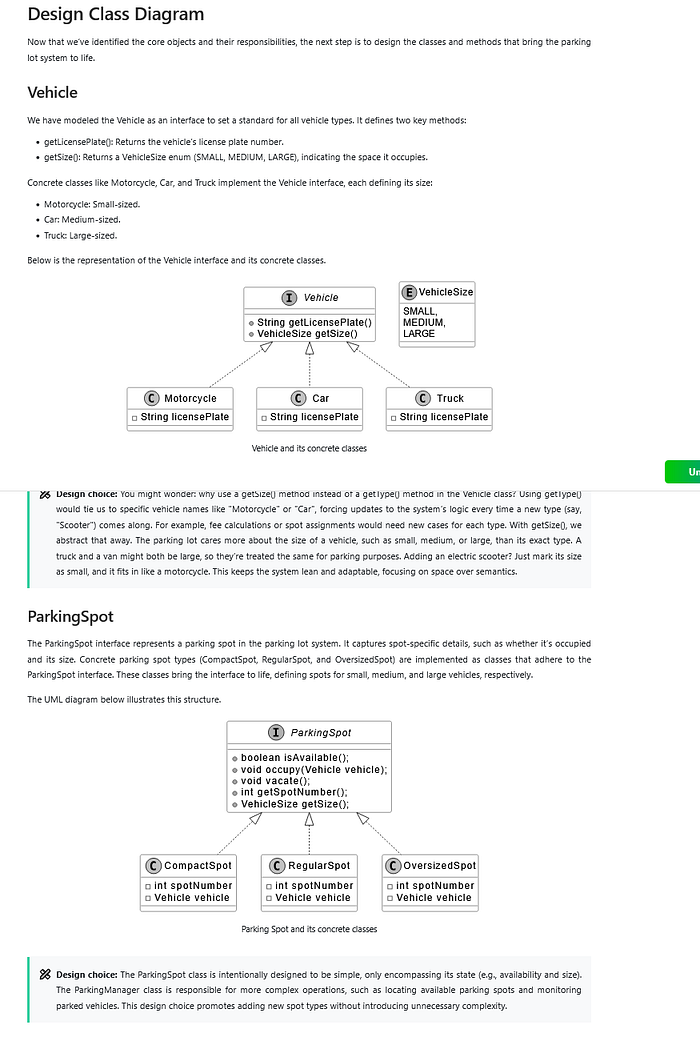
Their Parking Lot Design lesson is free, and it’s the most detailed and structured walkthrough of this classic OOP design problem I’ve found anywhere online.
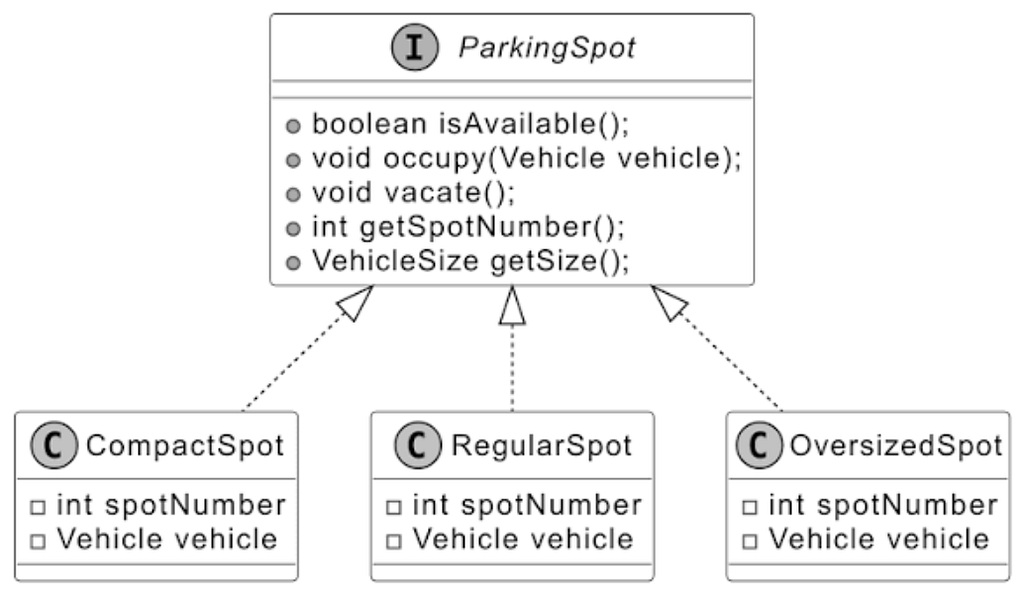
The lesson doesn’t just give you an answer. It walks through identifying core objects (ParkingLot, Vehicle, Ticket, ParkingSpot), defining their relationships, designing class hierarchies, drawing UML diagrams, and explaining every design choice along the way.
The visual quality is outstanding, and the reasoning sections — why this design, not that one — are what give you insight that transfers to new problems.
→ Try the free Parking Lot Design lesson
System Design · Coding · Behavioral · Machine Learning Interviews
Case Study Approach to OOAD
ByteByteGo teaches OOP design the way it’s actually used in real engineering — through case studies of real systems.
When they explain systems like Uber, Netflix, or WhatsApp, they first break down requirements (the analysis phase) and then map those requirements into interacting components and classes (the design phase).
This perfectly mirrors the OOAD process that interviewers are testing.
Design Patterns in Context
One of the biggest gaps in most OOP design education is that design patterns get taught in isolation — you learn what the Factory pattern is, but not when to use it or why it’s the right choice in a specific situation.
ByteByteGo shows patterns being applied to real design problems, which is how you develop the judgment to choose the right pattern in an interview.
Visual Diagrams That Make OOAD Stick
Traditional OOAD resources — textbooks, lecture slides, blog posts — tend to be dense and dry. Class diagrams, sequence diagrams, and use case diagrams are hard to follow when presented as static text.
ByteByteGo’s motion diagrams and visual storytelling turn these into something genuinely intuitive. After reading a ByteByteGo lesson on a design problem, the structure stays in your head in a way that wall-of-text explanations don’t.
From Low-Level to High-Level
ByteByteGo uniquely bridges low-level OOP design (designing a ParkingLot class hierarchy) with high-level architecture (handling reservations at scale across multiple regions).
Most resources teach these as completely separate topics. ByteByteGo’s approach shows how good OOP design at the class level creates the foundation for scalable systems at the architecture level — a connection that’s genuinely valuable for senior-level interviews.
Where ByteByteGo Has Gaps?
I believe in honest reviews, so here’s where the platform falls short for OOP design specifically:
Not ideal for complete beginners.
ByteByteGo assumes some familiarity with system design concepts. If you’ve never designed a class hierarchy or drawn a UML diagram before, you may feel lost without additional foundational resources.
In that case, start with a Udemy course like Low-Level System Design, Design Patterns & SOLID Principles before coming to ByteByteGo.
Low Level System Design, Design Patterns & SOLID Principles
No coding playground.
Platforms like Educative.io offer interactive coding environments where you can implement OOP design patterns directly in the browser. ByteByteGo is visual and conceptual, not hands-on coding. If you need coding practice alongside the theory, you’ll need to supplement.
Subscription model.
Unlike Udemy where you buy once and own forever, ByteByteGo is subscription-based. This makes the Lifetime Plan option (currently 50% off) significantly more attractive for long-term use — for a topic this evergreen, you’ll be returning to these resources for years.
System Design · Coding · Behavioral · Machine Learning Interviews
The Complete OOP Design Learning Stack
Based on my experience, here’s the combination that works best for serious OOP design interview preparation:
Tier 1: ByteByteGo (Visual Depth and Interview Context)
ByteByteGo for the visual conceptual foundation, design pattern application, and worked examples of classic OOP design problems. Start here.
Tier 2: Hands-On Practice (Udemy)
Pair ByteByteGo with practical coding courses:
- Low-Level System Design, Design Patterns & SOLID Principles — the best Udemy course for hands-on LLD and design pattern practice
- Object Oriented Programming and Design Bootcamp (OOP) — for stronger OOP fundamentals alongside design
Tier 3: Interactive Coding Practice (Educative.io)
Grokking the Low Level Design Interview Using OOD Principles on Educative — text-based, interactive, and coding-focused, great for solidifying what ByteByteGo teaches conceptually.
Tier 4: Books for Deep Understanding
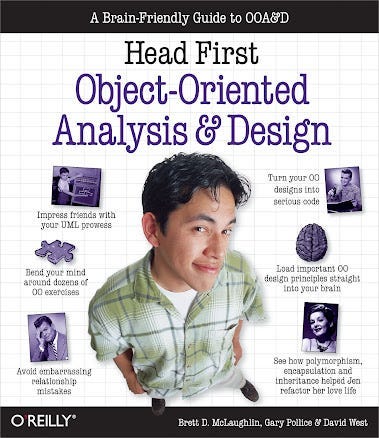
- Head First Object-Oriented Analysis & Design — the most beginner-friendly OOP design book available, excellent for building foundations before tackling interview-level problems:
- Object-Oriented Design Interview: An Insider’s Guide — Alex Xu’s dedicated book on OOP design interviews, now also available directly in the ByteByteGo platform
Who Should Join ByteByteGo for OOP Design?
Here are the folks who can join ByteByteGo to master object oriented analysis and design:
- Intermediate engineers
who already know basic OOP syntax and want to see how OOAD principles apply to real, large-scale systems. ByteByteGo’s framework for identifying core objects, building class hierarchies, and producing clean low-level designs translates directly to interview performance.
2. Interview candidates
preparing for OOP design or system design rounds at FAANG and top-tier companies. The classic OOP design problems ByteByteGo covers — Parking Lot, Vending Machine, Hotel Booking System, Tic-Tac-Toe, Coffee Machine — are exactly the problems these companies ask.
3. Engineers stepping into tech lead and architect roles
who need to think confidently about both class-level design and system-level architecture simultaneously. ByteByteGo uniquely bridges these two levels in a way most resources don’t.
The 50% Off Lifetime Plan — Should You Get It?
ByteByteGo’s current 50% off Lifetime Plan at $499 is a genuinely exceptional deal for anyone serious about technical interview preparation. Here’s why:
OOP design, system design, and software architecture are not skills you learn once and put away. They’re skills you return to repeatedly throughout your career — when preparing for a new job, when joining a new team, when working through a difficult architectural decision.
A lifetime plan that lets you access and re-access this material whenever you need it is worth significantly more than a subscription you might cancel.
I’ve been using ByteByteGo for years and I’ve seen this level of discount only once before, on a Black Friday deal. This is genuinely rare.
→ Join ByteByteGo Lifetime or Annual Plan at 50% Off
Final Verdict
Is ByteByteGo a good place to learn OOP Design for tech interviews in 2026? Yes — especially since Alex Xu integrated the full content of his OOP Design Interview book into the platform.
The visual quality is unmatched. The interview alignment is excellent. The case study approach — showing OOP design principles applied to real, recognizable systems — builds the kind of intuition that performs well under interview pressure, not just in preparation.
The gaps are real: it’s not ideal for complete beginners, and there’s no coding playground. But those gaps are easy to fill with a Udemy or Educative companion course.
For engineers who already have foundational OOP knowledge and want to level up to interview-ready OOP design skills — ByteByteGo is the best single resource available.
→ Start with the free Parking Lot Design lesson — it’s the best free demonstration of what ByteByteGo’s OOP content delivers.
→ Join ByteByteGo at 50% Off — the Lifetime Plan at $499 is the best value option while this discount lasts.
Other system design and OOP design resources you may like:
- I Found the Perfect Combo to Prepare for System Design Interviews in 2026
- Is ByteByteGo a Good Place to Learn Machine Learning System Design?
- Is ByteByteGo a Good Place for Coding Interview Preparation?
- ByteByteGo 50% Off — Should You Join?
- Is Codemia.io a Good Place to Learn Object-Oriented Design?
- Is DesignGuru’s System Design Course Worth It?
- How to Prepare for System Design Interviews in 2026
- 3 Best Mock Interview Platforms for System Design
P.S. — If you want to try ByteByteGo before committing, start with the free Parking Lot Design lesson. It’s the clearest demonstration of what makes their OOP Design content genuinely excellent — and it costs nothing. Then, if you decide to join, grab the 50% Lifetime Plan while it’s available.
System Design · Coding · Behavioral · Machine Learning Interviews

I Found the Perfect Resource to Learn OOP Design for Tech Interviews and It’s Awesome was originally published in Javarevisited on Medium, where people are continuing the conversation by highlighting and responding to this story.
This post first appeared on Read More