
Building my first RAG application was surprisingly easy.
In less than a week, I had a chatbot that could:
- Read PDFs
- Generate embeddings
- Store vectors
- Retrieve documents
- Answer questions using an LLM
From a demo perspective, it looked impressive.
From a production perspective, it was nowhere close.
The answers were inconsistent.
Latency increased as documents grew.
Some responses referenced outdated information.
Security concerns started appearing almost immediately.
And perhaps most importantly, I had no reliable way of knowing whether the answers were actually correct.
That’s when I realized something important:
Building a RAG demo is an AI problem.
Building a production RAG platform is a systems engineering problem.
Most tutorials stop once the chatbot starts answering questions.
Unfortunately, that’s exactly where the difficult engineering work begins.
The Demo Architecture Everyone Builds
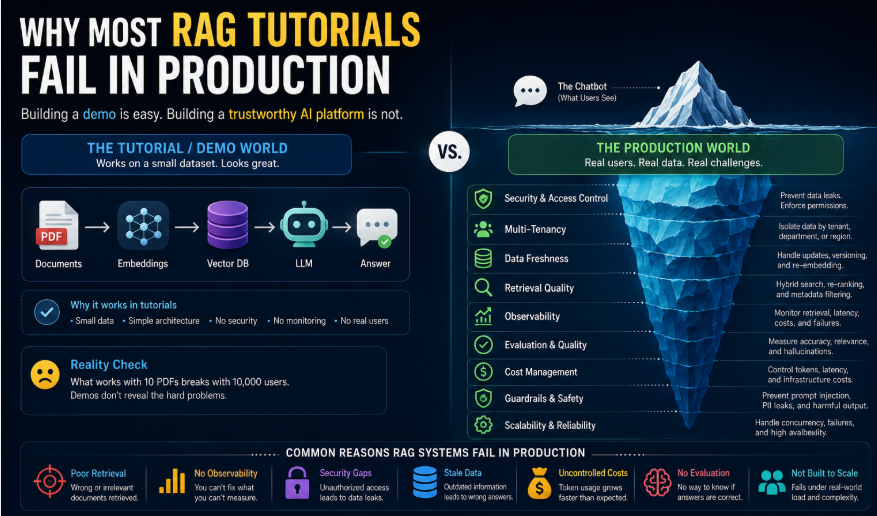
Most tutorials follow this architecture:
Documents
      ↓
Embeddings
      ↓
Vector Database
      ↓
     LLM
      ↓
Response
This architecture is perfect for learning concepts.
But production systems introduce entirely different challenges:
- Security
- Scale
- Observability
- Data freshness
- Multi-tenancy
- Evaluation
- Governance
- Cost optimization
None of these problems appear in simple tutorials.
Yet these are precisely the problems that determine whether a system succeeds in production.
Problem #1: Retrieval Quality Degrades as Data Grows
A demo typically contains:
- 10 PDFs
- 100 chunks
- Limited overlap
Everything works beautifully.
Then production arrives.
Now you have:
- Millions of chunks
- Thousands of documents
- Multiple business domains
Suddenly retrieval becomes significantly harder.
Questions start retrieving:
- partially relevant documents
- duplicate information
- outdated information
- contradictory information
The retrieval pipeline that worked perfectly during development begins to fail.
The challenge was never retrieval.
The challenge was retrieval at scale.
Problem #2: Security Is Much Harder Than It Looks
One of the first concerns that emerged in enterprise environments was:
What happens if retrieval returns information the user should never see?
Consider a multi-tenant banking platform.
Two users ask the same question.
Their permissions are completely different.
Without proper filtering:
User Query
      ↓
Vector Search
      ↓
Unauthorized Documents
      ↓
     LLM
      ↓
Data Leakage
The LLM isn’t the security boundary.
The retrieval layer is.
This fundamentally changes system design.
Every retrieval operation must become security-aware.
Production systems require:
- Metadata filtering
- Tenant isolation
- Row-level security
- Document access policies
Most tutorials never discuss this.
Yet this is often one of the first concerns raised by security teams.
Problem #3: Freshness Becomes a Serious Challenge
Tutorial datasets rarely change.
Enterprise knowledge does.
Policies evolve.
Documents are updated.
Procedures change.
New regulations appear.
A RAG system built yesterday may already contain outdated information.
This introduces difficult questions:
- How frequently should embeddings be regenerated?
- How do we handle document versioning?
- Should old embeddings be deleted?
- How do we invalidate stale knowledge?
Knowledge freshness quickly becomes an operational problem rather than an AI problem.
Problem #4: Nobody Talks About Observability
Traditional systems expose metrics like:
- CPU
- Memory
- Response times
RAG systems require entirely different metrics.
For example:
Retrieval Metrics
- Recall
- Precision
- Ranking Quality
AI Metrics
- Token Usage
- Context Size
- Hallucination Rate
Business Metrics
- User Feedback
- Citation Accuracy
- Answer Acceptance Rate
One of the biggest mistakes I made early on was assuming:
If the application works, it must be working correctly.
That assumption quickly failed.
Without observability, debugging AI systems becomes nearly impossible.
Problem #5: Hallucinations Are Usually Retrieval Problems
Initially, I blamed the model whenever incorrect answers appeared.
Over time, I started logging:
- User Question
- Retrieved Chunks
- Final Prompt
- Generated Response
The pattern became obvious.
Most hallucinations originated much earlier.
Examples:
- Wrong chunk retrieved
- Relevant document ranked too low
- Missing context
- Outdated document
The model was simply attempting to answer using incomplete information.
This realization completely changed how I debugged RAG systems.
Problem #6: Cost Increases Much Faster Than Expected
Small prototypes hide costs.
Production systems expose them.
Larger document collections introduce:
- More embeddings
- Larger indexes
- More retrieval operations
- Larger prompts
- More token consumption
A seemingly harmless decision such as:
Retrieve top 20 documents
can dramatically increase costs.
Production systems require careful balancing between:
- Recall
- Precision
- Latency
- Cost
This becomes an optimization problem.
Problem #7: Evaluation Is Surprisingly Difficult
One of the most difficult questions in production AI is:
How do we know whether the answer is good?
Traditional applications are deterministic.
AI systems are not.
Answers can be:
- Correct
- Partially correct
- Technically correct but misleading
- Contextually incomplete
Evaluating AI quality is far more difficult than evaluating traditional software.
Eventually, I realized that evaluation itself becomes a product capability.
Successful systems invest heavily in:
- Human feedback loops
- Automated evaluations
- Benchmark datasets
- Regression testing
Without evaluation, improvements become impossible to measure.
Problem #8: Context Windows Do Not Solve Everything
Larger context windows are incredibly useful.
But they don’t eliminate the need for retrieval.
Many developers assume:
If models can handle millions of tokens, why use RAG?
In practice:
Large contexts introduce:
- Higher costs
- Increased latency
- Attention dilution
- Security concerns
Providing more information does not necessarily produce better answers.
Providing the right information usually does.
Retrieval remains valuable because it improves signal quality.
Problem #9: Multi-Tenancy Changes Everything
Most tutorials assume:
One Knowledge Base
One User
Enterprise systems rarely work this way.
Instead, you may have:
- Departments
- Regions
- Customers
- Products
- Regulatory boundaries
The retrieval pipeline becomes significantly more complicated.
Now every question may require:
- Metadata filtering
- Permission checks
- Source prioritization
- Security validation
These concerns rarely appear in tutorials.
Yet they dominate production architectures.
Problem #10: RAG Is Not a Feature. It’s a Platform.
This was perhaps my biggest realization.
Initially, I thought I was building:
A chatbot.
Eventually, I realized I was building:
- Document ingestion pipelines
- Embedding services
- Retrieval systems
- Evaluation frameworks
- Security layers
- Monitoring systems
- Governance workflows
The chatbot was only the visible part.
The real engineering complexity existed underneath.
The Architecture I Would Build Today
If I were designing a production RAG platform today, it would look something like this:
Document Sources
       ↓
Ingestion Pipeline
       ↓
Chunking
       ↓
Embedding Service
       ↓
Vector Database
       ↓
Hybrid Retrieval
       ↓
Re-Ranking
       ↓
Security Filters
       ↓
Prompt Assembly
       ↓
      LLM
       ↓
Evaluation Layer
       ↓
Observability Platform
Notice something important.
The model is only one component.
Everything around the model determines whether the system is reliable.
The Bigger Lesson
Most tutorials optimize for learning.
Production systems optimize for reliability.
Those are very different goals.
Tutorials teach you how to:
- Generate embeddings
- Store vectors
- Call an LLM
Production systems require you to answer entirely different questions:
- Can users trust the answer?
- Is the data secure?
- Can the system scale?
- Can we evaluate quality?
- Can we monitor failures?
- Can we explain why an answer was generated?
These are architecture questions.
Not AI questions.
Final Thoughts
I still believe RAG is one of the most practical applications of generative AI.
But after building multiple prototypes, my perspective has changed considerably.
The difficult part isn’t making the chatbot answer questions.
The difficult part is building a system that people can actually trust.
That’s why most RAG tutorials fail in production.
They focus on generation.
Production systems require:
- information architecture
- retrieval engineering
- security engineering
- observability
- governance
- evaluation
In other words:
The real challenge of RAG isn’t building the chatbot.
It’s building everything around it.

Why Most RAG Tutorials Fail in Production was originally published in Javarevisited on Medium, where people are continuing the conversation by highlighting and responding to this story.
This post first appeared on Read More