
Running workshops isn’t just about a series of activities you guide a group through — it’s about driving strategic outcomes. To help set you up for success, this article expands on why you need to stop thinking like a follower and start thinking like a strategic designer and offers three examples of workshops I use in my work that drive a lot of value.
Why many product management workshops fail
Let’s imagine this. You’re dealing with stakeholders that are pulling you in different directions on a major product initiative. Marketing wants feature A, engineering is questioning the timeline, and leadership is second-guessing the approach. You desperately need alignment.
So you plan a design sprint-style workshop thinking, “Perfect! It’s a structured process, so we’ll walk out aligned.” You book the room, send invites, and prepare your agenda.
But instead of ideating solutions, people spend the entire time debating whether you’re solving the right problem. By lunch, you realize the design sprint format was never going to work because your real problem wasn’t generating ideas — it was getting everyone on the same page about what you were trying to achieve in the first place.
The problem? You followed a formula without really thinking about the problem you had and the outcome you wanted out of the session.
The moment you rephrase your goal from a method to an outcome, things start to fall into place. You start thinking about the stakeholders, the group dynamics, how you can maximize their time and not make them feel like they’re wasting hours just for the sake of following a workshop recipe.
Turns out you shouldn’t think that you’re just running a workshop. You’re actually helping your group achieve an outcome. And outcomes depend entirely on context, people, and timing.
Think of planning a workshop like designing a user journey
Instead of picking activities first, think about your workshop like designing a user journey. You’re taking participants from their current state (confusion, misalignment, unclear priorities) to your desired outcome (decisions made, concepts generated, buy-in achieved). Here’s six key steps to follow:
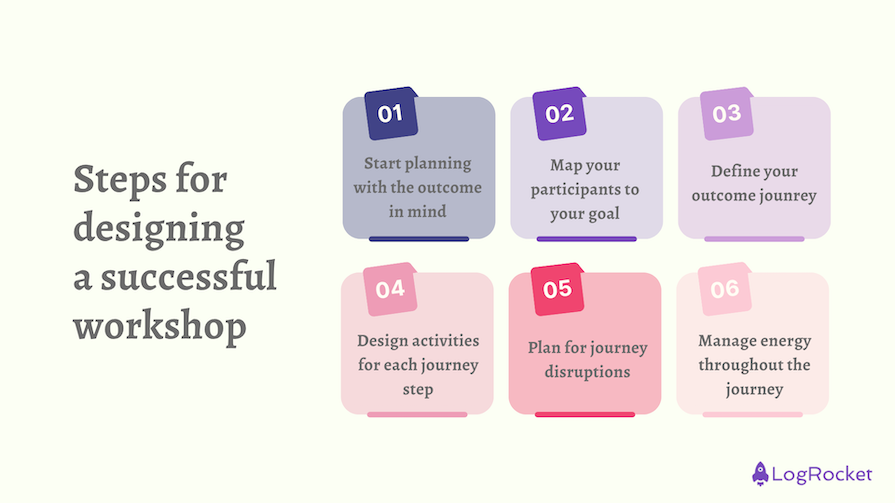
1. Start planning with the outcome in mind (not your activities)
We start by asking ourselves: “What exactly do I need to walk out of this room with?”
- New concepts to validate with users?
- A prioritized roadmap everyone commits to?
- Stakeholder buy-in for a major change?
Your outcome determines everything else.
Don’t start with “Let’s do some brainstorming.” Start with “We need three validated concepts to test next quarter.”
2. Map your participants to your goal
Now that you’ve established your outcome, who has the expertise you need? Who has the authority to make decisions? Who’ll need to implement whatever you decide?
In my experience, stakeholders fall into one of these four categories:
- Experts — People with deep knowledge of the problem
- Deciders — People with authority to commit resources
- Implementers — People who will do the actual work
- Stakeholders — People affected by the outcome
You need different combinations for different goals.
3. Define your outcome journey
Now that you have your outcome in mind, you need to define the steps you need your participants to take to achieve your goals. Remember, you’re not planning activities now, you’re thinking about the WHAT, not the HOW.
Start by asking: What journey do people need to go through to reach your outcome?
For example, if you need stakeholder alignment on priorities:
- Current state — Everyone has different assumptions about what matters
- Step one — Get shared understanding of criteria
- Step two — Individual assessment without influence
- Step three — Surface and discuss differences
- Step four — Reach consensus and commit
- Final state — Aligned priorities with clear ownership
Irrespective of the journey, each workshop should start and end the same:
- Step zero — Bring everyone in the room, mentally and physically
- Final step — Get feedback
4. Design activities for each journey step
Next, you pick activities for each step — but they should be specifically chosen to move people through your mapped journey.
The key is matching the activity type to what people need to do mentally and emotionally at that specific point in the journey:
| Goal | Activities you can use |
| Alignment | Use individual work (post-up) first, then group discussion. Silent read of background materials, followed by Q&A to surface assumptions |
| Creative | Prime thinking with examples and mindsetters, then generate individually:
|
| Decision/prioritization steps |
|
| Commitment |
|
| Consensus building |
|
5. Plan for journey disruptions (Always have plan B)
People won’t always follow your planned journey. Energy will drop. Someone will derail the conversation. A breakthrough insight will emerge.
Go mentally through your journey and for each activity map what could go wrong, then think of alternative approaches. You can find a list of potential disruptions in the table below:
| Disruption Type | Disruption | Alternative |
| Time | CEO shows up 30 minutes late | Have 20 minute versions for each exercise |
| Meeting runs over | Prepare “parking lot for next steps” wrap-up format | |
| People arrive scattered over 15 minutes | Design opening activity that works for latecomers | |
| Energy | Energy drops after lunch | Switch to movement-based activities or small group work |
| People seem checked out | Take unexpected break or pivot to interactive exercise | |
| Too much talking, not enough doing | Force silent individual work before any discussion | |
| Content | Someone derails with off-topic concerns | Use parking lot, acknowledge concern, promise follow-up |
| Group gets stuck debating one point | Set timer, agree to disagree or break into smaller groups | |
| People challenge the workshop premise | Address directly, adjust scope, or pivot objectives | |
| Personality | Someone dominates discussion | Use structured turn-taking or silent brainstorming |
| Quiet people aren’t participating | Create small groups breakouts or written input methods | |
| Skeptic questions everything | Give them specific role (devil’s advocated) or offline conversation | |
| Unexpected insights | Breakthrough idea emerges | Extend time for that discussion, capture fully before moving on |
| Major assumption gets challenged | Pause to address, may need to restart with new framing | |
| Technical | Miro crashes / tech fails | Have physical backup (sticky notes, flip charts) |
| Remote participants can’t engage | Prepare alternative participation methods |
6. Manage energy throughout the journey
Like any user experience, people have attention limits and emotional capacity. Design your journey with energy management in mind:
- Switch between individual and group work every 15-20 minutes
- Plan breaks based on cognitive load, not just time
- Use icebreakers that actually prepare minds for the journey ahead (no trust falls with VPs)
- End each step with clear progress indicators so people see movement toward the outcome
The key difference? You’re not running a workshop — you’re guiding people through a transformation journey that ends with your desired outcome.
Essential preparation steps that most people skip
I firmly believe that the golden rule of spending mindful, focused time prepping for a workshop is even more important than the workshop itself. In some cases it may take almost the same time to prep as the length of your workshop, and here’s why.
While it may be tempting to dive straight into workshop design, there’s critical prep work that separates successful facilitators from formula followers.
Research your participants
Before you design a single activity, understand who’s coming. What are their priorities? What’s their expertise level? Where might they resist?
From my experience, I spend time on LinkedIn, check recent project updates, and sometimes do quick informal chats. Technical stakeholders need different framing than business stakeholders. A marketing director approaches prioritization differently than an engineering manager.
Create context-specific icebreakers
Generic icebreakers kill workshops before they start. “Two truths and a lie” doesn’t prepare people to think about product strategy.
You can use AI to generate custom icebreakers that actually relate to your workshop goal and audience context, rather than relying on generic team-building exercises.
Set Up pre-work (Seriously, do this)
For decision-making workshops, everyone needs the same baseline understanding before you start. Send background materials 48 hours ahead. Include relevant data, case studies, or context documents.
Don’t make people learn about the problem during the workshop. Use workshop time for thinking and deciding, not information transfer.
Two strategic ways PMs can use workshops
From my experience, there are two strategic ways product managers should be thinking about workshops — not as generic “sticky note factories” but as specific tools for different outcomes:
- Decision-making accelerators when you need stakeholder consensus fast
- Change management tools when you need buy-in for major shifts
So let’s look at how to approach each one.
Decision-making to reach consensus in record time
These workshops help with feature prioritization, resource allocation, strategic trade-offs where you need multiple stakeholder perspectives but can’t debate forever. You have options, you have stakeholders with different priorities.
The challenge isn’t generating more ideas — it’s getting aligned on what to do next. You’re designing for decision-making, not discussion.
Here’s what to consider:
- Align on criteria before evaluating anything — What factors matter? How will you weigh them? Use frameworks like impact versus effort, RICE scoring, or MoSCoW based on your context
- Individual assessment first — Everyone scores options using your agreed framework before any group discussion. No talking, no influencing
- Surface and resolve differences — Look at where people aligned and diverged. Those differences often surface important considerations you missed
- Document everything — Decisions, rationale, and dissenting views. Don’t just override disagreements
What you walk out with:
A prioritized list with clear ownership, timeline commitments, and documented rationale that everyone understands and can commit to implementing.
Change management that gets people on board
Use this for major product pivots, process changes, organizational transformations where you need genuine buy-in, not just compliance. When you’re about to change how things work or are about to embark on a change journey.
The challenge isn’t convincing people it’s a good idea — it’s getting them to actively contribute to making it successful. You’re designing for ownership, not just acceptance.
Here’s what to consider:
- Build the vision together — Instead of presenting your vision of the future, create it collaboratively. People support what they help create
- Let people work through their concerns — Don’t skip or minimize impact discussions. Use structured exploration of how changes affect people personally
- Get specific contributions — Everyone identifies how they’ll contribute to success — not just “I’ll adapt” but concrete commitments and actions
- Create feedback loops — Agree on progress measures and check-in points so people can see their contributions working
What you walk out with:
Shared understanding of the change vision, individual commitment levels, and a concrete action plan with owners.
But here’s the critical part — you have to follow through. Check in regularly, celebrate early wins, and address obstacles as they emerge.
What happens after (What most people ignore)
So you’ve run a great workshop. You’ve energized people, made decisions, and captured concepts. Now what?
This is where most workshops fail. Not in the room, but in the follow-through.
Immediate follow-up (Within 48 hours)
Document everything. Not just the final decisions, but the reasoning behind them. Include photos of boards, key quotes, and dissenting views.
Send a comprehensive summary to all participants. Clarify next steps with specific owners and deadlines.
Address any important items from your parking lot. These often contain the seeds of future problems if ignored.
Processing different workshop types
For decision workshops, document the decision rationale and track implementation. Monitor for resistance and address it quickly.
With change management workshops, track commitment levels over time. Identify change champions and support them. Celebrate early wins publicly.
Measuring success
How do you know if your workshop actually worked?
Here are three measurement timeframes from my experience:
- Immediate metrics — Participant satisfaction, clear next steps assigned, maintained energy throughout
- 30-day metrics — Implementation rate of decisions, quality of follow-up work, improved stakeholder relationships
- 90-day metrics — Business impact of outcomes, process improvements implemented, increased collaboration
Don’t just measure whether people liked the workshop. Measure whether it achieved your strategic outcome.
Stop following formulas, start designing outcomes
I have a challenge for you: Next time you need to run a workshop, don’t start by looking for templates.
Start by asking yourself:
- What specific outcome do I need?
- What journey do people need to go through to get there?
- Who needs to be involved at each step?
- How will I know if we succeeded?
Then, design your approach around those answers.
Yes, this takes more work than copy-pasting a template. But it’s the difference between running activities and achieving outcomes.
The best PMs don’t just facilitate workshops — they design transformation journeys that move their product and organization forward.
Featured image source: IconScout
The post A guide to designing successful product management workshops appeared first on LogRocket Blog.
This post first appeared on Read More