

How to quickly estimate the revenue impact of new product ideas
Product managers spend a lot of time validating problems, checking if solutions make sense, and figuring out whether anyone actually needs the thing we want to build. But when it comes to revenue, we often skip the hard questions. That ultimately creates problems because most products still need to earn money in order to survive.
The good news is you don’t need a complex model or a giant spreadsheet to get a sense of whether an idea has financial legs. A simple five-minute exercise can give you enough clarity to decide which ideas are worth exploring and which ones should go straight to the “nope” pile.
The role of early revenue estimation in product discovery
Every product team has a long list of ideas. Some are exciting, some feel promising, and some are just “nice to have.” Without a quick way to assess revenue potential, it becomes almost impossible to prioritize them well.
Understanding revenue helps you compare ideas, get stakeholder buy-in, and build the business-focused mindset great PMs rely on.
If you want a broader strategic foundation, I would also recommend quickly brushing up on product strategy basics.
Common reasons product teams skip revenue validation
If revenue is so important, why do PMs rarely validate it early?
The biggest reason is that it feels hard. You think you need a ton of data like reach, conversion rates, cannibalization, pricing sensitivity, and a dozen other things. And when you try to estimate them, everything suddenly feels too made-up to trust.
So most people decide to skip the entire exercise.
But early revenue sizing isn’t about being right. It’s about comparing the size of the revenue opportunity between different solutions. Think of it along the lines of story points, but for monetary value.
A simple three-variable formula for fast revenue sizing
To get started, here’s the simple formula I use:
Total revenue impact = percent users impacted x percent adoption x percent revenue lift
The more you go through this exercise, the more specific your estimates are going to become over time. Not bragging here, but after three years of working on a single product, my “five-minute estimates” have roughly 80 percent accuracy once those ideas were launched.
It’s not because I’m so skilled, but because it’s an exercise I’ve been doing and learning from repeatedly every single week.
So, let’s unpack the questions to ask about your three inputs:
- Percent target users — How many users will be targeted by the new feature?
- Percent adoption — What percent of them will actually use the feature?
- Percent revenue lift — How much more revenue will you get from each user like that?
Even if you don’t know these numbers yet, you should have enough gut feeling and general understanding of the market to make some assumptions.
How to apply the model using real product examples
To help illustrate how this works, imagine you’re a product manager at booksy.com, an online platform for booking beauty appointments.
Your goal is to propose a strategy to improve the revenue providers get by 20 percent, and your key area of focus is increasing the value of each visit.
After some research and ideation, you have three main ideas on the table:
- Add a tipping option during the appointment booking process
- Give upsells to a better version of the service
- Create bundles of visits (e.g., “spa Saturday” with services from different providers)
Let’s walk through how to quickly assess the potential of each of these ideas.
1. Tipping during booking
Percent target users: 50 percent
I just asked ChatGPT how many US citizens use tip services like that. It said it’s around 50 percent. Since the number sounds reasonable, I stuck with it.
Percent adoption: 30 percent
I’m following my gut feeling here. I went with 30 percent because the act of tipping lets the provider remember your face, so most people might prefer to do it in person. Again, not trying to be scientific.
Percent revenue lift: 20 percent
I asked ChatGPT for the average tip value for services like that, and it said 20 percent. It aligns well with my personal habits and beliefs, so let’s roll with it.
The formula
50 percent target users x 30 percent adoption x 20 percent revenue lift = 3 percent revenue lift
Although the idea sounded nice at first, it’s a no-go. Even if my least-validated assumption of adoption is wrong and it’ll be twice as high, the revenue potential still isn’t there, and there’s no way the formula has a 1000 percent margin of error given the assumptions.
2. Premium service upsells
Percent target users: 50 percent
To understand the possible reach I’d need to understand how many users book types of services that actually have a “more premium” version in the providers they use. For example, users booking a “haircut” while the salon they use provides a “haircut premium” too.
Quick data analysis can give us the answer. Let’s assume I did it and the number is 50 percent.
Percent adoption: 30 percent
I know from experience that some people, usually around 15 percent, will get the most expensive option just because they can, without thinking if they even need it. I make another assumption that another 15 percent will be convinced by the upsell value itself.
Percent revenue lift: 30 percent
This is another thing a data check could show. But let’s use some common sense for this example. If a haircut is $30, how expensive can a haircut premium be?
Probably $40. So let’s say “premium” services are 30 percent more expensive.
Revenue formula
50 percent x 30 percent x 30 percent = 4.5 percent
It looks like a nice booster but still nowhere near target goals.
3. Bundled service packages
Percent target users and adoption: Five percent
Here we’re looking for a bit more niche use case, so I’m just using a single number to hypothesize how many users will try a bundle.
Since most people have one or two services they book regularly, encouraging them to buy a whole package is a use case transition and a habit change. These are hard to execute, so I’m on the conservative end here with a five percent assumption.
Percent revenue lift: 200 percent
Such bundles can have a solid revenue potential. Say someone’s trying to book a facial massage, and instead they get upsold the whole spa-like treatment. I’ll go crazy assuming we can triple the value of the visit.
Revenue formula
Five percent x 200 percent = 10 percent
Although 10 percent still isn’t the 20 percent we’re aiming for, it’s still just an assessment. A 10 percent guesstimate makes this idea promising enough to explore further or work on a more scientific revenue estimate.
What this quick analysis reveals for feature prioritization
We can immediately see that the tipping and upsells won’t work. There’s no need for further research or more complex math — that would be a waste of time.
The third idea, however, does show some promise and is worth exploring further from the revenue potential point of view.
Figuring all of this out only took me around seven minutes.
Potential mistakes and misguided assumptions aside, the amount of high-level clarity and direction this gave is definitely worth those seven minutes.
Not to mention the long-term benefits of this exercise — further honing your estimation skills, which will improve every time you perform such an analysis and then compare to real results down the road.
How to validate promising ideas after the initial estimate
Assuming an idea shows promise, here’s how you can take it through deeper validation steps:
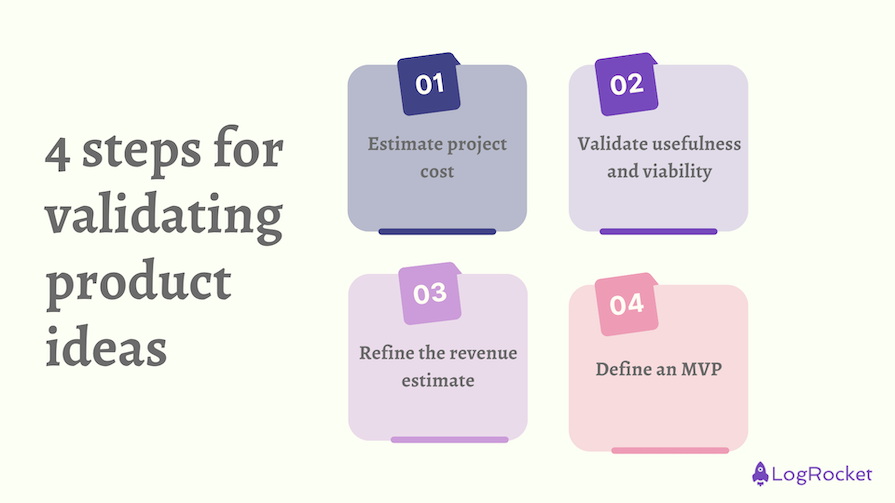
1. Estimate project cost
A quick look at development costs helps you understand whether the idea makes sense from an effort perspective.
2. Validate usefulness and viability
Run fake-door tests, lightweight prototypes, or simple concept checks. These techniques fit well with approaches in validating product ideas.
3. Refine the revenue estimate
Use early data, historical behavior, or simple segmentation to tighten your assumptions.
4. Define an MVP
Design the MVP to test the behavior that drives revenue, not just to ship a smaller version of the feature.
Key takeaway for using this method in your product process
At the end of the day, you don’t need perfect data or a giant spreadsheet to understand whether an idea can make money. A quick, five-minute revenue estimate helps you drop weak ideas early, identify the promising ones, and build a stronger intuition for how your product actually generates revenue.
Sometimes the best validation starts with simple math you can do on the back of a napkin.
Featured image source: IconScout
The post How to quickly estimate the revenue impact of new product ideas appeared first on LogRocket Blog.
This post first appeared on Read More