

How to stop forgetting your wins and actually get promoted
When a performance review arrives, some product managers find themselves struggling to recall their accomplishments. They haven’t touched their “wins” document for months.

Because of this, they end up sitting with their boss and sharing vague summaries of what they’ve achieved. The lack of strong outcomes leads to underreporting their impact and losing out on promotions or raises.
Forgetting your accomplishments isn’t a memory problem. It’s a workflow gap. Keep reading to learn strategic tips to stop forgetting your wins and get the recognition you deserve at work.
Practical systems to help you remember your wins
Remembering your wins doesn’t automatically happen. The best way to ensure that it does is to build practical systems into your day to day work so that you don’t find yourself scratching your head come the end of year.
To help you you get started, this section outlines five easy approaches:
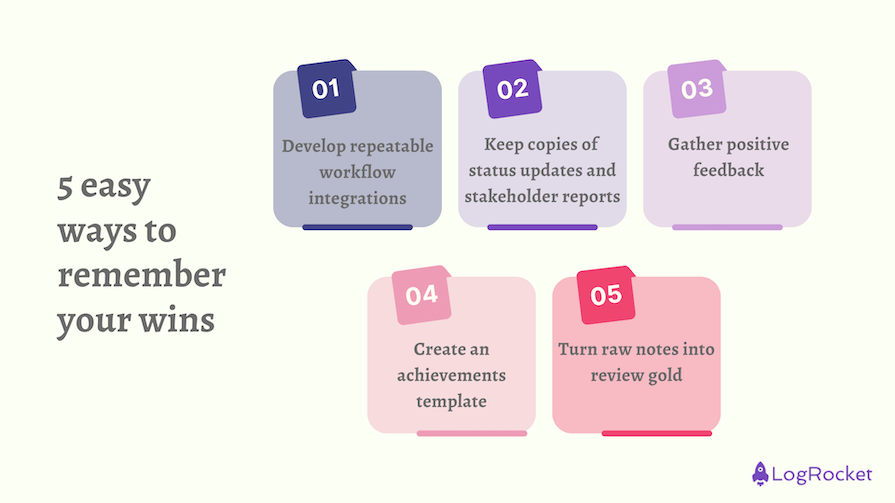
1. Develop repeatable workflow integrations
Every PM needs a way to track their accomplishments. You need to create a documentation process. The key is to create a documentation process that’s repeatable and easy to execute.
Choose a time interval
First, you’ll need to figure out a time interval that works for you. Aligning your self-reflections with sprint retrospectives is a good way to capture your personal wins. Some product managers prefer writing a daily log of their accomplishments or creating weekly status updates. Others find monthly or quarterly reports more achievable.
Create reminders
The second step is to set up reminders. Beyond adding it to your to-do list, you could put a recurring time block in your calendar. Even if it’s only for five minutes, the reminder can influence you to write out your accomplishments.
Another option is to use a Slack or Microsoft Teams bot. Both platforms let you set up a reminder and choose a default time, like every Friday at noon. You could also use an app like GeekBot to run a personal retrospective.
Pick a documentation tool
The next step is to use tools and formats that you’re comfortable using to track your progress. Avoid physical journals and use digital records. They are easier for keyword search, sharing, and exporting for reviews and job interviews.
Whether you create a Trello board or design a Notion page, choose something that you like to use. You can also create a tag system to make searches easier in the future. Some examples include:
- Milestone
- Praise
- Metrics
- Leadership
- Stakeholder communication
2. Keep copies of status updates and stakeholder reports
Product managers send progress reports to stakeholders on a routine basis. Whether it’s weekly or monthly, stakeholder updates are valuable for tracking your wins.
Your stakeholder reports contain an “activity summary” section that highlights the milestones reached and other team accomplishments. Keeping track of this section can help you realize your achievements over a period of time.
Here are a couple of ways to repurpose stakeholder reports for your use:
- Copy and paste the Activity Summary section into a “wins” document. You can keep this in a Google Doc or Notion page for your future performance reviews. You may want to add detailed notes about what happened
- If you send the progress report as an email, CC yourself and send a copy to a designated folder
3. Gather positive feedback
Collecting feedback from colleagues and stakeholders can further enhance your “wins” document. It helps provide diverse perspectives and validates your achievements. Here are a few places to look for additional comments about your work’s impact:
- Calendar — Your calendar is filled with random tasks, meetings, and other important time blocks that can trigger memories of what you’ve accomplished
- Slack or Teams channel for team wins — If your organization has a Slack channel for team wins, check if anyone has given you a shout-out and include a screenshot of it in your notes
- Slack, Teams, and email messages — Search all messages for keywords like “great work,” “thank you,” or “launched.” You can find small and meaningful actions that resulted in a positive ripple effect
- Closed tickets — Look at the closed tickets on Jira or Linear to get a list of shipped work
Another option could be sending out an anonymous survey about your performance. In her Leader Spotlight interview, Sandy Huang, VP of PM at GoodRx, points out: That’s interesting when you get anonymous feedback — people can be very transparent. We all should be self-aware, but people may see things that you just don’t even consider yourself. That was enlightening to me, and I thought, “Okay, well, that’s great. How can I do more of that?”
4. Create an achievements template
An achievements template can help you document your wins and progress with minimal effort. It’s structured for easy, regular use. Here’s an example of what this could look like:
- Date: (Enter date)
- Key projects: (List the main projects that you worked on)
- Tags: (If using a tagging system, add the relevant tags)
- Wins and accomplishments: (List what you achieved or shipped and briefly describe them)
- Feedback and praise: (Share any positive feedback or recognition that you received from colleagues or stakeholders)
- Impact and results: (Document the quantitative and qualitative results. Pair KPIs with the context of why it matters. What was the result or effect of your work?)
- Reflections: (Write what you learned this week, challenges you faced, or any other important notes that you want to remember)
Remember to keep it simple. If it turns into an overwhelming task, you won’t record your accomplishments on a routine basis.
Adjust the template to fit your needs. Make it shorter for quicker check-ins, or add questions to reflect on your performance.
Navya Rehani Gupta, Chief Product Officer at Peek, discusses that she has a personal roadmap and does her own retrospectives. She self-reflects on questions like:
- How can I further maximize my impact?
- What are the root causes of recent lowlights?
- What are some of the activities that I’m doing on autopilot that I need to take a step back from and may need to adjust?
“I’m not thinking about what went wrong, but taking a step back and thinking about what actually caused this issue that’s impacting me and my team,” said Gupta.
For your next self-retrospective, you can review the last retro’s challenges and see if you addressed them. Noting this can help you find your wins.
5. Turn raw notes into review gold
When review season comes around, you may end up with a large and messy document. Preparing for your review means that you have to turn your achievements log into clear impact stories.
There are behavioral interview frameworks that can help get your point across. Here are a few to consider using when reviewing your achievements:
- STAR (Situation, task, action, result) — Best for demonstrating your thought process and decision-making
- SAR (Situation, action, result) — Best for giving streamlined and straightforward answers
- CAR (Challenge, action, result) — Best for highlighting problem-solving and managing obstacles
- PAR (Problem, action, result) — Best for quick answers on how you solved a specific problem
- SOAR (Situation, obstacles, action, result) — Best for showcasing skills like resilience, critical thinking, and leadership
If you’re short on time, you can use AI to summarize your achievements. You can use tools like ChatGPT or Copilot to synthesize your notes. Here are a few prompt ideas that may help:
- Make a list of all projects and features shipped
- Summarize what was shipped, KPIs, highlights, and lessons
- Highlight the key wins and the impact they had on the organization
Key takeaways
It’s easier to track accomplishments when you make it a habit. You might get tempted to skip it, but you’ll thank yourself when your performance review comes around. You’ll have data-driven insights about how you’ve contributed to the organization’s success.
Getting the promotion or pay raise that you want all starts with visibility. Documenting your achievements will help propel your career further. Good luck!
Featured image source: IconScout
The post How to stop forgetting your wins and actually get promoted appeared first on LogRocket Blog.
This post first appeared on Read More