

Introducing Ask Galileo: AI that answers any question about your users’ experience in seconds
Since we started LogRocket in 2016, I’ve spent the last decade talking to product and engineering teams about how they understand user behavior.
Almost universally, the process looks the same: something breaks, conversion drops, or some other key indicator changes. Suddenly, our whole team is on a scavenger hunt, sorting through data scattered across 10 different tools.
We’re spending hours digging through session replays, support tickets, customer calls, and GitHub PRs. All in the name of finding an answer. And every second you don’t have that answer, customers are suffering.
That process made sense when it was the only option. It doesn’t anymore.
Today, we’re launching Ask Galileo, and I think it’s the most significant thing we’ve shipped since the original LogRocket session replay.
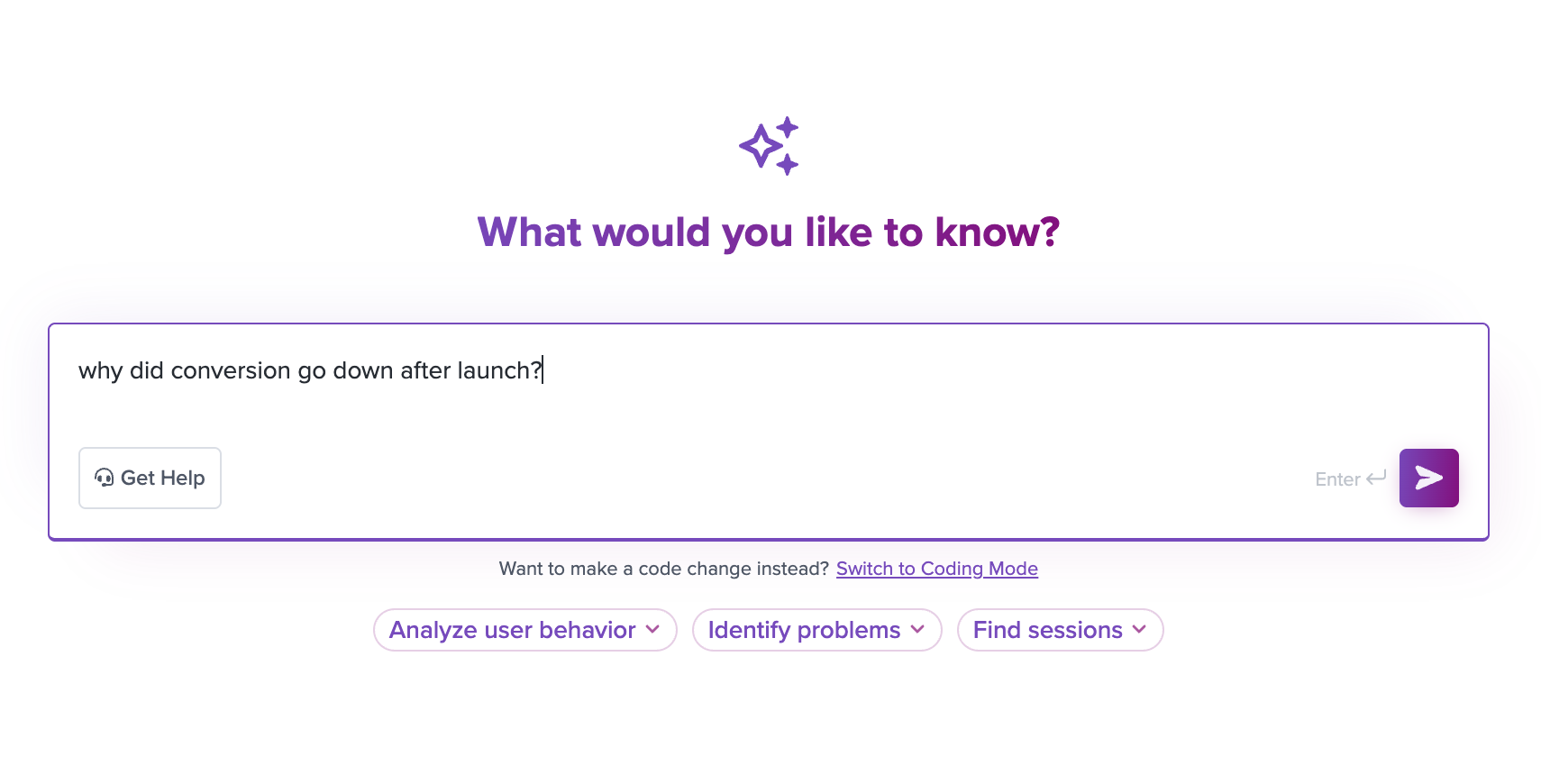
What is Ask Galileo?: Answer any product question in seconds.
Ask Galileo is an AI-powered chat that answers any question about your users’ experience in seconds.
It works like this:
- Type a question in plain English
- Galileo watches relevant session replays, reads customer feedback, and analyzes product changes
- You get an answer about what’s impacting users, and suggestions on what to do next:

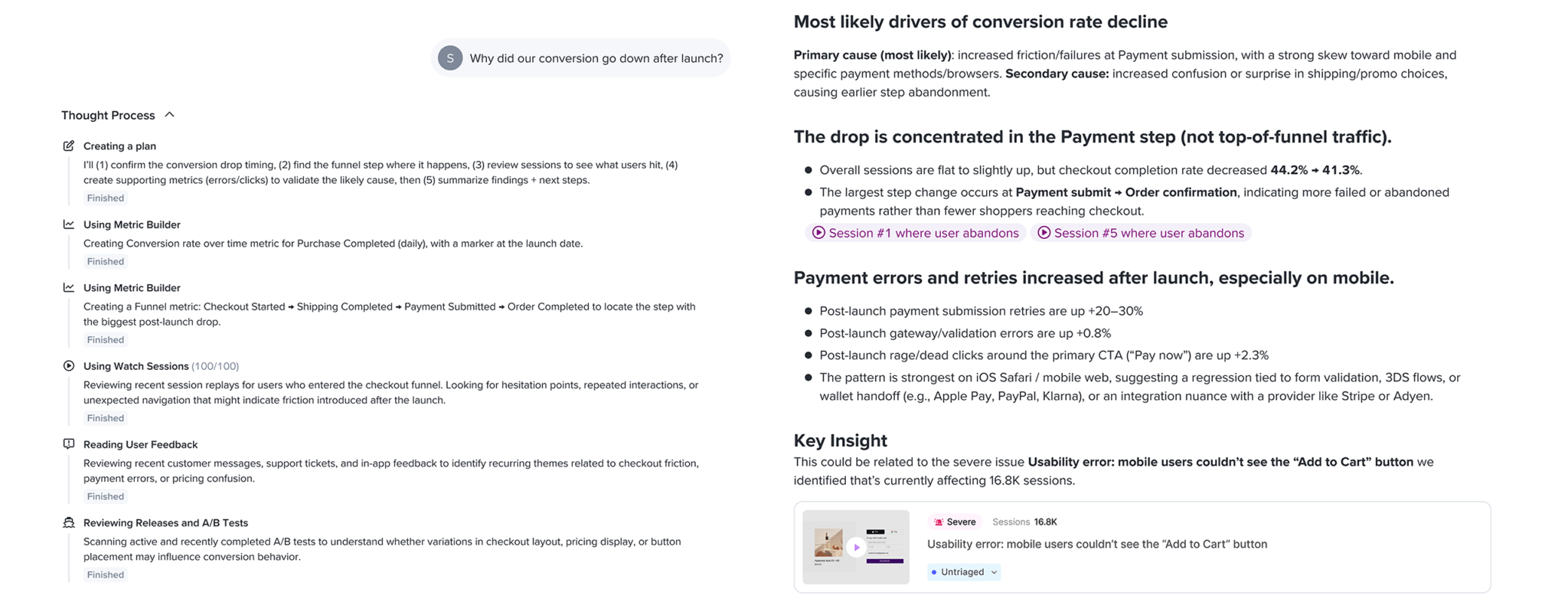
Here are some examples of questions asked by real Galileo users:
- “Please give any reasons why conversion may be down this month?”
- “Where is the biggest bottleneck on our app?”
- “Can you tell me in the last 24 hours the percentage of users who got a payment error at checkout?”
What makes this different from the wave of AI chatbots hitting the market is what it’s built on. Galileo develops a deep understanding of your application: watching session replays, reading support data, and tracking product changes. When you ask a question, it’s answered by referencing your actual product data.
Unifying your data
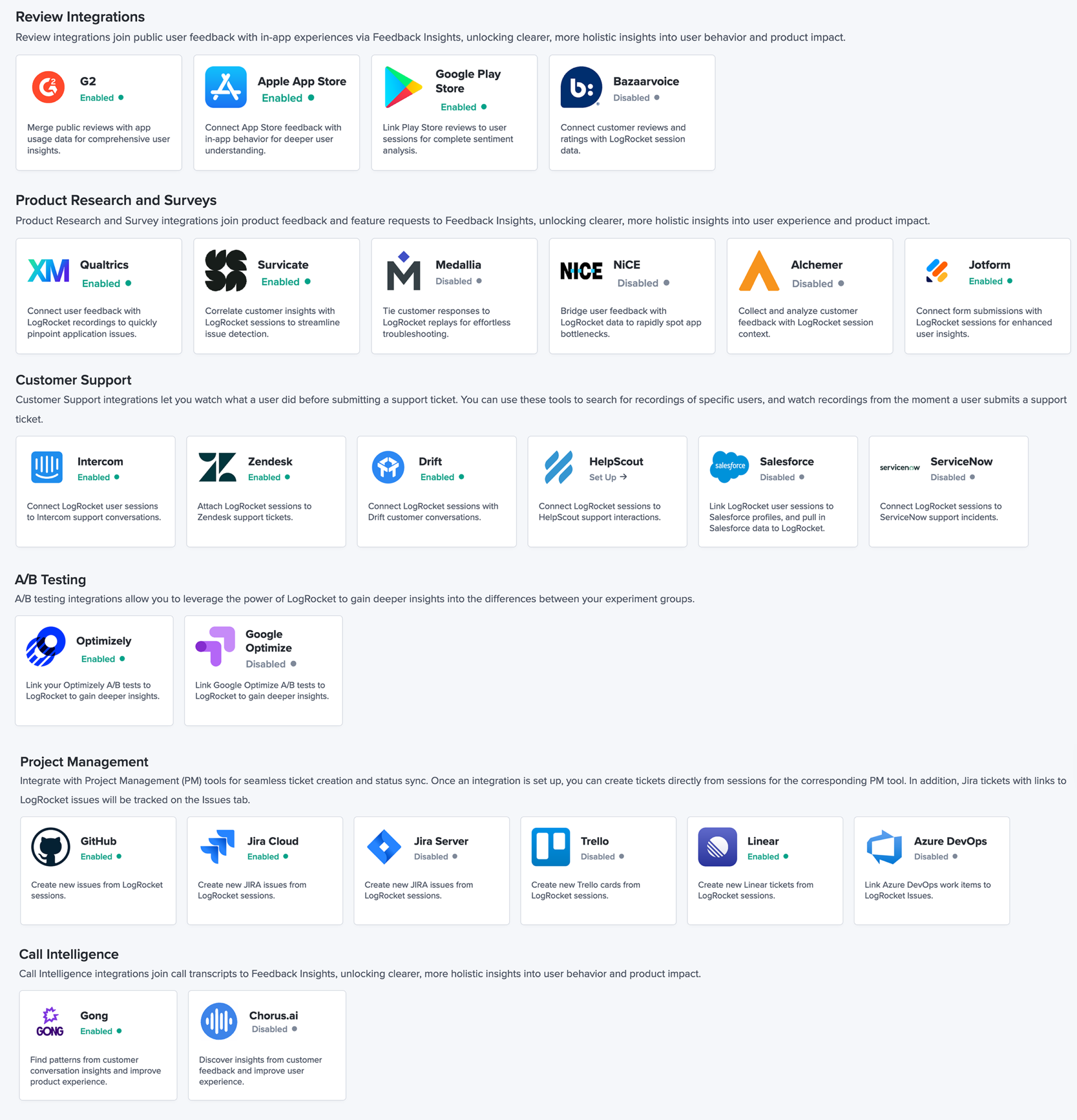
The problem isn’t a lack of data, it’s that we’re drowning in it.
Session replay exists in one place, customer calls in another, support tickets somewhere else, A/B test results in yet another tab, and so on.
Galileo pulls it all together. When you ask a question, it’s synthesizing your session replays, customer calls from Zoom and Gong, support tickets from Zendesk and Intercom, and product changes tracked in Linear and Jira.
And importantly, Galileo shows its work. Every answer surfaces the underlying sessions and data points it used to get there, so your team can validate the findings rather than just take the AI’s word for it.
Ask from wherever you work and build into agentic workflows
We thought it was important that Ask Gaiileo fits into how product teams actually operate.
You can Ask Galileo via MCP directly from Claude, ChatGPT, Gemini, or Cursor. You can query it from Slack or Microsoft Teams. Or use it inside the LogRocket platform.
Some of the most powerful use cases we’ve seen have been customers who integrate the Galileo MCP into their automated workflows: summarizing all customers’ experience in your helpdesk, automating post-release monitoring, and giving context to your sales and customer success teams in your CRM.
Early customers are already seeing the difference. Eitan Dantzig, VP of Product at Kaplan, put it well:
“We can now have a conversation with our data. This has put deeper insights about our users’ behavior at our fingertips. It even allows us to ask things like, ‘our customers are reporting an endless spinner, can you find that?’ Galileo finds the issue, shows you what it looks like, how often it’s happening, and even how to fix it.”
Can you trust Galileo AI?
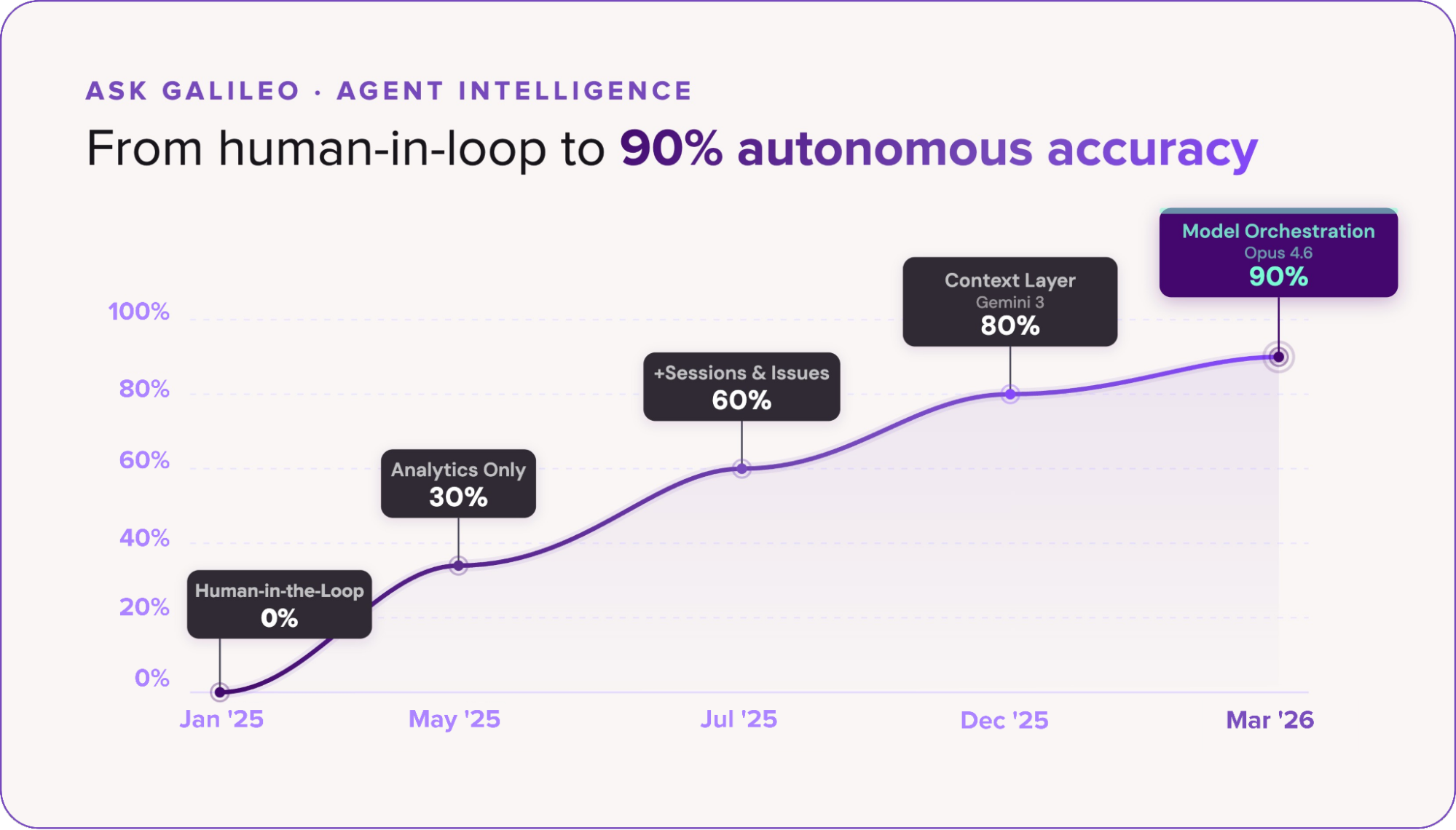
We measure Galileo’s performance two ways: through feedback customers can give on responses, and via human reviewers who score AI outputs based on veracity. Combined, those two signals show Ask Galileo answers roughly 90% of queries accurately, at least as well as we’d expect a human to, as of today (across our thousands of active Galileo users).
When we started building Galileo AI, the earliest version required a human in the loop for almost every meaningful output.
Over time, as we layered in more data sources and better models, performance compounded. Integrating analytics alone got us to about 30%. Adding sessions and issue tracking pushed that to 60%. Introducing our context layer, which gives the agent richer awareness of each product’s environment, brought us to 80%. And with our latest model orchestration approach, where multiple models handle different parts of the reasoning chain, we’ve reached 90%. Each generation of underlying models (Gemini, then Opus) pushed us further as we continued to iterate on the agentic approach and prompting strategies.
We’re at 90% today, and we’re not done.
That trajectory matters because it reflects something real: getting AI to reliably understand user experience is hard. The teams building in this space are only now reaching the performance bar where it’s genuinely useful in daily work, not just impressive in a demo:
Ask Galileo and the future of product innovation
The explosion of AI-generated code means teams are shipping features faster than ever. The complexity of modern products is growing.
That means more product data than ever. The teams that will win are the ones who can understand and act on it quickly.
Ask Galileo is our answer to that problem. And it’s the closest we’ve come to the vision we started LogRocket with: that you could truly understand how every customer uses your product, without it consuming all of your team’s time.
Try Ask Galileo for yourself →
The post Introducing Ask Galileo: AI that answers any question about your users’ experience in seconds appeared first on LogRocket Blog.
This post first appeared on Read More