
The process for adding functionality to your WordPress website has been the same for years. You find a plugin that fits your needs (or gets you close) and install it. It’s no wonder we have sites with dozens of plugins – many of which go unused.
Sure, building a custom plugin has always been an option. That’s fine for scenarios that require a code snippet. However, complex tasks were reserved for highly-skilled developers. This meant that most of us had to settle for whatever was available on the market.
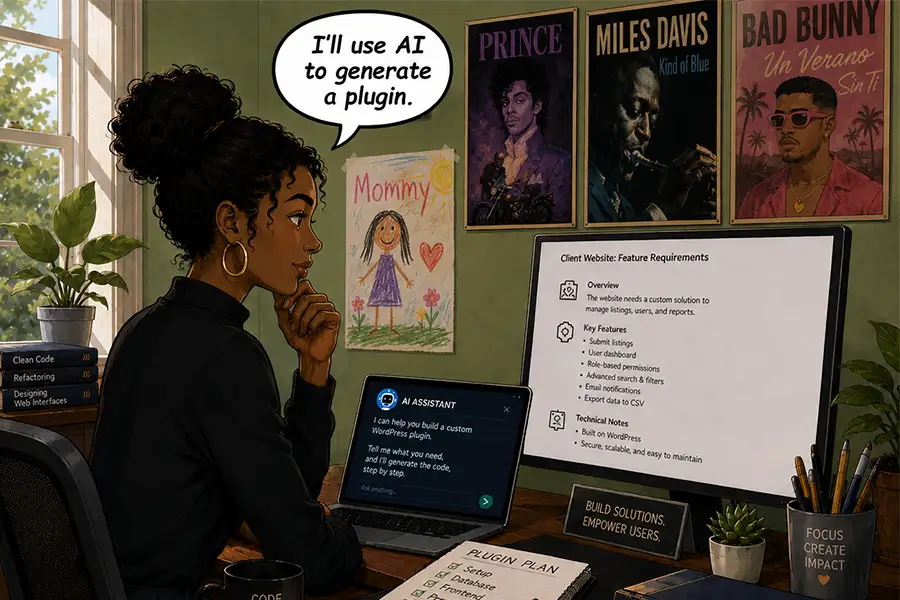
AI has swooped in to change that calculus. Advanced models like Claude Code enable even novice developers to build powerful, multi-layered projects. These days, it’s more about knowing what to ask for than understanding every line of code. We now have a tool that does the heavy lifting for us.
This technological shift gives new life to an old question: Should you use an existing plugin or build one yourself? AI certainly expands the potential scope of what’s possible, thus calling into question the need for third-party tools.
But don’t go on a vibe-coding rampage just yet! There are some important considerations when making this decision. Let’s talk about them.
Which Approach Best Fits Your Needs?
There are tens of thousands of WordPress plugins on the market. Some utility-based options are very niche, but most plugins are built to serve a broad range of use cases. Product makers must account for the many ways people use WordPress.
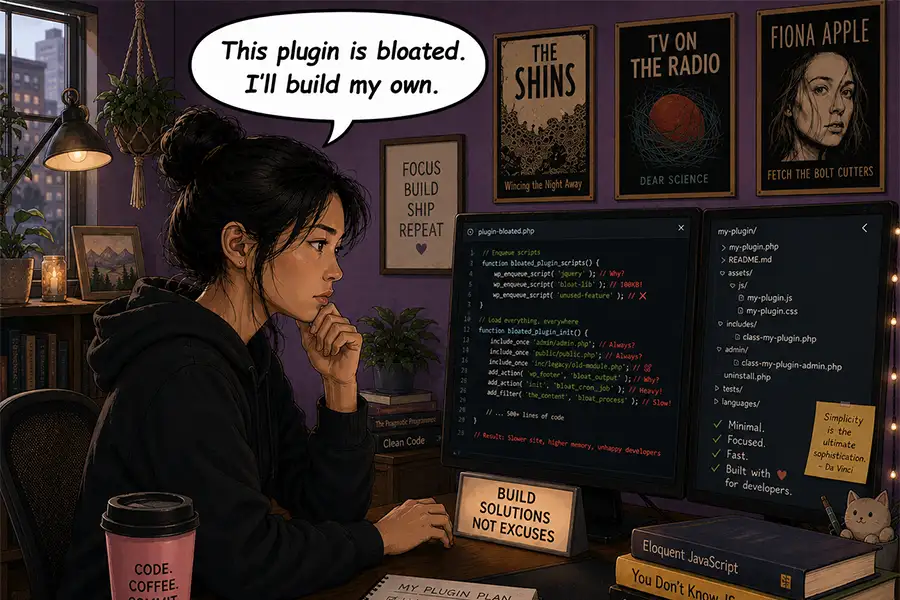
The downside of that approach is that a plugin might be more than what you need, or fall short in some areas. The old “too much or not enough” conundrum has long been a part of the plugin experience.
Building a plugin with AI, on the other hand, lets you narrow the focus. You can include only the features and functionality your project needs.
For example, let’s say you need a feature that only applies to one WooCommerce product. There is probably a third-party extension to fit this purpose. But a single-purpose plugin could do the same thing without the overhead or the cost of a yearly renewal. AI makes the process quick and easy.
On the other hand, needs evolve during a project’s lifecycle. Perhaps your client will need similar functionality on more products down the line. A vibe-coded solution may not be quite as flexible in that case. You may need to refactor the plugin to meet new requirements.
As such, it’s important to consider your current and future needs. If scope creep is a concern, a third-party plugin may be a better choice.
Do You Want the Maintenance Responsibilities?
An existing WordPress plugin may not solve your every need. However, it takes you off the hook regarding future maintenance. It’s the plugin author’s responsibility to fix bugs and build new features.
Naturally, that’s a double-edged sword. Some product makers are more responsive to issues than others. In addition, more than a few plugins have been abandoned over the years. And sometimes a product goes in a direction you don’t support. You don’t want to be left to pick up the pieces or placate clients when there’s a problem.
It’s all about control and responsibility. If your project (or personality) requires absolute control, then building it yourself makes sense. That way, you know what’s going on every step of the way. You don’t have to wait for someone else to take action.
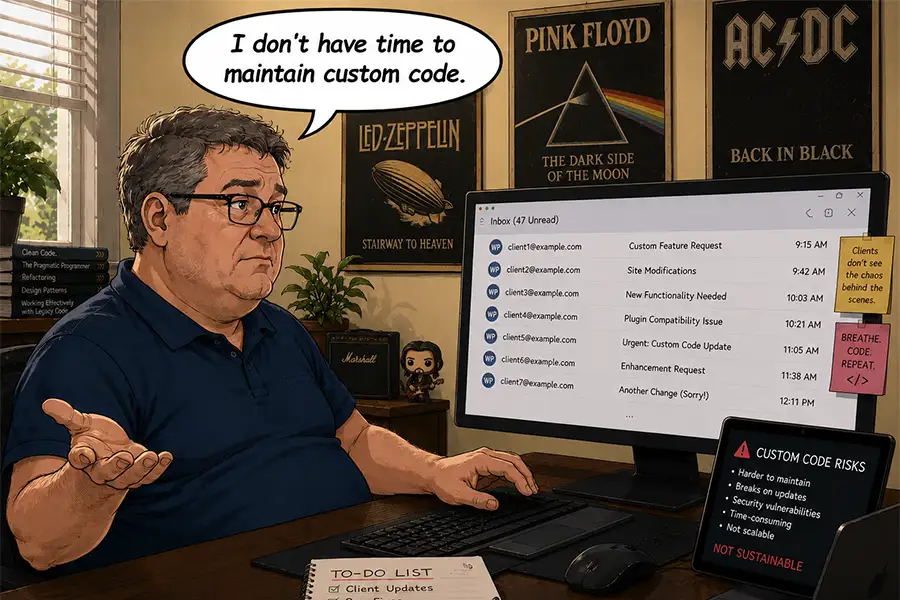
Still, we should note that vibe coding plugins result in a higher level of responsibility. It means checking for security holes, compatibility testing, and acting as your own technical support staff. The practice puts everything back into your capable hands.
Kudos to you if this fits with your philosophy! To be safe, we also suggest thinking about how these responsibilities scale. Maintaining a single plugin for a client is one thing. The upkeep of dozens of plugins spread over dozens of websites is another. Make sure you have processes in place to keep things running smoothly.
Can You Build It Better?
The final consideration on our list is simple. The idea is that just because you can build something with AI, it doesn’t mean you should do so. Sometimes, there are established products that do the job well enough. Why reinvent the wheel?
The scope and depth of a plugin play a role here. Consider a popular plugin like Jetpack. It does a lot of things and has been around for a long time. Sure, you could vibe code your own suite of similar functions. However, ask yourself if you want to take on a project of that magnitude, or if it’s even worth the effort. The same could be said for Yoast SEO, Gravity Forms, and other flagship products.
That being said, you could reasonably use AI to recreate specific aspects of a plugin. For example, building a social sharing plugin that includes a few of the missing features you want. Smaller and more focused projects are better in most cases. And there’s also an opportunity to build your own extensions of an existing plugin.
There are also scenarios when your needs are very specific, and there aren’t any great options available. It’s here where vibe coding really begins to shine. You can take your idea to your favorite AI model and build it from scratch. It’s empowering for those working with clients!
The bottom line is to use AI when it’s beneficial. You might be able to build the next WooCommerce, but what’s the payoff? Instead, look for opportunities that help you level up.
There Are Endless Plugin Options and Opportunities
The WordPress plugin ecosystem has an answer for many project requirements. It’s one reason why the content management system (CMS) has remained so popular. Adding more capabilities has always been a few clicks away.
The introduction of AI into the development process has expanded those possibilities even further. If an existing plugin doesn’t do everything you need, it’s easier than ever to build your own solution. In many cases, AI works quickly and is cost-effective. It helps us provide clients with more personalized functionality.
All of this makes deciding to go custom more compelling. AI lowers the bar for building complex features. Sometimes that means fewer advantages for existing products.
Still, vibe coding isn’t always the best option. It comes with a higher level of responsibility and adds to your long-term maintenance list. Plus, there are questions about code safety and stability. AI doesn’t necessarily reduce those risks.
The good news is that you have a world of choices. We hope the considerations above help you make the right one!
The post A New Choice: Use an Existing Plugin or Vibe Code Your Own? appeared first on Speckyboy Design Magazine.
This post first appeared on Read More