
Cybernetics might just be the most important body of knowledge in 2026 and beyond. But don’t take my word for it. Look at the evidence: from technical staff at Anthropic to a production engineering talk at Factory, and YC founders speaking at Stanford — a pattern keeps emerging. They’re all talking about cybernetics. And as far as I can tell, nobody’s noticed they’re all describing the same almost century-old science.
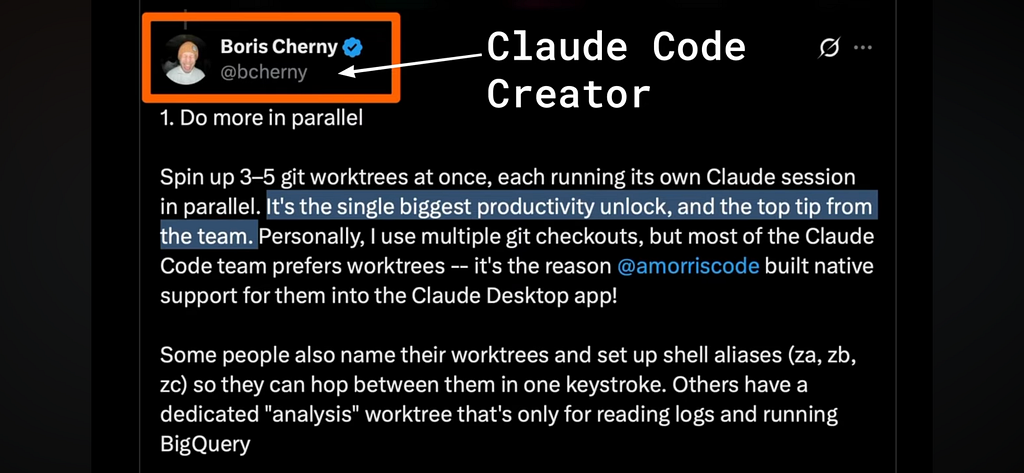
The head of Claude Code at Anthropic, Boris Cherny, recently made a statement that deserves to be read slowly. “I don’t prompt Claude anymore,” he said. “I have loops running that prompt Claude and figuring out what to do. My job is to write loops.” The person building Anthropic’s flagship coding agent does not talk to AI. He designs systems in which AI talks to itself , or ‘self-referential control loops’ that govern what Claude does and how it corrects itself without a human in the cycle. This is the transition, he says, that will define the rest of the year.
“I don’t prompt Claude anymore. I have loops running that prompt Claude and figuring out what to do. My job is to write loops.” —Boris Cherny (Head of Claude Code, Anthropic).
And we can see this pattern everywhere. Something significant is happening across the AI engineering community, where teams and practitioners are building real systems… I mean the people putting actual code in production. What I’ve observed over recent weeks is that all of them are arriving at the same structural insight through completely independent paths (an example of equifinality). Indeed, they are using different but similar vocabulary, working at different scales, and serving different audiences, but they are describing the same conceptual architecture.
That architecture has a name, and is far from new. It’s not a framework, a product, or a methodology. It’s actually a set of scientific principles, a body of knowledge formalised in the late 1940s by Norbert Wiener and extended through the 1950s and 1970s by W. Ross Ashby, Gordon Pask, and William T. Powers.
My argument here is that modern practitioners should be leveraging the original and stated concepts, rather than using heuristics to rediscover them. As we shall see, it was intentional that the connection was forgotten, but I believe it’s now time to formally rediscover them and apply them.
Those original concepts are from the field of cybernetic, and agentic systems are already rewarding those who apply it in practice.
A short primer on cybernetics
Cyber-what? Indeed, I hear you, it’s been a niche topic over the last few decades, so it demands a proper primer. Cybernetics is the science of goal-directed systems — of how any system, biological, mechanical, social, or designed, pursues a purpose and corrects its own behaviour when it drifts from it. The word comes from the Greek kubernetes (“the steersman”) meaning, not the one who rows but who holds the course. Norbert Wiener formalised the discipline in 1948, when observing that the same principles govern anti-aircraft predictors, nervous systems, and markets. It is not a technology. It is a vocabulary of principles that operate above any specific domain.
The foundational mechanism is the control loop. Every purposive system holds a reference state, or a specification of what it is trying to maintain or reach. It continuously compares that reference against its perception of the current state of the world. When a discrepancy is detected, it generates corrective behaviour to close the gap. William T. Powers (1973) showed this is the universal mechanism underlying all purposive human behaviour, not just in machines, but in every goal-directed act a person performs. You use it all the time to regulate your temperature, your appetite, or keep your car on the road. And one more thing is true, that without a reference state, there is no comparator. Without a comparator, there is no control. There is only execution.
Feedback is the signal that makes correction possible. Negative feedback reduces discrepancy, for example, in the thermostat detecting that the room is too cold and turning the heating on. Positive feedback amplifies a signal, which is the flywheel that accelerates growth. Both have their place, but a system running positive feedback without a balancing negative loop will eventually collapse.
Variety, as defined by W. Ross Ashby (1956), is the number of distinct states a system can occupy. Ashby’s Law of Requisite Variety states that a regulator must possess at least as much variety as the system it is regulating. A system facing more complexity than its response repertoire can match will fail, but not because it lacks intelligence, but because it lacks variety.
Homeostasis is the regulated maintenance of a stable internal state against external disturbance. The goal is not a fixed destination but a dynamic equilibrium. Stafford Beer (1979) extended this to organisations, arguing that a viable system is one that can maintain its own viability through internal regulatory mechanisms. His POSIWID principle (“the purpose of a system is what it does”) cuts through stated intentions and asks what the system demonstrably produces. If the observed behaviour diverges from the stated purpose, the system is regulating toward the wrong objective.
Finally, Gordon Pask (1968) introduced the Phase Space: the full trajectory of states a system moves through over time, not just its current configuration. A system without memory of its trajectory cannot use that history to constrain its next state. A system with it compounds experience into capability.
These six basic concepts (reference state, feedback, variety, homeostasis, POSIWID, and Phase Space (along with many others)) are the ideas through which the following should be interpreted.
Tom Blomfield at Y Combinator: the organisation as viable system
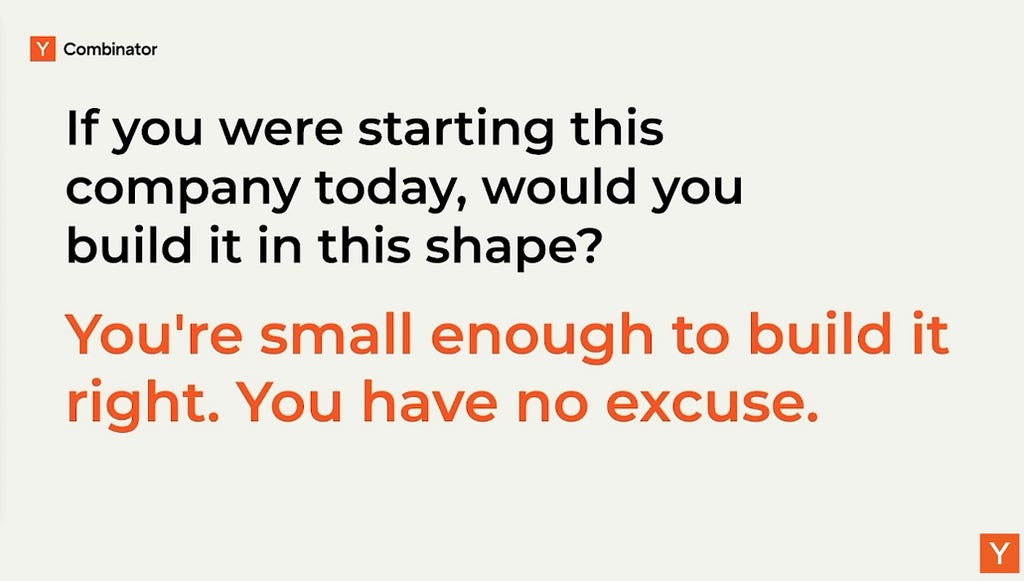
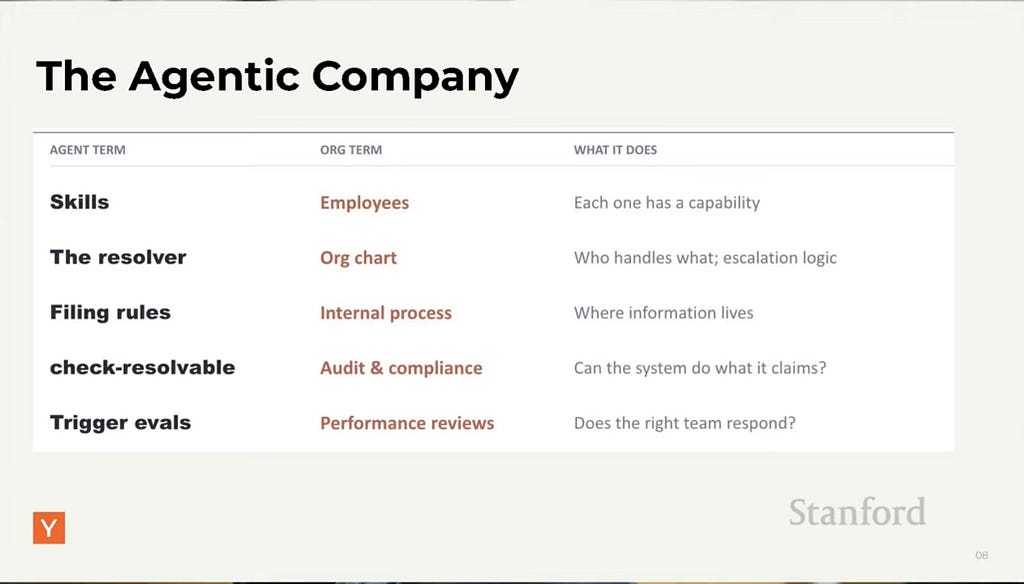
The most operationally direct statement of the convergence comes from Tom Blomfield’s YC batch talk, published 19th May 2026, in which the General Partner and Monzo co-founder argues that most founders are building AI wrong — adding it on top of existing hierarchical structures rather than reconceiving the company itself as a set of recursive, self-improving loops. Blomfield’s core example is a YC internal query agent that partners could use to ask questions about founder meetings and history; useful but unremarkable until a monitoring agent was placed on top of it, watching every query, tracking successes and failures, and — when queries failed — diagnosing why overnight, writing the fix, opening a pull request, having a separate review agent check it, and deploying it before the next morning, so that the same query that failed the night before succeeded without any human intervention. He describes this as his “holy shit moment” — the recognition that the system had regulated itself back to a functional state without being told to.
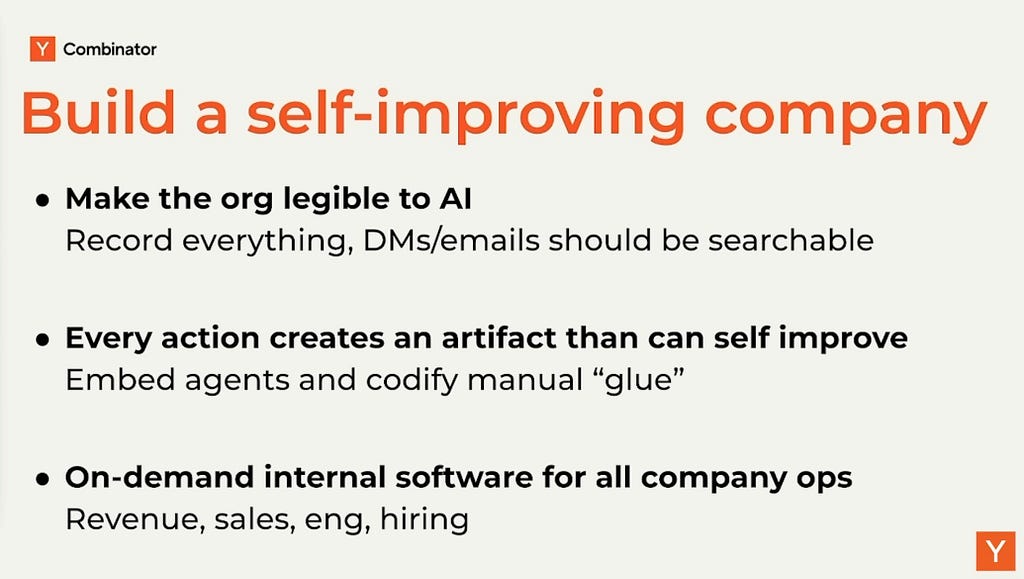
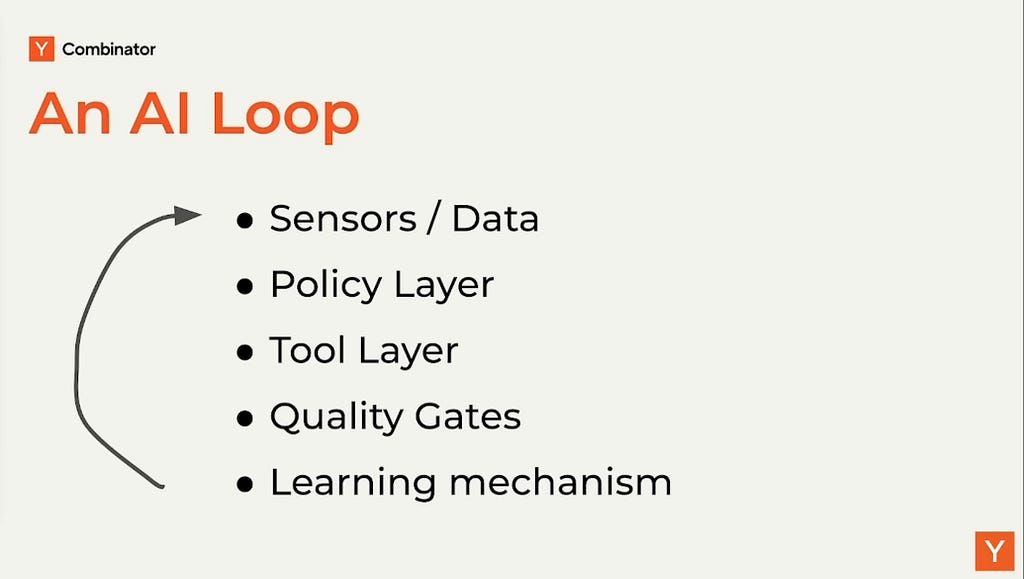
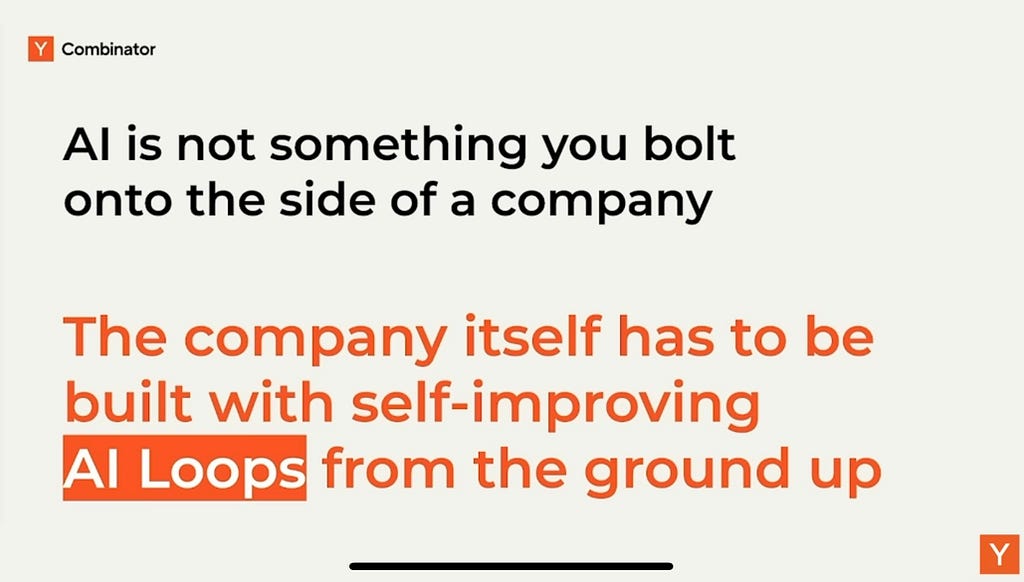
In cybernetic terms, what Blomfield witnessed was Stafford Beer’s Viable System Model in spontaneous operation: a monitoring function detecting discrepancy, generating corrective behaviour, and closing the loop on a cycle that previously required a human coordinator to complete.
His framing of traditional companies as “Roman legions” (information flowing upward through hierarchies, commands flowing downward through management chains) is a precise description of a variety-attenuation architecture designed for a specific communication constraint; his argument that AI dissolves this structure is the argument that Ashby’s Law now operates at organisational scale. When an AI system can match the variety of operational disturbances that middle management previously absorbed, the human attenuation layer is no longer necessary for regulation.
His closing observation that “software is ephemeral, context is valuable” names the same distinction that Murag (see below) makes through memory architecture: what persists and compounds in value is not the implementation but the accumulated organisational knowledge that defines what the system should do, the reference state against which all subsequent regulatory behaviour is calibrated.
Mahesh Murag at Anthropic: memory as Phase Space, Dreaming as second-order homeostasis
The most architecturally complete statement of what the convergence requires at the infrastructure level comes from Mahesh Murag’s session at Code with Claude San Francisco, published 8th May 2026, in which the Anthropic product manager who built the Model Context Protocol argues that memory is the next primitive — the missing building block that turns agents from single-session executors into systems that accumulate capability over time.
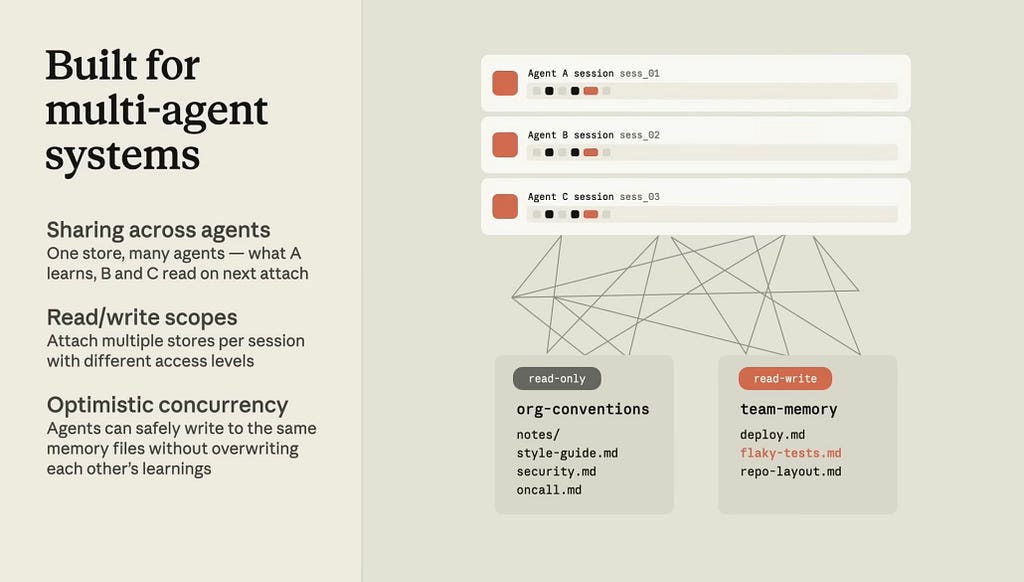
His argument is a direct statement of Pask’s Phase Space principle: a system without memory begins each session in the same state regardless of prior trajectory and cannot be state-determined, because history is not accessible to it; with memory, the current state encodes the trajectory, and what the agent has learned compounds rather than evaporates.
The design decision that most clearly reflects cybernetic thinking is not that memory exists but how it is modelled: rather than imposing fixed schemas, Anthropic lets Claude manage memory as a plain-text file system the agent organises for itself, applying Ashby’s Law at the memory-architecture level — a fixed-schema store whose structural variety is less than the variety of the agent’s operational experience will systematically fail to encode what matters.
The feature Murag presents as most novel is Dreaming: a background consolidation process that runs outside the agent’s normal work path, reads recent sessions alongside existing memory, removes duplicates and stale information, and surfaces patterns no single session had enough perspective to detect — a second-order homeostatic mechanism, analogous to biological memory consolidation during sleep, that maintains the quality of the regulatory architecture itself rather than the quality of any individual task output, and whose costs are paid once while benefits compound across every subsequent session.
Most significantly, Murag identifies shared memory across agent swarms as the prospect he finds most compelling. Imagine if hundreds of agents in parallel contributing trajectory observations to a collective state representation, making cross-agent patterns visible that no individual agent could detect. And from the cybernetic perspective, this is arguably the mechanism by which Wiener’s (1948) made his original insight about shared error signals increasing collective regulatory capacity. This ‘new’ discovery by Murag shows how Wiener’s model extends, 78 years later, to fleets of AI agents building a shared understanding of their environment over time.
Daisy Hollman: “The secret isn’t a better model — it’s tighter feedback loops”
At Anthropic’s Code with Claude conference in London on 22nd May 2026, Daisy Hollman (a Member of Technical Staff at Anthropic) gave a workshop titled “Beyond the Basics with Claude Code.” One of the central claims, delivered at 14:30, is a precise statement of a cybernetic principle to have emerged from the practitioner community this year (so far).
The secret to doing great work with Claude Code is not a better model. It is tighter feedback loops. — Daisy Hollman (Member of Technical Staff, Anthropic).
This is Wiener’s foundational argument from 1948, restated for a 2026 engineering audience without the Wiener. Wiener’s original observation was that the performance of a purposive system — any system trying to achieve a goal — is determined by the quality of the feedback mechanism that corrects its behaviour, not by the raw power of its components. An anti-aircraft predictor that cannot receive information about where its shells are landing will not improve, regardless of how sophisticated its ballistic calculations are. A Claude Code agent that cannot receive structured information about the quality of its outputs will not improve, regardless of model capability.
Hollman makes the same point through a different route: context windows have not grown in over a year, and she does not expect that to change. While raw capability has scaled, the constraint is informational — specifically, the selection of what goes into the fixed box. She describes hooks as “red squigglies for agents” — small corrections injected at the moment of a mistake rather than caught later in review. This is the principle of early-cycle feedback: detect discrepancy at the earliest possible point in the loop rather than post-hoc. Powers’ Perceptual Control Theory (1973) is built entirely on this principle. The value of a feedback signal is inversely proportional to the delay between error and correction.
Her framing of memory as a “context engineering primitive” (30:00) is the second cybernetic insight in the talk. Context is not a container — it is the agent’s perception of the current state. What goes into the context defines what the agent can detect, and what it can detect defines what discrepancies it can act on. This is not a memory management problem. It is a perception architecture problem. Powers’ hierarchy is explicit: a control system can only regulate what it can perceive. Hollman has arrived at the same conclusion from the engineering side.
Nick Saraev: the DOE framework as control loop architecture
Nick Saraev, who runs a Claude-focused channel and Skool community, published a course on advanced Claude Code workflows in which he separates the agentic workflow into three components: Directives (i.e. SOPs , or the standing operating procedures that define expected behaviour), Orchestration (the AI “brain” that directs activity), and Execution (deterministic Python scripts that carry out specific tasks). He frames this as a way to stop AI from hallucinating and start making it reliable for business.
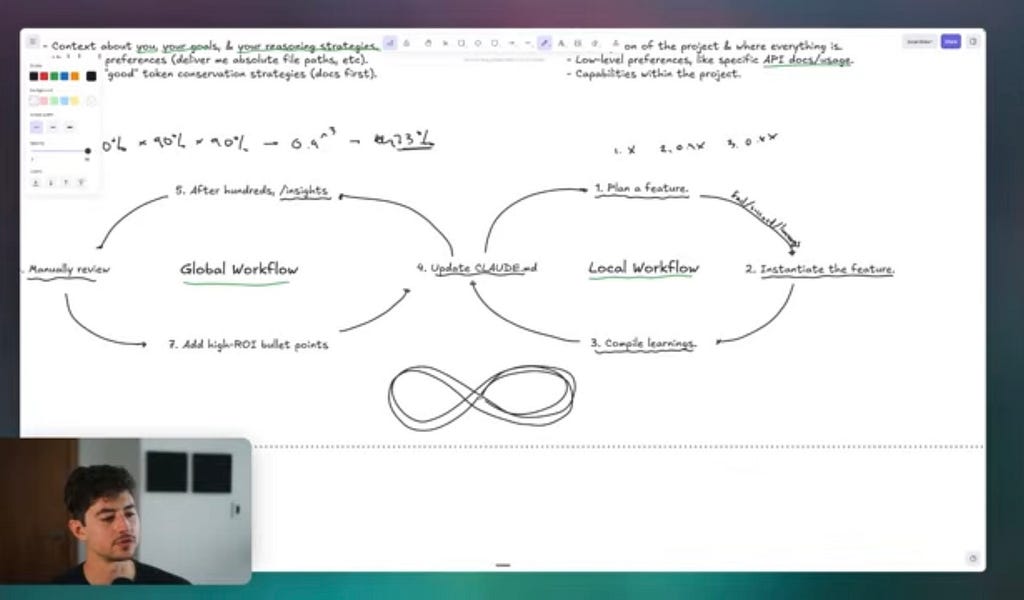
The DOE framework is a control loop in practical form. The Directives are the reference state: a specification of how the system should behave. The Orchestration layer is the comparator and action generator: it evaluates current behaviour against the Directives and selects the next action. The Execution layer is the effector: the mechanism that produces observable changes in the world. The separation is structural rather than stylistic because a system in which the agent that specifies the reference state also generates the action, and evaluates the output has collapsed the comparator into the actor. Saraev has independently discovered that this produces hallucination and unreliability, and that the remedy is separation of function.
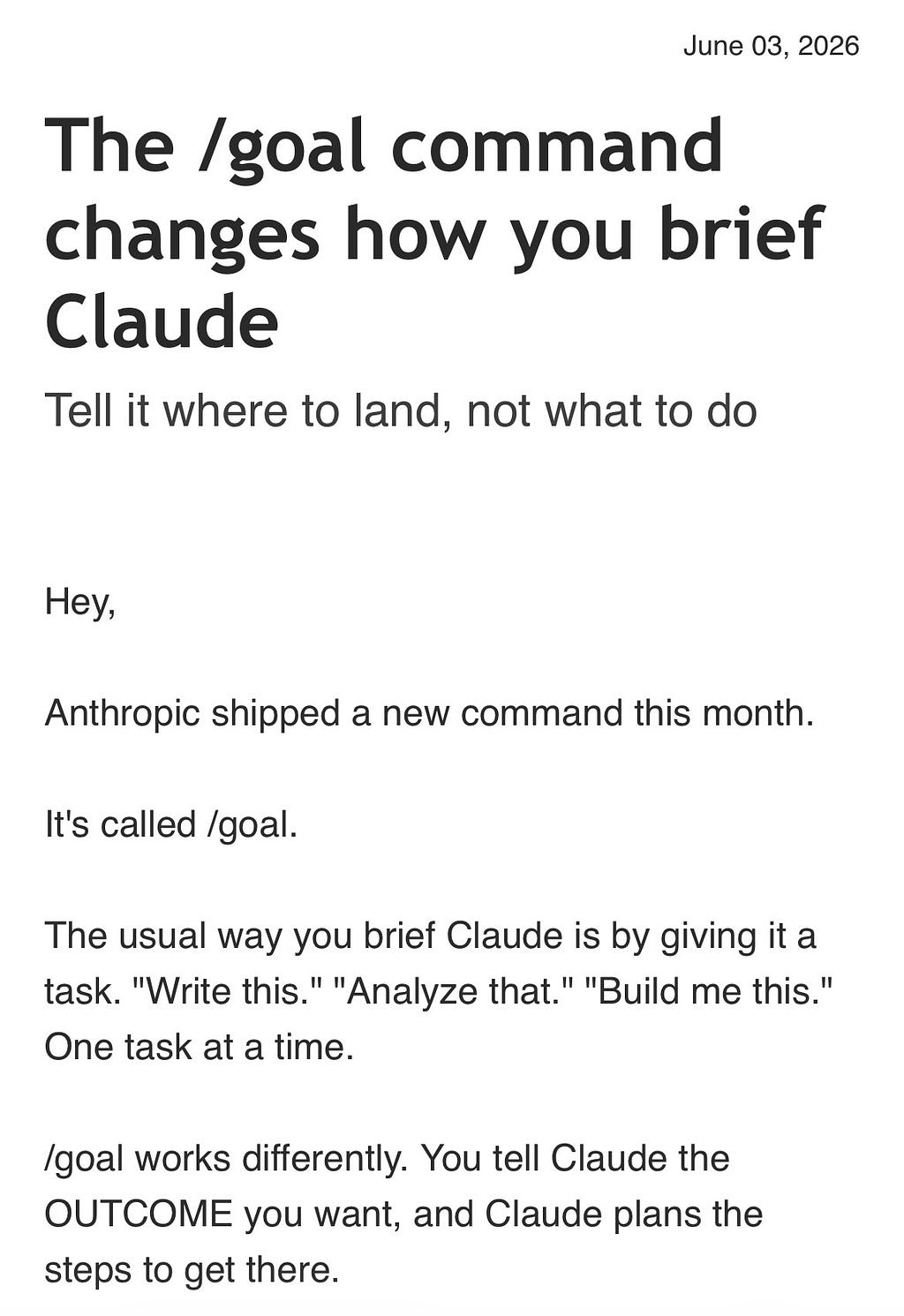
The self-referential loop he describes is the application of this structure recursively: the Orchestration layer continuously compares the state of execution against the Directives and generates corrective behaviour until the condition is satisfied. This is exactly what Anthropic’s /goal command implements at the platform level — with the added cybernetic refinement that the evaluator is a separate model from the one doing the work. The comparator must not be the same system as the actor.
Luke Alvoeiro at Factory: serial execution, validators, and adversarial verification
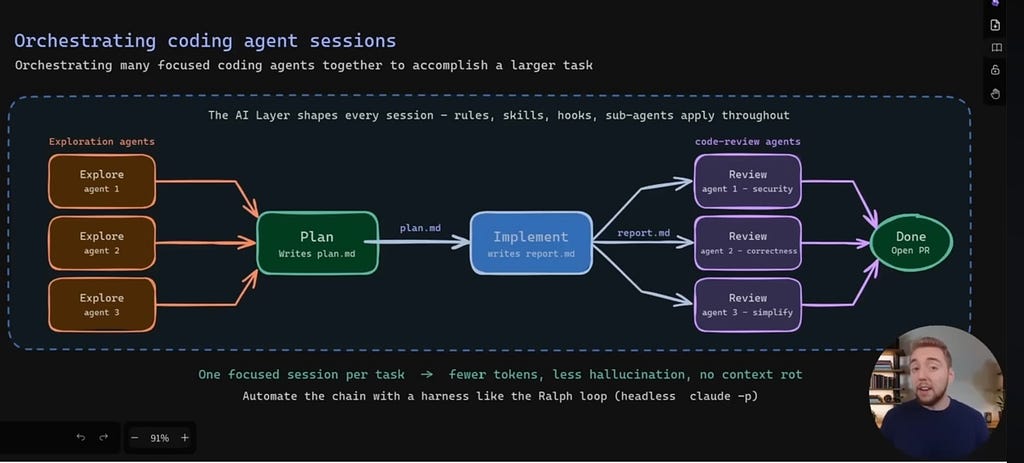
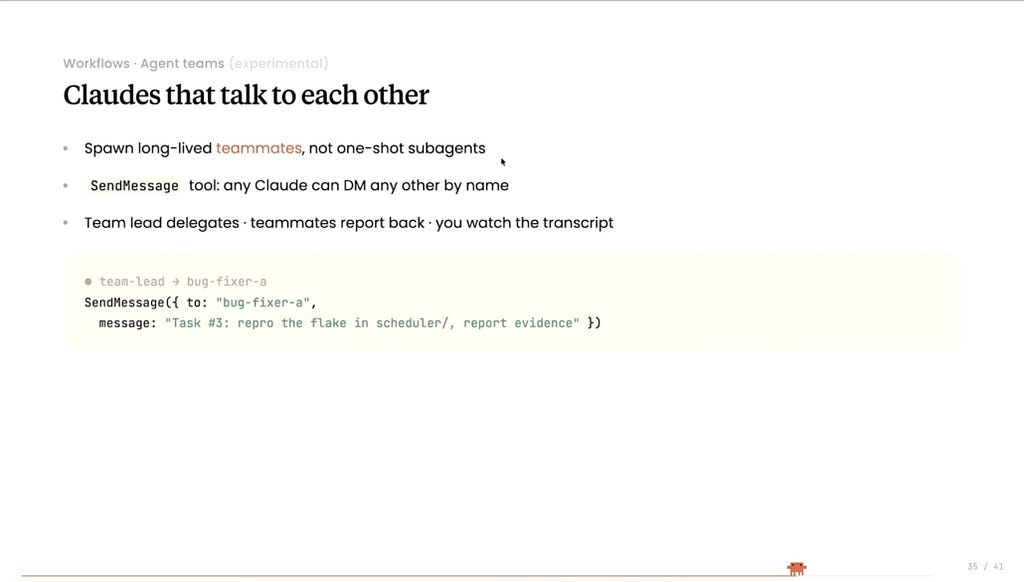
Luke Alvoeiro’s talk at Code with Claude San Francisco on 6th May 2026 (“The Multi-Agent Architecture That Actually Ships”) makes the most structurally complete argument of any practitioner presentation in the current period. His taxonomy of five frontier multi-agent strategies and the three-role production system he describes (orchestrator, workers, validators) map precisely onto a distributed control loop.
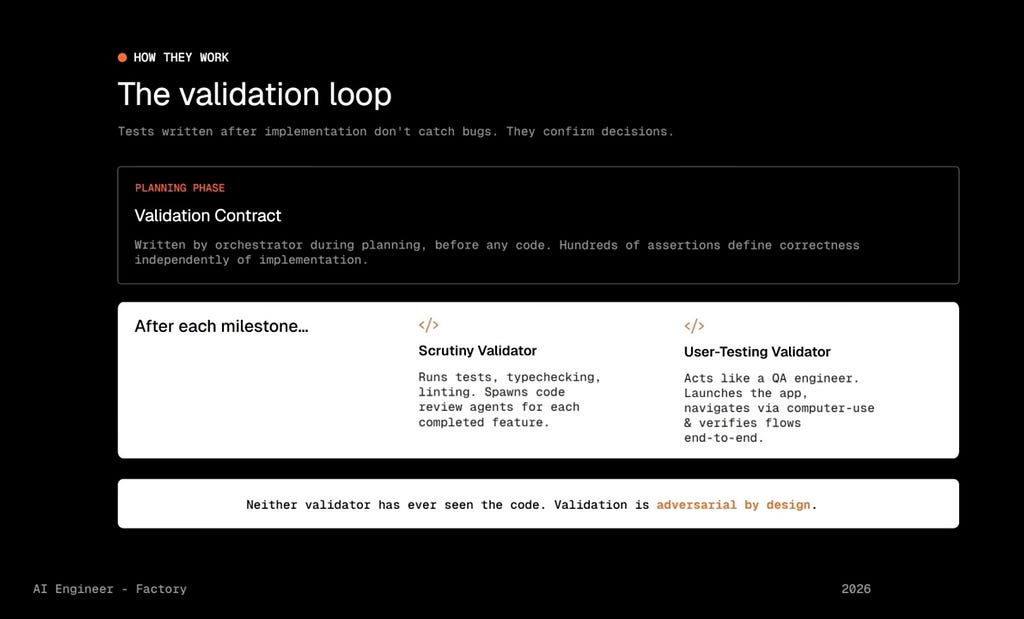
The orchestrator holds the goal and decomposes it into subtasks. The workers generate outputs. The validators are comparators: their function is to detect discrepancy between the workers’ outputs and the expected standard, using what Alvoeiro calls “validation contracts” and “adversarial verification.” The adversarial element is significant — the validator is explicitly designed to find discrepancy, not to confirm adequacy. This is the design of a sensitive comparator. In Powers’ model, a comparator calibrated to find discrepancy rather than confirm completion produces tighter loops and faster correction.
Alvoeiro’s argument for serial over parallel execution is also cybernetically precise. Parallel execution generates multiple outputs simultaneously without inter-agent feedback during generation. Serial execution allows each step’s output to inform the next — feedback can propagate through the chain in real time. The case for serial is not about latency. It is about feedback architecture. Tighter loops require sequential dependency.
His third argument — that model selection per role is a “compounding advantage” — is an application of Ashby’s Law of Requisite Variety (1956) at the component level. A validator requires different capabilities than a generator. Assigning the wrong model to a role reduces that component’s regulatory capacity below the variety of the inputs it faces. Over time, this compounds: a validator with insufficient variety will systematically fail to detect certain classes of discrepancy, and those failures will accumulate invisibly in production outputs.
His stated goal of designing systems “that get better with each model generation instead of being made obsolete by them” is the most strategically sophisticated idea in the talk. It is a principle of regulatory architecture over implementation architecture: design the control loop structure so that model improvements increase the system’s regulatory capacity without requiring structural redesign. The value of the system is in the feedback structure, not in the specific components instantiated within it.
The Ralph Loop and recursive self-improvement
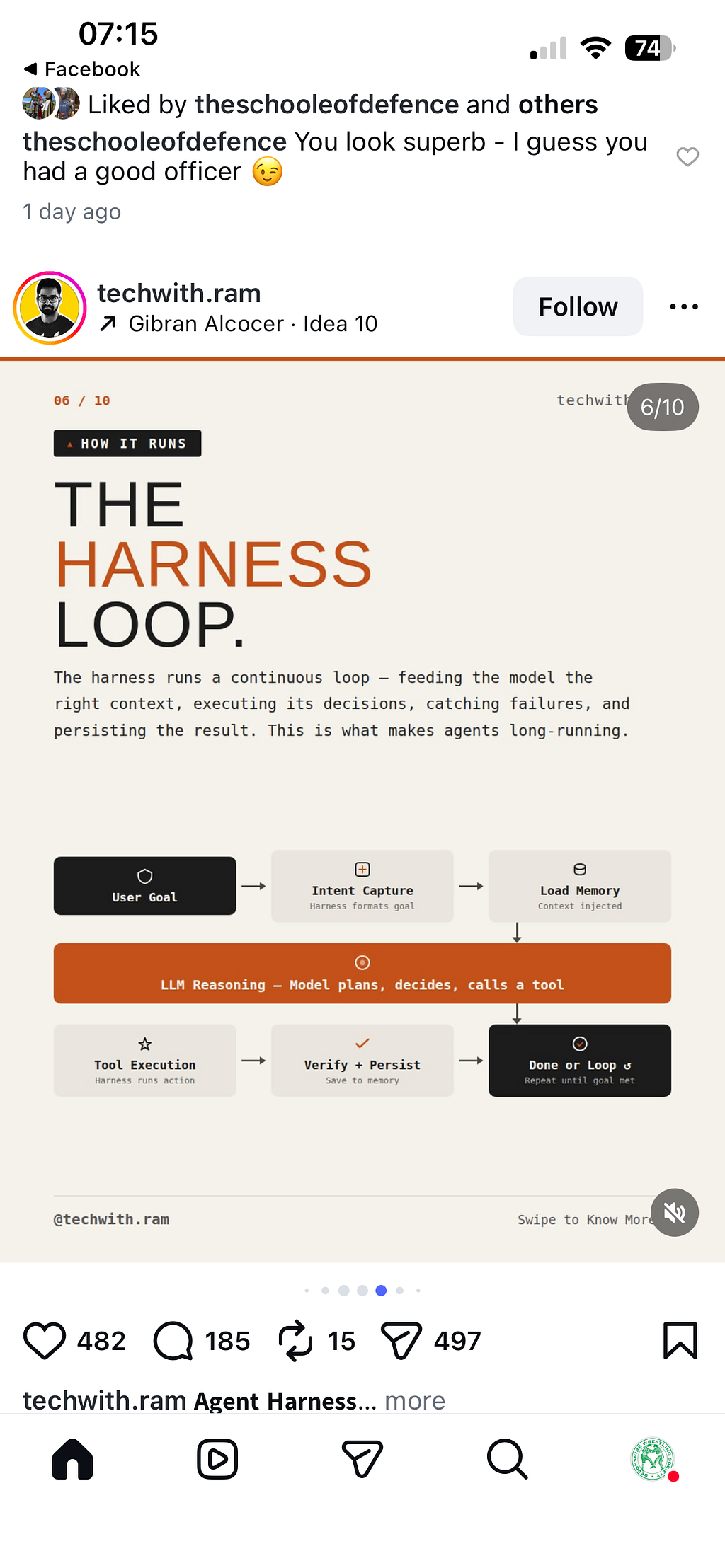
The practitioner community has also independently discovered what the Alibaba Cloud engineering blog calls the “Ralph Loop” — a self-referential iterative loop that allows an agent to continuously see its own previous outputs through external state (code, test results, commit records) and iterate until a condition is satisfied. The core mechanism is that the agent’s output becomes part of its next input via the file system and version history. Not simply an “output as input”, but rather it is feedback through an external state representation, which is precisely the mechanism that allows a control system to maintain a model of the world rather than simply responding to immediate stimuli.
Anthropic’s Managed Agents features (announced at Code with Claude 2026) formalise this. Effectively, outcomes let you define success criteria so agents can iterate and improve over time; Dreaming allows Claude to recall previous sessions and build on past work. These are examples of homeostatic mechanisms operating at different time scales. Outcomes is a per-task comparator, and Dreaming is a cross-session memory update, or the accumulation of experience across the through-states of the agent’s operational life-span.
The MindStudio analysis of compounding knowledge loops describes the same structure. By pairing session lifecycle hooks with an automatically updated knowledge base, you can create a Claude agent that genuinely gets smarter over time . This is where each session leaves the agent better equipped for the next, and therefore this is homeostasis at the organisational level. The agent’s reference state is improving across sessions, and the feedback architecture ensures that improvements are retained and compounded rather than lost at session end.
The self-evolving COO
The concept of a self-evolving organisational agent — the “self-evolving COO” — extends the same architecture to the level of business operations. ServiceNow’s Project Arc, announced at Knowledge 2026, is described as “a long-running, self-evolving autonomous desktop agent… that connects natively to enterprise systems.” Unlike standalone AI agents, Project Arc connects natively to enterprise workflow context and governance from ServiceNow AI Control Tower.
The research taxonomy of self-evolving agents is more precise about the architecture. Emergentmind’s synthesis of self-evolving agent papers identifies the key axes: what to evolve (model parameters, prompts, memory, tools, workflow graphs, or agent roles); when to evolve (intra-task via test-time reflection, or inter-task via evolutionary search across episodes); and how to validate evolution (dual audits, ablation studies).
This is the design of a second-order homeostatic system: a control loop that maintains not just a performance state but the capability to maintain that state as conditions change. Stafford Beer described this as the viable system requirement: a system that can adapt its own regulatory architecture in response to environmental change is qualitatively more robust than a system that can only regulate within a fixed architecture.
The great remembering
The convergence documented in this article is not simply independent rediscovery. I argue, that it is actually the return of a suppressed origin. To understand why, it is necessary to know a piece of history that most practitioners building AI systems today might not have encountered.
In the summer of 1955, John McCarthy (the man who coined the term “Artificial Intelligence”) was planning what would become the Dartmouth Conference of 1956 , the founding event of the field we now call AI. As he prepared the proposal, he faced a naming decision. The natural choice was “cybernetics” because it was already in use, already established, already the vocabulary for precisely the problems he intended to address. As we’d seen earlier, Norbert Wiener had coined the term, defined the field, and written its foundational text. Cybernetics was the right word.
McCarthy chose a different one. His own explanation survives in his Stanford archives: “one of the reasons for inventing the term ‘artificial intelligence’ was to escape association with ‘cybernetics.’ Its concentration on analog feedback seemed misguided, and I wished to avoid having either to accept Norbert Wiener as a guru or having to argue with him.” mexc
The decision was partly intellectual because McCarthy was interested in digital computing rather than analog feedback, but it was also partly personal. Wiener was, by multiple contemporary accounts, a difficult character. He was often possessive of his ideas, a poor listener, prone to dominating conversations in fields not his own. McCarthy didn’t want cybernetics’ most prominent figure to claim ownership of the new conference. So he invented a new name, and a new field, and a new vocabulary that pointed away from the one Wiener had built.
As Punya Mishra observes, this choice had profound and far-reaching consequences. Unlike “cybernetics,” which was relatively neutral, “intelligence” carries significant philosophical and emotional weight. It implies a direct comparison to human cognition and has led to decades of debate about whether machines can truly “think.” The anthropomorphic framing shaped research directions, public expectations, and funding priorities in ways that a more neutral, systems-oriented vocabulary might not have. Every subsequent debate about whether machines are conscious, whether they “hallucinate,” whether they will surpass human intelligence. These are arguably the downstream effects of a naming decision made partly to avoid an argument with a difficult colleague.
The practical consequence for engineering was subtler but equally significant. By departing from cybernetics, the field departed from its vocabulary of feedback, variety, control, homeostasis, and reference states. The concepts did not disappear but were absorbed into control theory, systems engineering, biology, and organisational science, where they continued to develop. But the community building AI systems lost the shared language that connected them to those concepts. Each generation of engineers has had to independently derive, from production failure, the principles that cybernetics had formalised by 1956.
This is what makes the convergence documented in this article more than an interesting coincidence. Daisy Hollman’s “tighter feedback loops,” Luke Alvoeiro’s “validation contracts,” Mahesh Murag’s “Dreaming,” Tom Blomfield’s “recursive self-improving loops,” Boris Cherny’s “my job is to write loops” — none of these practitioners are drawing on Wiener, Ashby, Powers, or Beer. They are arriving at the same principles through the pressure of production systems that fail when those principles are absent. The field is finding its way back to its own forgotten foundations. In this case not through scholarship, but through the irresistible logic of building systems that are required to work.
I believe that McCarthy was right that cybernetics and digital AI were not identical. Who knows what might have happened if he had not drawn a distinction. Might we have had AI earlier, or later, or at all? But one thing is more certain. The principles cyberneticians established such that purposive behaviour requires feedback, that regulators must match the variety of what they regulate, that the purpose of a system is what it does — operate regardless of whether the substrate is analog or digital, biological or computational. They are not properties of a technology. They are properties of any goal-directed system. And systems that ignore them fail, whatever they are called.
The forgotten patterns
So what can we observe in this article? We can see how across a Skool course, multiple Anthropic staff workshops, a Factory engineering talk, multiple platform feature announcements, a research taxonomy, and many more on a week-on-week basis — the same structural pattern recurs:
A system generates output. Something separate from the generator evaluates that output against a reference. If discrepancy is detected, the loop continues with the evaluator’s finding as input to the next cycle. The loop terminates when the reference state is satisfied or a bound is reached.
What makes this convergence particularly striking is that it is happening simultaneously across disciplines, not just across practitioners. On 11th May 2026 — the same month as the talks documented in this article — researchers at Singapore Management University, Hong Kong Polytechnic University, Nanyang Technological University, A*STAR, and Shanghai AI Lab published “The Agent Use of Agent Beings: Agent Cybernetics Is the Missing Science of Foundation Agents” (arXiv:2605.10754, echoing a paper written by Weiner about the Human Use of Human Beings). Their conclusion was identical to the one this article draws from the practitioner evidence: engineering practice has converged on useful primitives assembled by empirical trial and error rather than from first principles, and cybernetics provides the missing theoretical scaffold.
A parallel paper from the control engineering community — Eslami & Yu’s “A Control-Theoretic Foundation for Agentic Systems” (arXiv:2603.10779, 2026) — arrived at the same architectural conclusions from a dynamical systems perspective, developing a five-level hierarchy of agent autonomy grounded in closed-loop control theory. Academic computer science, control engineering, and production practice, working entirely independently, converged on the same point in the same month. We can see that the equifinality is now demonstrable across disciplines.
And as we have seen, this is Powers’ Perceptual Control Theory (1973), Wiener’s negative feedback loop (1948), and Ashby’s regulatory system (1956). It is the universal architecture of purposive behaviour, described formally in the mid-20th century and is what I believe is being independently rediscovered by practitioners in 2026 because it is finally possible to build systems complex enough to require it. (To be fair, society was already a complex enough system to require it, but humanity tends to suffer from the Solomon effect. Now we need to solve it to use AI effectively).
The practical implications of naming the convergence are not academic. Teams that understand the underlying cybernetic principles can:
- Design the comparator first — before the agent, before the prompt, before the tool selection. The reference state specification is the primary design decision; everything else serves it. This is a forcing mechanism for you to think through what you’re actually trying to change, or what value you’re optimising.
- Instrument the feedback loop explicitly. Not as a monitoring afterthought, but as the load-bearing structure of the system. Hollman’s 80% prompt cache hit rate target is an operationalisation of this: if you cannot measure cache efficiency, you cannot optimise context selection, and if you cannot optimise context selection, you cannot tighten the feedback loop.
- Apply Ashby’s Law as a design constraint — before specifying each agent’s role, audit the variety of the problem space it will face. A validator whose response repertoire does not cover the range of failures the workers can produce is not a comparator. It is a checkbox.
- Distinguish homeostatic mechanisms by time scale — per-task loops (Saraev’s DOE, Alvoeiro’s validators), per-session persistence (hooks, Dreaming), and cross-session evolution (compounding knowledge loops, self-evolving agents) are all negative feedback mechanisms operating at different temporal resolutions. They compose, but they must be designed separately.
And now it appears that the engineering community has arrived, through applied practice, at a conclusion that the cybernetic community reached over 70 years ago: that purposive systems require comparators, and comparators require reference states, and reference states must be specified before anything else is built.
The name for the science that established this is cybernetics. And it might just be the skill the 2026+ job market needs, without even knowing it.
What do you think? Will cybernetics will be the next big in-demand skillset in 2027?
Disclosure: I am an Ex-officio council member of the Cybernetics Society. Massive thank you to my fellow Cyberneticians, and The Cybernetics Society for filling my brain with wisdom for years. My fellow council members Peter Tuddenham (current VP of the Cybernetics Society), and Alan Outten who proof read and provided feedback on this piece.
References
Ashby, W. R. (1956). An Introduction to Cybernetics. New York: Wiley.
Powers, W. T. (1973). Behavior: The Control of Perception. Aldine de Gruyter.
Beer, S. (1979). The Heart of the Enterprise. Chichester: Wiley.
Anthropic (2024). Building effective agents. anthropic.com/engineering/building-effective-agents
Ebert, C. (2026). Notes from Code with Claude 2026. chrisebert.net
Alibaba Cloud (2026). From ReAct to Ralph Loop: a continuous iteration paradigm for AI agents.
MindStudio (2026). Compounding knowledge loop: Claude Code.
Emergentmind (2026). Self-evolving AI agents.
Anthropic Claude Code documentation (2026). /goal command. code.claude.com/docs/en/goal
Mishra, P. (2024). Cybernetics or AI? What’s in a name? punyamishra.com
Cherny, B. (2026). Quoted in Guillermo Flor, LinkedIn. June 2026.
Wang, X., Yang, C., Zhao, H., Lin, Z. & Hu, S. (2026). The agent use of agent beings: agent cybernetics is the missing science of foundation agents. arXiv:2605.10754
Davies, D. (2024). The Unaccountability Machine: Why Big Systems Make Terrible Decisions — and How the World Lost Its Mind. Profile Books.
Eslami, A. & Yu, J. (2026). A control-theoretic foundation for agentic systems. arXiv:2603.10779
Koralus, P. (2025). The philosophic turn for AI agents. Mind & Society, 24(2), 563–586.

The forgotten science behind self-improving companies was originally published in UX Collective on Medium, where people are continuing the conversation by highlighting and responding to this story.
This post first appeared on Read More